
ᐅ Service: Submersible Pressure Pump for Cistern Automatic Irrigation System
Created on: 30 Nov 2020 12:53
H
hippjohaHello everyone,
I am currently thinking about garden irrigation. I experimented a bit with the Gardena planner (see attachment).
What capacity would a submersible pump need to have in order to ensure proper water distribution to the garden house?
The distance from the cistern to the garden house is about 35 m (115 feet) with a height difference of approximately 5 m (16 feet). What capacity would be required to maintain enough pressure at the garden house to operate the water distribution for the garden there (4 solenoid valves)?
Would you irrigate the lawn around the house as well, or only the "main garden" in front of the house (as shown on the plan)?
Best regards and thanks
Hannes
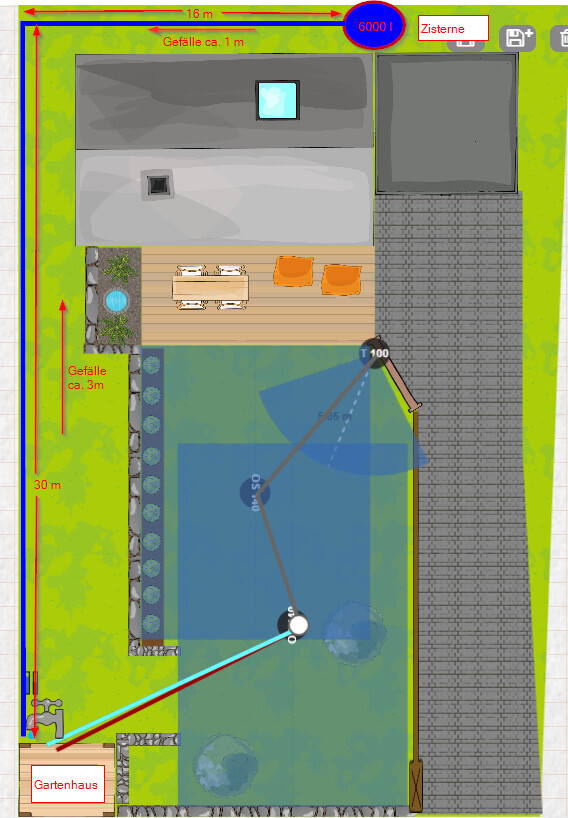
I am currently thinking about garden irrigation. I experimented a bit with the Gardena planner (see attachment).
What capacity would a submersible pump need to have in order to ensure proper water distribution to the garden house?
The distance from the cistern to the garden house is about 35 m (115 feet) with a height difference of approximately 5 m (16 feet). What capacity would be required to maintain enough pressure at the garden house to operate the water distribution for the garden there (4 solenoid valves)?
Would you irrigate the lawn around the house as well, or only the "main garden" in front of the house (as shown on the plan)?
Best regards and thanks
Hannes

Hello Hannes,
there are already several posts on this topic.
If you are going to install an irrigation system, it should cover the entire garden/lawn.
Your question cannot be answered as it stands. There are several steps to consider beforehand.
1. Forget about Gardena (especially the multi-area sprinklers). After 1-2 years, you will want to rebuild...
2. The valves/zones are not visible on your drawing.
3. Sprinklers need to have overlapping coverage.
I can recommend the Hunter rotators with pressure-regulating housings. Use PE-HD pipes with a diameter of 32mm (1¼ inches). Avoid the soft, overpriced 25mm (1 inch) pipes from Gardena.
In principle, you should look for a pump with more than 4 bar and over 5 m³/h (cubic meters per hour) capacity.
Install an air compressor connection in the valve box for blowing out the system.
Take the datasheet for the Hunter rotators and distribute the sprinklers across your property (with overlapping coverage).
Enter the flow rates into a table. This way, you can create zones based on water demand, location, and flow rate. This will determine how many valves you need.
How do you plan to control the system? The Hunter Hydrawise is practical for standalone operation.
there are already several posts on this topic.
If you are going to install an irrigation system, it should cover the entire garden/lawn.
Your question cannot be answered as it stands. There are several steps to consider beforehand.
1. Forget about Gardena (especially the multi-area sprinklers). After 1-2 years, you will want to rebuild...
2. The valves/zones are not visible on your drawing.
3. Sprinklers need to have overlapping coverage.
I can recommend the Hunter rotators with pressure-regulating housings. Use PE-HD pipes with a diameter of 32mm (1¼ inches). Avoid the soft, overpriced 25mm (1 inch) pipes from Gardena.
In principle, you should look for a pump with more than 4 bar and over 5 m³/h (cubic meters per hour) capacity.
Install an air compressor connection in the valve box for blowing out the system.
Take the datasheet for the Hunter rotators and distribute the sprinklers across your property (with overlapping coverage).
Enter the flow rates into a table. This way, you can create zones based on water demand, location, and flow rate. This will determine how many valves you need.
How do you plan to control the system? The Hunter Hydrawise is practical for standalone operation.
Opensprinkler is a good option if you want to integrate the system with your house.
It also allows you to run multiple zones simultaneously, but that only works with high flow rates, which you don’t have.
It’s best to install a water tap or outlet on the supply line to the valve box. This way, you can easily connect a hose.
If you want an affordable and simple solution, go for a TIP.
T.I.P. 30082 deep well pump stainless steel AJ 4 Plus 100/57 AUT with integrated electronic pump control, up to 6,000 liters/hour (1,585 gallons/hour) flow rate
I know several installations that use this type of pump. In case of a defect, it’s affordable and easy to replace.
It also allows you to run multiple zones simultaneously, but that only works with high flow rates, which you don’t have.
It’s best to install a water tap or outlet on the supply line to the valve box. This way, you can easily connect a hose.
If you want an affordable and simple solution, go for a TIP.
T.I.P. 30082 deep well pump stainless steel AJ 4 Plus 100/57 AUT with integrated electronic pump control, up to 6,000 liters/hour (1,585 gallons/hour) flow rate
I know several installations that use this type of pump. In case of a defect, it’s affordable and easy to replace.
Similar topics