
ᐅ Peat in the Soil – Pile Foundations, Well Foundations, or Vibro-Concrete Columns?
Created on: 5 Feb 2024 12:04
N
Nordlichter
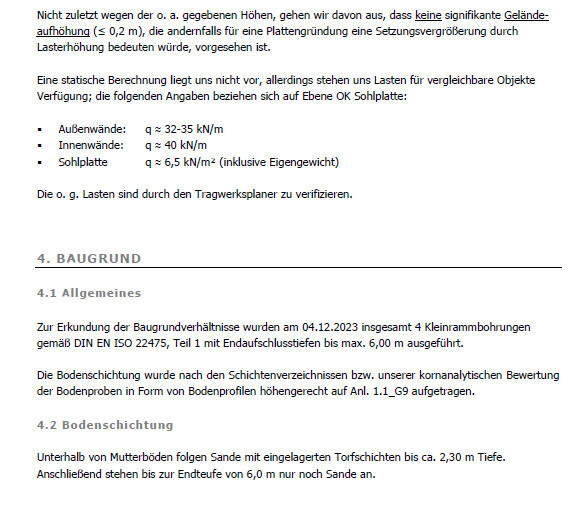
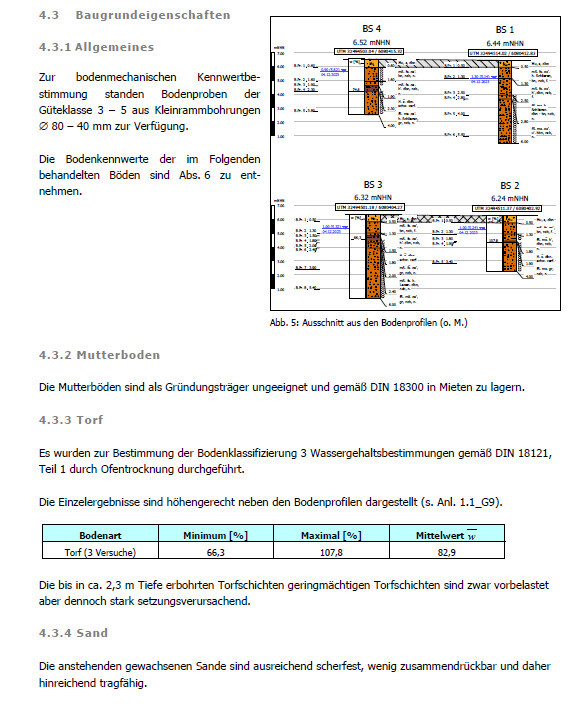
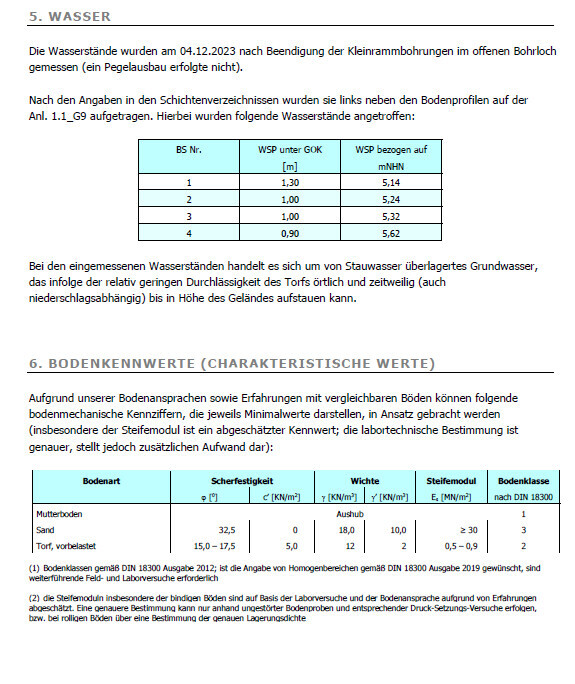
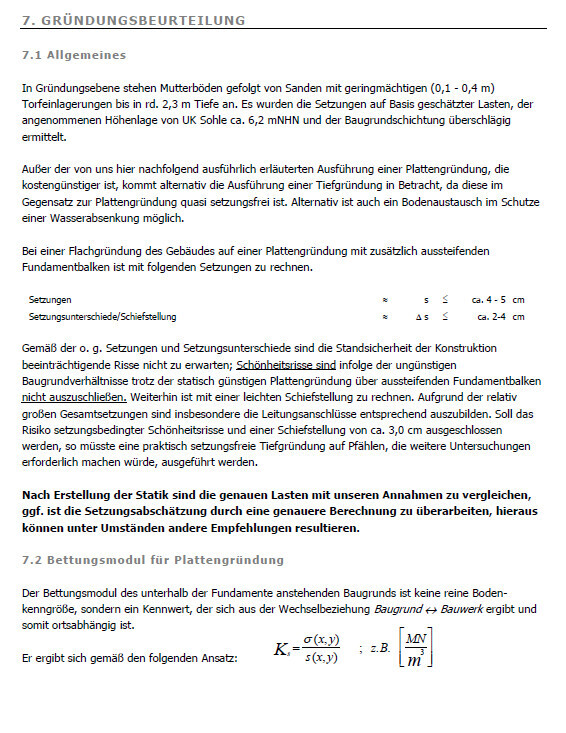
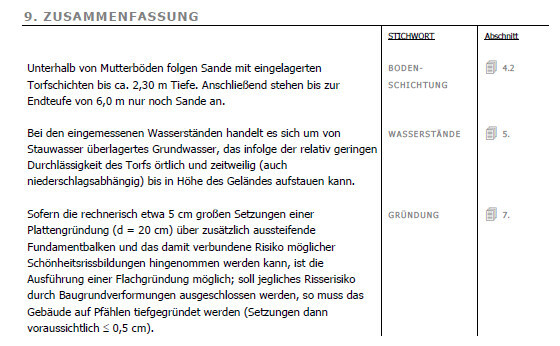
Hello! We were fortunate to be able to reserve a plot of land that really appeals to us again. Unfortunately, the soil report we commissioned revealed peat in the ground. Since the peat layer isn’t very deep, the potential general contractor suggested that soil replacement might be the most financially attractive option for a safe and stable foundation. We contacted every company that came up in our online search for a quote, but only received one offer, which amounted to nearly 75,000 euros. Because the groundwater level is relatively high, soil replacement might not actually be a sensible option. We are now looking at alternatives; we have found various methods such as pile foundations, drilled foundations, and vibro stone columns, but we are completely overwhelmed in trying to assess which methods might be feasible, which would be the most reasonable option, and we have so far only relied on browser searches to find a suitable company. Through this post, we hope to get some information that will help us understand the situation better and take the right steps. I have attached the soil report and would like to thank anyone who takes the time to have a look! A slab foundation with reinforced concrete might be possible, but everything we have read so far sounds like "just don’t do it." Are we correct in thinking that?
Honestly, I would be inclined to say unfortunate luck, peat in the soil means expensive costs, so we should look for another plot. That is what we have been doing over the past few weeks—we are on every waiting list we found, have visited various plots, and the search area of "Schleswig-Holstein" was not exactly small. However, mentally and in conversation, we keep coming back to this plot; this new development is exactly in the area where we most want to live, and we really like the town and the surroundings. It’s just uncertain whether we can get the foundation work on a reasonable financial footing, so we would be very grateful for any help!
Best regards,
Kerstin

Honestly, I would be inclined to say unfortunate luck, peat in the soil means expensive costs, so we should look for another plot. That is what we have been doing over the past few weeks—we are on every waiting list we found, have visited various plots, and the search area of "Schleswig-Holstein" was not exactly small. However, mentally and in conversation, we keep coming back to this plot; this new development is exactly in the area where we most want to live, and we really like the town and the surroundings. It’s just uncertain whether we can get the foundation work on a reasonable financial footing, so we would be very grateful for any help!
Best regards,
Kerstin
Nordlichter schrieb:
What is a planning contract? I've never heard of that; no one offered it to us.
That is when only the design and the structural engineering are commissioned, completely separate from the house construction contract. You need the structural engineering for your columns, no matter what the "column guy" says.
Oh, and for special foundations, in Schleswig-Holstein the reviewing structural engineer also gets involved... That costs a few extra euros as well.

Nordlichter schrieb:
Hello! We were lucky to be able to reserve a plot of land that really appeals to us again. Unfortunately, the soil survey we commissioned revealed peat in the ground. Since the peat is not that deep, the potential general contractor suggested that soil replacement might be the most financially attractive option for a safe and stable foundation. Oh, you again… Are you using a dowsing rod to find plots, or why do you always seem to have issues with wet soil? I’m not keen on hearing about a “potential general contractor” this early. Look for builders only after you’ve finished planning — and even then, don’t get drawn in by fixed-price package promises.
Nordlichter schrieb:
Actually, I’m inclined to say tough luck, peat in the ground means expensive, let’s look for another plot. That’s what we have been doing for weeks, we are on every waiting list we found, we have viewed various plots, and our search area, Schleswig-Holstein, wasn’t exactly small. But mentally and in conversation, we keep coming back to this plot; this new development is just exactly in the area where we most want to live, and we really like the town and the surroundings. An entire federal state is far too large a search area. That only deepens confirmation bias that plots are impossibly hard to find. “Exactly the area where we most want to live” is a much better-defined search area (and you’d be surprised what’s available there).
The first page of the report shows the location of the plot, apparently in a newly developed housing area. Is that a retention basin directly south of the surveyed plot, and did you deliberately pick the plot with the problematic ground?
Nordlichter schrieb:
We had to determine the exact house position for the soil survey so that the drilling would match, and that was already frustrating, without knowing the house dimensions. If the house turned out smaller, larger, or differently shaped, could the soil contain a deeper peat lens there, meaning the foundation would have to be handled differently? Or is that a mistaken assumption? Drilling only where the results look less concerning, despite expecting heterogeneous ground conditions, is definitely a big mistake.
Nordlichter schrieb:
Without signing the general contractor’s contract, we don’t get the floor plans. The house size would be adjusted to the floor plan (half a meter more here, one meter less there). The internet is full of floor plans. I would put that builder straight at the top of my blacklist.
Nordlichter schrieb:
What is a planning contract? I’ve never heard of that; we were never offered one. Basically, yes — but under different wording: “floor plans only after signing.” A planning contract — which I strongly advise against! — usually means the builder wants you to pay upfront for the necessary architectural planning to secure his position, even though he would later offset these costs if you proceed with him. It’s a kind of deposit to bind you. As popular as it is questionable.
Nordlichter schrieb:
Yes, that’s true, just signing first and planning later can go seriously wrong… We’d ideally want to know the exact costs down to the cent before starting construction, but that’s just wishful thinking. “In the hundred-thousand range” might be a more accurate description in your case.
Keep searching. It may well be possible to manage such a plot somehow. But you are accepting foundation cost overheads here that bear no reasonable relation to the total construction costs of a normal single-family home. Neither ongoing rent nor possible interest rate increases can even remotely come close to the scale of extra foundation expenses on this plot. Wake up urgently from this nightmare; land in your federal state doesn’t come without this massive catch!
Definitely don’t spend any money trying to perfectly position a house on this plot based on borehole locations!
https://www.instagram.com/11antgmxde/
https://www.linkedin.com/company/bauen-jetzt/
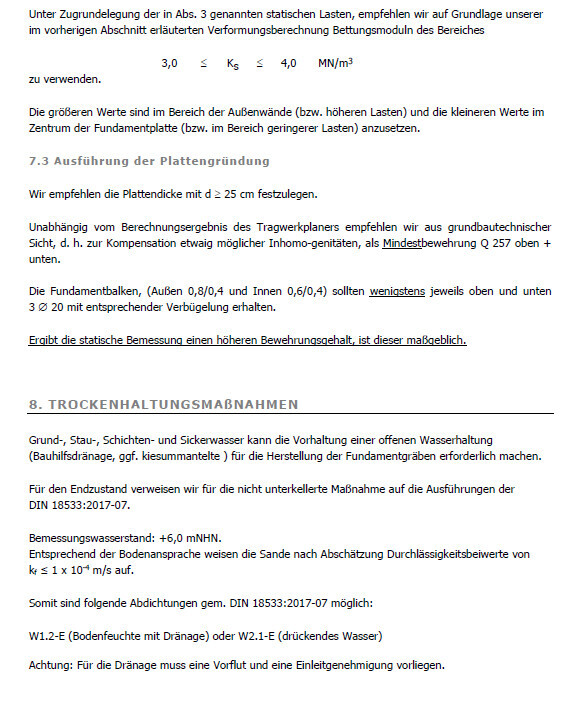
The advantage of vibro-replacement columns is that they are not a special or deep foundation, but rather a ground improvement technique. After installation, a load-distributing cushion is placed on top, and the slab design is calculated using an improved subgrade modulus.
It is quite unlikely that this construction site is the only one in the area with peat in the subsoil.
It is quite unlikely that this construction site is the only one in the area with peat in the subsoil.
Cronos86 schrieb:
It is quite unlikely that this is the only area in the development with peat in the subsoil. If I am correct in assuming that the facility on the neighboring property is a retention basin, then the answer is yes and no (we don’t know which came first: the soil conditions or the choice of location).
https://www.instagram.com/11antgmxde/
https://www.linkedin.com/company/bauen-jetzt/
N
Nordlichter1 Mar 2024 11:39Hello everyone! Many, many thanks for your replies!
@ Rübe1
I have sent another email to the geotechnical engineer and hope he can tell us whether a structural engineer for foundation verification is also required with this type of foundation. We are trying to get as complete a picture as possible of what building a foundation on this soil entails, thanks for the hint!
@11ant
The two plots are located in neighboring municipalities, so we didn’t have far to go with the dowsing rod! And bam, another direct hit. Peat was found in several places during the development of the building area, which we already knew and had been communicated very transparently. But whether there is peat on this specific plot (which had not been investigated before) was unknown; it could have been fine, but it’s not.
The stormwater retention basin (yes, exactly, adjoining the plot to the south) was planned and built as part of the development of the building area. They didn’t just fence off an existing water-retaining hole; rather, the hole for the basin was excavated—I have seen pictures of this. Why the basin was built at this particular location, I do not know.
You are definitely right, using an entire state as a search area is too large, and we have also realized this is the area where we want to live. If we now simply take that as a given—this is where we want to be... in this new development there is peat, in the new development in the neighboring town there is peat, then maybe we have to swallow that frog (if manageable) and accept that a single-family house in this part of the country will cost more than building on easy-to-develop land elsewhere. Whether it is “more” or “too much” is the question now.
Regarding foundation costs—it would be naive to think if the soil here is not right, then we can just figure out if it’s affordable to make it suitable. I have been reading through this forum for months now and what is said about fill and leveling, retaining walls (L-walls), soil replacement, and pile foundations gives me the impression that anyone lucky enough to find a plot with perfect conditions is fortunate, and everyone else has to work on optimizing the circumstances.
The basis for the whole project is still whether it makes financial sense. We are still at the starting line with “we want to” and researching everything we can; the outcome is still open. But planning down to the tenth of a hundred thousand, for heaven’s sake—who could realistically plan that precisely? Okay, cents is wishful thinking, and a tenth of a hundred thousand is utopian... maybe subtract one zero from that? Once the list of expected financial items feels somewhat complete, I plan to ask the forum what we might still have forgotten.
@ Cronos86
What does an improved bearing modulus for the foundation slab mean in terms of the scope of work and costs?
@ Rübe1
I have sent another email to the geotechnical engineer and hope he can tell us whether a structural engineer for foundation verification is also required with this type of foundation. We are trying to get as complete a picture as possible of what building a foundation on this soil entails, thanks for the hint!
@11ant
The two plots are located in neighboring municipalities, so we didn’t have far to go with the dowsing rod! And bam, another direct hit. Peat was found in several places during the development of the building area, which we already knew and had been communicated very transparently. But whether there is peat on this specific plot (which had not been investigated before) was unknown; it could have been fine, but it’s not.
The stormwater retention basin (yes, exactly, adjoining the plot to the south) was planned and built as part of the development of the building area. They didn’t just fence off an existing water-retaining hole; rather, the hole for the basin was excavated—I have seen pictures of this. Why the basin was built at this particular location, I do not know.
You are definitely right, using an entire state as a search area is too large, and we have also realized this is the area where we want to live. If we now simply take that as a given—this is where we want to be... in this new development there is peat, in the new development in the neighboring town there is peat, then maybe we have to swallow that frog (if manageable) and accept that a single-family house in this part of the country will cost more than building on easy-to-develop land elsewhere. Whether it is “more” or “too much” is the question now.
Regarding foundation costs—it would be naive to think if the soil here is not right, then we can just figure out if it’s affordable to make it suitable. I have been reading through this forum for months now and what is said about fill and leveling, retaining walls (L-walls), soil replacement, and pile foundations gives me the impression that anyone lucky enough to find a plot with perfect conditions is fortunate, and everyone else has to work on optimizing the circumstances.
The basis for the whole project is still whether it makes financial sense. We are still at the starting line with “we want to” and researching everything we can; the outcome is still open. But planning down to the tenth of a hundred thousand, for heaven’s sake—who could realistically plan that precisely? Okay, cents is wishful thinking, and a tenth of a hundred thousand is utopian... maybe subtract one zero from that? Once the list of expected financial items feels somewhat complete, I plan to ask the forum what we might still have forgotten.
@ Cronos86
What does an improved bearing modulus for the foundation slab mean in terms of the scope of work and costs?
Nordlichter schrieb:
You are definitely right, having an entire state as a search area is too large, and we have also realized that this is the region where we want to live. If we now simply accept that as a given—this is where we want to be... this new development area has peat soil, and the neighboring new development area has peat as well—then maybe we have to swallow that pill (if feasible) and accept that a single-family home in this part of the country will cost more than building on straightforward, well-draining land elsewhere. The question now is whether it is "more" or "too much." I could quite well imagine that this might still be the worst plot in the development area and that better options could be found nearby (they don’t necessarily have to be in new developments when searching for a site).
Nordlichter schrieb:
Regarding foundation costs, isn’t it really naive to think that if the soil here isn’t suitable, we just try hard to find out whether it can be made suitable at an affordable price? I have been reading through this forum extensively for months now, and what is written about fill-ins/leveling, retaining walls (L-walls), soil replacement, and pile foundations gives me the impression that anyone who finds a plot with perfect conditions can consider themselves lucky, and everyone else has to work on optimizing the circumstances. Yes, that is naive—especially because of the wishful thinking about affordability. Foundation costs are entirely “sunk costs” that do not increase the value of the house by even the slightest amount, nor do they increase the mortgage lending value.
By the way, retaining walls (L-walls) are mostly “cosmetics,” mainly intended for aesthetic terrain shaping. Their effectiveness for true slope stabilization is often overestimated. I tend to put question marks behind them, each about as tall as the L-walls themselves.
Nordlichter schrieb:
The basis for the entire project is still whether it is financially viable... [...] ...subtracting a zero from a tenth of a million? Shifting decimal places has nothing to do with subtracting.
Nordlichter schrieb:
As soon as the list of expected financial items feels roughly complete, I plan to ask the forum if we may have forgotten something after all. That certainly sounds much more reasonable than being pressured to receive floor plans only after signing a planning contract.
https://www.instagram.com/11antgmxde/
https://www.linkedin.com/company/bauen-jetzt/
Similar topics