

Hi everyone!
As it’s starting to get warmer, some exterior work will probably need to be done soon! Before I dive into it, I’d like to hear a few opinions from you.
Here’s what needs to be done:
1) Installing curbstones
2) Spreading and compacting lean concrete (sometimes called flowable fill)
3) Paving the terrace and parking areas
4) Building a retaining wall
5) Garden shed
The priority is to pave the surfaces first to keep dirt away from the house.
For that, I should first install the curbstones and then fill with lean concrete.
Can lean concrete be left as is after compacting, or does it need to be leveled immediately with gravel and then paved?
(We already roughly backfilled and compacted during the groundwork, but it’s quite uneven now.)
Should the drainage channels be installed first and then compacted around? We definitely need one at the parking space facing the street. What about the terrace? At the house, along the wall, or both?
I have a wastewater connection at the heat pump, but that would require quite a lot of digging and curved piping now. Would it be an option to connect directly to the existing house connections instead? (Basically just cutting a piece out and installing a Y-connector.)
Thanks in advance for your input
Marvin
As it’s starting to get warmer, some exterior work will probably need to be done soon! Before I dive into it, I’d like to hear a few opinions from you.
Here’s what needs to be done:
1) Installing curbstones
2) Spreading and compacting lean concrete (sometimes called flowable fill)
3) Paving the terrace and parking areas
4) Building a retaining wall
5) Garden shed
The priority is to pave the surfaces first to keep dirt away from the house.
For that, I should first install the curbstones and then fill with lean concrete.
Can lean concrete be left as is after compacting, or does it need to be leveled immediately with gravel and then paved?
(We already roughly backfilled and compacted during the groundwork, but it’s quite uneven now.)
Should the drainage channels be installed first and then compacted around? We definitely need one at the parking space facing the street. What about the terrace? At the house, along the wall, or both?
I have a wastewater connection at the heat pump, but that would require quite a lot of digging and curved piping now. Would it be an option to connect directly to the existing house connections instead? (Basically just cutting a piece out and installing a Y-connector.)
Thanks in advance for your input
Marvin
Image 6 = right rain gutter drain
Image 10 = left rain gutter drain
I haven’t fully excavated it yet; I just wanted to check the direction it goes, and to see if there is even a Y-connector like the one at the heat pump.
There should also be a small distributor in front of the house, but I’ll have to dig deeper for that!
Here is another picture showing how it looked after the groundwork, before the roof was installed.
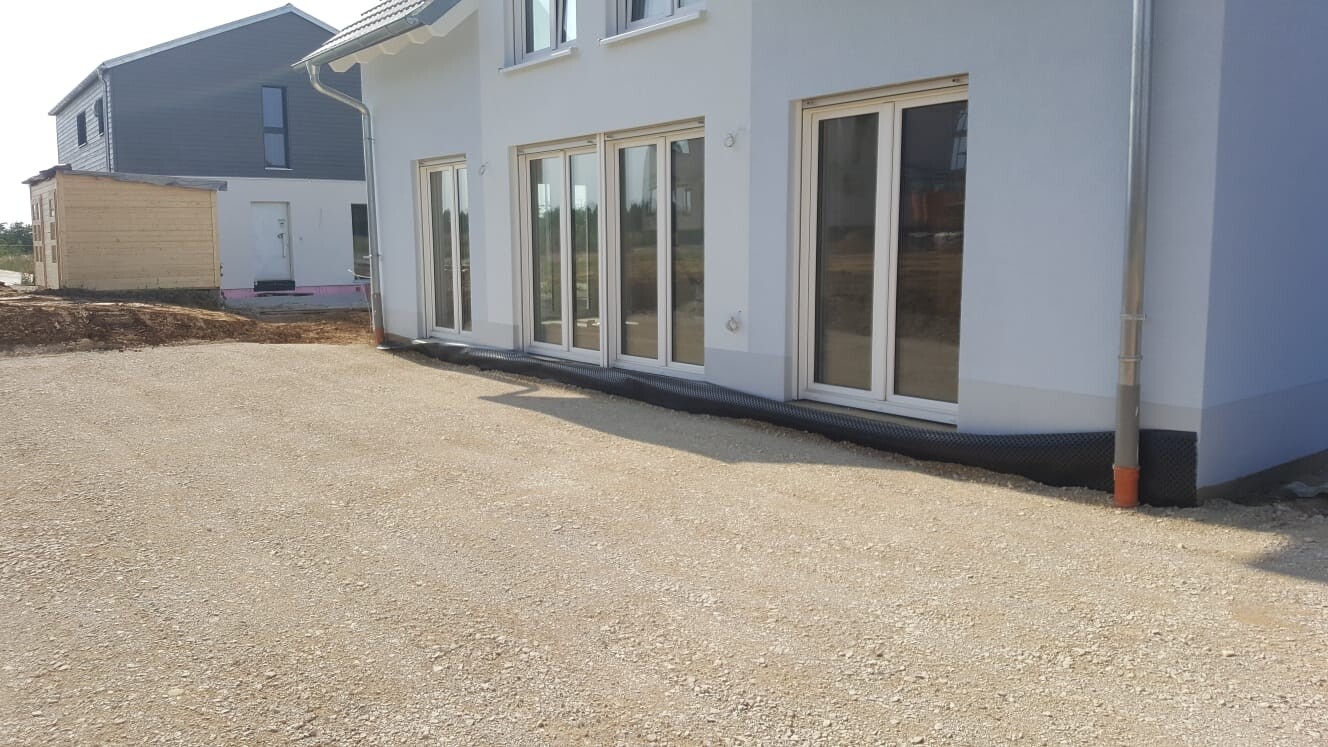
Image 10 = left rain gutter drain
I haven’t fully excavated it yet; I just wanted to check the direction it goes, and to see if there is even a Y-connector like the one at the heat pump.
There should also be a small distributor in front of the house, but I’ll have to dig deeper for that!
Here is another picture showing how it looked after the groundwork, before the roof was installed.
Similar topics