
Hi!
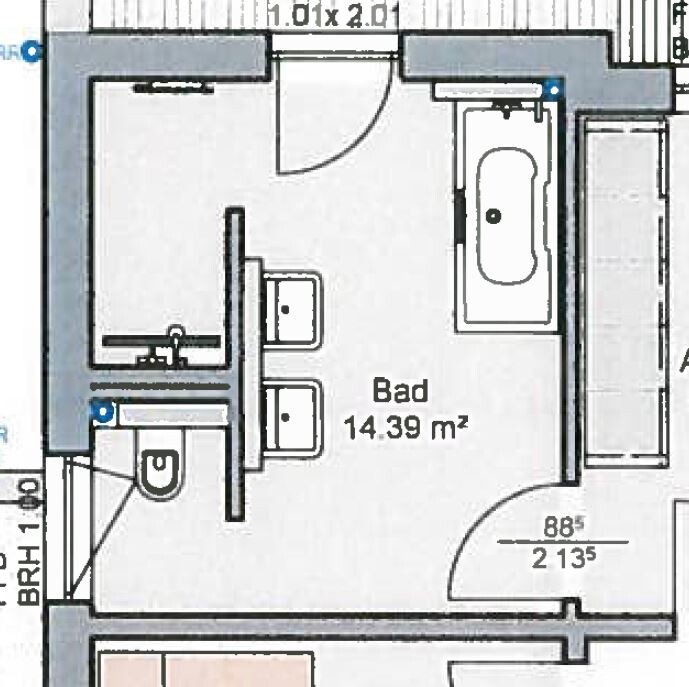
What do you think about this master bathroom layout?
We didn’t really want the shower to be so hidden since we plan to outfit it in a high-quality and stylish way. It would be nice if it could be more visible, not just for showering. But during the plumbing planning, we were advised to keep it like this (because of the water pipes).
What’s your opinion? Or does anyone have an idea on how to create more visibility into the shower?
The two washbasins are marked incorrectly. We will only use one washbasin (1m wide (39 inches)). Our idea is to move the bathtub to where the washbasins are currently shown and place the washbasin on the right wall instead. We want the bathtub to have a prominent spot in the room instead of being “in the corner” when we bathe.
Currently planned components:
Toilet: Duravit Happy D.2 extended version, 25500900001
Washbasin: Villeroy & Boch Venticello 1000x500mm (39x20 inches), 4104ALR1
Bathtub: still considering either Villeroy & Boch Squaro Edge 12 Combipool Invisible (UIP190SQE2B1V96) or a Kaldewei Conoduo, both 190x90cm (75x35 inches) (235200010001)
Shower:
Villeroy & Boch shower tray Futurion or Squaro Infinity
Hansgrohe Axor ShowerSolutions thermostat module Select 530 / 90 for 3 outlets, 18356000
Hansgrohe Axor Shower Solutions 350 1jet overhead shower with ceiling connection, chrome, 26035000
Keuco meTime_spa waterfall showerhead, 59982010000
Hansgrohe Axor Starck 1jet handheld shower, chrome, 10531000
Looking forward to your feedback!
What do you think about this master bathroom layout?
We didn’t really want the shower to be so hidden since we plan to outfit it in a high-quality and stylish way. It would be nice if it could be more visible, not just for showering. But during the plumbing planning, we were advised to keep it like this (because of the water pipes).
What’s your opinion? Or does anyone have an idea on how to create more visibility into the shower?
The two washbasins are marked incorrectly. We will only use one washbasin (1m wide (39 inches)). Our idea is to move the bathtub to where the washbasins are currently shown and place the washbasin on the right wall instead. We want the bathtub to have a prominent spot in the room instead of being “in the corner” when we bathe.
Currently planned components:
Toilet: Duravit Happy D.2 extended version, 25500900001
Washbasin: Villeroy & Boch Venticello 1000x500mm (39x20 inches), 4104ALR1
Bathtub: still considering either Villeroy & Boch Squaro Edge 12 Combipool Invisible (UIP190SQE2B1V96) or a Kaldewei Conoduo, both 190x90cm (75x35 inches) (235200010001)
Shower:
Villeroy & Boch shower tray Futurion or Squaro Infinity
Hansgrohe Axor ShowerSolutions thermostat module Select 530 / 90 for 3 outlets, 18356000
Hansgrohe Axor Shower Solutions 350 1jet overhead shower with ceiling connection, chrome, 26035000
Keuco meTime_spa waterfall showerhead, 59982010000
Hansgrohe Axor Starck 1jet handheld shower, chrome, 10531000
Looking forward to your feedback!
niri09 schrieb:
Our mechanical and electrical technician (TGA) also accepts online orders and charges for installation hours, so that works as well. However, he does not take liability for any components that do not come from him. And this is exactly where (but not necessarily) the trouble can start. Right at the transition between pipe installation (TGA liability) and the sanitary ware (no liability), leaks can occur... often only discovered months later because it’s wet underneath. What do you think the TGA will say? “Everything is fine, I’ll cover the damage” or “Nope, it was the sanitary ware, not my problem. Too bad for you!” And please don’t assume they act out of goodwill, but rather based on the experience many (though not all) tradespeople, especially in the gas and water sector, tend to behave.
It’s not about online orders being lower quality or second-rate. For example, if a good plumber tightens a connection too much and hairline cracks develop that are only noticed later, that’s when the arguments start. He will say: “That wasn’t me, the crack was already in the sanitary ware, not my problem.” If he takes on the entire scope of work, then he is liable and responsible for it. The open interface like this is simply a potential weak point for liability issues.
By the way, I’m still considering whether to place the interface there myself, for the same reasons. The prices from Reuter really bring tears to one’s eyes... but is it worth the risk? I’m still thinking about it... it’s probably more a matter of personal risk tolerance than an objective decision of right or wrong.
At my neighbor’s place, the same thing happened after 3 months in their new house: water damage in the basement caused by “installation issues.” The plumber is responsible since it’s all one trade. I wouldn’t want to imagine how it would play out otherwise. And even if you are right, that doesn’t mean you’ll get what you’re owed. When you have 12 inches (30 cm) of water in the basement, you don’t want to be fighting about how to fix it and who pays for it. But as I said, it ultimately comes down to the severity of the damage, the likelihood of it happening, and your personal risk tolerance...
I see it differently: if there is visible damage to the ceramic, then the issue is clear. I don’t assume everyone is well-meaning, but I also don’t automatically suspect bad intent in every case.
“Installation” is covered by the mechanical, electrical, and plumbing (MEP) contractor, and any “installation problems” are addressed through that. I would really only buy the ceramic parts myself, not seals or other components. In addition, we work with the MEP contractor who has collaborated with our architect for years, is local rather than based elsewhere, and has a reputation to uphold. Things can always go wrong; you can never be 100% protected against that.
“Installation” is covered by the mechanical, electrical, and plumbing (MEP) contractor, and any “installation problems” are addressed through that. I would really only buy the ceramic parts myself, not seals or other components. In addition, we work with the MEP contractor who has collaborated with our architect for years, is local rather than based elsewhere, and has a reputation to uphold. Things can always go wrong; you can never be 100% protected against that.
The problem with hairline cracks is that they are not easily visible. It was just an example; there are a thousand other things that can go wrong that you would never even think of. As I said before, it’s a personal risk assessment. However, pretending that there is no risk at all strikes me as naive and overly optimistic.
Regarding the topic of do-gooders or bad actors, my intention was not to accuse anyone of malicious intent. It’s simply a subjective perspective on the same situation when damage occurs. I didn’t mean that the installer knowingly claimed the porcelain was faulty; rather, from their point of view—and possibly yours as well—they believe that everything was fine, especially since nothing was visible beforehand.
It’s also not about minor amounts like $2.40, but cases where significant damage has occurred. And you can be sure that your MEP (mechanical, electrical, and plumbing) contractor is not going to be a philanthropist who willingly covers a substantial four-figure cost when the cause is unclear. Why would they? If they genuinely believe the building-supplied material was at fault, it makes no economic sense for them to pay.
I can understand that stance. So this is not about ill will. The point is simply that the interface you create introduces a potential risk that otherwise wouldn’t exist. You just need to be aware of that. It’s perfectly reasonable to accept the risk, but I think it’s careless to pretend the risk doesn’t exist just because you’re focused on the money [emoji6].
There is a wide range of risk tolerance; some people build houses based on a handshake and no contract, while others send the architect a 100-page requirements document. Both approaches exist, and both can work out fine. Maybe, but not necessarily. What you’re willing to risk is a personal decision. That’s all I’m saying. With that in mind: good luck.
Regarding the topic of do-gooders or bad actors, my intention was not to accuse anyone of malicious intent. It’s simply a subjective perspective on the same situation when damage occurs. I didn’t mean that the installer knowingly claimed the porcelain was faulty; rather, from their point of view—and possibly yours as well—they believe that everything was fine, especially since nothing was visible beforehand.
It’s also not about minor amounts like $2.40, but cases where significant damage has occurred. And you can be sure that your MEP (mechanical, electrical, and plumbing) contractor is not going to be a philanthropist who willingly covers a substantial four-figure cost when the cause is unclear. Why would they? If they genuinely believe the building-supplied material was at fault, it makes no economic sense for them to pay.
I can understand that stance. So this is not about ill will. The point is simply that the interface you create introduces a potential risk that otherwise wouldn’t exist. You just need to be aware of that. It’s perfectly reasonable to accept the risk, but I think it’s careless to pretend the risk doesn’t exist just because you’re focused on the money [emoji6].
There is a wide range of risk tolerance; some people build houses based on a handshake and no contract, while others send the architect a 100-page requirements document. Both approaches exist, and both can work out fine. Maybe, but not necessarily. What you’re willing to risk is a personal decision. That’s all I’m saying. With that in mind: good luck.
I never claimed that something like that would never happen. I’m not pretending it doesn’t exist; I just see it differently and simply have another opinion.
In unclear situations, an expert can help!
It’s like this: everyone has their own preferences and beliefs. There are countless opinions on every topic. What is important to know here is that there are technical building services companies where you can, of course, purchase and install sanitary fixtures, ensuring full warranty coverage. If you decide to buy the fixtures yourself, there is naturally a risk involved, and if damage caused by the fixtures is proven, then unfortunately you bear the consequences. This is basically the same as with many DIY tasks—if something goes wrong, you have to pay for it out of your own pocket.
In unclear situations, an expert can help!
It’s like this: everyone has their own preferences and beliefs. There are countless opinions on every topic. What is important to know here is that there are technical building services companies where you can, of course, purchase and install sanitary fixtures, ensuring full warranty coverage. If you decide to buy the fixtures yourself, there is naturally a risk involved, and if damage caused by the fixtures is proven, then unfortunately you bear the consequences. This is basically the same as with many DIY tasks—if something goes wrong, you have to pay for it out of your own pocket.

R.Hotzenplotz schrieb:
That is due to online ordering. I don’t see why I should pay up to twice as much just because the product isn’t sold through an online store but through a three-level, mafia-like plumbing distribution network, which in my opinion is completely outdated. Am I really already out of date if the idea of receiving ceramic fixtures by parcel delivery makes me shudder?
https://www.instagram.com/11antgmxde/
https://www.linkedin.com/company/bauen-jetzt/
R
R.Hotzenplotz24 Apr 2018 20:5011ant schrieb:
Am I really becoming old-fashioned if the idea of receiving ceramics through a parcel delivery service makes me shudder?I receive everything by parcel delivery service. Flat-screen TVs, ovens, furniture... except for groceries and about half of my clothing, I no longer buy anything in physical stores. But not always to save money, also for greater convenience.
Similar topics