
Hello everyone,
We are in the early stages of planning our house and are currently visiting various model home exhibitions.
We saw a house featuring a window wall about 4 meters (13 feet) wide spanning two floors, which definitely looked very impressive visually. The windows were divided into sections measuring 2 by 2 meters (6.5 by 6.5 feet) each, with two elements stacked vertically.
My online research showed that window costs are not as high as I expected
Of course, installation costs are extra.
Is it easy to combine multiple units like this? In this case, four pieces of 2 x 2 meters (6.5 x 6.5 feet)?
What other drawbacks might I be overlooking? I’m aware of insulation values and cleaning concerns.
Has anyone worked with panoramic windows like these and can share concrete cost examples?
Maybe it will just be a passing idea and we’ll move on from it in a week.
Thanks in advance!
We are in the early stages of planning our house and are currently visiting various model home exhibitions.
We saw a house featuring a window wall about 4 meters (13 feet) wide spanning two floors, which definitely looked very impressive visually. The windows were divided into sections measuring 2 by 2 meters (6.5 by 6.5 feet) each, with two elements stacked vertically.
My online research showed that window costs are not as high as I expected
- Fixed uPVC window – 300 x 260 cm (10 x 8.5 feet) – 750 EUR
Of course, installation costs are extra.
Is it easy to combine multiple units like this? In this case, four pieces of 2 x 2 meters (6.5 x 6.5 feet)?
What other drawbacks might I be overlooking? I’m aware of insulation values and cleaning concerns.
Has anyone worked with panoramic windows like these and can share concrete cost examples?
Maybe it will just be a passing idea and we’ll move on from it in a week.
Thanks in advance!

Maria16 schrieb:
Here, I usually adjust the heating. Unfortunately, my boyfriend notices every degree I turn it up and sometimes secretly turns it back down. But I always notice right away... :-(What a pig!The U-value of the glass panes, meaning the thermal transmittance, for triple-glazed windows is between 0.5 and 0.6, while the Uf-value (frame) is between 0.9 and 1.0. With warm edge spacers, standard profiles (70mm (2.8 inches)) for large-scale elements achieve Uw-values (whole window) ranging from 0.8 to 0.7 with thicker frames, and even 0.6 in passive house standards. Compared to an exterior wall standard of 0.24, this of course is considerably higher but not drastic, and especially for fixed glazing elements, the additional cost for thicker frames and glass remains moderate.
South-facing triple-glazed windows with warm edge spacers (i.e., plastic spacers between the panes instead of aluminum or stainless steel) can even have a positive energy balance! Over the entire heating season, the solar heat gains exceed the heat losses through the windows. For this, the windows must of course be properly oriented (south), shaded from above in summer, and the exposed surfaces should have a heating potential/thermal mass for intermediate storage (no wallpaper and no carpet).
For a west-facing orientation, I would advise against large, especially tall, window fronts.
As a general guideline:
North: small windows, no shading necessary
East/West: medium-sized window areas ideally with adjustable shading, preferably external
South: large window areas, tall windows, structural sun protection through eaves, overhangs, etc.
In addition to the costs for the window units themselves, installation costs apply, as well as coupling profiles for combined elements and structural couplings for stacked elements or elements with doors.
The additional costs for triple glazing compared to double glazing, and especially the extra cost for warm edge spacers, usually pay off.
South-facing triple-glazed windows with warm edge spacers (i.e., plastic spacers between the panes instead of aluminum or stainless steel) can even have a positive energy balance! Over the entire heating season, the solar heat gains exceed the heat losses through the windows. For this, the windows must of course be properly oriented (south), shaded from above in summer, and the exposed surfaces should have a heating potential/thermal mass for intermediate storage (no wallpaper and no carpet).
For a west-facing orientation, I would advise against large, especially tall, window fronts.
As a general guideline:
North: small windows, no shading necessary
East/West: medium-sized window areas ideally with adjustable shading, preferably external
South: large window areas, tall windows, structural sun protection through eaves, overhangs, etc.
In addition to the costs for the window units themselves, installation costs apply, as well as coupling profiles for combined elements and structural couplings for stacked elements or elements with doors.
The additional costs for triple glazing compared to double glazing, and especially the extra cost for warm edge spacers, usually pay off.

Not very large, but still 2.5m (8.2 ft) high and 5.15m (17 ft) wide:
Base price: 1800€ (triple glazing Ug=0.6, warm edge Swiss Spacer gray, gray foil decor on the outside, Drutex IGLO 5 Classic profile 70mm (2.8 inches))
Plus two static coupling profiles on the right and left of the double door (+2*200€)
+Installation according to RAL standards with foil on the inside (visible in the picture, not plastered yet), compressible sealing tape on the outside about 900€ (proportionally from total order, excluding plastering work)
Dividing the fixed side elements was not necessary and is also not optimal from an energy perspective – but the site management requested it for aesthetic reasons.
Orientation is SSW with about 1m (3.3 ft) roof overhang directly above. On the north side, we chose the more energy-efficient 82mm (3.2 inches) profiles; on the south side, with the large façades (there is another one in the adjoining room), that would have added about 1000€ more in total.
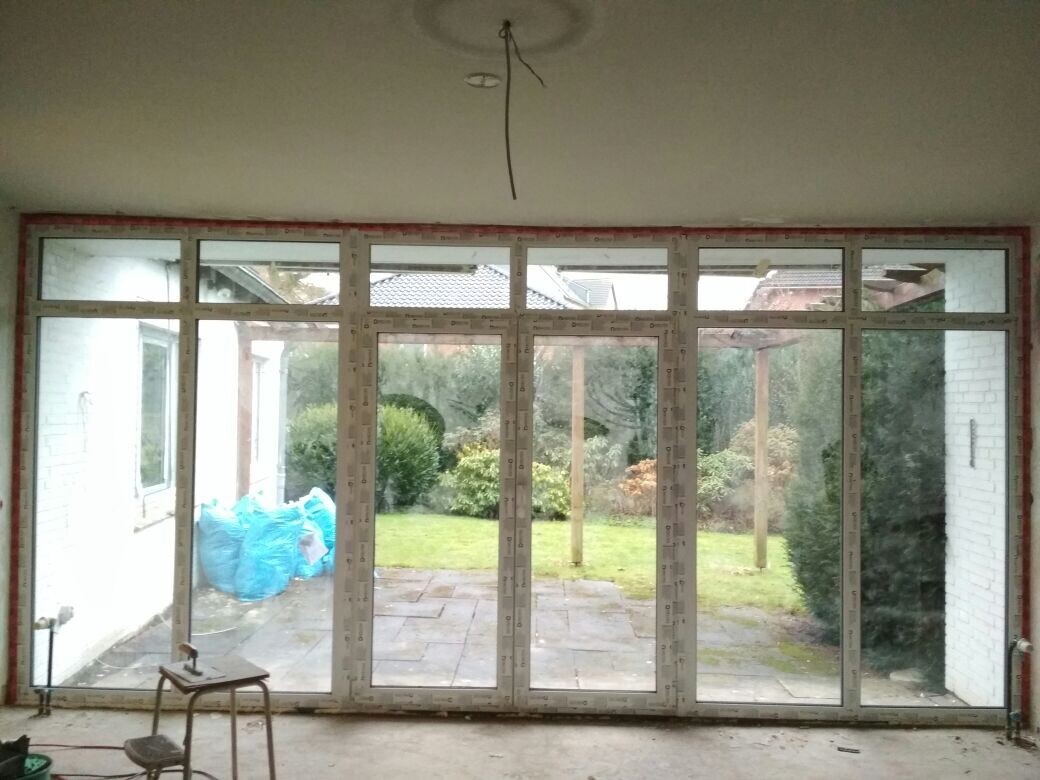
Oh yes: old building and construction site, so it’s neither tidy nor cleaned.
There will be no cold drafts at the window – see heating pipe connections on the right and left. The old 60 cm (24 inches) high radiators have already been replaced with only 30 cm (12 inches) high baseboard heaters, which should be sufficient with the new windows. On the other side of the room, there is another radiator, and the room is called the “fireplace room.”
Here is an example from the adjacent room, 4.8m * 2.2m (15.7 ft * 7.2 ft), showing how NOT to do it. Without a significant roof overhang, also oriented SSW (photographed at sunrise; leveling fill for the dry screed is on the floor). The windows are frosted on the outside in the morning! The sun fully hits them from noon on, even in summer. (A canopy/shading will still be installed there, but here in northern Germany, too much sun exposure is less often a problem.)
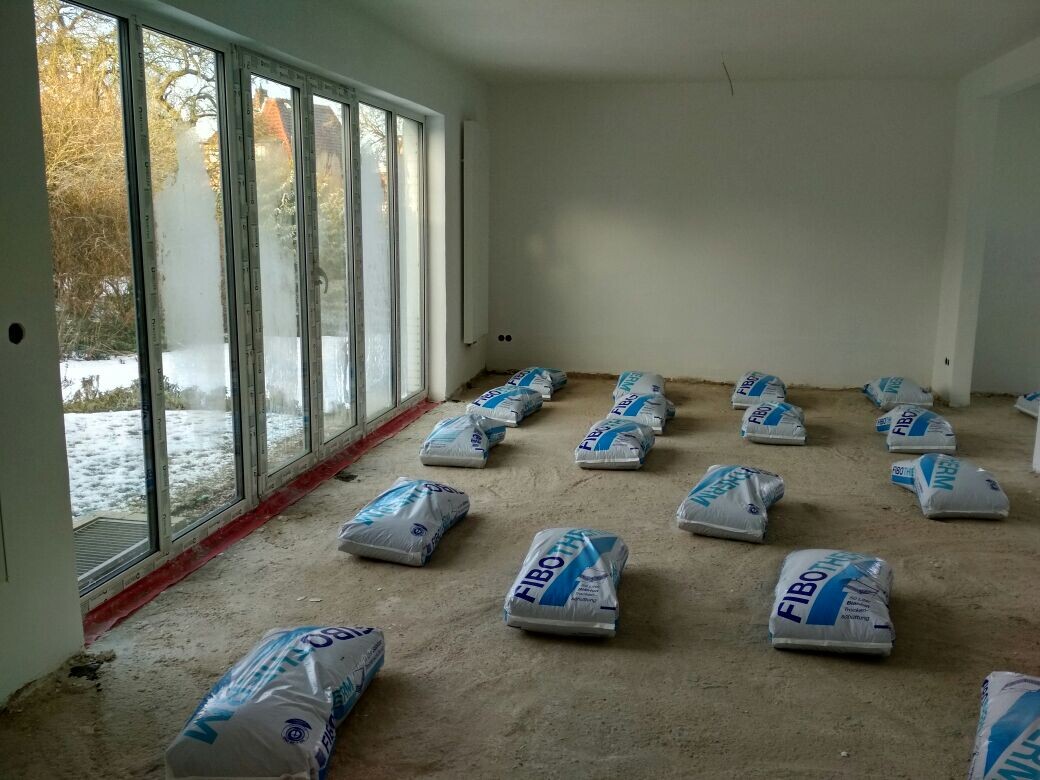
Heating solution here with vertical radiators on the right and left of the window. In this case, however, the difference between the window and wall U-values is lower; the wall’s U-value is about 0.5 (built in 1960).
Now, when the sun shines in winter, no heating is needed in the rooms between 11 a.m. and 3 p.m.
Overall, our house has 52m² (560 sq ft) of window area on 135m² (1450 sq ft) of living space. Energetically not perfect, but not a bunker – plenty of LIGHT.
Does anyone know Drutex?
Base price: 1800€ (triple glazing Ug=0.6, warm edge Swiss Spacer gray, gray foil decor on the outside, Drutex IGLO 5 Classic profile 70mm (2.8 inches))
Plus two static coupling profiles on the right and left of the double door (+2*200€)
+Installation according to RAL standards with foil on the inside (visible in the picture, not plastered yet), compressible sealing tape on the outside about 900€ (proportionally from total order, excluding plastering work)
Dividing the fixed side elements was not necessary and is also not optimal from an energy perspective – but the site management requested it for aesthetic reasons.
Orientation is SSW with about 1m (3.3 ft) roof overhang directly above. On the north side, we chose the more energy-efficient 82mm (3.2 inches) profiles; on the south side, with the large façades (there is another one in the adjoining room), that would have added about 1000€ more in total.
Oh yes: old building and construction site, so it’s neither tidy nor cleaned.
There will be no cold drafts at the window – see heating pipe connections on the right and left. The old 60 cm (24 inches) high radiators have already been replaced with only 30 cm (12 inches) high baseboard heaters, which should be sufficient with the new windows. On the other side of the room, there is another radiator, and the room is called the “fireplace room.”
Here is an example from the adjacent room, 4.8m * 2.2m (15.7 ft * 7.2 ft), showing how NOT to do it. Without a significant roof overhang, also oriented SSW (photographed at sunrise; leveling fill for the dry screed is on the floor). The windows are frosted on the outside in the morning! The sun fully hits them from noon on, even in summer. (A canopy/shading will still be installed there, but here in northern Germany, too much sun exposure is less often a problem.)
Heating solution here with vertical radiators on the right and left of the window. In this case, however, the difference between the window and wall U-values is lower; the wall’s U-value is about 0.5 (built in 1960).
Now, when the sun shines in winter, no heating is needed in the rooms between 11 a.m. and 3 p.m.
Overall, our house has 52m² (560 sq ft) of window area on 135m² (1450 sq ft) of living space. Energetically not perfect, but not a bunker – plenty of LIGHT.
Does anyone know Drutex?
(
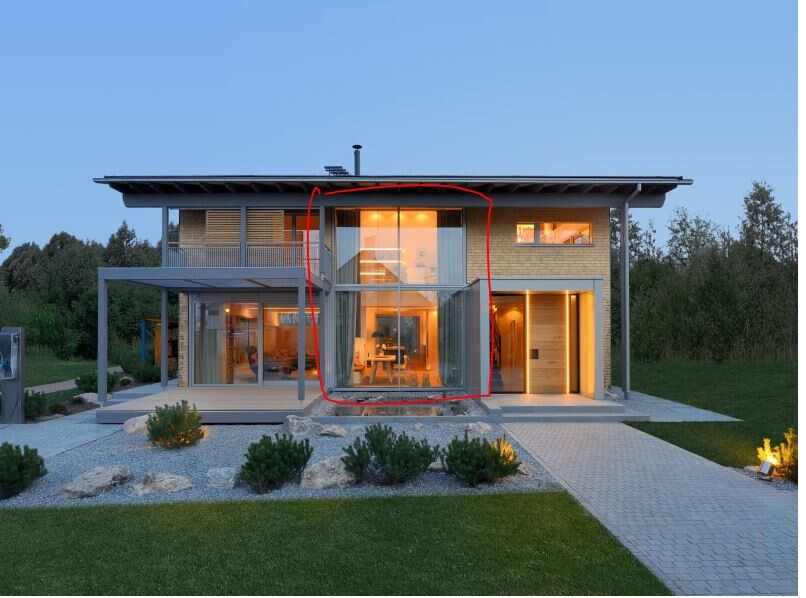
((andreas))22 Feb 2018 12:56What do you think, how much would a window in this style roughly cost?
The size of the individual window should be about W x H 2 x 3 meters (6.5 x 10 feet).
I understand that something like this facing south is only possible with blinds. The roof overhang won’t help much in summer for a two-story building…
The size of the individual window should be about W x H 2 x 3 meters (6.5 x 10 feet).
I understand that something like this facing south is only possible with blinds. The roof overhang won’t help much in summer for a two-story building…
Similar topics