
ᐅ Painter’s fleece / renovation fleece vs. textured wallpaper in new construction
Created on: 12 Nov 2023 10:02
B
Baulaie_Marcus
Hello dear forum,
We are building a new house using solid construction methods, with drywall partitions on the top floor. About a year ago, when signing the contract with our house builder, we were convinced that "walls and floors" would be very simple and something we could do ourselves.
However, it seems it is not as easy as we were told. Our budget does not allow us to suddenly hire a professional company to do all this work. So now we have to manage it ourselves. Currently, we are stuck with the following basic questions:
According to the building contract, our walls will be handed over at Q2 finish quality. I've heard different opinions: Our site manager thought that we should cover the walls with painting fleece or renovation fleece before painting, to prevent cracks and possibly mold. However, my online research shows that such fleece is only used with a Q3 finish, while Q2 surfaces usually get a medium to coarse textured woodchip wallpaper (or similar textured wallcovering). So, which is correct? Also, assuming no extremely high demands on the walls, would it be sufficient to apply woodchip wallpaper on the Q2 surface and then paint, or do you think more preparation is needed? What about the risk of mold? Thank you very much.
Best regards
Marcus
We are building a new house using solid construction methods, with drywall partitions on the top floor. About a year ago, when signing the contract with our house builder, we were convinced that "walls and floors" would be very simple and something we could do ourselves.
However, it seems it is not as easy as we were told. Our budget does not allow us to suddenly hire a professional company to do all this work. So now we have to manage it ourselves. Currently, we are stuck with the following basic questions:
According to the building contract, our walls will be handed over at Q2 finish quality. I've heard different opinions: Our site manager thought that we should cover the walls with painting fleece or renovation fleece before painting, to prevent cracks and possibly mold. However, my online research shows that such fleece is only used with a Q3 finish, while Q2 surfaces usually get a medium to coarse textured woodchip wallpaper (or similar textured wallcovering). So, which is correct? Also, assuming no extremely high demands on the walls, would it be sufficient to apply woodchip wallpaper on the Q2 surface and then paint, or do you think more preparation is needed? What about the risk of mold? Thank you very much.
Best regards
Marcus
Baulaie_Marcus schrieb:
I had read that a renovation fleece, due to its breathable properties, is supposed to prevent mold growth. There are also gummy bears sold that supposedly don’t make you gain weight. You have to promote your product somehow.
Mold growth can be prevented by a well-insulated wall without thermal bridges and sufficient ventilation. Surface materials with certain properties can only delay it.
Baulaie_Marcus schrieb:
No fleece, because Q3 is required for that. Nope. Without fleece or wallpaper, you will get small settlement cracks on new masonry and plastered surfaces. Nothing dramatic, but something to be aware of. In drywall construction, without a Q3 finish you can see the unspackled gypsum board surfaces through the paint at Q2. You need continuous filling like Q3 if you don’t cover the surface with something else.
My opinion and experience (there are other methods):
At least in drywall construction, I would recommend renovation fleece, or however it is called. Not the heavy “painter’s fleece” with 130 g/m² (4 oz/yd²), but the thin, semi-transparent type with about 40 g/m² (1.3 oz/yd²). As a non-professional, I have worked with both and the thin one is much easier.
The advantage of all fleece wallpapers compared to woodchip wallpaper is that you only paste the wall and then pull the wallpaper up from the roll on the floor, press it onto the wall and cut it off at the bottom. No pasting table, no tearing, much faster. The thin fleece is overlapped by 3–5 cm (1½–2 inches) and cut directly on the overlap with a utility knife (can also be done in wavy lines—even better), then the excess is peeled off. This creates no seams or gaps.
I just wallpapered our old building with surfaces far from Q3 quality and it worked really well.
The only disadvantage: this stuff soaks up paint like crazy. I would recommend applying a cheap coat of paint first to let it soak in, then a high-quality one on top.
xMisterDx schrieb:
Pasting fleece isn’t easy either. Long strips are okay, but when it comes to corners and stuff… you have to know how to handle it, otherwise the joints will look like Q0 in the end. Definitely start in the storage room, work your way through the dressing room and upstairs hallway, then move on to the workroom and children’s rooms, and finish with the entrance area, kitchen, and living room.
X
xMisterDx13 Nov 2023 08:40Hmm. My ceiling was finished by the drywall contractor with a Q3 level of joint treatment. The drywall in the bathroom and one drywall panel that was replaced later only reached Q2. And after two coats of good-quality paint, you can’t see any joints at all.
Isn’t a primer (such as penetrating primer) usually used to prevent the substrate from absorbing too much?
Paint isn’t that incredibly expensive these days. I think we used about seven 20-liter (5.3 US gallons) buckets of white paint for a new build of 152 m² (1,636 sq ft), which is roughly 500 m² (5,382 sq ft) of surface area. Ceilings were painted twice, walls only needed one coat. We still have about three-quarters of a bucket left for touch-ups.
I’d rather apply two coats of primer and only one coat of paint. That also saves time.
I was taught that if the foundation of your work is cheap and shoddy (bad paint, poor design planning, no cable labeling, gravel under the topsoil, etc.), then everything you add on top will be low quality, too.
Cracks will happen, yes. But you can just apply fine filler, sand it down, inspect carefully, and you’re done.
To hide just a few cracks, are you really going to cover 500 m² (5,382 sq ft) with smooth fleece wallpaper? If you have the time and money, sure. But it would be unwise to then skimp on paint… better to skip the fleece wallpaper and use good paint instead.
Isn’t a primer (such as penetrating primer) usually used to prevent the substrate from absorbing too much?
Paint isn’t that incredibly expensive these days. I think we used about seven 20-liter (5.3 US gallons) buckets of white paint for a new build of 152 m² (1,636 sq ft), which is roughly 500 m² (5,382 sq ft) of surface area. Ceilings were painted twice, walls only needed one coat. We still have about three-quarters of a bucket left for touch-ups.
I’d rather apply two coats of primer and only one coat of paint. That also saves time.
I was taught that if the foundation of your work is cheap and shoddy (bad paint, poor design planning, no cable labeling, gravel under the topsoil, etc.), then everything you add on top will be low quality, too.
Cracks will happen, yes. But you can just apply fine filler, sand it down, inspect carefully, and you’re done.
To hide just a few cracks, are you really going to cover 500 m² (5,382 sq ft) with smooth fleece wallpaper? If you have the time and money, sure. But it would be unwise to then skimp on paint… better to skip the fleece wallpaper and use good paint instead.
xMisterDx schrieb:
Just to avoid seeing a few cracks, glue 500m² (5,382 sq ft) of smooth fleece? Only if you have the time and money. But it would be silly to then have to save on the paint... better to skip the fleece and use good paint instead. No, I only meant the drywall and just the walls and possibly the sloped ceilings. You can do the solid construction if you want and feel like it.
Unfortunately, a primer doesn’t help with renovation fleece. It’s not about the absorbency of a porous, hard substrate, but the structure is a bit like cotton wool. There are many cavities. Of course, primer is applied to the wall before the adhesive goes on.
You can also embed the fleece directly into the wet top coat plaster, which makes it easy to paint afterward. It’s a bit like the fiberglass tape used for drywall joints, just 1 meter (3.3 ft) wide.

The issue with Q2 finish and fleece is that the smooth fleece tends to highlight small uneven spots rather than conceal them. Every tiny plaster crumb basically gets covered with a thin paper tent. In our first house, we used Q2 and faced a similar problem as you—simply not having a five-figure budget left to have it done professionally.
We chose a middle ground, but don’t expect optical perfection from it. I just absolutely didn’t want to have textured wallpaper (like "Raufaser") anymore. While it can effectively hide unevenness, I just can’t stand the look anymore. Every student apartment had textured wallpaper, and I really hate it.
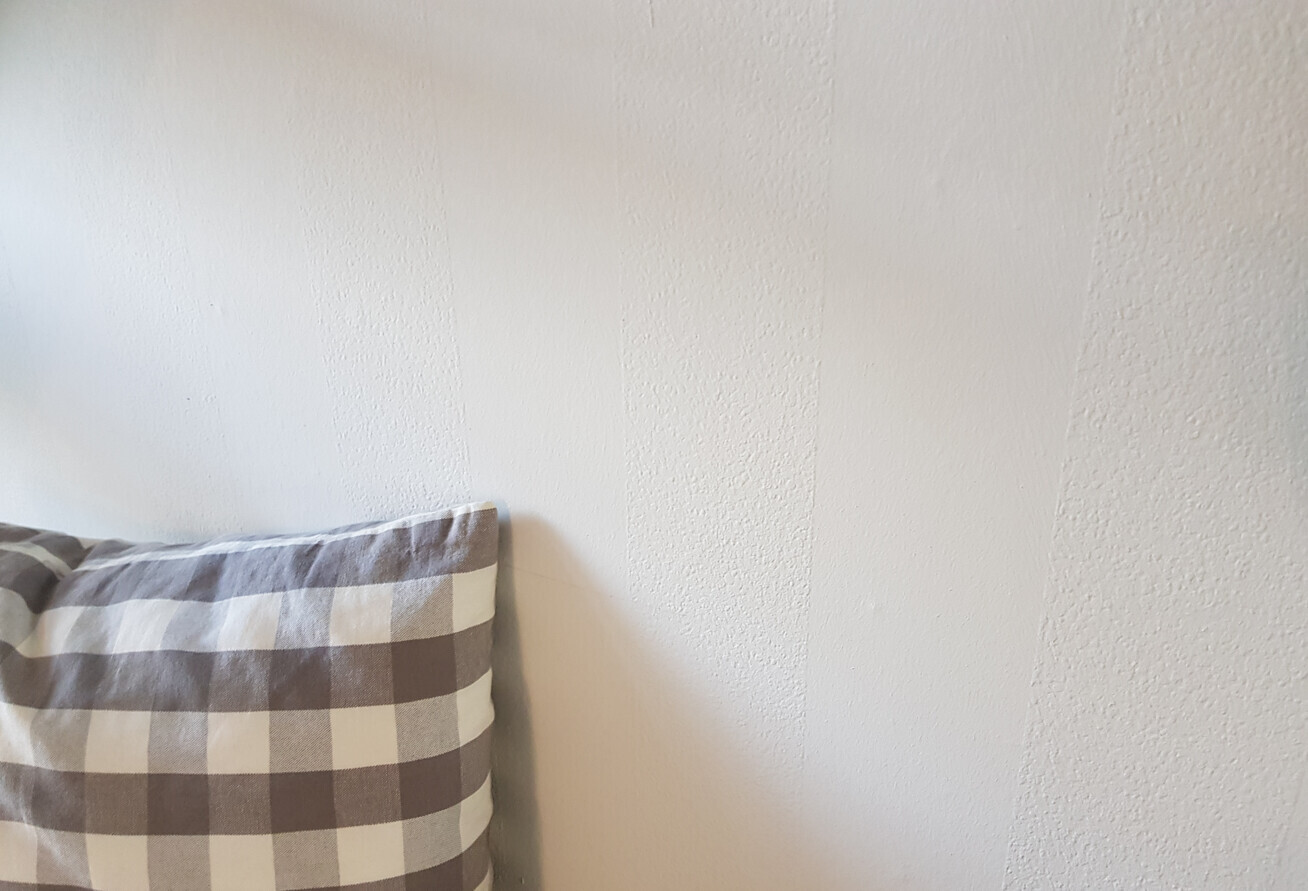
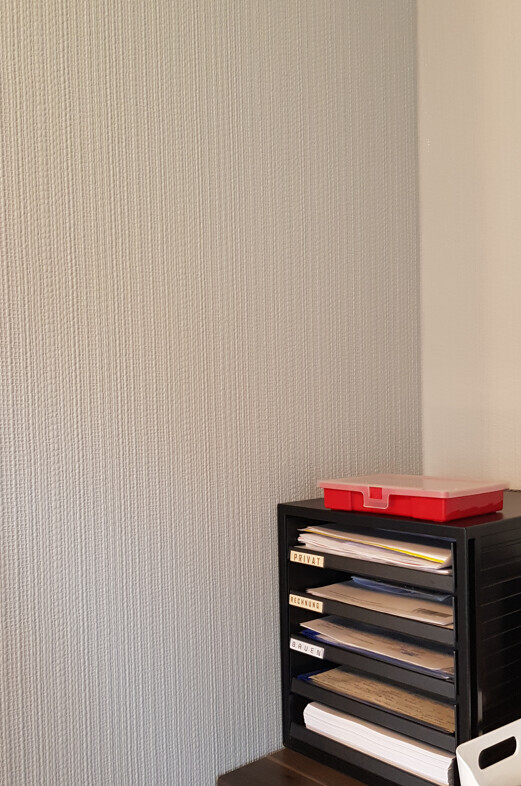
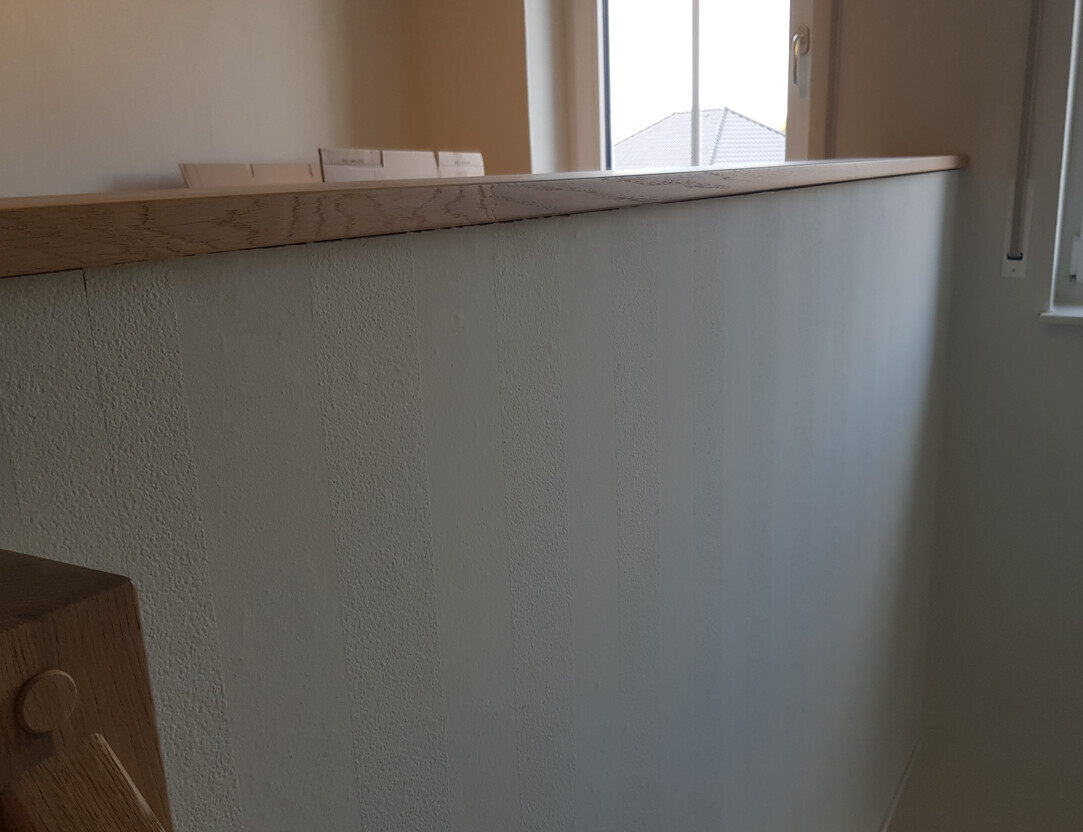
We then selected a so-called fleece fiber wallpaper from Erfurt. These are nonwoven wallpapers that are easy to install. However, they are not as smooth as painter’s fleece; instead, they come in various textures with different levels of relief. They look really good once painted.
For example, in the hallway, we chose one with a striped texture. Not color stripes, but textured stripes. It looked really nice there, especially in the stairwell where the walls are quite tall. However, it had some stripes in between that were less textured (almost smooth), and in those areas, unevenness was quite visible. But only if you looked closely. In everyday life, no one stands right in front of the wallpaper inspecting it in detail. 😉
It also matched our rather rustic interior style, so overall we were satisfied with the solution. That was all we could afford with the budget at the time, and we managed well with it.
I’m attaching a few photos to show what I mean. In the last one, you can also see many small "bumps" in one spot that was not perfectly sanded. Without the wallpaper, it looked significantly less bumpy. The smooth texture visually intensifies this, so you have to be aware of that.
We chose a middle ground, but don’t expect optical perfection from it. I just absolutely didn’t want to have textured wallpaper (like "Raufaser") anymore. While it can effectively hide unevenness, I just can’t stand the look anymore. Every student apartment had textured wallpaper, and I really hate it.
We then selected a so-called fleece fiber wallpaper from Erfurt. These are nonwoven wallpapers that are easy to install. However, they are not as smooth as painter’s fleece; instead, they come in various textures with different levels of relief. They look really good once painted.
For example, in the hallway, we chose one with a striped texture. Not color stripes, but textured stripes. It looked really nice there, especially in the stairwell where the walls are quite tall. However, it had some stripes in between that were less textured (almost smooth), and in those areas, unevenness was quite visible. But only if you looked closely. In everyday life, no one stands right in front of the wallpaper inspecting it in detail. 😉
It also matched our rather rustic interior style, so overall we were satisfied with the solution. That was all we could afford with the budget at the time, and we managed well with it.
I’m attaching a few photos to show what I mean. In the last one, you can also see many small "bumps" in one spot that was not perfectly sanded. Without the wallpaper, it looked significantly less bumpy. The smooth texture visually intensifies this, so you have to be aware of that.
S
Schorsch_baut13 Nov 2023 09:13Woodchip wallpaper makes any color appear somewhat gray or dull because each bump casts a shadow.
If you still have some extra money, take a look at sites with handyman services or other contractor comparison portals. We found a tradesperson there who plastered the entire house to Q4 standard. He will start painting next week, but so far everything looks very good. I’m already quite satisfied, even though his Q4 quality will probably be closer to a painter’s Q3, but that is completely sufficient for us. We only paid a total of €6,000 (about $6,400), which is a great deal. There really is nothing to complain about. On the contrary, we’re even considering giving him a small Christmas gift since the price almost feels unfair... 😀
We had initially considered doing the painting work ourselves, but in hindsight, we’re glad we took this route, even if we might need to arrange an additional €5,000 (about $5,300) in the end. Especially when it comes to filling in the ceilings and edges, you can tell it was done by someone with experience. I would never have managed that myself. And if in five years we’re not happy with it anymore or settlement cracks become excessive, I can just repair it gradually without any time pressure.
Of course, it all depends a bit on the tradesperson you find. Maybe we were just very lucky, but with a bit of common sense and the reviews from the portal, you can at least get a sense of who you’re dealing with.
Important: Google their VAT ID or company information once and only pay invoices after the work is completed.
We had initially considered doing the painting work ourselves, but in hindsight, we’re glad we took this route, even if we might need to arrange an additional €5,000 (about $5,300) in the end. Especially when it comes to filling in the ceilings and edges, you can tell it was done by someone with experience. I would never have managed that myself. And if in five years we’re not happy with it anymore or settlement cracks become excessive, I can just repair it gradually without any time pressure.
Of course, it all depends a bit on the tradesperson you find. Maybe we were just very lucky, but with a bit of common sense and the reviews from the portal, you can at least get a sense of who you’re dealing with.
Important: Google their VAT ID or company information once and only pay invoices after the work is completed.
Similar topics