
ᐅ Painting basement floor with white efflorescence, built in 1960
Created on: 22 Oct 2025 20:56
J
JochenG2Hello,
we have a terraced house built in 1960. In the basement (without a continuous concrete slab) there is a (cement?) screed with some old paint stains (see picture).
Basically, it is dry, with only very few white efflorescences in some spots. Only if you place a metal can on it, after a month there is a damp spot underneath.
The floor is partly rough (raw concrete/screed, etc.) and does not look nice. Now the question is, what should we do:
1) Liquid plastic, for example swingcolor 2in1 floor paint / liquid plastic 2in1 RAL 7031. But this is apparently not vapor-permeable. I am wondering if the floor would then be completely wet after a few months and the coating would no longer hold. It says the floor must be "protected against rising moisture from below."
2) A vapor-permeable epoxy resin, for example Remmers 2K epoxy primer with 2K floor coating. This might be good for the floor, but it could be a problem if I put cardboard/wood or similar on it for a long time, because moisture can still come from below. Even though it says it is "protected from moisture coming from the back during use."
3) A mineral, silicate-based solution was also recommended to me. I know silicate paint for walls since I have applied it there. Is there something similar for floors? Or what exactly is meant here? Well, vapor permeability makes sense for the floor, but the load is of course walking traffic. The floor is in a laundry room where maybe a little water runs on it once a week briefly.
There are neighbors with the same house who seem happy with epoxy.
What do you think?
Or completely different ideas?
Thanks in advance,
Jochen
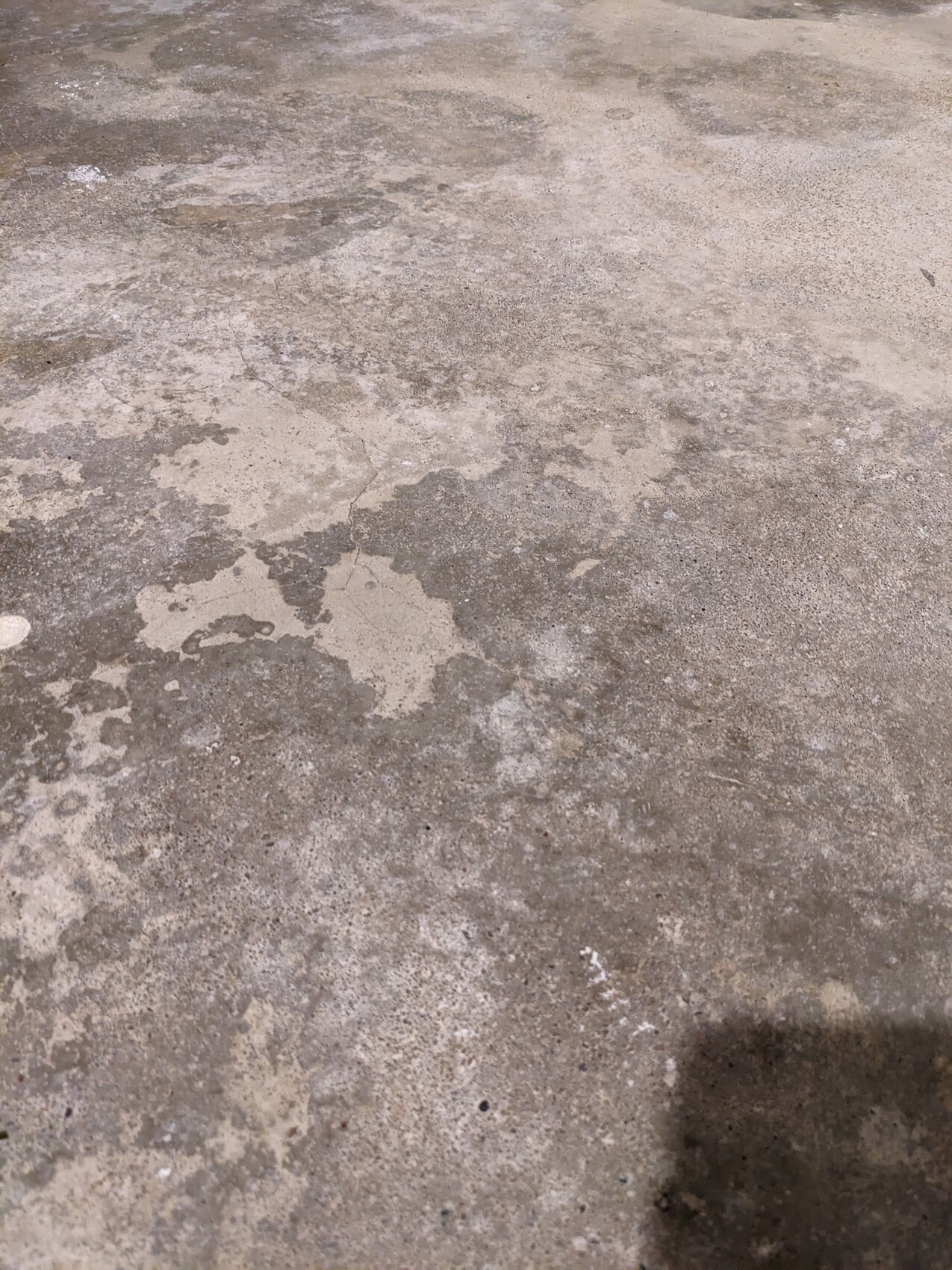
we have a terraced house built in 1960. In the basement (without a continuous concrete slab) there is a (cement?) screed with some old paint stains (see picture).
Basically, it is dry, with only very few white efflorescences in some spots. Only if you place a metal can on it, after a month there is a damp spot underneath.
The floor is partly rough (raw concrete/screed, etc.) and does not look nice. Now the question is, what should we do:
1) Liquid plastic, for example swingcolor 2in1 floor paint / liquid plastic 2in1 RAL 7031. But this is apparently not vapor-permeable. I am wondering if the floor would then be completely wet after a few months and the coating would no longer hold. It says the floor must be "protected against rising moisture from below."
2) A vapor-permeable epoxy resin, for example Remmers 2K epoxy primer with 2K floor coating. This might be good for the floor, but it could be a problem if I put cardboard/wood or similar on it for a long time, because moisture can still come from below. Even though it says it is "protected from moisture coming from the back during use."
3) A mineral, silicate-based solution was also recommended to me. I know silicate paint for walls since I have applied it there. Is there something similar for floors? Or what exactly is meant here? Well, vapor permeability makes sense for the floor, but the load is of course walking traffic. The floor is in a laundry room where maybe a little water runs on it once a week briefly.
There are neighbors with the same house who seem happy with epoxy.
What do you think?
Or completely different ideas?
Thanks in advance,
Jochen
Hi Jochen,
you’ve really put the right thoughts into this – many just paint over the problem and then wonder about blisters or mold. If the basement doesn’t have a continuous concrete slab, moisture from below simply can’t be ignored. Anything that is vapor-tight will eventually cause problems, no matter what the label says.
These so-called “vapor-permeable” epoxy resins are usually only more permeable than the fully sealed types, but they are not truly breathable coatings in the real sense. This means that with an older basement without a vapor barrier, you still risk moisture buildup. I’m surprised your neighbors are satisfied with it – have you seen what their floors look like now, or just heard that “everything is fine”?
A mineral, silicate-based solution would be much more sensible here. It might look a bit plain but is technically sound. If you do it properly, you’ll have peace of mind and no materials peeling off after just six months. Or are you planning to use the basement more intensively, for example as a workshop with wheeled loads? That would be an important factor in your choice.
Have a good evening
you’ve really put the right thoughts into this – many just paint over the problem and then wonder about blisters or mold. If the basement doesn’t have a continuous concrete slab, moisture from below simply can’t be ignored. Anything that is vapor-tight will eventually cause problems, no matter what the label says.
These so-called “vapor-permeable” epoxy resins are usually only more permeable than the fully sealed types, but they are not truly breathable coatings in the real sense. This means that with an older basement without a vapor barrier, you still risk moisture buildup. I’m surprised your neighbors are satisfied with it – have you seen what their floors look like now, or just heard that “everything is fine”?
A mineral, silicate-based solution would be much more sensible here. It might look a bit plain but is technically sound. If you do it properly, you’ll have peace of mind and no materials peeling off after just six months. Or are you planning to use the basement more intensively, for example as a workshop with wheeled loads? That would be an important factor in your choice.
Have a good evening
Jochen, since you’re already familiar with silicate, you’re not far off from the right approach. There are indeed mineral-based floor coatings that use water glass as a base—in essence, a type of “silicification” of the screed. The surface remains vapor-permeable but becomes harder and more resistant to dust and abrasion. Visually, it’s not a high-gloss finish but rather a matte, technical look that appears very clean.
You just shouldn’t expect this material to hide cracks or smooth out minor unevenness; it remains honest—showing the floor as it really is. And that’s probably better than some kind of plastic layer that would only trap moisture in the end.
Have you actually tested how much moisture is really under the container? Whether it is pushing up from below or just condensation caused by the temperature difference? That’s the crucial question before you apply anything at all.
You just shouldn’t expect this material to hide cracks or smooth out minor unevenness; it remains honest—showing the floor as it really is. And that’s probably better than some kind of plastic layer that would only trap moisture in the end.
Have you actually tested how much moisture is really under the container? Whether it is pushing up from below or just condensation caused by the temperature difference? That’s the crucial question before you apply anything at all.
Thank you. I am quite sure that the moisture is coming from below. On one hand, this is due to the age of the basement. On the other hand, I find it hard to believe that the basement floor reaches the dew point at 30% humidity and 18 to 20 degrees Celsius (64 to 68 degrees Fahrenheit), since that would be far off.
What exactly is a silicate floor paint? When I search for floor paint, I only find products for walls. Or do you simply use wall paint on the floor?
Best regards, Jochen
What exactly is a silicate floor paint? When I search for floor paint, I only find products for walls. Or do you simply use wall paint on the floor?
Best regards, Jochen
Hi
It is indeed true that searching for mineral-based floor coatings can be very confusing. The term “silicate floor paint” is rarely encountered in hardware stores – these are usually special silicate treatments (impregnation) or thin cementitious coatings, and seldom paint in the traditional sense. Please do not use silicate wall paint for floors; it will not hold up under load and moisture, but rather will dust off or flake away.
A suitable product would be something along the lines of a “silicification” treatment or a “water glass-based floor hardener.” Well-known brands for this type of product include Lithofin or Kiesol. Occasionally, you can find special coatings from Remmers or Mapei designed for old concrete that are explicitly diffusion-open floor impregnations. Unfortunately, the terminology is often mixed up – truly trafficable, diffusion-open floor coatings are a niche product since there is often little demand for them in craftsmanship. It’s important that the product is not epoxy, not a “sealing coat,” and not a standard floor paint.
It is indeed true that searching for mineral-based floor coatings can be very confusing. The term “silicate floor paint” is rarely encountered in hardware stores – these are usually special silicate treatments (impregnation) or thin cementitious coatings, and seldom paint in the traditional sense. Please do not use silicate wall paint for floors; it will not hold up under load and moisture, but rather will dust off or flake away.
A suitable product would be something along the lines of a “silicification” treatment or a “water glass-based floor hardener.” Well-known brands for this type of product include Lithofin or Kiesol. Occasionally, you can find special coatings from Remmers or Mapei designed for old concrete that are explicitly diffusion-open floor impregnations. Unfortunately, the terminology is often mixed up – truly trafficable, diffusion-open floor coatings are a niche product since there is often little demand for them in craftsmanship. It’s important that the product is not epoxy, not a “sealing coat,” and not a standard floor paint.
Similar topics