
Dear forum members,
We bought a plot of land last autumn and are currently deep into the floor plan design. We would like to share our current draft with you and welcome any comments and opinions.
[F]irst some preliminary information about the plot and its buildability:[/F]
Best regards
We bought a plot of land last autumn and are currently deep into the floor plan design. We would like to share our current draft with you and welcome any comments and opinions.
[F]irst some preliminary information about the plot and its buildability:[/F]
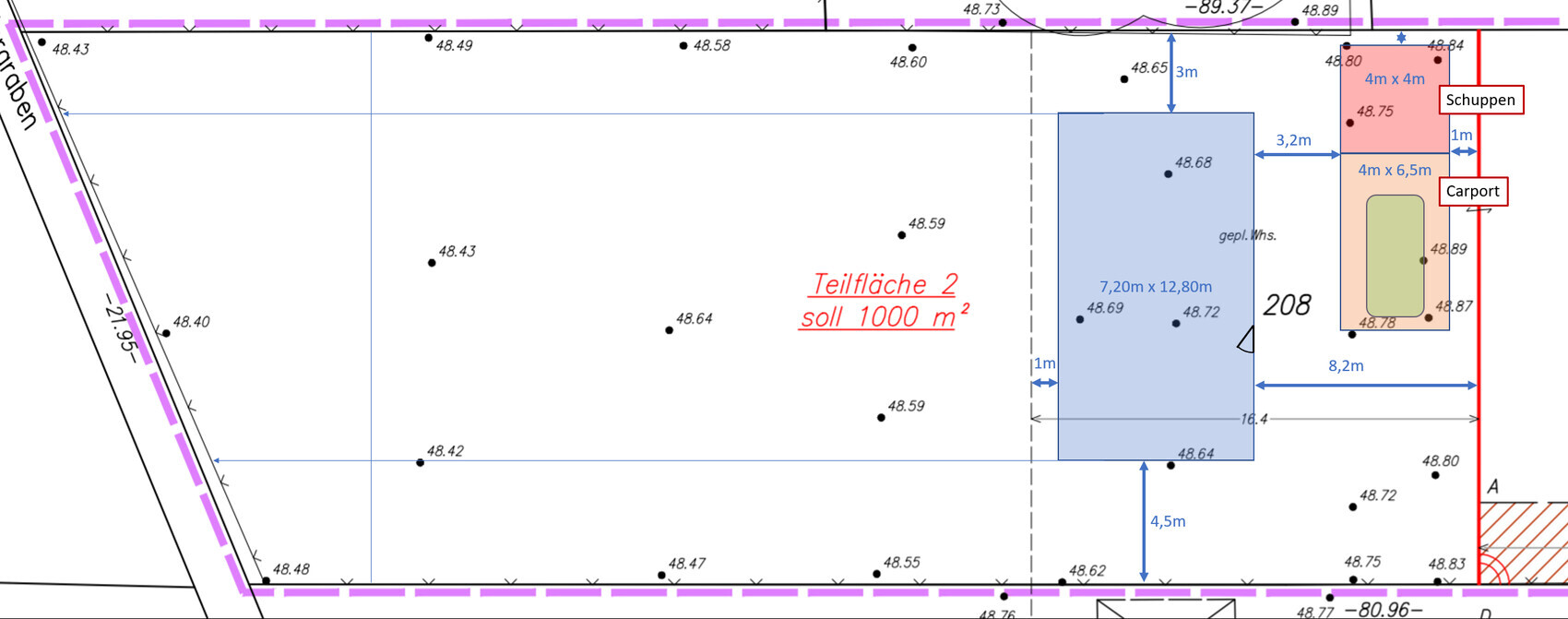
- 1000 m² (10,764 sq ft) rear plot, southwest facing (so southwest is on the left side of the site plan)
- Building boundary up to approx. 16 m (52 ft) behind the property line (up to the dashed line on the site plan)
- No zoning plan (construction according to § 34 of the Building Code)
- Groundwater at surface level and peaty soil (exact geotechnical report pending), so piled foundation required and no basement
- Affordable! (Our maximum budget for the house including foundation slab is €230,000)
- Country house style
- Bright, large windows facing south/garden
- Open living/dining/kitchen area
- Family of four, 1 bedroom and 2 children’s rooms
- Not oversized, max 150 m² (1,615 sq ft), preferably less
- Solid construction using Ytong blocks (for us the most cost-effective option, although we would have liked to build with wood as well).
- Developed ourselves after studying various floor plans (including from the book "Affordable Building with a Small Budget" by Achim Linhardt) with support from architect friends and our planner (an independent civil engineer).
- Dimensions 12.50 x 7.50 m (41 x 25 ft) (the measurements shown on the site plan are from an earlier draft).
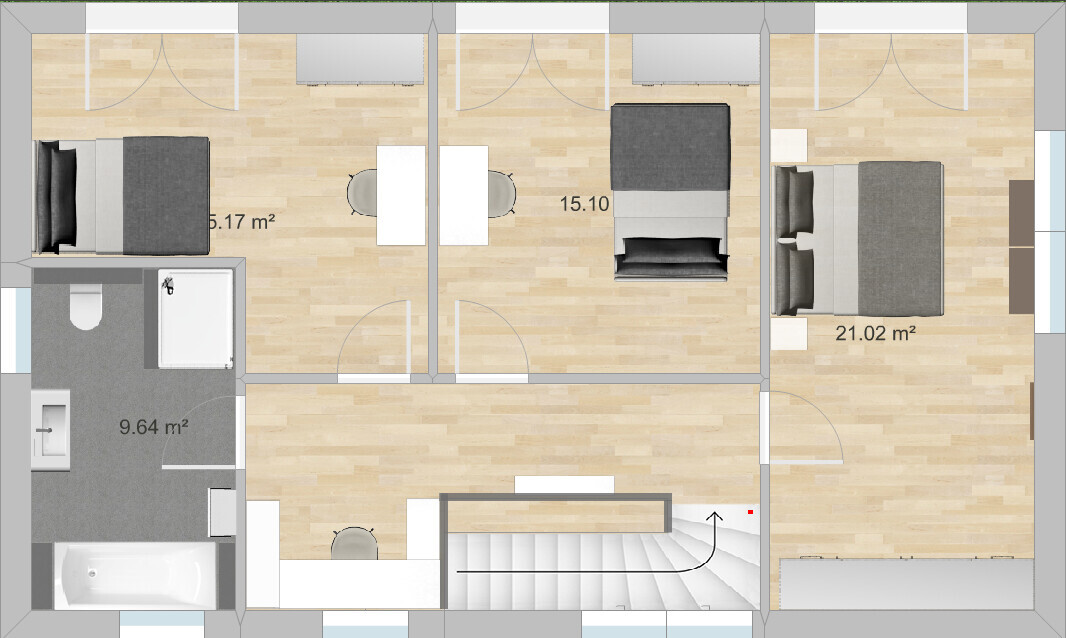
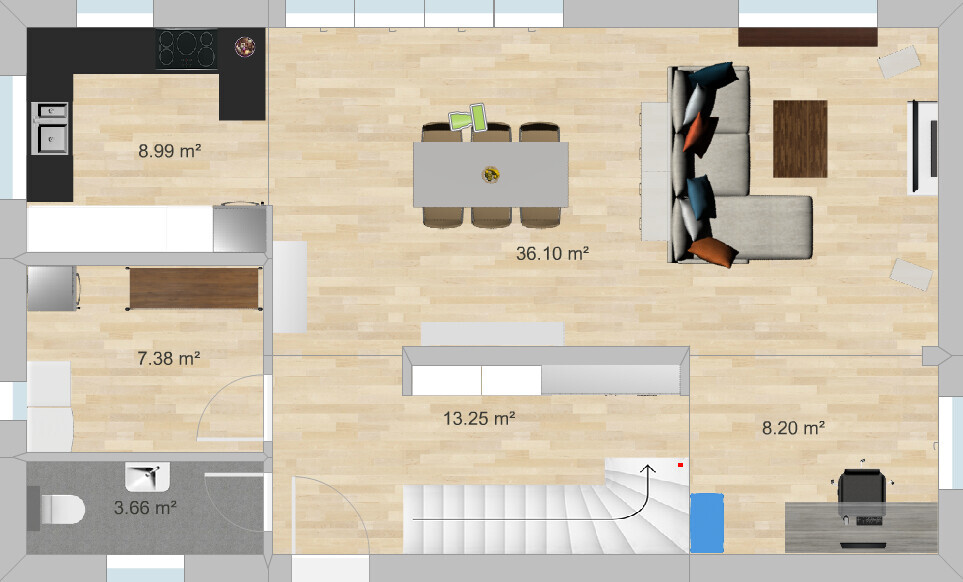
- What we like: open living area, all main rooms have large windows facing the garden, efficient size, although the children’s and bedroom could be smaller, sewing/work nook behind the stairs upstairs, plenty of wall space for large wardrobes in the upstairs bedroom and hallway on the ground floor, light shaft in the stairwell, staircase (we originally wanted a straight run staircase but it would have taken too much space; the one with three quarter turns is also fine with us).
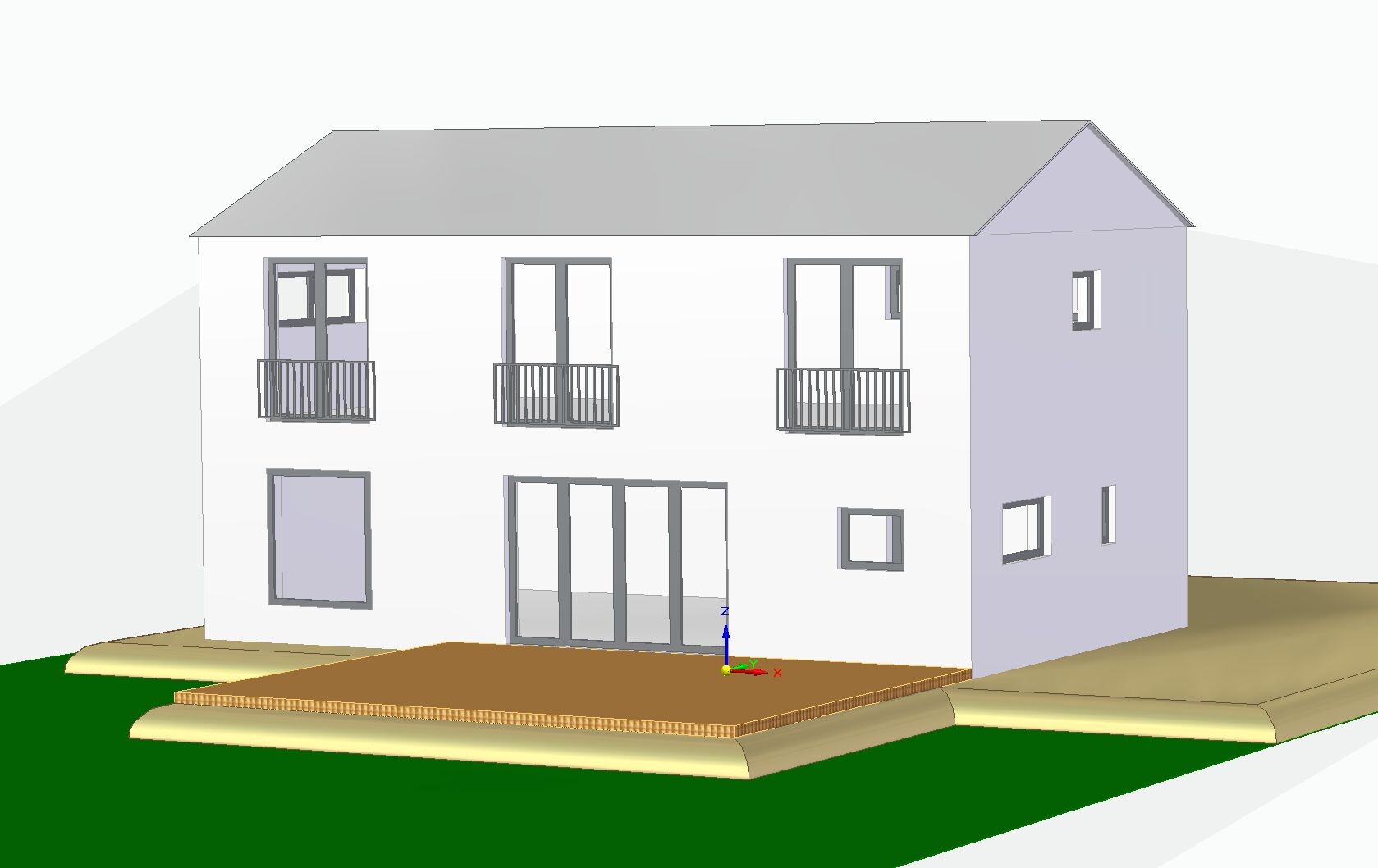
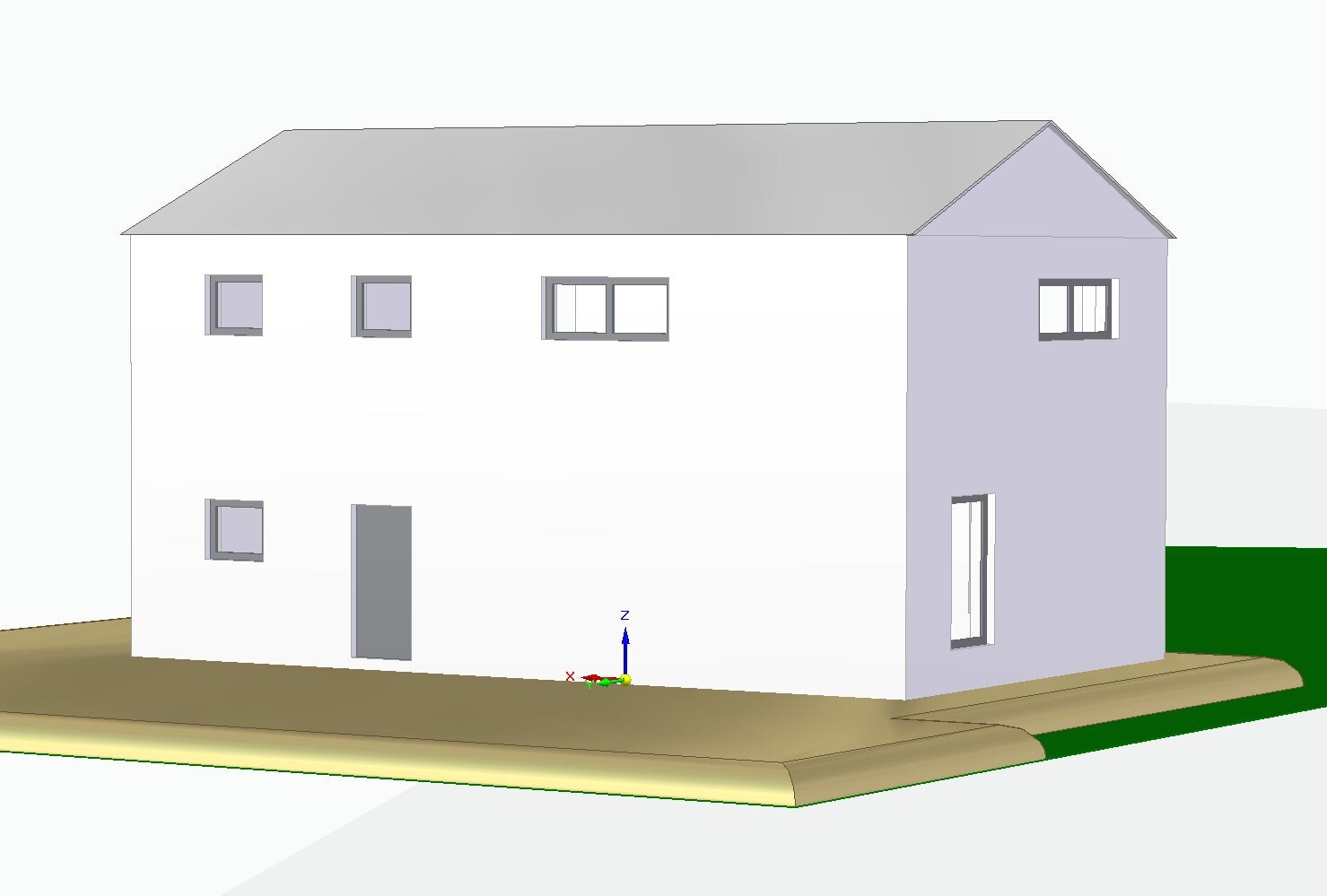
- What we don’t like 100% yet: the height of the house from the outside. It is currently planned as a two-story house with an eaves height of 6.2 m (20 ft), with the ground floor 2.84 m (9 ft 4 in) high and the upper floor 2.60 m (8 ft 6 in) high. The gable roof will be an uninsulated, unfinished cold roof, mainly because of the economical prefabricated truss construction method. This is a bit disappointing because I really like sloped ceilings and did not want the character of a townhouse. Lowering the roof with a knee wall of about 1.90 m (6 ft 3 in) and an insulated roof with open sloped ceilings would probably be more expensive due to the rafter/beam construction. We would also lose the garden view through the floor-to-ceiling bedroom windows.
- Simple: What do you think about the floor plan?
- Can you still imagine the relatively tall two-story house having a country house character? Maybe it depends on the facade design and choice of materials? Do you think it looks too “blocky,” especially from the front entrance side? Or would a lower eaves height with an attic conversion including a knee wall be preferable?
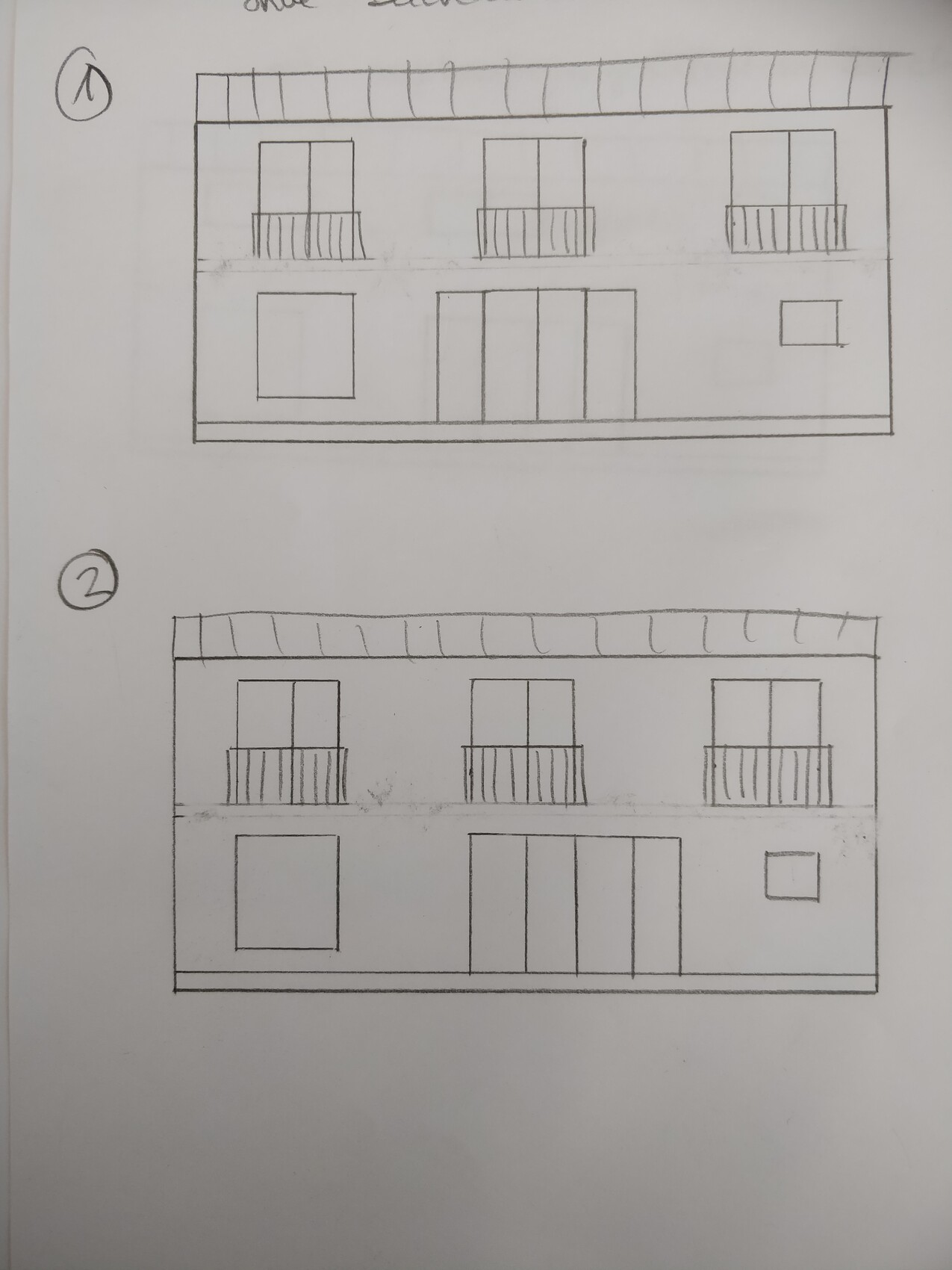
- We are still unsure how to arrange the windows on the garden side. The drawing with the elevations shows two possible versions. We actually prefer it when the upper floor window is centered over the lower window front. However, this does not align the interior line of sight from the entrance door to the garden/patio door (see ground floor plan). This represents version two; for version one, the window front would have to be shifted about one window width to the right, so that the patio door is behind the dining table. With the window front shifted left, the interior looks better to us, but from the outside it looks strange if it is offset from the upper floor window, right? What do you think?
Best regards
H
hampshire9 Mar 2020 09:57Stairs and Prices:
We liked the construction stairwell. It could be a bit nicer, though. The design is very simple. Glued laminated timber beams as stringers, solid wood steps, everything screwed together and done. In a DIY project, you can probably keep the cost under 1000€ (about 1100 USD). Choose a different railing option to protect your children and to get an easier building inspection or permit approval. We love it!

Whether it’s like this or otherwise—thinking outside the box will lead to solutions. With your budget, you can’t avoid creative thinking and doing a lot of the work yourself.
We liked the construction stairwell. It could be a bit nicer, though. The design is very simple. Glued laminated timber beams as stringers, solid wood steps, everything screwed together and done. In a DIY project, you can probably keep the cost under 1000€ (about 1100 USD). Choose a different railing option to protect your children and to get an easier building inspection or permit approval. We love it!
Whether it’s like this or otherwise—thinking outside the box will lead to solutions. With your budget, you can’t avoid creative thinking and doing a lot of the work yourself.
 la.schnute9 Mar 2020 10:32
Vitalio schrieb:
20 pages of discussion, and in the end it will fail because of the budget.
Don’t take this the wrong way, but five years ago I built my house for that amount of money and spent six months on the construction site from morning until evening. You say friends and family are helping—don’t they have to work too, or is the work only done on weekends? Will the contractors wait for you to finish everything before continuing?
If you’ve already changed the floor plan 10 times in one week, I don’t want to know how long it will take to decide on technical aspects, fixtures, tiles, or wall colors. Hmm, I already explained earlier in the thread where we see potential to save. We definitely can’t spend six months from morning till evening on the site. But spending every weekend plus the annual vacation over the course of a year is possible. Planned DIY work includes drainage on the plot, pouring the foundation slab (actually!), building the roof structure (truss frames) (I honestly have no clue about these two, but my father-in-law is confident that he and my friend can manage it themselves with some support), drywall and insulation, heating and plumbing installation including underfloor heating, flooring (except for tiles), possibly exterior cladding, and of course the outdoor areas (building the terrace, carport—these could be done 2 to 3 years later).
I think frequently changing the floor plan is quite normal. I know very few families who haven’t spent a lot of time figuring out and rearranging their floor plan. Of course, that’s the core of the design: all the furniture you plan to bring must fit, etc. That doesn’t mean we don’t already know exactly what we want in terms of fixtures and technical features.
saralina87 schrieb:
Maybe I missed it: What heating system do you plan to install?
With only six to seven square meters for the utility/technical room, it might be a bit tight, depending on what else needs to fit in there.
Our architect says we need at least 12 square meters.
I quite like the current preferred floor plan—we wouldn’t build it ourselves because we don’t want what you want (a linear arrangement of kitchen, dining, and living areas, and a staircase in the living area). But since you have a different idea, I think it’s good.
By the way, everyone who doesn’t want to build a palace here has this discussion about storage space. Some simply cannot understand that not everyone has the same expectations about storage. Don’t worry about it. That’s just on point! We’ll install a gas condensing boiler. Not the most ecological choice, but a geothermal heat pump is immediately ruled out because of our very challenging peat soil and limited budget. An air-source heat pump doesn’t appeal to us because of poor efficiency in winter and the bulky outdoor unit. We’re paying €3,500 for the condensing boiler, and my father-in-law will install it (plus, of course, the underfloor heating and the gas connection). The condensing boiler is about the size of a large refrigerator (drawn in the utility room on the floor plan), so it should fit. In the latest floor plan draft (attached again), our utility room is now over 8 square meters, and the kitchen is a bit more than 9 square meters—more than enough space for cooking and preparing meals, in my opinion. Currently, our kitchen is 10 square meters and includes the dining table.
Thanks for your positive comment, even if you would build differently yourself. It’s great to have people here who can accept different approaches!
Pinkiponk schrieb:
Am I right that not all windows have been added to the plans yet? Correct, the windows in the attached floor plan are now basically final. The elevations are still missing; I’ll gladly upload them once we have finished preparing them. After a lot of back and forth, we have now decided on external dimensions of 11.7 x 7.5 meters (38.4 x 24.6 feet).
la.schnute9 Mar 2020 10:40hampshire schrieb:
Stairs and Costs:
We liked the construction stairs. They could be a bit nicer though. The design is very simple. Glulam beams as stringers, solid treads, everything screwed together and done. For a DIY project, you should be able to stay under 1000€ (about 1100 USD). Choose a different railing option to protect your children and to make the building inspection easier. We love it!
[ATTACH alt="CFDE7407-248A-4171-80BC-1D18B45C5060_1_201_a.jpeg"]43946[/ATTACH]
Whether it’s like this or differently – those who think outside the box find solutions. With your budget, you won’t avoid creative thinking and doing a lot yourself all the way. Wow, I really like that! I’ll keep it in mind! If we add some storage underneath, it’s done.
opalau schrieb:
When I read these extra costs, I’m regularly glad that we liked and still like a (relatively affordable) closed concrete staircase with landing the best. We were thinking about concrete so far too. Approximately how much did your staircase cost? So far, we only have prices for wooden stairs because we want to request the concrete together with the precast slab (which hasn’t been calculated yet). I’m really curious, especially since you have the same stair shape...
11ant schrieb:
The double-flight staircase as you planned is affordable because the start and end points are close together. Where you planned the landing (which is basically a step), you can fit five winders - that’s four more, or each side will then be two steps shorter. Ah, good to know. I didn’t realize how much space you can save with winder steps... we’ll try that out again in the floor plan.
When the budget is tight, tips regarding custom-made furniture and the like are only of limited help... after all, these are not free and often not affordable without using personal funds.
I think you have to make the best of the available resources (in this case, the budget), accepting that compromises are inevitable... which is perfectly natural.
In my hallway, I have a shelf that is 80 cm (31 inches) wide and 2 m (79 inches) high, holding all the shoes owned by the three women living in the house. For the shoes currently in use, there is a bench with compartments and a drip mat. A simple coat rack with a few hooks—not a closet—holds the jackets currently in use. Seasonal items are stored in the wardrobe, where a clothes rail is thankfully sufficient. The suitcase is stored on top of the wardrobe, and travel bags are inside. Under the bed, I use under-bed storage boxes for various things. I’ve also moved some clutter to the attic, including the box with Christmas decorations. The utility room is 7 m² (75 sq ft) and contains the heating system, utility connections, washing machine, cleaning and laundry supplies, and even the vehicles (bicycles, scooters). At the moment, it still stores some leftover wallpapering materials, which will be cleared out soon to make the space more organized.
I didn’t show the floor plan here back then because it would have surely triggered a storm of criticism regarding storage space. But what’s the use? The house couldn’t be any bigger (the walls and roof were already up, and the setback requirements were fully utilized), and my budget wouldn’t have allowed for a different, larger property. Compared to our 70 m² (750 sq ft) apartment, we have improved in practically every respect, and that was the goal.
That should also be the goal for the original poster: the budget is fixed, the area is fixed, so now make the most of it within the constraints of an open floor plan. There won’t be much room for luxury. Perhaps built-in furniture can be purchased bit by bit once the main construction is complete and things settle down a bit...
I think you have to make the best of the available resources (in this case, the budget), accepting that compromises are inevitable... which is perfectly natural.
In my hallway, I have a shelf that is 80 cm (31 inches) wide and 2 m (79 inches) high, holding all the shoes owned by the three women living in the house. For the shoes currently in use, there is a bench with compartments and a drip mat. A simple coat rack with a few hooks—not a closet—holds the jackets currently in use. Seasonal items are stored in the wardrobe, where a clothes rail is thankfully sufficient. The suitcase is stored on top of the wardrobe, and travel bags are inside. Under the bed, I use under-bed storage boxes for various things. I’ve also moved some clutter to the attic, including the box with Christmas decorations. The utility room is 7 m² (75 sq ft) and contains the heating system, utility connections, washing machine, cleaning and laundry supplies, and even the vehicles (bicycles, scooters). At the moment, it still stores some leftover wallpapering materials, which will be cleared out soon to make the space more organized.
I didn’t show the floor plan here back then because it would have surely triggered a storm of criticism regarding storage space. But what’s the use? The house couldn’t be any bigger (the walls and roof were already up, and the setback requirements were fully utilized), and my budget wouldn’t have allowed for a different, larger property. Compared to our 70 m² (750 sq ft) apartment, we have improved in practically every respect, and that was the goal.
That should also be the goal for the original poster: the budget is fixed, the area is fixed, so now make the most of it within the constraints of an open floor plan. There won’t be much room for luxury. Perhaps built-in furniture can be purchased bit by bit once the main construction is complete and things settle down a bit...
la.schnute9 Mar 2020 10:56Altai schrieb:
When the budget is tight, tips about "custom furniture" and the like only help to a limited extent... after all, that isn’t free and would have to be financed from equity as it’s an additional cost.
I think you have to make the best use of what you have (in this case: budget), and compromises are inevitable... that’s just natural.
In my hallway, I have an 80cm (31.5 inch) wide and 2m (6 ft 7 inch) tall shelving unit where all the shoes of the three women living in the house are stored (for shoes currently in use, there is a small bench with compartments and a drip mat). There is a standard coat rack with a few hooks, not a closet, where the jackets currently in use are hung. Out-of-season clothes are stored in the wardrobe, thankfully the hanging rod is sufficient. The suitcase sits on top of the wardrobe, with travel bags inside. Under the bed, I store various things in under-bed boxes. I moved some clutter up to the attic, including the box with Christmas decorations.
The utility room is 7m² (75 ft²) and houses the heating system, building connections, washing machine, cleaning supplies, and even the bike and scooter parking. At the moment, there are still some leftover wallpapering materials stored there, but those will be cleared soon to make things a bit more organized.
I didn’t share the floor plan here back then, because it surely would have triggered an outcry about the storage space. But what’s the use, the house couldn’t have been bigger (walls and roof were already built, and setback requirements were fully utilized), and my budget wouldn’t have allowed a different, larger property anyway. Compared to our 70m² (750 ft²) apartment, we improved in practically every way, and that was the goal.
That must also be the goal of the original poster: the budget is fixed, the space is fixed, so now you get the most out of the open layout. There won’t be much room for fancy extras. Perhaps the built-in furniture can be acquired gradually after construction is completed and things settle down... Exactly! And we are currently using storage at home in a very similar way. I also think: after living in our 86m² (925 ft²) apartment, anything beyond 100m² (1,075 ft²) with two children's rooms would feel spacious to me. Another argument is that once the children eventually move out, I wouldn’t want to be sitting in a house that’s far too large and empty.
In addition, our building permissions window isn’t fully used yet, so if we want, we could always add an extension later on.
Similar topics