
ᐅ OSB boards or tongue-and-groove planking for the floor in a convertible attic?
Created on: 23 Feb 2019 21:39
H
hauspeter- We are building a bungalow with an expandable attic space featuring a 38-degree roof pitch.
- The intermediate ceiling already has a vapor barrier and insulation installed.
- The roof beams are approximately 24cm (9.5 inches) high and spaced 50cm (20 inches) apart, with insulation in between.
- The mineral wool insulation is about 16cm (6.3 inches) thick.
The roof was originally intended to remain unheated (cold roof). However, we are also considering adding insulation next summer. We have read about mold issues with OSB boards and cold roofs because, unlike tongue-and-groove boards, OSB is vapor-tight.
- Are 22mm (7/8 inch) or 25mm (1 inch) OSB boards or 24mm (15/16 inch) tongue-and-groove boards better suited for the subfloor?
- Is a counter batten system useful to allow ventilation between the beams, or should the OSB boards be laid directly on the beams?
- Should the boards be fixed with screws or installed as a floating floor?
H
hampshire8 Feb 2021 12:23Tongue-and-groove boards are great and also make a pleasant floor. They often look much better than any laminate.
Underfloor heating on top? Better not. You can also heat with a partition wall using a low supply temperature.
Impact sound insulation with simple tongue-and-groove boards nailed to joists is excellent; the sound is actually amplified rather than dampened. So it depends on what will be placed above and what activities will take place below.
We have tongue-and-groove boards as both ceiling and floor on the mezzanine above our kitchen-dining area. It looks great and is at the same time very basic and affordable. Naturally, you can hear when someone walks above, which doesn’t bother us in our open-plan setup.
Underfloor heating on top? Better not. You can also heat with a partition wall using a low supply temperature.
Impact sound insulation with simple tongue-and-groove boards nailed to joists is excellent; the sound is actually amplified rather than dampened. So it depends on what will be placed above and what activities will take place below.
We have tongue-and-groove boards as both ceiling and floor on the mezzanine above our kitchen-dining area. It looks great and is at the same time very basic and affordable. Naturally, you can hear when someone walks above, which doesn’t bother us in our open-plan setup.
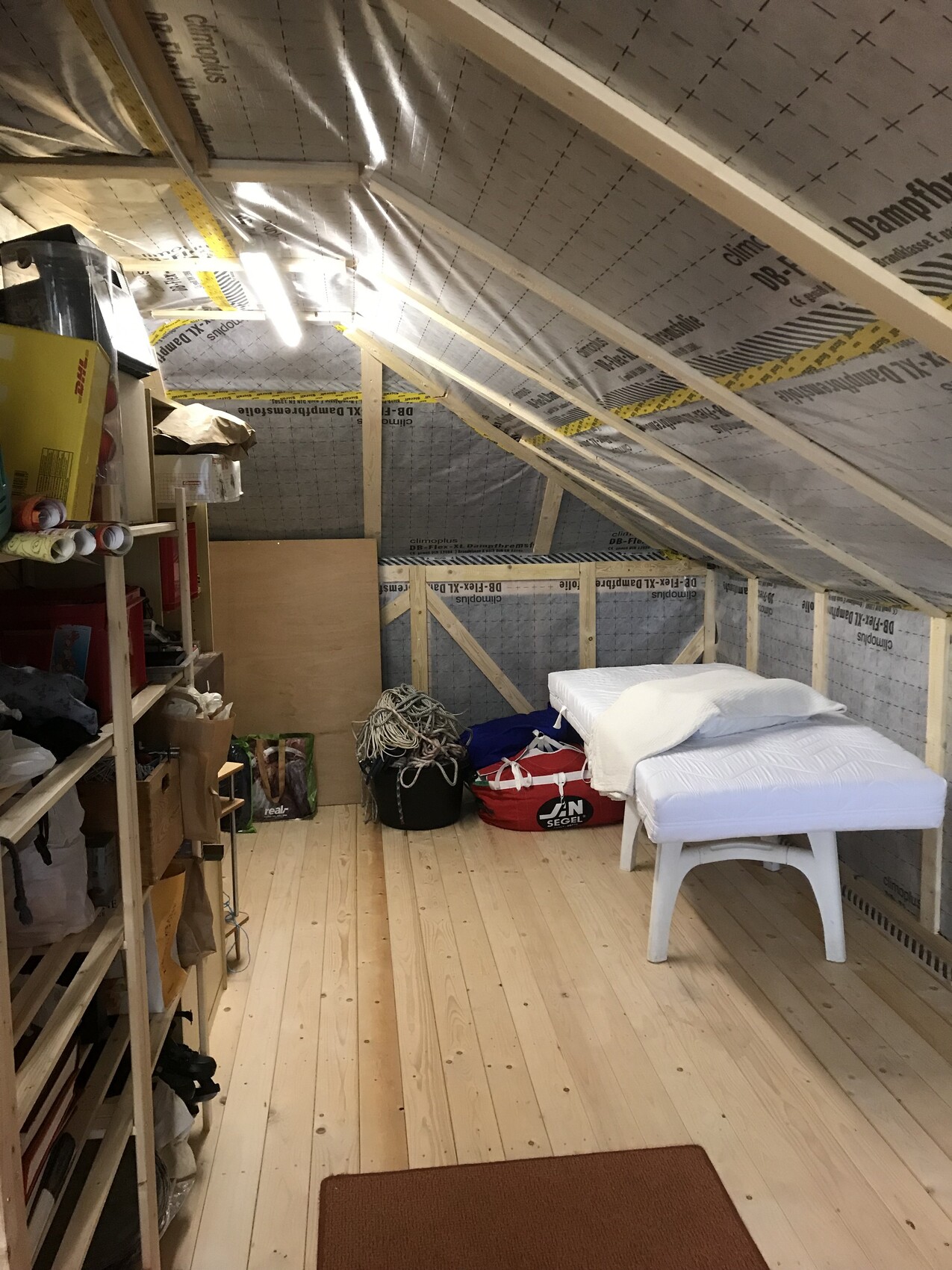
Regarding insulation. Do it. We did it too. As a result, despite temperatures as low as minus xy and an east wind up there, we now have a reasonably comfortable attic compartment where I do my Pilates exercises and some weight training every day. Drinks are kept cool but frost-free there, just like in the cellar used to be. My model train setup handles it well too.

S
Stefan2.848 Feb 2021 14:45Great. That's exactly what I had in mind. I will implement it that way as well. However, I’m still unsure how to handle the brick gable walls that are not plastered. But basically, I will follow your approach for the rest. Do you have a substructure in place now, or is the sheathing directly screwed onto the rafters?
P
pagoni20208 Feb 2021 16:51hauspeter schrieb:
That’s what makes it complicated if I have to cut each board to length. Random staggered joint means I only cut when I hit an obstacle. You can actually buy the boards in almost any size you need.
What are you planning to do up there? Living space or storage? Otherwise, you could just lay OSB panels or even use plain boards without tongue and groove if it’s just for storage.
Is there really supposed to be an underfloor heating system installed later in that space (storage?), or am I misunderstanding?
There’s no need for ventilation behind it either—just install it directly; although I personally prefer using screws.
Underfloor heating is definitely possible with a wooden floor if the space is inhabited, but then you should carefully consider the floor construction. There are straightforward systems designed specifically for wood flooring.
We used rough-sawn boards in the sauna area before; to me, that’s a natural wood floor without any fancy finishes.
S
Stefan2.849 Feb 2021 07:00Nordlys schrieb:
Plastering gable walls? You’re practicing up there, the result isn’t that important.I’m just wondering if I should really plaster that area. Otherwise, there wouldn’t be any air circulation up there. As it is, it’s a bit drafty, and the air can be exchanged. Or am I misunderstanding something?Similar topics