
Q
quattro1234 Sep 2020 07:51Hello everyone,
First of all: yes, I know this topic has been discussed multiple times (all over the internet).
But I am still a bit uncertain and would like to ask more specifically, AND I would be very grateful for any advice.
Situation:
I am having drywall installed in my upper floor and plan to insulate, install a vapor barrier, and cover the attic myself with drywall panels. I don’t know yet what the attic will be used for; maybe it will become some kind of hobby room or similar, but it will definitely never be heated. However, I would like to insulate it so that it’s not completely cold.
The floor structure (or ceiling structure of the floor below) from bottom to top would be:
Drywall panel
Vapor barrier
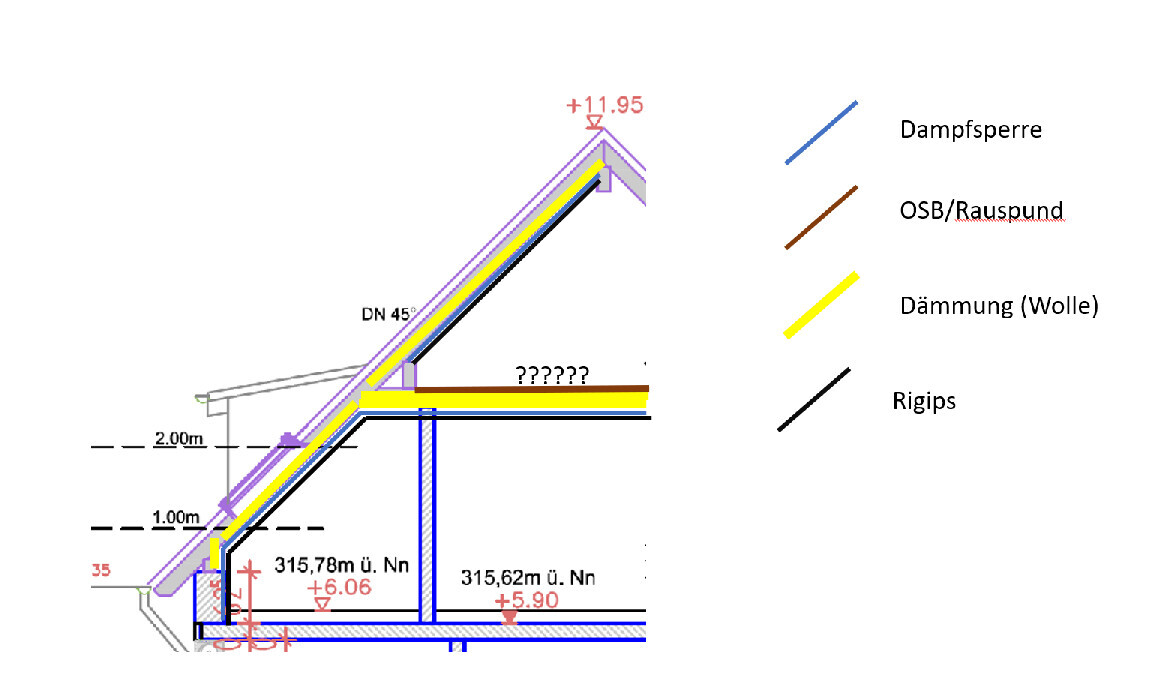
Insulation between collar beams
OSB / tongue and groove boards (?)
I have sketched this out as an example in the attached picture.
Now, here’s my question. As mentioned, I want to insulate the attic soon and install a vapor barrier. I’ve often read that using OSB boards is fine for a warm roof because the diffusion tightness is acceptable due to the temperature. Otherwise, it is better to use tongue and groove boards, as there are often mold problems with OSB in these cases.
In general, because of the word “mold,” I tend to prefer tongue and groove boards. But: when do you call an attic a “cold” roof? When it is completely uninsulated? Or once I insulate it, can I use OSB boards without worry?
What do you think? Should I play it safe and go with tongue and groove boards, or is OSB perfectly fine in my case?
Best regards!
First of all: yes, I know this topic has been discussed multiple times (all over the internet).
But I am still a bit uncertain and would like to ask more specifically, AND I would be very grateful for any advice.
Situation:
I am having drywall installed in my upper floor and plan to insulate, install a vapor barrier, and cover the attic myself with drywall panels. I don’t know yet what the attic will be used for; maybe it will become some kind of hobby room or similar, but it will definitely never be heated. However, I would like to insulate it so that it’s not completely cold.
The floor structure (or ceiling structure of the floor below) from bottom to top would be:
Drywall panel
Vapor barrier
Insulation between collar beams
OSB / tongue and groove boards (?)
I have sketched this out as an example in the attached picture.
Now, here’s my question. As mentioned, I want to insulate the attic soon and install a vapor barrier. I’ve often read that using OSB boards is fine for a warm roof because the diffusion tightness is acceptable due to the temperature. Otherwise, it is better to use tongue and groove boards, as there are often mold problems with OSB in these cases.
In general, because of the word “mold,” I tend to prefer tongue and groove boards. But: when do you call an attic a “cold” roof? When it is completely uninsulated? Or once I insulate it, can I use OSB boards without worry?
What do you think? Should I play it safe and go with tongue and groove boards, or is OSB perfectly fine in my case?
Best regards!
Since the vapor retarder is continuous at the bottom (on the interior side), you can also install OSB. However, in case the vapor retarder (on the interior side) is damaged and moisture enters the insulation, I would recommend using tongue-and-groove boards instead.
I am more concerned about the vapor retarder you plan to install on the rafters. It is not connected to the airtight layer below, which almost guarantees connection issues. I would definitely discuss this detail with a designer or planner.
I am more concerned about the vapor retarder you plan to install on the rafters. It is not connected to the airtight layer below, which almost guarantees connection issues. I would definitely discuss this detail with a designer or planner.
Similar topics