
Hello everyone,
we plan to start building our house within the next 2-3 years.
The location is about 20km (12 miles) west of Innsbruck in Tyrol. The plot is on a gentle slope. The house is planned for 2 adults and 2 children.
I apologize in advance. This is the very first step towards building our house. Of course, we have already researched and have some ideas, but we are not professionals. Our thoughts are still in the early stages and certainly have room for improvement, which is exactly why I’m here: I want to receive both positive and negative feedback as early as possible to design the best possible home for us.
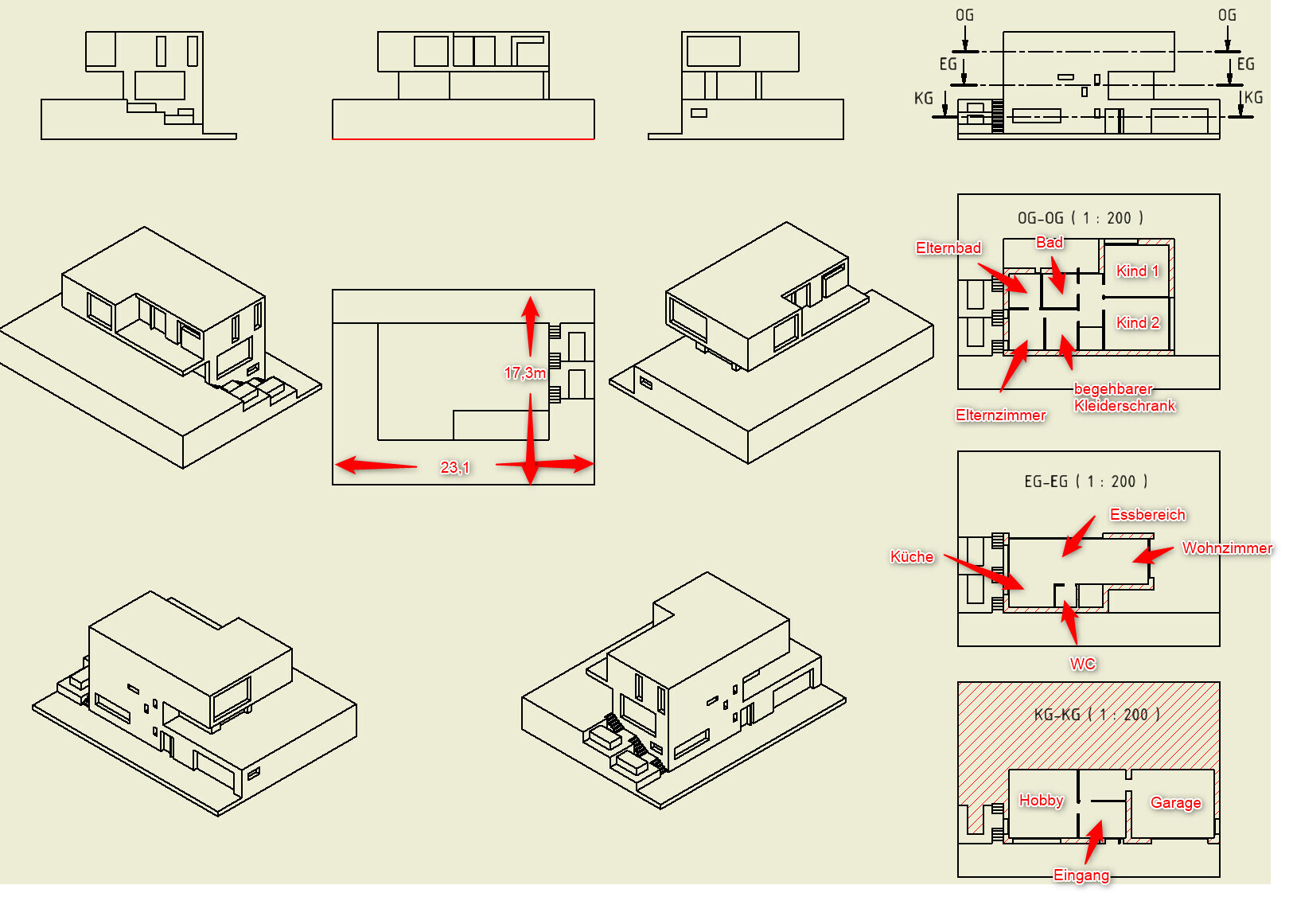
A brief explanation of the attached image: Based on the initial information about the room layout and legal requirements, the sketch below is a first draft of the initial ideas. It was drawn with the limited tools I have available. The street side is north and the garden faces south. Due to the slope, the garage is accessed by car through the basement level, which is at the same height as the street.
The house will mainly be constructed using prefabricated steel segments. The east, south, and west walls of the basement will serve as retaining walls appropriate for the slope. The steel frame should already be in place on the north side. The entire house should be well insulated, although we are still unsure about the exact level or “class” of insulation.
A decentralized ventilation system should be installed in the basement, living/dining area, restroom, bathrooms, and bedrooms. The reason for a decentralized system is the desire to control the temperature in each room individually, as well as to accommodate different daily routines, etc.
The bathrooms will be heated with electric underfloor heating directly beneath the tiles, so the screed does not need to be heated. All other rooms will be heated with infrared heaters.
Regarding flooring: All rooms will have “warm” floor coverings, such as hardwood floors, linoleum, or cork. Naturally, the bathrooms will be tiled, which is why underfloor heating will be installed there.
Shading is planned for the living/dining area and bedrooms.
The entire building will have home automation (heating, shading, lighting, security system, etc.). Before anyone objects: I will try to do as much of this myself as possible. I have experience from my training with home automation and am a certified KNX installer. However, I plan to use Z-Wave as the standard in the house. The idea is to only heat rooms that are in occasional use minimally, for example, the multi-purpose/hobby room. Bathrooms will only be heated in the morning or evening, and only when someone is at home, etc., thereby saving energy.
Because a planned electric car and the heating system will result in significant electricity consumption, a 15kWp photovoltaic system is planned. The energy consumption will also benefit from a lighting concept using 100% LEDs. The current electricity price is about 14 cents/kWh, which is relatively low. For higher energy demands, there are alternative providers offering a higher fixed fee but a lower price per kWh. The plan is to switch providers if needed.
Please be patient with me. I’m not inventing these ideas myself; I have picked them up somewhere and they seemed logical and useful to me. In our region, these topics are quite unusual, so there is little local experience. That’s why I’m turning to the forum.
I hope you will help me develop our ideas.
we plan to start building our house within the next 2-3 years.
The location is about 20km (12 miles) west of Innsbruck in Tyrol. The plot is on a gentle slope. The house is planned for 2 adults and 2 children.
I apologize in advance. This is the very first step towards building our house. Of course, we have already researched and have some ideas, but we are not professionals. Our thoughts are still in the early stages and certainly have room for improvement, which is exactly why I’m here: I want to receive both positive and negative feedback as early as possible to design the best possible home for us.
A brief explanation of the attached image: Based on the initial information about the room layout and legal requirements, the sketch below is a first draft of the initial ideas. It was drawn with the limited tools I have available. The street side is north and the garden faces south. Due to the slope, the garage is accessed by car through the basement level, which is at the same height as the street.
The house will mainly be constructed using prefabricated steel segments. The east, south, and west walls of the basement will serve as retaining walls appropriate for the slope. The steel frame should already be in place on the north side. The entire house should be well insulated, although we are still unsure about the exact level or “class” of insulation.
A decentralized ventilation system should be installed in the basement, living/dining area, restroom, bathrooms, and bedrooms. The reason for a decentralized system is the desire to control the temperature in each room individually, as well as to accommodate different daily routines, etc.
The bathrooms will be heated with electric underfloor heating directly beneath the tiles, so the screed does not need to be heated. All other rooms will be heated with infrared heaters.
Regarding flooring: All rooms will have “warm” floor coverings, such as hardwood floors, linoleum, or cork. Naturally, the bathrooms will be tiled, which is why underfloor heating will be installed there.
Shading is planned for the living/dining area and bedrooms.
The entire building will have home automation (heating, shading, lighting, security system, etc.). Before anyone objects: I will try to do as much of this myself as possible. I have experience from my training with home automation and am a certified KNX installer. However, I plan to use Z-Wave as the standard in the house. The idea is to only heat rooms that are in occasional use minimally, for example, the multi-purpose/hobby room. Bathrooms will only be heated in the morning or evening, and only when someone is at home, etc., thereby saving energy.
Because a planned electric car and the heating system will result in significant electricity consumption, a 15kWp photovoltaic system is planned. The energy consumption will also benefit from a lighting concept using 100% LEDs. The current electricity price is about 14 cents/kWh, which is relatively low. For higher energy demands, there are alternative providers offering a higher fixed fee but a lower price per kWh. The plan is to switch providers if needed.
Please be patient with me. I’m not inventing these ideas myself; I have picked them up somewhere and they seemed logical and useful to me. In our region, these topics are quite unusual, so there is little local experience. That’s why I’m turning to the forum.
I hope you will help me develop our ideas.
D
Deliverer18 Apr 2019 11:14Tobi_83 schrieb:
The electrical energy you put in is not converted into heat energy at a 1:1 ratio.Well, almost.
And that’s the point. An efficiency of 1 (or even worse in the end) is the real issue. Although, of course, electricity prices in AT (thanks to hydropower, I assume) at 15 cents already shift the calculation...
What I can’t really imagine is that it’s comfortable. I’d be sweating on my forehead, but my knees shaking under the table?!
But that’s just a guess. I have only tried it on a small scale...
I always find this type of house quite impressive, even though I personally wouldn’t want to live in such a rather cool-feeling house. Why cool? Too many corners and edges. From my Feng Shui perspective, that just doesn’t work.
But okay, everyone should build however they like.
Cool... cold...
I think you have put a lot of thought into the "How do I want to live?"... "How can I implement what I want for myself and my family?"
However, I believe you started somewhere in the middle, without a clear guiding thread, found alternative possibilities on the internet without researching whether the technologies or design elements actually work together, etc.
I am certainly no expert in technical matters, but combining many systems is more complicated than using one system that works well with another.
This also applies to functionality and the question "What do I want to achieve with it?"
Let’s take a look at these two quotes from you:
How old is the rule to waste as little energy as possible? What does every homeowner want today and what has been regulated by the government? Exactly: energy consumption. So why do you make it so complicated and rely, for example, on an old rule that can no longer be applied with today’s technology? Constantly reheating a cooled-down room uses more energy than maintaining a constant temperature.
A very important element (I don’t know if a mechanical engineer understands this) is solar energy trapped in rooms through windows. You have nice large windows, but because of the overhangs—similar to houses in South Africa—they do not let in direct sunlight. That means no energy comes in, and it gets pitch dark in your living spaces. During the day, you will need quite a bit of artificial lighting.
On the topic of functionality:
I find it hard to believe that you want to have a house of over 200m² (2153 sq ft) and do laundry in the same space where you bathe, relax, and feel comfortable. There is also the issue of storage and sorting of dirty laundry, as well as storing and drying clean laundry. Not everything is suitable for tumble drying and some items must be air-dried. Later, the clothes will be waiting for ironing day (again, where? In the bathroom?). Are you aware of this process?
Garage usage: after that, going into the cold storage room (TK-Raum), then storing outerwear in the narrow and too small hallway? Okay, I also read that the cold storage is supposed to store outerwear, but why not build a) a cold storage room and b) a separate area for coats and related items? Why is the space already being mentally repurposed instead of properly planning? The same applies to the hobby room.
I think it’s important to plan a hobby room. Unfortunately, it’s already "full" with office stuff, so why do you want to use it also as storage? That confuses me. Why not have a separate storage room?
Plan: cold storage with storage options and laundry*, a hallway with storage options, a coat area, and a hobby room, and/or a laundry room with storage possibilities upstairs.
About the floor plan:
That’s really tiny and uncomfortable. Also, the children always have to pass through your living area.
https://www.hausbau-forum.de/threads/grundrissplanung-unbedingt-vor-Beitrag-Erstellung-lesen.11714/
Additional points:
The bedroom lacks a place for the bed. The children's rooms seem disproportionately large.
The open space on the ground floor is a narrow, long corridor. A dark corridor.
The windows facing east and west emphasize the length.
The hobby room is not 15m² (161 sq ft) but 36m² (387 sq ft)???
There is a lack of storage both upstairs and on the ground floor.
The kitchen feels too open to the neighboring room for my taste.
But then a roof terrace would probably not be possible!
Conventional construction (straight, square, good) plus a sloped site with simple technical equipment already costs more...
So I have written far too much here for what is really just a pipe dream.
But okay, everyone should build however they like.
matte1987 schrieb:
I think the house design itself is pretty cool.
Cool... cold...
hampshire schrieb:
In my experience, most homeowners intensely ask themselves the question "Where do I want to live?". The much more important question, however, is: "How do I want to live?". A house is a shell for the life of the people living in it. Habits, desires, attitudes, tasks, social connections, aesthetic sense, body awareness, and health – these aspects should guide the architecture. Building styles are meant to support these aspects. Don’t force your life into a design idea. Instead, design creatively for your life.
I think you have put a lot of thought into the "How do I want to live?"... "How can I implement what I want for myself and my family?"
However, I believe you started somewhere in the middle, without a clear guiding thread, found alternative possibilities on the internet without researching whether the technologies or design elements actually work together, etc.
I am certainly no expert in technical matters, but combining many systems is more complicated than using one system that works well with another.
This also applies to functionality and the question "What do I want to achieve with it?"
Let’s take a look at these two quotes from you:
MuHaha202 schrieb:
The plan is to only minimally heat rooms that are used only occasionally. For example, the multipurpose/hobby room. Bathroom only in the morning or evening. Only when someone is home, etc. And thereby save energy.
MuHaha202 schrieb:
If we calculate with 160m² (1722 sq ft) of heated area, that is 4800 kWh heating energy per year.
Costs for purchase and installation of infrared heating: €8000 (€ equals just the currency, no conversion)
Costs for purchase and installation of air-to-water heat pump: €12,500
Operating costs of air-to-water heat pump per year: €150-200 (experience from a comparable family single-family house)
Regarding the operating costs of the infrared heating panels:
The key word here is "electricity costs".
So, for electricity – Tiwag:
Cost per kWh is 7.376 cents/kWh
However, additional fees from Tinetz bring the final price per kWh to about 14 cents/kWh.
This results in running costs for the infrared heating of about €670
How old is the rule to waste as little energy as possible? What does every homeowner want today and what has been regulated by the government? Exactly: energy consumption. So why do you make it so complicated and rely, for example, on an old rule that can no longer be applied with today’s technology? Constantly reheating a cooled-down room uses more energy than maintaining a constant temperature.
A very important element (I don’t know if a mechanical engineer understands this) is solar energy trapped in rooms through windows. You have nice large windows, but because of the overhangs—similar to houses in South Africa—they do not let in direct sunlight. That means no energy comes in, and it gets pitch dark in your living spaces. During the day, you will need quite a bit of artificial lighting.
On the topic of functionality:
MuHaha202 schrieb:
Laundry will be done in the bathroom.
I find it hard to believe that you want to have a house of over 200m² (2153 sq ft) and do laundry in the same space where you bathe, relax, and feel comfortable. There is also the issue of storage and sorting of dirty laundry, as well as storing and drying clean laundry. Not everything is suitable for tumble drying and some items must be air-dried. Later, the clothes will be waiting for ironing day (again, where? In the bathroom?). Are you aware of this process?
Garage usage: after that, going into the cold storage room (TK-Raum), then storing outerwear in the narrow and too small hallway? Okay, I also read that the cold storage is supposed to store outerwear, but why not build a) a cold storage room and b) a separate area for coats and related items? Why is the space already being mentally repurposed instead of properly planning? The same applies to the hobby room.
I think it’s important to plan a hobby room. Unfortunately, it’s already "full" with office stuff, so why do you want to use it also as storage? That confuses me. Why not have a separate storage room?
MuHaha202 schrieb:Why does it have to run through there??? This could be better planned!!
Some shoes and jackets will be stored in the utility room because the entrance from the garage runs through this room.
Plan: cold storage with storage options and laundry*, a hallway with storage options, a coat area, and a hobby room, and/or a laundry room with storage possibilities upstairs.
About the floor plan:
MuHaha202 schrieb:
The green area is the staircase (sorry, I forgot to mention).
The floor plan measures 2m x 2.135m (6 ft 7 in x 7 ft)
That’s really tiny and uncomfortable. Also, the children always have to pass through your living area.
MuHaha202 schrieb:
I found hardly any useful design guidelines for stairs on the internet. What I found was a description with these dimensions.
Too small?
https://www.hausbau-forum.de/threads/grundrissplanung-unbedingt-vor-Beitrag-Erstellung-lesen.11714/
Additional points:
The bedroom lacks a place for the bed. The children's rooms seem disproportionately large.
The open space on the ground floor is a narrow, long corridor. A dark corridor.
The windows facing east and west emphasize the length.
The hobby room is not 15m² (161 sq ft) but 36m² (387 sq ft)???
There is a lack of storage both upstairs and on the ground floor.
The kitchen feels too open to the neighboring room for my taste.
MuHaha202 schrieb:
There have already been conversations with neighbors. For example, the garage should adjoin the neighbor’s garage.
But then a roof terrace would probably not be possible!
MuHaha202 schrieb:
The budget is currently €320,000 (about $350,000) but up to €380,000 (about $415,000) would be possible. The goal is to need less rather than more.
MuHaha202 schrieb:
As I said, I was aware that it would not be feasible at this price.
Conventional construction (straight, square, good) plus a sloped site with simple technical equipment already costs more...
So I have written far too much here for what is really just a pipe dream.
H
hampshire18 Apr 2019 11:37kaho674 schrieb:
I keep wondering who can supply electricity for 7 cents per kWh. We pay over 20. Is this some kind of special "Germans are crazy" thing? Electricity prices in Germany are among the highest, comparable to those in Denmark. In Austria, you can average less than half of that.
haydee schrieb:
Budget
I think costs in Austria will be similar
2,000 euros per sqm (10.8 sq ft)
+ higher energy standards
+ higher quality features (e.g., rain shower, many floor-to-ceiling windows, tilt-and-slide doors, fireplace, etc.)
+ costs for more complex floor plans (protrusions and recesses, e.g., a bay window costs almost as much as extending the wall and thus the floor area by the same depth)
+ earthworks are much more expensive on a slope
+ landscaping on a slope is significantly costlier than on flat land
+ additional construction-related costs such as site development, temporary power supply, etc. Conclusion: just forget about the 2,000 euros per sqm (10.8 sq ft) figure. That applies to a cost-effective building method and not to special properties as you want them. The detailed solutions
The detail of the far overhanging upper floor is very complex to construct if you want to avoid support columns. With support columns, the design loses much of its charm. Such a solution quickly adds a six-figure premium.
What I don’t like is the "function follows form" approach. Many aspects inside are impractical. The rooms seem forced to fit into the exterior shape. Great design is "form follows function."

ypg schrieb:
In this respect, I wrote way too much here for a pipe dream This thought kept running through my mind the whole time while reading...Similar topics