
Hello fellow home builders,
We are currently planning our house. We already have a plot with a development plan. However, this restricts the possible knee wall height depending on the roof pitch as follows:
25° roof pitch - knee wall height = 0.80 m (2 ft 7 in)
30° roof pitch - knee wall height = 0.82 m (2 ft 8 in)
35° roof pitch - knee wall height = 0.85 m (2 ft 9 in)
Only a gable roof is permitted. The plot is on a slope, with the basement at garden level and the ground floor at street level. This means we intend to use the basement rooms as living spaces with natural daylight.
Originally, we planned for a basement plus one and a half floors. However, these restrictions make us consider whether it would be better to increase the ground floor area instead of having an attic floor, which we would omit entirely. Because the low knee wall height in the attic would lead to a significant loss of usable space. Does that make sense?
The ground floor area is limited to 120 m² (1,292 sq ft) according to the development plan. The plot size is 536 m² (5,770 sq ft).
So far, we have planned a single-family home with a living area of 155 m² (1,668 sq ft) and 44 m² (474 sq ft) of additional space (basement plus 1.5 floors). Is it possible to fit this into just the basement and ground floor?
Of course, it would also be very helpful if you could share your thoughts on the cost aspect. Which of the two options would be more expensive?
Best regards,
readmi
We are currently planning our house. We already have a plot with a development plan. However, this restricts the possible knee wall height depending on the roof pitch as follows:
25° roof pitch - knee wall height = 0.80 m (2 ft 7 in)
30° roof pitch - knee wall height = 0.82 m (2 ft 8 in)
35° roof pitch - knee wall height = 0.85 m (2 ft 9 in)
Only a gable roof is permitted. The plot is on a slope, with the basement at garden level and the ground floor at street level. This means we intend to use the basement rooms as living spaces with natural daylight.
Originally, we planned for a basement plus one and a half floors. However, these restrictions make us consider whether it would be better to increase the ground floor area instead of having an attic floor, which we would omit entirely. Because the low knee wall height in the attic would lead to a significant loss of usable space. Does that make sense?
The ground floor area is limited to 120 m² (1,292 sq ft) according to the development plan. The plot size is 536 m² (5,770 sq ft).
So far, we have planned a single-family home with a living area of 155 m² (1,668 sq ft) and 44 m² (474 sq ft) of additional space (basement plus 1.5 floors). Is it possible to fit this into just the basement and ground floor?
Of course, it would also be very helpful if you could share your thoughts on the cost aspect. Which of the two options would be more expensive?
Best regards,
readmi
G
garfunkel28 Sep 2016 21:57Is it possible to install dormer windows in the attic? They can significantly increase the usable space. If they are incorporated during the initial roof construction, the additional costs are not too high.
It is also worth considering whether you might want to use this option later and build as Aotearoa suggested—that is, keeping a flexible reserve for potential future expansion.
It is also worth considering whether you might want to use this option later and build as Aotearoa suggested—that is, keeping a flexible reserve for potential future expansion.
@Aotearoa
Yes, that's how we envisioned it with the new version. Because there is definitely a cost difference whether we have a knee wall at 80cm (31 inches) or at 0 for an attic. But then we need more living space downstairs in the form of a larger footprint.
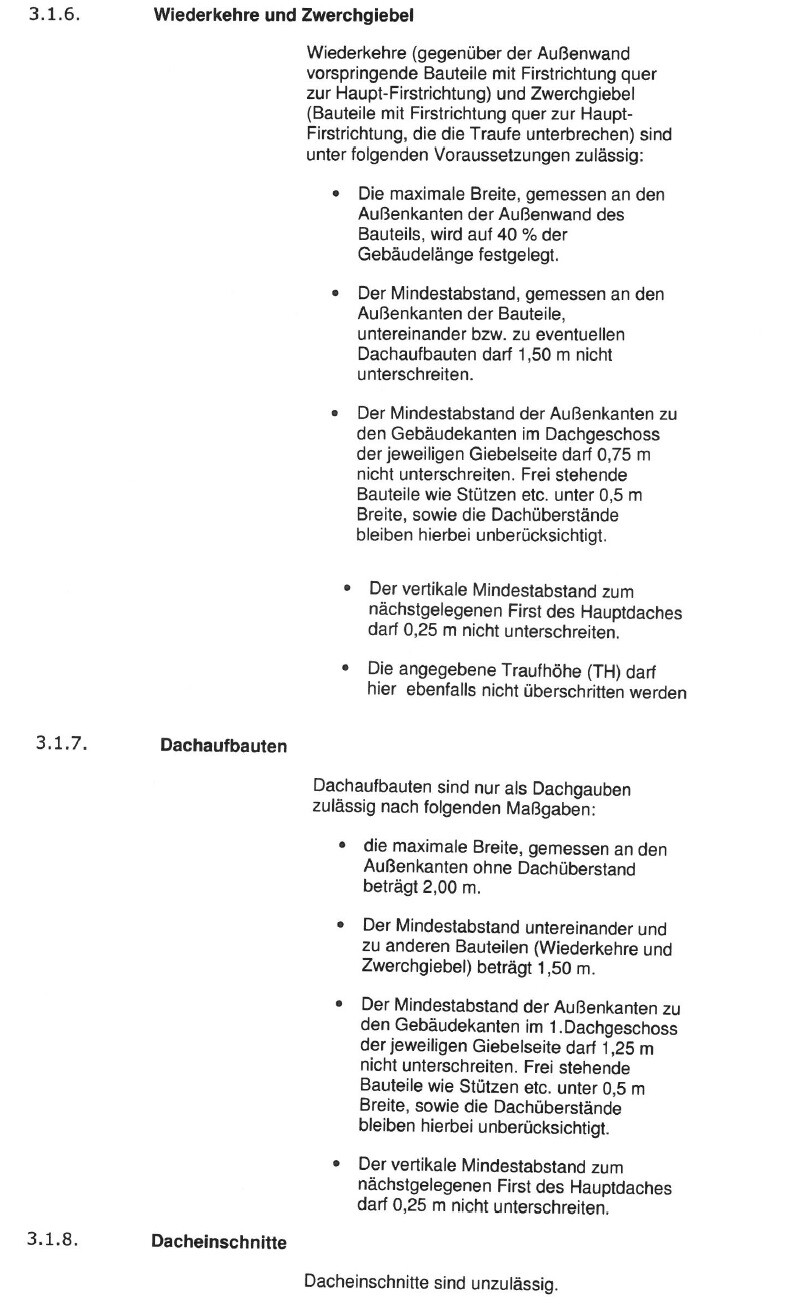
@garfunkel Yes, dormers are allowed. We have already considered that. I've attached an excerpt from the development plan. It’s not that straightforward...
Yes, that's how we envisioned it with the new version. Because there is definitely a cost difference whether we have a knee wall at 80cm (31 inches) or at 0 for an attic. But then we need more living space downstairs in the form of a larger footprint.
@garfunkel Yes, dormers are allowed. We have already considered that. I've attached an excerpt from the development plan. It’s not that straightforward...
It’s worth calculating exactly what is more expensive now. However, a house is naturally an investment that stays with you well into old age. Therefore, you should carefully consider whether the plot of land really needs to be larger. I observed this with my former neighbors, who had about 3000m² (0.74 acres) of land and had to constantly pay a gardener during the summer.
Best regards, Mayer
Best regards, Mayer
Similar topics