
ᐅ Here is the final floor plan — 189 sqm without a basement; urban villa
Created on: 19 Aug 2016 21:10
G
Grym
The local authority has provided some further clarifications on the development plan, and now we have come to the conclusion that a basement is not necessary. In our opinion, the house is also planned to be large enough and offers sufficient usable space (utility room, home office, walk-in closet), so a basement or attic conversion is not required. Of course, there will be a retractable attic ladder and tongue-and-groove boarding (or OSB panels) upstairs.
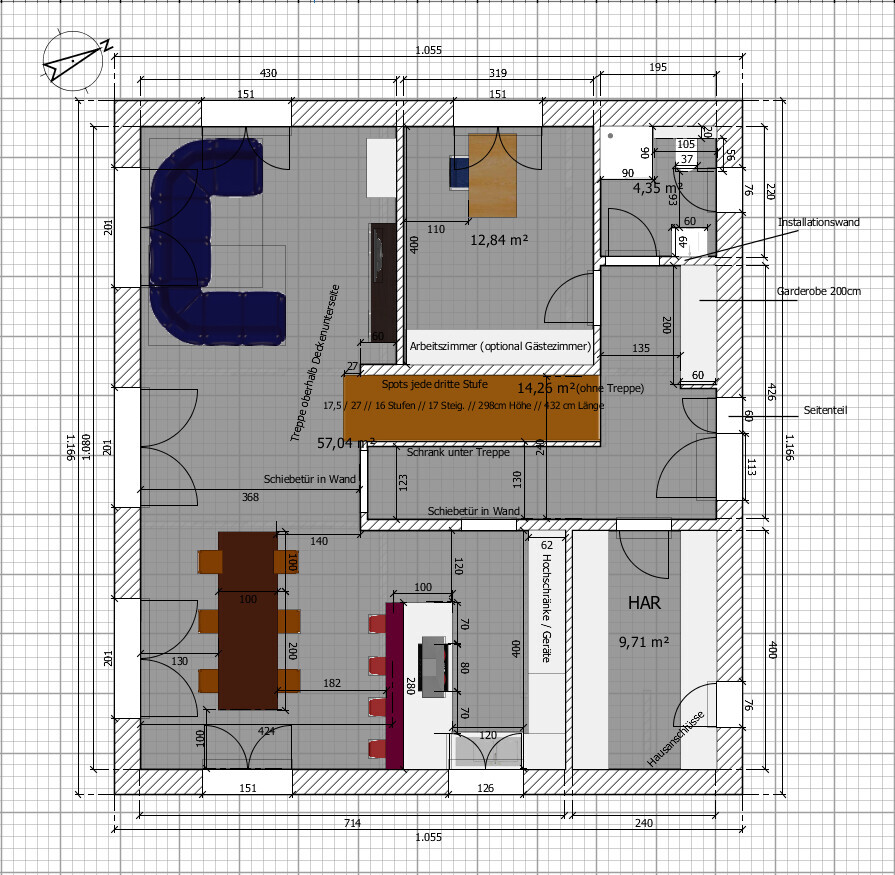
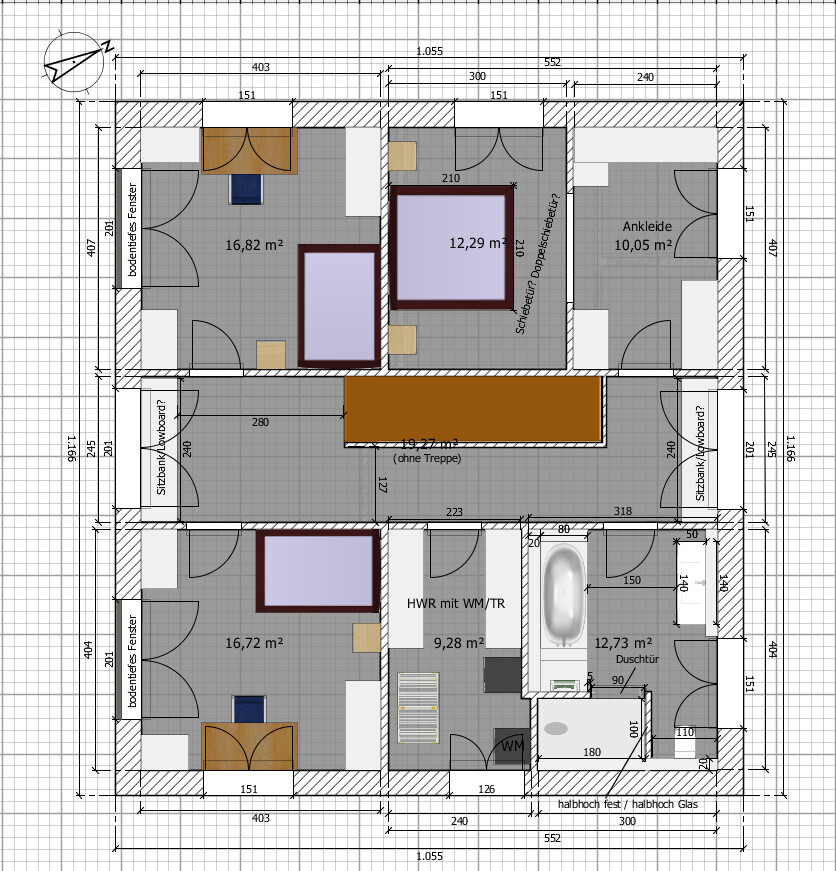
Floor plans:
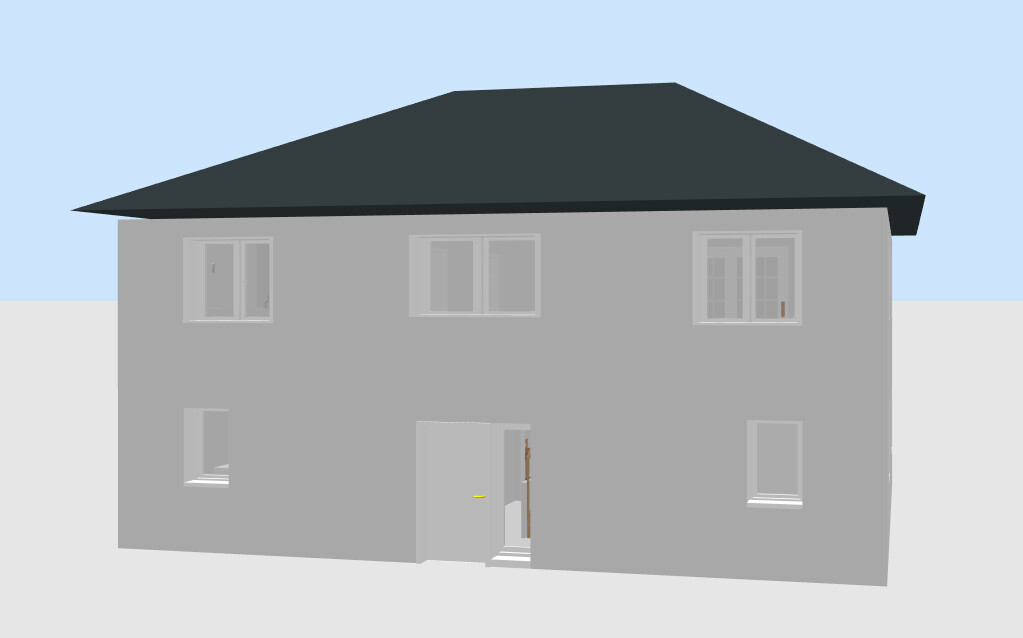
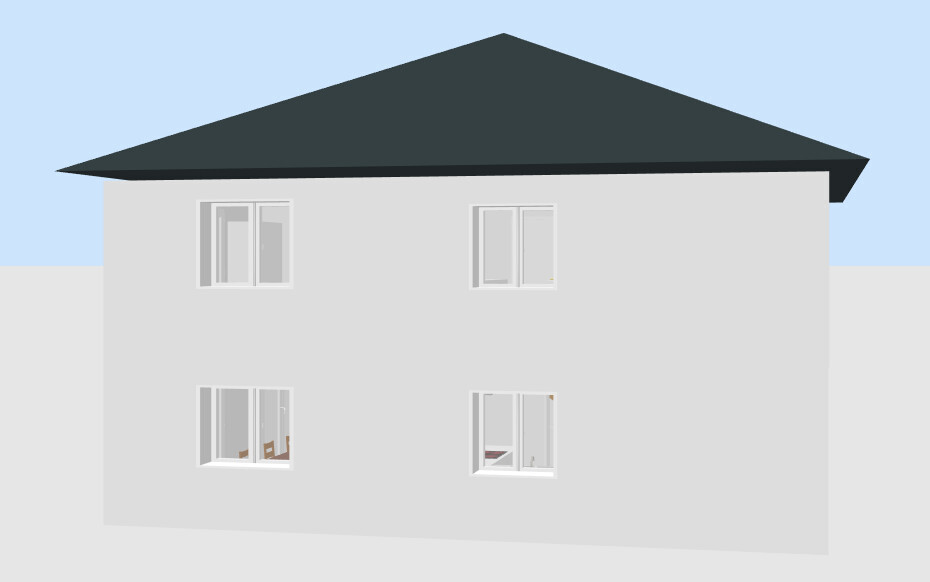
Elevations (greatly simplified):
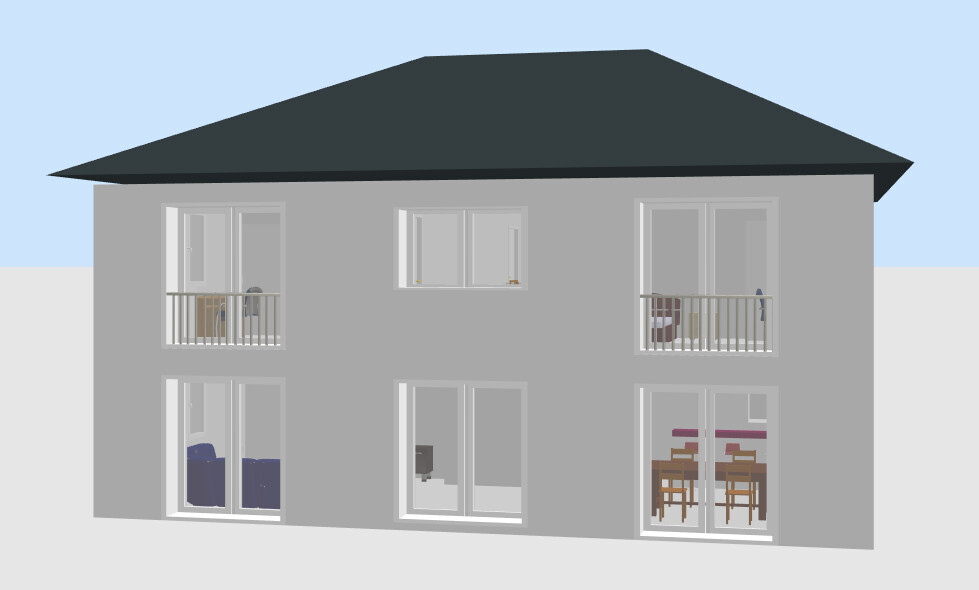
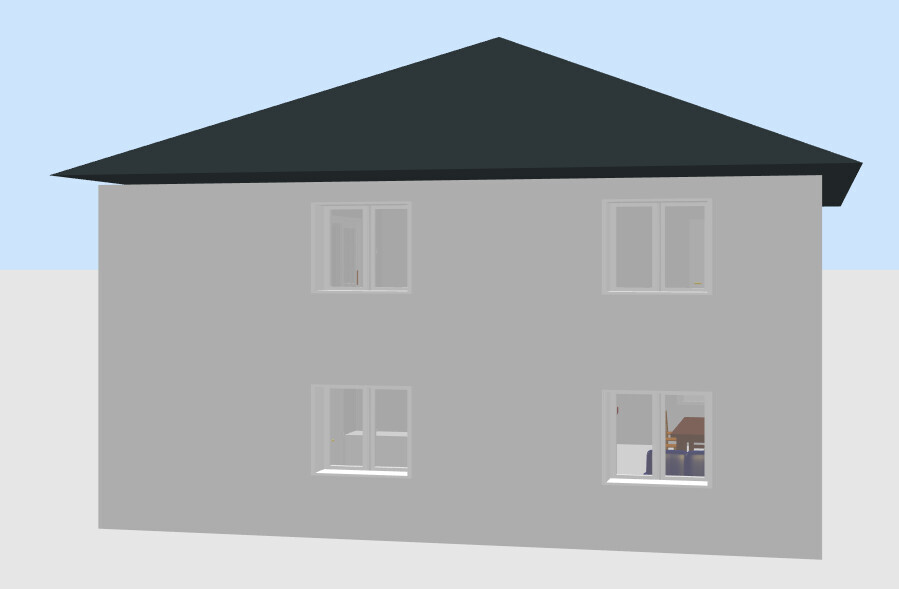
Plot:
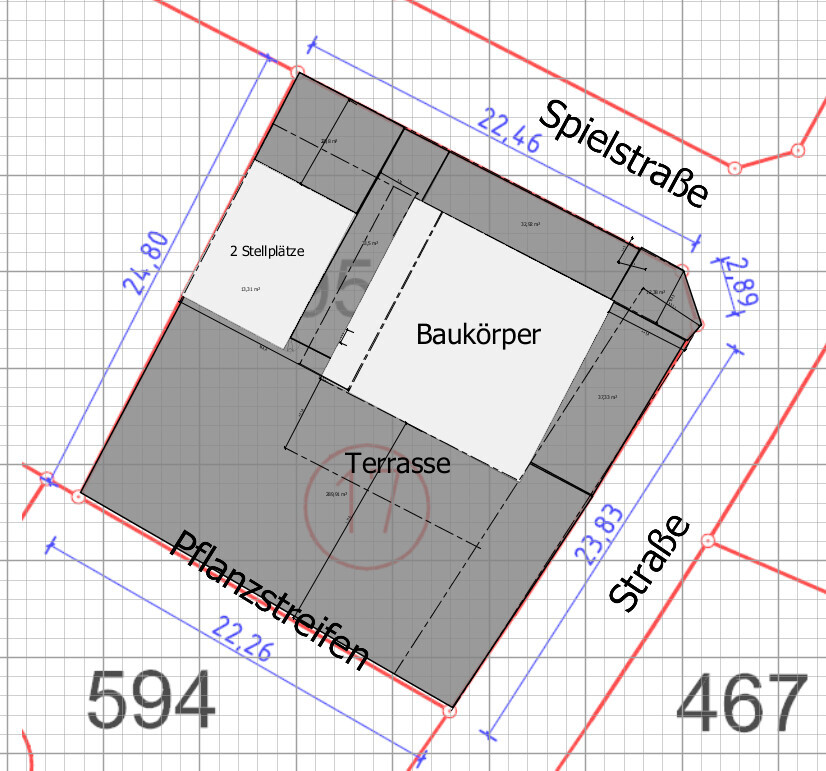
Please imagine the windows in basalt grey (RAL 7012). There will be a base render, but we have not yet decided on one or multiple facade colors.
The design of the entrance to the living room is also not final yet. It could be a regular door, just a simple frame without a door, or a sliding door. The door in the hallway is almost always open for us, so...
The plot is just under 600 square meters (about 6450 square feet) and according to the floor area ratio 1 (FAR-1) we may build approximately 210 square meters (about 2260 square feet), and for floor area ratio 2 (FAR-2) about 270 square meters (about 2900 square feet). Two parking spaces must be provided, but there is only one car. The roof is a hip roof as required by the development plan, with a certain minimum ridge length.
There are three of us, eventually definitely four – so two children’s rooms. We wanted the home office/PC room on the ground floor. There will be a utility room upstairs (ironing is done rarely; the utility room is mainly for washing, drying, and storage). The home office on the ground floor can also serve as a guest room (just move the table, unfold the sofa, or put down an air mattress).
In the living room, the sofa could also be rotated 180 degrees with the TV placed between the two windows – there is about 2 meters (6.5 feet) of space there. We will provide the necessary cables and electrical outlets in both locations.
The kitchen bar is partly a visual room divider. The sink in front of the window is a big wish of my wife. It is clear that the window might only be tilt-operated. We will pay attention to the window sill height to keep it visually harmonious. A controlled mechanical ventilation system is planned (KfW55 standard), so the windows don’t necessarily have to be operable (certainly not all of them). Since it is apparently possible, there will likely be a ducted range hood rather than a recirculating one. The air will be exhausted through the upper floor structure.
We would like to build the exterior walls using 42.5 cm (about 17 inches) aerated concrete blocks and the interior masonry with calcium silicate blocks. Of course, there will be a massive intermediate slab made of reinforced concrete – so sound insulation should be sufficient. Mainly for internal soundproofing, while noise protection to the outside is less critical.
The table shown in the plans represents a possible extended state, about 2 meters (6.5 feet) long for 4 people (a generous 1 meter (3 feet) per person). The extended table can definitely accommodate 8-10 people and can be further lengthened.
The cloakroom is planned at about 2 meters (6.5 feet) wide, with additional space under the stairs. This staircase is NOT visible from the living room, as the height is already above the bottom edge of the raw ceiling. We plan a slightly raised ground floor (about 2.67 meters (8 feet 9 inches) clear height from finished floor to ceiling). The staircase will have a rise (riser) of about 17.5 to 18.0 cm (6.9 to 7.1 inches) and a tread depth of 27 cm (10.6 inches). We have been told that such a slope is quite shallow for a single-family house. Sure, with single-family homes, stairs are often steeper – but usually more out of necessity?
In the utility room for building services we will likely install the indoor unit of the air-to-water heat pump (combined directly with an integrated hygienic hot water tank), the controlled mechanical ventilation system, and the usual equipment (water filter, pressure reducer, fuse box, electricity meter, etc.). The rest will be storage space, perhaps even for garden tools initially, as there is probably space and it is right next to the front door.
We have now furnished the children’s rooms with a 160 cm (63 inches) desk plus chair and a 210 x 140 cm (83 x 55 inches) bed plus bedside table and storage/wardrobe options. I think/hope that fits well.
For the upstairs stair railing, I could imagine a closed solution – what is that usually? Drywall? So a white, half-height wall with a handrail on top.
The bathroom might need another screenshot for better understanding:

The bathtub will be partly built-in on the front, back and side with drywall and tiles as shelf space. The shower will have a large shower tray (180 x 100 cm (71 x 39 inches); we were thinking of something like Kaldewei Conoflat) with a rain shower head from Hansgrohe, while there will still be a shower enclosure. On the wall next to the toilet, the shower will be separated at the bottom by a half-height wall and therefore not visible from the shower. Above that, the partition will continue with glass. For the washbasin, we will probably go for something like Pelipal Cassca, which we simply prefer to ceramic. Also a mirror, but no mirrored cabinet. There would have been a small gap between shower and bathtub, but not much. So we decided to close it off and place the towel radiator above it (so it will be close to both bathtub and shower). Behind the shower and toilet there will be a pre-wall installation (half-height or full-height – still to decide), with the washing machine connection there (mainly for wastewater).
Between the walk-in closet and bedroom, probably a kind of double sliding door recessed into the wall. Below the window, which is not yet shown, there would be space for a dressing table, for example. The walk-in closet is not very large (just over 5 meters (16.5 feet) of wardrobe space shown, each about 60 cm (24 inches) deep), but things that are currently stored in the bedroom like bed linen, towels, or miscellaneous will be moved to the utility room, so daily clothes will have space there, and basically nothing else.
Oh yes, a chimney could be installed in the lower left corner of the home office and then continue in the lower left corner of the bedroom. Then we could install a fireplace under the stairs. It would probably fit, and sure, we would take it if it were free. But we don’t know if it’s worth it (4,000 EUR for the chimney, 6,000 EUR for the fireplace, plus further effort possibly due to the mechanical ventilation and range hood). Maybe initially just install the chimney to be safe, although I’ve read that even this can be retrofitted within 1-2 days after the house is finished. The space just has to be available.
Uh, yes, suggestions for improvement are welcome. The living area is about 189 square meters (about 2035 square feet). The ideas are not completely out of thin air either. There is something similar in the Rensch-Haus brochure “Innovation R” under R2.
Floor plans:
Elevations (greatly simplified):
Plot:
Please imagine the windows in basalt grey (RAL 7012). There will be a base render, but we have not yet decided on one or multiple facade colors.
The design of the entrance to the living room is also not final yet. It could be a regular door, just a simple frame without a door, or a sliding door. The door in the hallway is almost always open for us, so...
The plot is just under 600 square meters (about 6450 square feet) and according to the floor area ratio 1 (FAR-1) we may build approximately 210 square meters (about 2260 square feet), and for floor area ratio 2 (FAR-2) about 270 square meters (about 2900 square feet). Two parking spaces must be provided, but there is only one car. The roof is a hip roof as required by the development plan, with a certain minimum ridge length.
There are three of us, eventually definitely four – so two children’s rooms. We wanted the home office/PC room on the ground floor. There will be a utility room upstairs (ironing is done rarely; the utility room is mainly for washing, drying, and storage). The home office on the ground floor can also serve as a guest room (just move the table, unfold the sofa, or put down an air mattress).
In the living room, the sofa could also be rotated 180 degrees with the TV placed between the two windows – there is about 2 meters (6.5 feet) of space there. We will provide the necessary cables and electrical outlets in both locations.
The kitchen bar is partly a visual room divider. The sink in front of the window is a big wish of my wife. It is clear that the window might only be tilt-operated. We will pay attention to the window sill height to keep it visually harmonious. A controlled mechanical ventilation system is planned (KfW55 standard), so the windows don’t necessarily have to be operable (certainly not all of them). Since it is apparently possible, there will likely be a ducted range hood rather than a recirculating one. The air will be exhausted through the upper floor structure.
We would like to build the exterior walls using 42.5 cm (about 17 inches) aerated concrete blocks and the interior masonry with calcium silicate blocks. Of course, there will be a massive intermediate slab made of reinforced concrete – so sound insulation should be sufficient. Mainly for internal soundproofing, while noise protection to the outside is less critical.
The table shown in the plans represents a possible extended state, about 2 meters (6.5 feet) long for 4 people (a generous 1 meter (3 feet) per person). The extended table can definitely accommodate 8-10 people and can be further lengthened.
The cloakroom is planned at about 2 meters (6.5 feet) wide, with additional space under the stairs. This staircase is NOT visible from the living room, as the height is already above the bottom edge of the raw ceiling. We plan a slightly raised ground floor (about 2.67 meters (8 feet 9 inches) clear height from finished floor to ceiling). The staircase will have a rise (riser) of about 17.5 to 18.0 cm (6.9 to 7.1 inches) and a tread depth of 27 cm (10.6 inches). We have been told that such a slope is quite shallow for a single-family house. Sure, with single-family homes, stairs are often steeper – but usually more out of necessity?
In the utility room for building services we will likely install the indoor unit of the air-to-water heat pump (combined directly with an integrated hygienic hot water tank), the controlled mechanical ventilation system, and the usual equipment (water filter, pressure reducer, fuse box, electricity meter, etc.). The rest will be storage space, perhaps even for garden tools initially, as there is probably space and it is right next to the front door.
We have now furnished the children’s rooms with a 160 cm (63 inches) desk plus chair and a 210 x 140 cm (83 x 55 inches) bed plus bedside table and storage/wardrobe options. I think/hope that fits well.
For the upstairs stair railing, I could imagine a closed solution – what is that usually? Drywall? So a white, half-height wall with a handrail on top.
The bathroom might need another screenshot for better understanding:
The bathtub will be partly built-in on the front, back and side with drywall and tiles as shelf space. The shower will have a large shower tray (180 x 100 cm (71 x 39 inches); we were thinking of something like Kaldewei Conoflat) with a rain shower head from Hansgrohe, while there will still be a shower enclosure. On the wall next to the toilet, the shower will be separated at the bottom by a half-height wall and therefore not visible from the shower. Above that, the partition will continue with glass. For the washbasin, we will probably go for something like Pelipal Cassca, which we simply prefer to ceramic. Also a mirror, but no mirrored cabinet. There would have been a small gap between shower and bathtub, but not much. So we decided to close it off and place the towel radiator above it (so it will be close to both bathtub and shower). Behind the shower and toilet there will be a pre-wall installation (half-height or full-height – still to decide), with the washing machine connection there (mainly for wastewater).
Between the walk-in closet and bedroom, probably a kind of double sliding door recessed into the wall. Below the window, which is not yet shown, there would be space for a dressing table, for example. The walk-in closet is not very large (just over 5 meters (16.5 feet) of wardrobe space shown, each about 60 cm (24 inches) deep), but things that are currently stored in the bedroom like bed linen, towels, or miscellaneous will be moved to the utility room, so daily clothes will have space there, and basically nothing else.
Oh yes, a chimney could be installed in the lower left corner of the home office and then continue in the lower left corner of the bedroom. Then we could install a fireplace under the stairs. It would probably fit, and sure, we would take it if it were free. But we don’t know if it’s worth it (4,000 EUR for the chimney, 6,000 EUR for the fireplace, plus further effort possibly due to the mechanical ventilation and range hood). Maybe initially just install the chimney to be safe, although I’ve read that even this can be retrofitted within 1-2 days after the house is finished. The space just has to be available.
Uh, yes, suggestions for improvement are welcome. The living area is about 189 square meters (about 2035 square feet). The ideas are not completely out of thin air either. There is something similar in the Rensch-Haus brochure “Innovation R” under R2.
If you want to create a sense of spaciousness, you can skip the sliding door to the walk-in closet. It tends to cause disturbances, even if one person gets up early while the other still wants to sleep.
But, as with many things, it ultimately comes down to personal preference. It’s just something to consider.
However, I would always recommend having shower doors open inward. I notice this repeatedly when staying in hotels (on business trips) or at friends’ houses. The wet floor outside the shower after showering always seems inconvenient.
But, as with many things, it ultimately comes down to personal preference. It’s just something to consider.
However, I would always recommend having shower doors open inward. I notice this repeatedly when staying in hotels (on business trips) or at friends’ houses. The wet floor outside the shower after showering always seems inconvenient.
kbt09 schrieb:
...
And actually, you should compare it with your first floor plan. I did some research. This should have been the first one.
But I find the experiments in the meantime much more "interesting."
Oh, and the requirements: urban villa, square shape, about 130m² (1400 sq ft) of living space.
Due to a related discussion (parallel thread), I took a look at the Danwood 181W: a townhouse-style villa where I find both the exterior designs and the room layouts more interesting. Personally, I find the 169W quite charming – with a few small adjustments, it becomes optimal.
What I want to say is: beyond a certain size, there are hardly any design points left that require intricate thought.
Online, you can find plenty of townhouse-style villas around 180 square meters (1,940 square feet) that will meet all your requirements.
What I want to say is: beyond a certain size, there are hardly any design points left that require intricate thought.
Online, you can find plenty of townhouse-style villas around 180 square meters (1,940 square feet) that will meet all your requirements.
kbt09 schrieb:
Your wife should consider whether it might be more practical to have the work surface in front of the window so you can look outside while working. You don’t spend that much time right at the sink anyway. When working, you look into the room (the workspace NEXT to the cooking area). When washing up, which often happens the next morning or after work on the following day when, for example, our child is still at daycare or with grandma, you look outside. Of course, we still need to think more about the kitchen layout, maybe try out the ALNO kitchen planner and share it here.
Bathroom upper floor... I like it with the shower; however, I would hinge the shower door on the left side and have it open inward. That way, you avoid drips in front of the shower. That’s a good tip; we’ll probably do it that way—but with a swing door. Based on my research, it shouldn’t open only inward because if someone gets unconscious in the shower, it would be impossible to help them.
In the bedroom, I wouldn’t like the solution with the large access opening in the middle. I would position the dressing room window at the top of the plan or at least place the door to the bedroom right away in the bottom corner of the plan. At the top of the plan, it might be better to have a mirror integrated into the closet, which then provides side lighting when standing in front of the mirror. You can also step half a meter away from the mirror to check your appearance. I know that placing the door at the bottom of the plan creates more storage space, but on one hand, that’s somewhat sufficient since many items currently stored in the bedroom closets will be distributed to other rooms (bedding, towels, decorative items, seasonal clothing for storing by season...). On the other hand, I like the spatial effect of the open double door.
Sebastian79 schrieb:
In three months, there will be a basement again Well, even then, the floor plan would be pretty similar if I compare it to our current basement layout. The difficult part was deciding which rooms are needed, where they should be, and their sizes (living room - southwest; dining area - southeast; kitchen around the corner; guest toilet with shower; study on the ground floor // 2 children's rooms both facing south; bathroom; bedroom; sufficient closet space in the bedroom). In the larger house without a basement, there is still a utility room on the ground floor and a laundry room on the upper floor. In the smaller house, these two rooms are located in the basement. The rest, in terms of orientation and size, remains fairly similar. No rooms are added or removed.
Bamue89 schrieb:
What I personally don’t like is the hallway situation. But that’s probably because I’m not really the type for this kind of town villa with these narrow corridors. What exactly do you mean by “narrow corridors”?
Also, I hope the living/dining area doesn’t feel too corridor-like in the final version. That could really be unpleasant. What ceiling heights are planned? The living area is definitely planned so that you don’t see the entire kitchen directly from the living room. The structure will have 11.5 and 11.0 courses of bricks at 25cm (10 inches) each in the shell. The finished clear heights will probably be roughly 2.70 and 2.57 meters (8 ft 10 in and 8 ft 5 in), approximately.
kbt09 schrieb:
If you want to create a sense of spaciousness, you can save yourself the sliding door to the dressing room. It actually causes disturbance when, for example, one person gets up first and the other still wants to sleep. For example, the double sliding door is open at night = larger space; pathway for the kids at night is not blocked; etc. If one gets up and the other stays asleep, just close the double sliding door and that’s fine. When both are awake, it can stay open during the day.
ypg schrieb:
Due to a related thread, I took a closer look at the Danwood 181W: a city villa where I find both the exterior views and the room layouts much more interesting. Personally, I find the 169W quite charming – with a few small adjustments, it becomes near perfect.
What I want to say is: beyond a certain size, there are hardly any critical junctions left that require much clever tweaking.
On the internet, you’ll find plenty of city villas around 180sqm (about 1,940 sqft) that will meet all your requirements. The living room and sight lines in the 181W are not bad. The dining area seems small to me. It is about 3.45m (11.3 ft) from the window to the kitchen. For a 100cm (39 inch) table, a clearance of at least 3.40m (11.2 ft) is recommended. It’s borderline but still acceptable. Lengthwise, space is limited to 3.52m (11.5 ft), so you couldn’t even set up a long banquet table for guests. A table about 2.00 to 2.50m (6.6 to 8.2 ft) long fits without blocking an end, allowing a maximum of nine seats. The kitchen is significantly smaller than in our plan. Especially, you can’t have an island facing the dining area (which would need a depth of 100-120cm (39-47 inches)) but only a simple counter about 60cm (24 inches) deep. Also, there’s no option for a visual separation like a breakfast bar toward the dining area.
The cloakroom at 160cm (63 inches) is okay. In the bathroom, 1.80 x 1.80m (5.9 x 5.9 ft) might still allow for a shower, sure. The 6.5sqm (70 sq ft) technical room is small. Considering there is no utility room, it’s very small. The study is good and offers 3.60m (11.8 ft) of closet space. Over 13sqm (140 sq ft), the grand hallway up to the stairs has some appeal (though here it remains completely unused); unfortunately, the staircase is an uncomfortable fully curved design (neither a straight staircase nor a half-landing staircase with straight steps). About 5sqm (54 sq ft) behind the stairs is wasted space. With a passage width of 1.75m (5.7 ft), you could still place a closet there and have 1.15m (3.8 ft) remaining.
Regarding the upper floor: the children’s bedrooms are not facing the garden or south. The parents’ walk-in closet is only accessible from the general hallway and rather small. At 1.93m (6.3 ft) wide, it’s only suitable for single-sided wardrobes. The bathroom isn’t large, but there is a third room. The children’s bedrooms are relatively small, with minimal closet space.
Similar topics