
ᐅ Not another city villa... 1,600 sq ft box house on a 4,500 sq ft suburban lot
Created on: 30 Dec 2025 19:18
N
NiWi_NRW
Hello everyone,
A brief introduction about me/us: My husband, 36, a landscaping gardener—hereafter referred to as the homeowner—and I, 33, an administrative specialist (city planning and building regulations office *oops* but my area is administrative law, and I disclaim all-knowing expertise upfront) want to replace our 90sqm (970 sq ft) miner’s cottage built in 1918 with a Flair 152 RE model, hopefully built in 2026. Financing is already secured, so there is no separate thread about that; we will own the plot soon (notary appointment 01/2026). We received several strong recommendations for the local Town & Country franchisee from multiple parties and have therefore decided to go with them. We have allowed generous buffers for upgrades, and I now know the construction specifications and contract draft by heart—we know what to expect.
Our current living situation is characterized by “where should I put this” and “Honey, bring all your shoes upstairs”—in short: no storage space, no entrance area, a quirky floor plan with walk-through rooms, and three very small floors on a typical narrow miner’s lot.
The townhouse design itself is, to be honest, not our personal favorite architectural style purely from an aesthetic perspective. Even though we are financially comfortable, the bank was a bit nervous about “architect and separate contracts,” and honestly, so were we. Therefore, we are opting for a catalog house and have come to terms with the fact that we are riding the current “everyone has one” wave—we are taking it with a sense of humor, and with a fixed price guarantee in mind, it works pretty well. Our house won’t be a stunning example of Bauhaus style nor will it become famous for groundbreaking design. It isn’t that, nor do we want it to be. At least we have committed to avoiding “white facade with gray windows”—that will have to suffice here 😀
Enough rambling, now on to the important part.
Zoning Plan/Restrictions
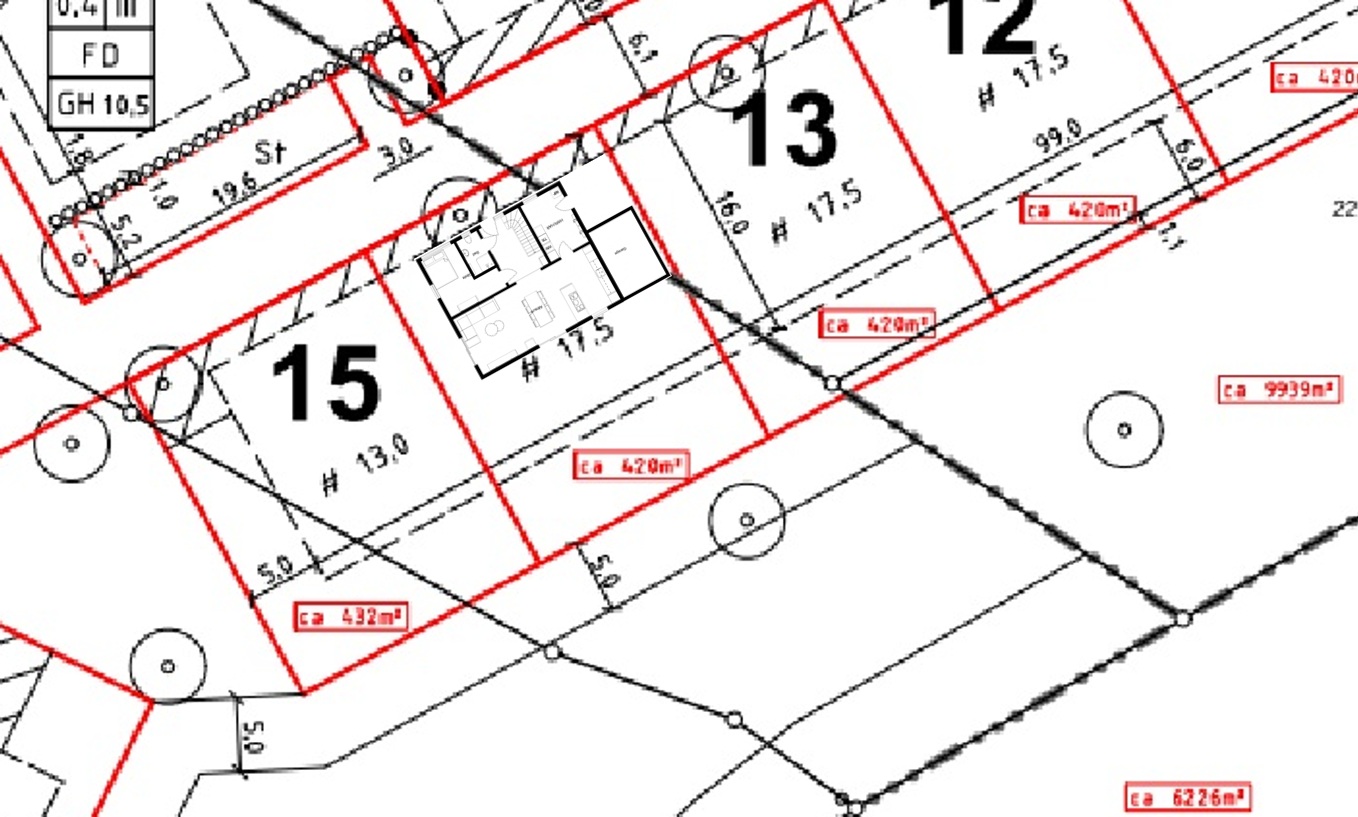
The zoning plan including textual specifications can be found under City of Marl – ZP 175e South – Living at Freer Bruch. The plan for our new development area includes quite a few restrictions, which we are aware of, but we like it very much since it leads to a neighborhood where we can well imagine living. The area is not yet developed, and currently, we are basically buying 420sqm (5,070 sq ft) of dirt—there’s nothing else there yet. Building approval will be granted no earlier than the end of July!
![Lageplan_nord.jpg"]94623[/ATTACH]<br />
<br />
Site plan oriented north</b><br />
<br />
Plot size: 420sqm (5,070 sq ft) – <b>No. 14 on preliminary subdivision plan</b> <br />
Slope: no <br />
Floor area ratio: 0.3 <br />
Floor space index: - <br />
Building envelope, building line, and boundary: see plan; building envelope 16 x 17.5m (52.5 x 57.5 ft) <br />
Adjacent development: garage <br />
Number of parking spaces: Zoning plan minimum 1.5; planned garage + 2 parking spaces (garage for 2 vintage motorcycles, parking spaces for 2 private cars) <br />
Number of floors: 2 <br />
Roof style: pitched roof <br />
Architectural style: townhouse <br />
Orientation: open living area facing southeast <br />
Maximum height/limits: max. total height 10.5m (34.5 ft) <br />
Other requirements: various green area regulations; green roofs on main and auxiliary buildings; on-site infiltration using soakaway.<br />
<br />
<u>Homeowners’ Requirements</u> <br />
Basement, floors: no basement, 2 floors <br />
Number of occupants, ages: 2, aged 33 and 36 <br />
Space requirements on ground floor and upper floor: <br />
Ground floor: open living area, utility room including storage, guest room, guest shower bathroom <br />
Upper floor: bedroom and walk-in closet, main bathroom, office, “hobby room” (details below), storage room <br />
Office use: family use and home office <br />
Guest stays per year: homeowner’s daughter (12 years old) stays every 2 weeks, half of school vacations, plus “whenever she wants,” so regularly, though currently tending to decrease with age; otherwise occasional friend visits, about 10 nights per year <br />
Open kitchen, cooking island: both. The kitchen shown (and the other furniture) corresponds to the current planned furnishing <br />
Number of dining seats: 6 <br />
Fireplace: planned for the future, but provisionally marked next to the TV in the living area on the floor plan <br />
Balcony, roof terrace: no <br />
Garage, carport: garage <br />
Vegetable garden, greenhouse: no <br />
Other wishes/special features/daily routines, with explanations for why certain choices were made or omitted: <br />
Guest room: “The kid” ;-) had a choice between a large room upstairs and a small room downstairs. She chose the smaller room on the ground floor, so that will be the guest room—we have factored in that she might eventually not like the location on the ground floor, and we could simply swap it with the office upstairs.<br />
<br />
Hobby room: The homeowner’s room. I am blessed with a jack-of-all-trades man with many hobbies: hunter, angler, beekeeper. Originally, the guest room on the ground floor was intended as “his room.” After planning storage, we quickly realized the room is too small and badly shaped to accommodate everything. He is aware that he has the privilege :p of a very large room upstairs—and I am fine with that as I have been promised that all that stuff, which should not be stored in the garage due to temperature sensitivity, won’t be spread around the rest of the house (this might be the current situation in our current home …). The gun safes must be inside the house anyway (and ideally against an exterior wall), and we prefer them upstairs and thus “under surveillance,” especially at night. The idea of a “typical basement room upstairs” initially felt unusual, and surely it will be for others, too, but it suits our needs well and will probably be the second most frequently used room after the kitchen. The storage room adjacent to this room is intended for Christmas decorations, and is used irregularly enough that it does not need to be directly accessible from the hallway.<br />
<br />
<u>House Design</u> <br />
Who designed it: <br />
- Planner from a construction company <br />
- Do-it-yourself <br />
What do you particularly like? Why? <br />
The large open living area and the layout where only private rooms are upstairs. With the large utility room and the separate storage room upstairs, I feel like we have enough space to store “stuff” on both floors even without a basement or attic. <br />
What do you dislike? Why? <br />
The layout of the bathroom upstairs—neither in the standard plan nor in our own design. The standard plan is rather unimaginative, and I feel it will look dated afterward. In our floor plan, I feel the room tries to be more than it is—a forced T-shaped solution. <br />
<b>I would appreciate your input here! Whether other ideas or arguments for or against the standard or our own design—everything is welcome.</b> <br />
Estimated price according to architect/planner: 460,000 <br />
DIY work: bathrooms (sanitary work within close family), exterior landscaping including green roofing (the homeowner certainly insists on doing that), flooring and painting work <br />
Preferred heating technology: heat pump + underfloor heating <br />
<br />
<u>If you had to give up something,</u> which details/build-outs <br />
- could you do without: <br />
- could you not do without: two full bathrooms, hobby room, large utility room <br />
<br />
<u>Why did the design turn out the way it is now?</u> <br />
We actually liked the standard design from the builder very much. Initially, we mirrored the floor plan because I preferred the side living room window on the right side of the plan rather than the left (northeastern) side. But since we have no idea how the neighbors will build (where their garages will be, whether they will be on the boundary line and potentially “steal” light), this might still change, and we might mirror it back. In addition, the following changes were conceived by ourselves. None of these ideas have been commissioned or finalized yet. <br />
<b>I would like an assessment of whether our ideas might make things worse or whether we might be opening new “issues” we haven’t seen yet.</b><br />
<br />
<a href=](/attachments/94619/)
[ATTACH type="full" width="500px" alt="Obergeschoss Grundriss mit Schlafzimmer, Kind 1, Kind 2, Bad und Treppenhaus">
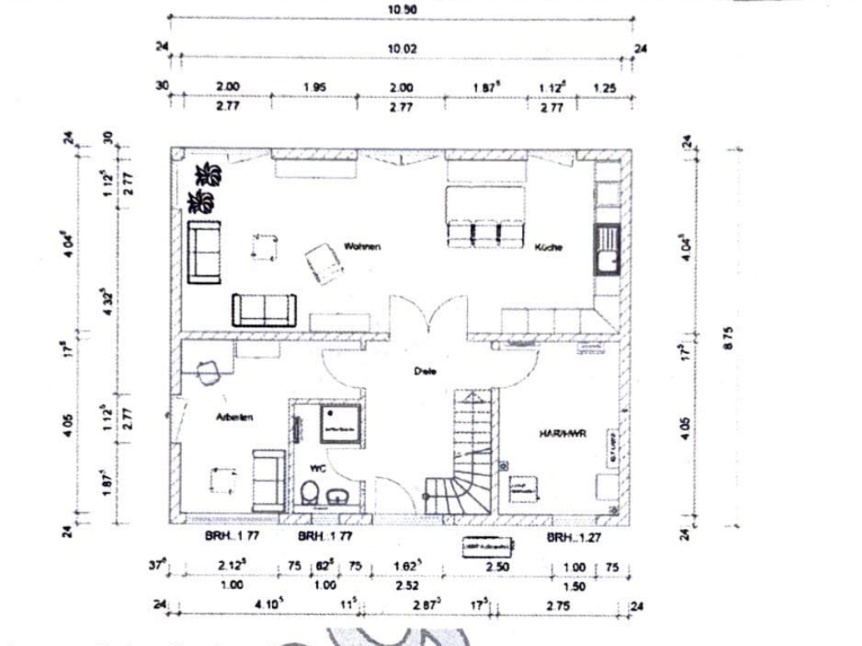
Standard floor plans (unfortunately I don’t have better views, especially of the ground floor; the Town & Country website shows the floor plans also in a “prettier” way but without dimensions)
Site plan oriented north (red line: property boundary; black line: building envelope)
Phew. I think that’s everything. If you have questions—I did not intend to leave anything unclear and will do my best to answer.
Regards, NiWi_NRW
A brief introduction about me/us: My husband, 36, a landscaping gardener—hereafter referred to as the homeowner—and I, 33, an administrative specialist (city planning and building regulations office *oops* but my area is administrative law, and I disclaim all-knowing expertise upfront) want to replace our 90sqm (970 sq ft) miner’s cottage built in 1918 with a Flair 152 RE model, hopefully built in 2026. Financing is already secured, so there is no separate thread about that; we will own the plot soon (notary appointment 01/2026). We received several strong recommendations for the local Town & Country franchisee from multiple parties and have therefore decided to go with them. We have allowed generous buffers for upgrades, and I now know the construction specifications and contract draft by heart—we know what to expect.
Our current living situation is characterized by “where should I put this” and “Honey, bring all your shoes upstairs”—in short: no storage space, no entrance area, a quirky floor plan with walk-through rooms, and three very small floors on a typical narrow miner’s lot.
The townhouse design itself is, to be honest, not our personal favorite architectural style purely from an aesthetic perspective. Even though we are financially comfortable, the bank was a bit nervous about “architect and separate contracts,” and honestly, so were we. Therefore, we are opting for a catalog house and have come to terms with the fact that we are riding the current “everyone has one” wave—we are taking it with a sense of humor, and with a fixed price guarantee in mind, it works pretty well. Our house won’t be a stunning example of Bauhaus style nor will it become famous for groundbreaking design. It isn’t that, nor do we want it to be. At least we have committed to avoiding “white facade with gray windows”—that will have to suffice here 😀
Enough rambling, now on to the important part.
Zoning Plan/Restrictions
The zoning plan including textual specifications can be found under City of Marl – ZP 175e South – Living at Freer Bruch. The plan for our new development area includes quite a few restrictions, which we are aware of, but we like it very much since it leads to a neighborhood where we can well imagine living. The area is not yet developed, and currently, we are basically buying 420sqm (5,070 sq ft) of dirt—there’s nothing else there yet. Building approval will be granted no earlier than the end of July!
[ATTACH type="full" width="500px" alt="Obergeschoss Grundriss mit Schlafzimmer, Kind 1, Kind 2, Bad und Treppenhaus">
Standard floor plans (unfortunately I don’t have better views, especially of the ground floor; the Town & Country website shows the floor plans also in a “prettier” way but without dimensions)
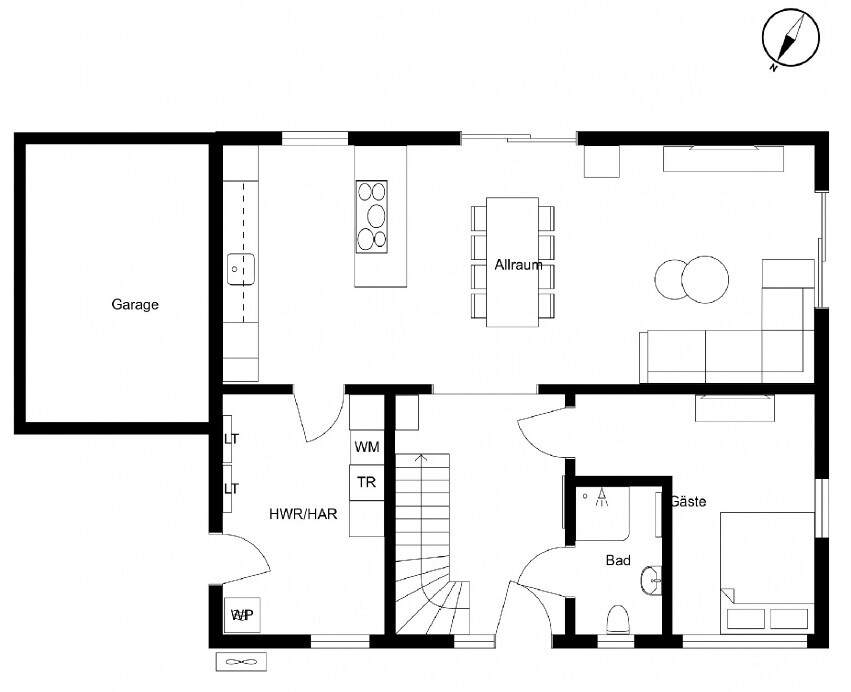
- Relocate entry door for the utility room from the hallway to the kitchen The idea was to gain space in the hallway for a larger cabinet under the stairs, which I would like to extend along the entire wall. Since the utility room will also serve as a pantry, I found the shorter route from the kitchen an additional advantage. The downside is that carrying laundry will be a longer route. Cooking to washing (for two people) seems okay to me. To avoid carrying groceries through the entire house, we opted for an additional exterior door in the utility room that connects the parking space in front of the garage to the utility room.
- Shift double window in the living room to the side of the house We have a fairly large TV, and I don’t like sofas facing away from the room. In the standard plan’s “window front” there was no glare-free wall where we liked the TV position or the sofa placement. Therefore, we gave up the small fixed glass element on the house side, “moved” the large window element over, and now have enough space to fit a large sideboard and the TV. In general, we shifted window positions in the standard plan at several places to adapt them to our layout (e.g., bathroom upstairs).
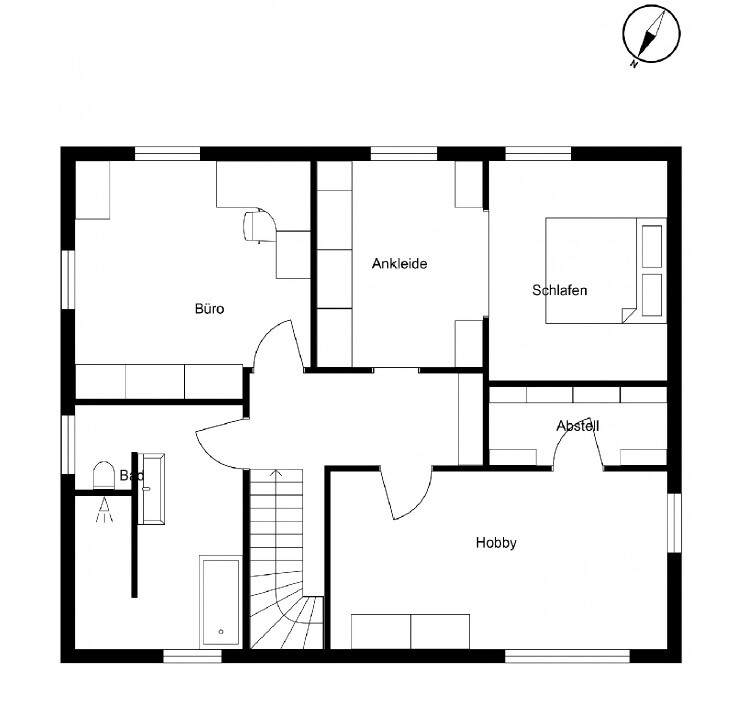
- Change from “entry through bedroom” to “entry through walk-in closet” I think this is self-explanatory—I wanted to have the bedroom at the end of the corridor-walk-in bed chain so that whoever *cough* sleeps longer has peace and quiet. This created a relatively large empty corner inside the bedroom. Since we don’t want to place wardrobes or other furniture like armchairs or sideboards there, the corner felt useless. We trimmed it off and converted it into a storage room. It is accessible through the hobby room since I want to keep the hall free for a console table or a picture on the wall (so no third door).
Site plan oriented north (red line: property boundary; black line: building envelope)
Phew. I think that’s everything. If you have questions—I did not intend to leave anything unclear and will do my best to answer.
Regards, NiWi_NRW
 Papierturm30 Dec 2025 20:52
Very entertainingly written text, hats off! Even the thread title is somehow brilliant.
Whooping cough in 420m² (4500 sq ft) will stick in my memory.
Okay. Now to the actual topics.
Bathroom on the upper floor:
I would solve it slightly differently, specifically by shortening the shower a bit (the splash guard is less relevant since it ends against a wall). Instead, I would make the shower wider and place the sink on the upper wall, opposite the toilet. This would offer the following advantages:
The bathroom also has enough space to add some shelves or borders around the bathtub.
Other points:
Whooping cough in 420m² (4500 sq ft) will stick in my memory.
Okay. Now to the actual topics.
Bathroom on the upper floor:
I would solve it slightly differently, specifically by shortening the shower a bit (the splash guard is less relevant since it ends against a wall). Instead, I would make the shower wider and place the sink on the upper wall, opposite the toilet. This would offer the following advantages:
- Daylight at the mirror/sink
- View of the sink/mirror/window when entering the room
- An “efficient” workflow (toilet -> sink -> leave the room in one route)
The bathroom also has enough space to add some shelves or borders around the bathtub.
Other points:
- I find the storage room on the upper floor very important and good. I’m not sure if the door in the hobby room is a good idea (issue: what happens if room uses are swapped later?).
- The walk-in closet seems to have a lot of “dancing space” in the middle.
- Utility room with a door to the kitchen: This makes sense at first. Two things I recommend considering: 1. Is there enough storage space? Utility rooms with two doors can sometimes be too small. 2. If photovoltaics are planned: inverters can generate quite a bit of heat in summer. A door leading to the kitchen does not retain heat as well as an insulated interior wall.
- Cloakroom area: planned under the stairs? I feel it’s still a bit missing.
Papierturm schrieb:
Very entertainingly written text, hats off! Even the thread title is somehow brilliant. Thank you very much – I thought the more you know about us, the better advice you can give. Thanks for your quick response!
Papierturm schrieb:
Bathroom on the upper floor:
I would solve it slightly differently, by shortening the shower a bit (splash protection is less relevant there anyway, because it ends against a wall). Instead, make the shower wider and place the sink on the upper wall, opposite the toilet. I played around with it a bit and I really like it. This eliminates the “bottleneck” between the vanity and the bathtub and makes it look more harmonious. I hadn’t really considered that the shower doesn’t need much length because of the wall. Right now the shower entrance is “in the room,” and even with a 1.40 m (5 ft) shower wall, some splash water ends up outside the shower area. I placed the bathtub in front of the toilet for now; I’m not yet sure whether I prefer it there or on the opposite wall...
Papierturm schrieb:
– The walk-in closet seems to have a lot of “dance floor” space in the center. In the new draft, I slightly increased the bedroom size at the expense of the walk-in closet. I like that better; it gives the bed some more breathing room. However, now there’s an awkward “poorly planned” corner in the lower left of the bedroom, so I might adjust the storage room wall to create a flush alignment. But that should just be fine-tuning. I don’t want to take more space from the walk-in closet, since we often use it together and don’t want to get in each other’s way. Maybe I can even add a narrow bench in the middle of the room – my little toe will be happy about that...
Papierturm schrieb:
– Utility room with door to the kitchen: That’s logical at first glance. I recommend considering two things: 1. Is there enough storage space? Utility rooms with two doors are sometimes too small. 2. If photovoltaics are planned: inverters can emit quite a bit of heat in summer. A door to the kitchen doesn’t keep heat in as well as an insulated interior wall. I think there should be enough space for the technical equipment. The floor plan includes two distribution boxes, the indoor unit of the heat pump, a freezer, washing machine and dryer, as well as a 60 cm (24 inch) tall cabinet for supplies. Even if a battery for the solar system is added, plus possibly the module for a central ventilation system (we have accounted for that in the buffer, but we’re still unsure if it’s worth it), there should be sufficient room. Above the washing machine and dryer, there will be two 60 cm (24 inch) wall cabinets for cleaning products, etc. The vacuum cleaner can go beside the kitchen door. It should fit! Thanks for the note about the heat, I hadn’t considered that. Are there doors that are better or worse suited for this? Since this door isn’t directly next to other interior doors, I could imagine installing a “special door” here.
Papierturm schrieb:
Coat storage space: planned under the stairs? I feel that’s still a bit lacking. Yes, exactly, the cupboard is meant to serve as the coat storage – I can imagine integrating a bench there, or simply hiding the whole flood of jackets, shoes, and hats behind built-in cupboard doors. In any case, the entire wall under the stairs is planned for this.
Thanks so much for your thoughts!!
Now, by cutting and pasting quotes, I’ve brushed aside your objection regarding the door to the storage room on the upper floor:
If any room swaps were to take place, it would be at most the office moving in instead of the hobby room, since I wouldn’t want the bedrooms facing the street side. Although I don’t expect it to get very noisy here, we have such a lovely location at the back, so that would be more of a Plan Z. Since both walls are drywall, in the worst case we would consider relocating the door to the other side—that’s something we could do ourselves and accept the risk. Your objection made me reconsider it, and now I feel a bit more confident about it, thanks!
If any room swaps were to take place, it would be at most the office moving in instead of the hobby room, since I wouldn’t want the bedrooms facing the street side. Although I don’t expect it to get very noisy here, we have such a lovely location at the back, so that would be more of a Plan Z. Since both walls are drywall, in the worst case we would consider relocating the door to the other side—that’s something we could do ourselves and accept the risk. Your objection made me reconsider it, and now I feel a bit more confident about it, thanks!

It’s not really that boxy. The roof style should also be selectable with Town & Country, right?
I would recommend switching to a gable roof. It has several advantages:
Better use of the attic space for storage options, especially with a studio truss roof structure (with an unheated roof only suitable for durable items, but still very useful).
Better roof area utilization for photovoltaic panels (ideally oriented east/west to achieve good performance spread throughout the day).
Simpler construction, which should provide some cost benefits (possibly not relevant for Town & Country in a show house).
I have experience with this—I have a hipped roof and regularly regret that decision.
Regarding the actual floor plan, I’ll avoid going into too much detail as I’m not very skilled in that area. The ground floor is almost identical to ours. I can say that it works quite well, although we would have preferred an additional 1 meter (3 feet) in depth.
I believe the layout of the office and guest WC could be optimized in your case. The short entrance to the office won’t be very useful; I would consider extending the hallway and then moving the entrance to the guest bathroom into the newly created hallway. Otherwise, you always have a collision point right at the entrance door (your version).
You can take a look at mine for inspiration
https://www.hausbau-forum.de/threads/lage-stadtvilla-oder-einfamilienhaus-auf-500-m2-grundstueck-rechteck.33505/post-409926
That’s the final floor plan.
Before that, you can read about its development if you’re interested.
I would recommend switching to a gable roof. It has several advantages:
Better use of the attic space for storage options, especially with a studio truss roof structure (with an unheated roof only suitable for durable items, but still very useful).
Better roof area utilization for photovoltaic panels (ideally oriented east/west to achieve good performance spread throughout the day).
Simpler construction, which should provide some cost benefits (possibly not relevant for Town & Country in a show house).
I have experience with this—I have a hipped roof and regularly regret that decision.
Regarding the actual floor plan, I’ll avoid going into too much detail as I’m not very skilled in that area. The ground floor is almost identical to ours. I can say that it works quite well, although we would have preferred an additional 1 meter (3 feet) in depth.
I believe the layout of the office and guest WC could be optimized in your case. The short entrance to the office won’t be very useful; I would consider extending the hallway and then moving the entrance to the guest bathroom into the newly created hallway. Otherwise, you always have a collision point right at the entrance door (your version).
You can take a look at mine for inspiration
https://www.hausbau-forum.de/threads/lage-stadtvilla-oder-einfamilienhaus-auf-500-m2-grundstueck-rechteck.33505/post-409926
That’s the final floor plan.
Before that, you can read about its development if you’re interested.
Thanks for your input, Tolentino! I agree, your solution for the entrances to the guest bathroom and guest room makes a lot of sense. I’ll redraw it as you suggested and discuss it with the client ;-)
Regarding the roof shape, we are bound to the pitched roof (gable roof) option. We once considered a gap site (which fell through due to contaminated soil, etc.), where the cube would have had a different roof – the flat roof is actually a deviation from the catalog, as Town & Country’s standard for this house is a hipped roof. We could opt for a 10-degree (about 18%) pitch, so an almost flat pitched roof, but that would make the green roofing more complicated, as it’s still required. I’m not really a fan of that either, as it kind of looks like “I actually didn’t want a pitched roof” 😀
Regarding the roof shape, we are bound to the pitched roof (gable roof) option. We once considered a gap site (which fell through due to contaminated soil, etc.), where the cube would have had a different roof – the flat roof is actually a deviation from the catalog, as Town & Country’s standard for this house is a hipped roof. We could opt for a 10-degree (about 18%) pitch, so an almost flat pitched roof, but that would make the green roofing more complicated, as it’s still required. I’m not really a fan of that either, as it kind of looks like “I actually didn’t want a pitched roof” 😀
Similar topics