
Good day!
After more than 20 years, I have recently started noticing a short, low-pitched noise occurring whenever cold water is drawn somewhere in the house. For example, when the washing machine starts running, when flushing the toilet and the cistern is refilled, or simply when quickly opening a tap.
At first, I suspected anything related to water flowing through the basement, such as the utility company’s valves, at least one of which contains a spring, and also the backwash filter, which also includes a spring. It must be something that can start vibrating. If I heard and felt it correctly, the noise does not come from a specific point but rather diffuses from a section of pipe. Such vibrations tend to spread through the house and can then sound much louder and stronger far from their origin than right at the source.
Now I am wondering: Could it be that there is a buildup of limescale somewhere in the pipe system that partially blocks the pipe, causing vibrations when the water flow begins? I mean: in Berlin, everything calcifies if it is not regularly descaled, so why should a fresh water pipe system be any different?
If we assume this is the case: how could something like this be eliminated? If something is vibrating somewhere, the next step would be that something breaks eventually. Under no circumstances do I want a burst pressurized water pipe in my basement, even though such a failure would be detected quickly by sensors.
There is a drain screw in the service room where I could empty the system. If the valve is closed again afterward, it might be possible to introduce an acid through an upper-angle valve on the cold water side. I remember something like "use acetic acid for warm descaling, citric acid for cold descaling." If the appropriate solution is left in the system for a few hours, all the deposits should supposedly flow out thinly at the drain valve afterward, right?
Or are my assumptions going completely in the wrong direction?
Matthias
After more than 20 years, I have recently started noticing a short, low-pitched noise occurring whenever cold water is drawn somewhere in the house. For example, when the washing machine starts running, when flushing the toilet and the cistern is refilled, or simply when quickly opening a tap.
At first, I suspected anything related to water flowing through the basement, such as the utility company’s valves, at least one of which contains a spring, and also the backwash filter, which also includes a spring. It must be something that can start vibrating. If I heard and felt it correctly, the noise does not come from a specific point but rather diffuses from a section of pipe. Such vibrations tend to spread through the house and can then sound much louder and stronger far from their origin than right at the source.
Now I am wondering: Could it be that there is a buildup of limescale somewhere in the pipe system that partially blocks the pipe, causing vibrations when the water flow begins? I mean: in Berlin, everything calcifies if it is not regularly descaled, so why should a fresh water pipe system be any different?
If we assume this is the case: how could something like this be eliminated? If something is vibrating somewhere, the next step would be that something breaks eventually. Under no circumstances do I want a burst pressurized water pipe in my basement, even though such a failure would be detected quickly by sensors.
There is a drain screw in the service room where I could empty the system. If the valve is closed again afterward, it might be possible to introduce an acid through an upper-angle valve on the cold water side. I remember something like "use acetic acid for warm descaling, citric acid for cold descaling." If the appropriate solution is left in the system for a few hours, all the deposits should supposedly flow out thinly at the drain valve afterward, right?
Or are my assumptions going completely in the wrong direction?
Matthias
Pianist schrieb:
And how does it arise in this context?Locally restricted fluid flow velocities inside the pipe. Probably caused by the cross-sectional narrowing you suspected, which results from deposits.Ok. The approach to fix this would probably be to use the small drain valve on the shut-off valve behind the water meter to drain the entire system, and then introduce a suitable acid (diluted with water) at a corner valve somewhere upstairs in the house. Most likely citric acid. This would need to be left to work, and ideally, then the limescale slurry would come out from the drain valve below.
Am I the only one with this problem, or has anyone else experienced something similar?
Matthias
Am I the only one with this problem, or has anyone else experienced something similar?
Matthias
I just received a warning because apparently external links are not allowed here. That’s quite unusual for a forum. Also, you cannot upload audio files here. How are you supposed to share something with others if you can neither upload nor link to it?
Anyway, I’m going to try using citric acid now. I made a filling tube with a funnel that I can screw on instead of the shower hose. Since this is probably the highest point in the house, I should be able to reach the entire pipe system this way.
What mixing ratio should I use? One to ten?
Matthias
Anyway, I’m going to try using citric acid now. I made a filling tube with a funnel that I can screw on instead of the shower hose. Since this is probably the highest point in the house, I should be able to reach the entire pipe system this way.
What mixing ratio should I use? One to ten?
Matthias
My first attempt didn’t really lead to success; I probably only reached a small part of the pipe system. I will likely have to drain the entire hot water tank as well, because otherwise the water pushes back, so the relevant section on the cold water side probably won’t be reached. This time, I won’t start at the highest point but at a sink on the ground floor, where I will unscrew the aerator and connect the hose coupling via an adapter piece that has a ½-inch (half-inch) external thread on both ends.
But something else has happened: since then, the backwash filter has been dripping, and I have to remember to empty a 10-liter (2.6-gallon) bucket every few days. What is the purpose of this backwash filter? And does it now need to be replaced? For that, the entire system would have to be drained again.
Matthias
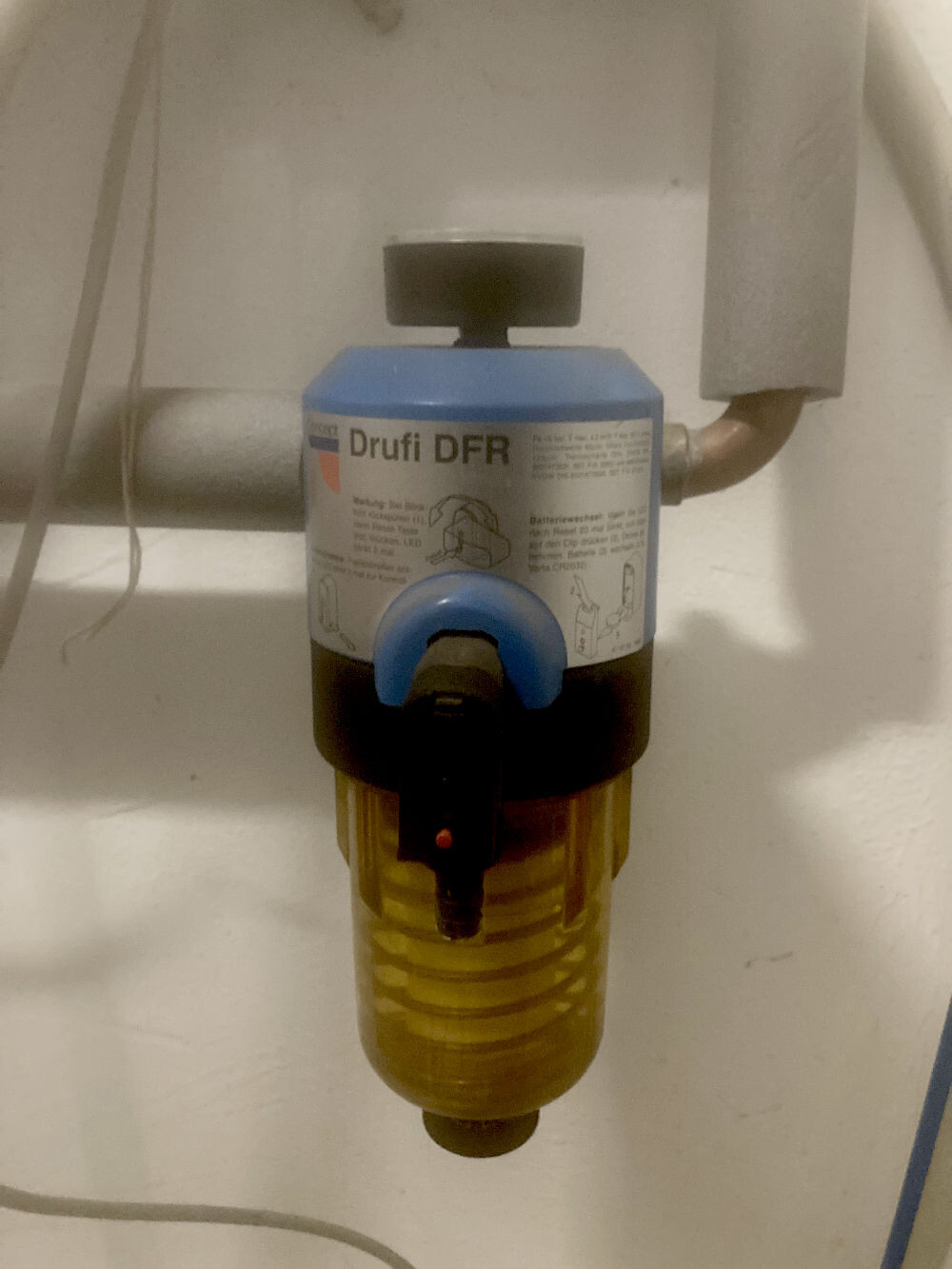
But something else has happened: since then, the backwash filter has been dripping, and I have to remember to empty a 10-liter (2.6-gallon) bucket every few days. What is the purpose of this backwash filter? And does it now need to be replaced? For that, the entire system would have to be drained again.
Matthias