
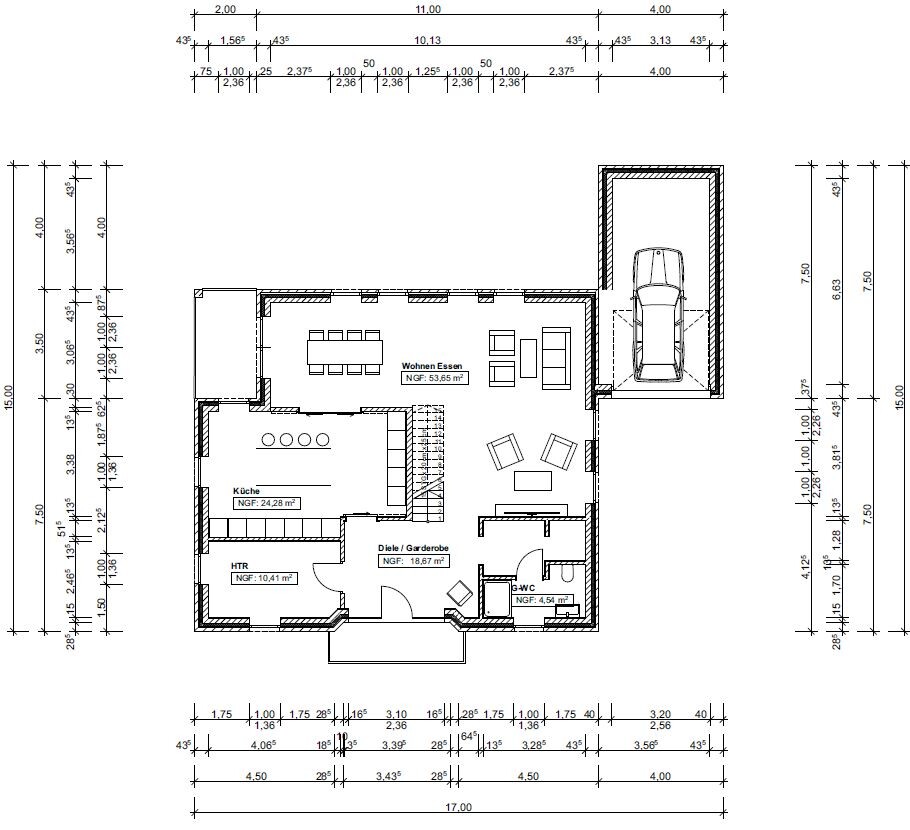
ᐅ New construction of a single-family house, approximately 220 sqm. Please provide feedback on the floor plan.
Created on: 30 Jul 2020 13:05
I
idasb79
Hello everyone,
After quietly following this forum for a long time, I have now registered and would like to hear your opinions on our current planning status. The plan is to live in the house for about 15–20 years and then sell it.
So, here we go!
Development Plan / Restrictions
Plot size: 620 m² (6676 sq ft)
Site coverage ratio: 0.4
Floor area ratio: 0.8
Building envelope, building line and boundary: 12 m x 14 m (39 ft 4 in x 46 ft)
Number of parking spaces: 1 plus 1 garage
Number of stories: 2
Roof type: pitched roof
Orientation: north
Additional requirements: drainage ditch in front of the building envelope on the south side, 3 m wide (10 ft), with a planned 4 m wide (13 ft) crossing
Client Requirements
Style, roof type, building type: urban villa
Basement, floors: no basement, 2 full stories
Number of occupants, age: 4 persons – 40, 41, 14, 14 years old
Guest bedrooms per year: none
Conservative or modern construction: modern
Open kitchen, kitchen island: kitchen island, semi-open with sliding door to dining area
Number of dining seats: 8
Fireplace: yes, as a room divider between living and dining
Music/sound system wall: no
Balcony, roof terrace: yes
Garage, carport: yes
Utility garden, greenhouse: no
Additional wishes / special features / daily routine, also reasons why this or that should or should not be included
House Design
Planner: do-it-yourself
What do you particularly like? Why?
Large living area and master bedroom with walk-in closet and bathroom
Large kitchen
What do you dislike? Why?
Cost estimate according to architect/planner:
No cost estimate yet, as no contact has been made so far
Personal budget for the house, including fittings:
No idea yet
Preferred heating technology:
No preference, but if the combination with subsidies and so on is right, a geothermal heat pump would be welcome again. Otherwise, price-performance ratio should be good.
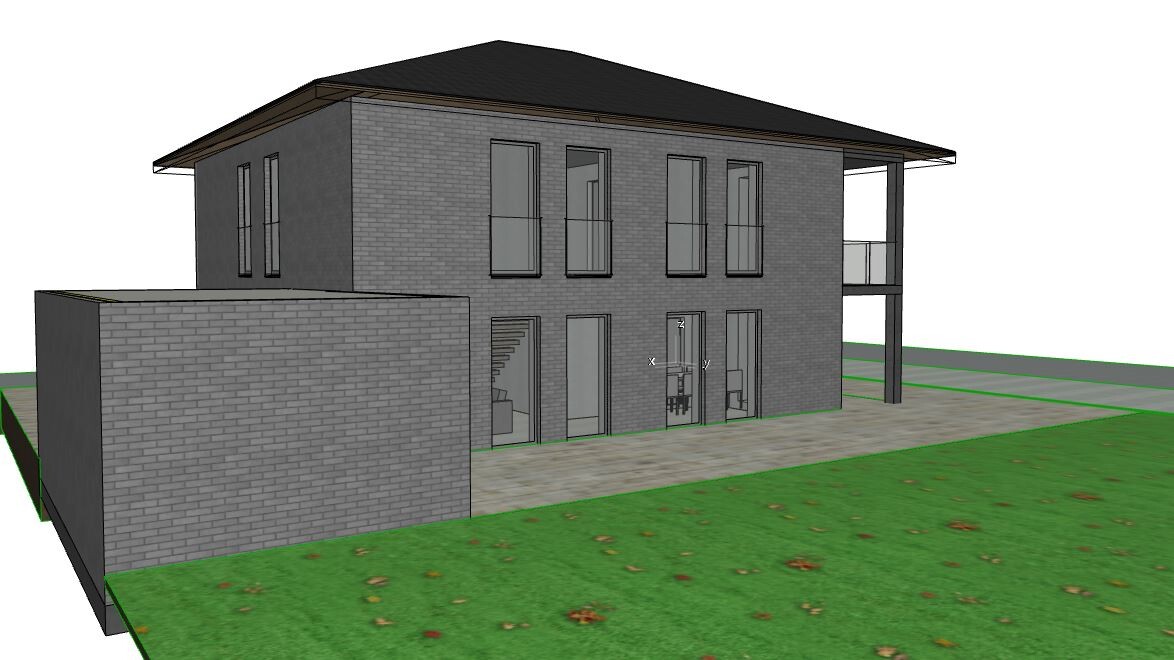
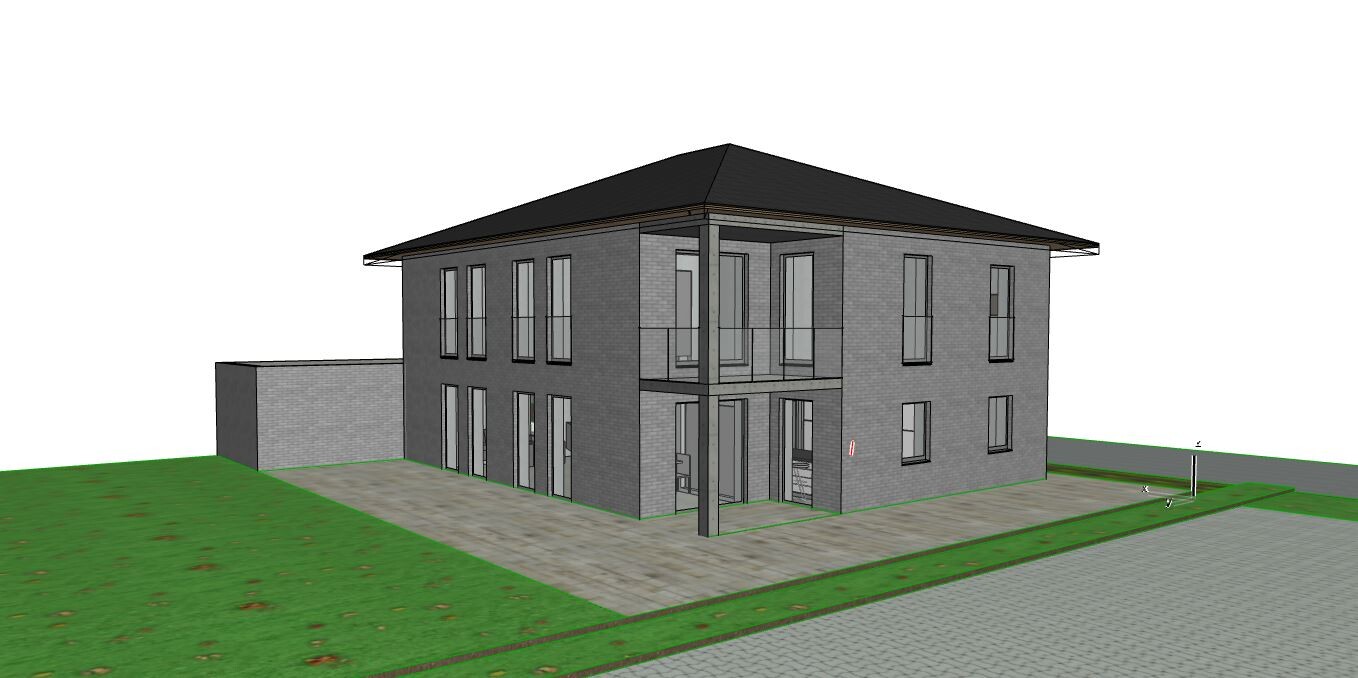
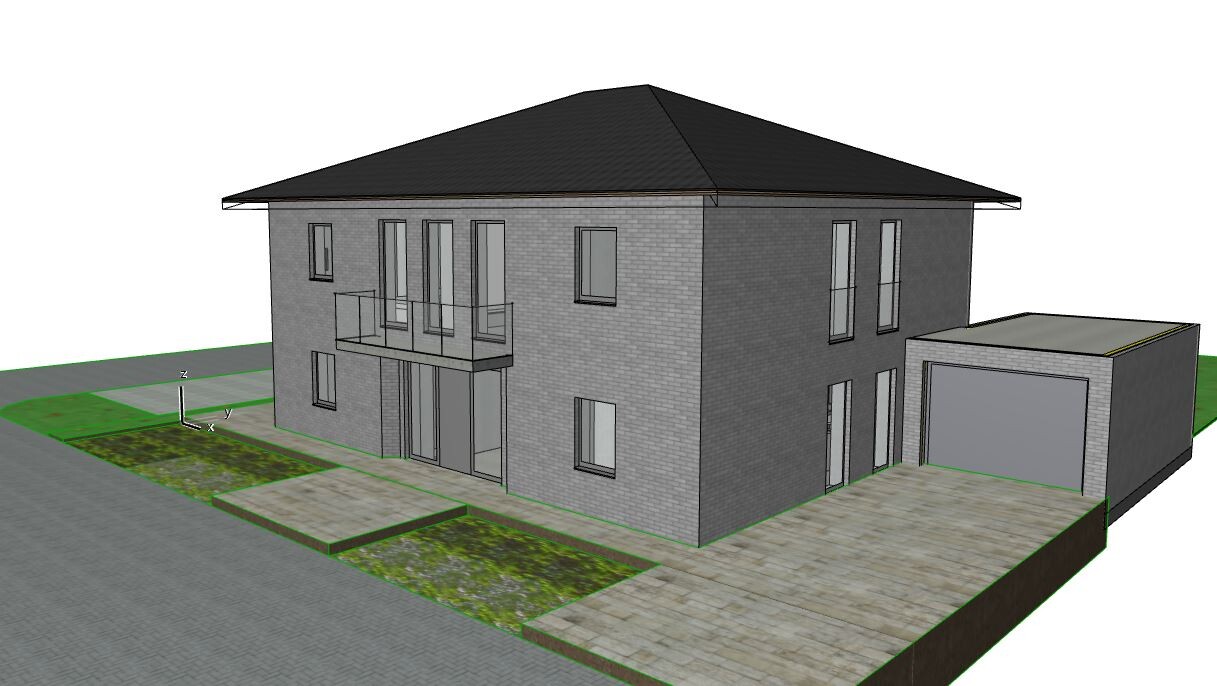
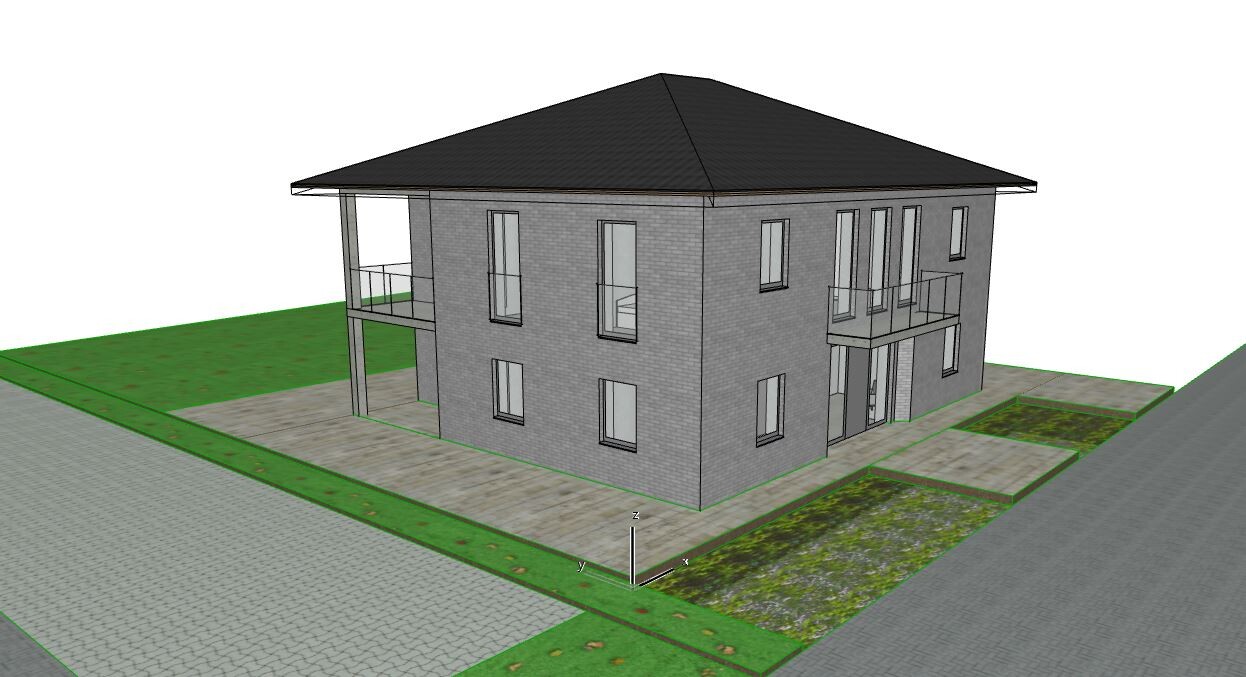

After quietly following this forum for a long time, I have now registered and would like to hear your opinions on our current planning status. The plan is to live in the house for about 15–20 years and then sell it.
So, here we go!
Development Plan / Restrictions
Plot size: 620 m² (6676 sq ft)
Site coverage ratio: 0.4
Floor area ratio: 0.8
Building envelope, building line and boundary: 12 m x 14 m (39 ft 4 in x 46 ft)
Number of parking spaces: 1 plus 1 garage
Number of stories: 2
Roof type: pitched roof
Orientation: north
Additional requirements: drainage ditch in front of the building envelope on the south side, 3 m wide (10 ft), with a planned 4 m wide (13 ft) crossing
Client Requirements
Style, roof type, building type: urban villa
Basement, floors: no basement, 2 full stories
Number of occupants, age: 4 persons – 40, 41, 14, 14 years old
Guest bedrooms per year: none
Conservative or modern construction: modern
Open kitchen, kitchen island: kitchen island, semi-open with sliding door to dining area
Number of dining seats: 8
Fireplace: yes, as a room divider between living and dining
Music/sound system wall: no
Balcony, roof terrace: yes
Garage, carport: yes
Utility garden, greenhouse: no
Additional wishes / special features / daily routine, also reasons why this or that should or should not be included
House Design
Planner: do-it-yourself
What do you particularly like? Why?
Large living area and master bedroom with walk-in closet and bathroom
Large kitchen
What do you dislike? Why?
Cost estimate according to architect/planner:
No cost estimate yet, as no contact has been made so far
Personal budget for the house, including fittings:
No idea yet
Preferred heating technology:
No preference, but if the combination with subsidies and so on is right, a geothermal heat pump would be welcome again. Otherwise, price-performance ratio should be good.
11ant schrieb:
That wouldn’t be smart anyway, because the mason doesn’t apply the plaster in the same work step, but not at all, and someone else does it later. In this example, the plasterer’s entire layer thickness is already less than the mason’s tolerance for position and dimension alone – not to mention further precision sizing. Masonry and plaster on the same plan therefore represent precisely that kind of sum that, hopefully, every student today still knows who cuts from (Ingo Insterburg sang to that: I live in Paris, I’m “not a Berliner”).
Well, then I might as well quote Mirja Boes: “no way, little Peter!”
That’s what old Ähnen already told me, Schöler Pfeiffer: you’d better stop confusing the façade and stop playing the foreground incorrectly – then the floor plan will also survive the alcoholic fermentation!
I also consider this a strong recommendation, to look more consciously at market compatibility. Hello 11Ant,
here it is again for you to take note.
This is a design of mine, not from an architect, and certainly not a construction-ready plan for the tradespeople.
Since you still haven’t contributed anything constructive on the topic, I’ll do the same as you—start with a first assumption without knowing you and categorize you as one of those envious people who don’t wish others a nice home. What is your issue with the façade? The materials are not fixed, oh yes, even the construction isn’t finalized, and yet you’ve stuck to the façade.
It can’t be that hard to simply read that all objects in the floor plan are just placeholders, and wall thicknesses or other installation details do not matter in this plan. It’s not a construction plan.
As someone who does not cut sums short, I always complement my concerns with possible solutions, which you have not done.
I try to respond to every objection here, but your previous contributions in this thread are simply off the mark.
A famous man once said that some people have a horizon with a radius of zero—and they call that their point of view.
Always work with existing or desired furniture to scale. Never use placeholders.
The staircase makes the living space feel small. The kitchen isn’t to my taste – but that’s a matter of personal preference.
The hallway is very large; the wardrobe seems insufficient to me.
The layout in the living room feels like a makeshift solution. Why are there three full bathrooms?
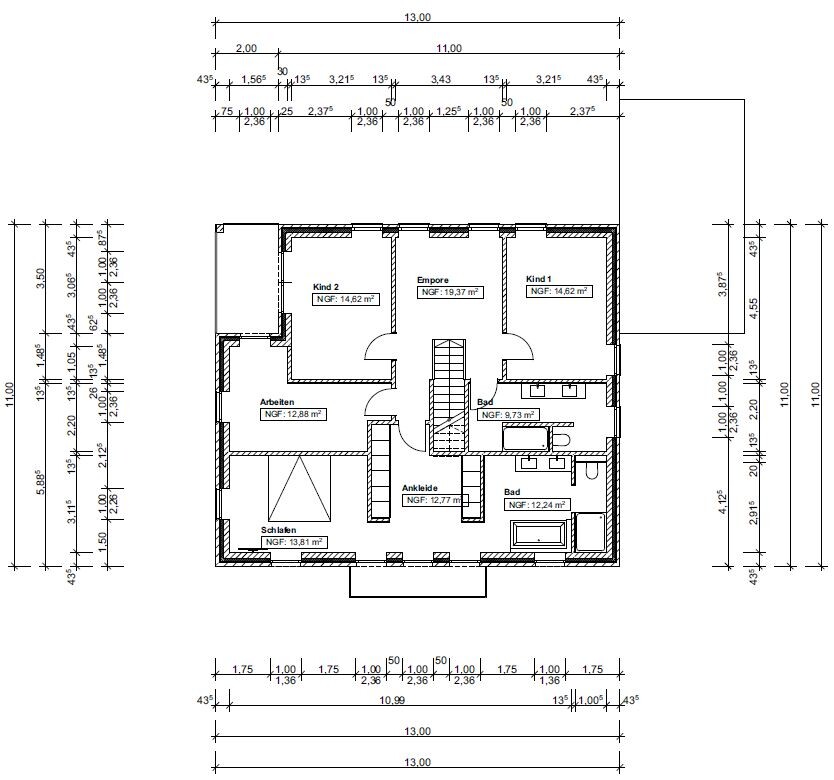
The upper floor needs to be redesigned. The gallery is too large. The children’s rooms are relatively small.
The shower in the kids’ bathroom is too narrow, with a rough opening measurement of 80 cm (31.5 inches).
The study looks like a leftover space.
I don’t see the appeal of the balconies. I find there is a lack of storage space.
The staircase makes the living space feel small. The kitchen isn’t to my taste – but that’s a matter of personal preference.
The hallway is very large; the wardrobe seems insufficient to me.
The layout in the living room feels like a makeshift solution. Why are there three full bathrooms?
The upper floor needs to be redesigned. The gallery is too large. The children’s rooms are relatively small.
The shower in the kids’ bathroom is too narrow, with a rough opening measurement of 80 cm (31.5 inches).
The study looks like a leftover space.
I don’t see the appeal of the balconies. I find there is a lack of storage space.
The staircase is too short or currently too steep, especially since in such a design you certainly wouldn't save on ceiling height.
With your terrace, half of the table will be outside the upper balcony, because if you place the table exactly inside, you won’t be able to get out of the door anymore.
With your terrace, half of the table will be outside the upper balcony, because if you place the table exactly inside, you won’t be able to get out of the door anymore.
Hello hanse987,
At the spot beneath the balcony, if anything, a small table could be placed; otherwise you’re right, there won’t be enough room for more. The main terrace is located at the rear of the living-dining area. We are also considering, due to the north-facing garden area—how shall I put it—building a separate terrace away from the house so that we can actually sit in the sun sometimes.
hanse987 schrieb:The staircase currently has a riser height of 20cm (8 inches). The floor-to-floor height is planned at 3m (10 feet), so after subtracting floor structure and ceiling thickness, there will be just over 2.60m (8.5 feet) of ceiling height left. We could flatten the staircase, there is enough space. What riser height would you recommend? Should we plan for a higher ceiling?
The staircase is too short or currently too steep, especially since in such a design you wouldn’t save on ceiling height.
With your terrace, half the table will be outside the upper balcony, because if you place a table exactly there, you won’t be able to get through the door anymore.
At the spot beneath the balcony, if anything, a small table could be placed; otherwise you’re right, there won’t be enough room for more. The main terrace is located at the rear of the living-dining area. We are also considering, due to the north-facing garden area—how shall I put it—building a separate terrace away from the house so that we can actually sit in the sun sometimes.
Stairs are not designed based on riser height alone; rather, the riser height results from other dimensions. One of the most important formulas is the walking step rule (2 × tread depth + riser height ≈ 630mm (25 inches)). If I have correctly interpreted the measurements from your drawing, I would suggest 16 steps in this case. This would bring the total closer to 630mm (25 inches). Currently, the staircase has an angle of 39°, but I would personally lean more towards 35°, which corresponds to extending the stairs by about 50cm (20 inches). It’s best to look at and walk on different staircases to get a feel for the dimensions and take measurements.
For me, the main terrace should always be located near the kitchen. If I have to walk across half the property to reach it with my things, I would hardly ever use that distant terrace.
For me, the main terrace should always be located near the kitchen. If I have to walk across half the property to reach it with my things, I would hardly ever use that distant terrace.
idasb79 schrieb:
We are now 40 and 41, and the children are 14. How long should I live in such a big house? Between 55 and 60, we don’t want to primarily take care of a large house. Then why are you building such a large house that will be too big for you in a few years?
I would also make sure the house fits the area, meaning a very large, expensive house belongs in an expensive neighborhood; otherwise, it will be difficult to sell later on.
Best regards,
Sabine
Similar topics