
ᐅ New Single-Family Home Construction: Choosing the Right Builder?
Created on: 8 May 2015 17:01
C
ChriGroHello forum members,
We now have a plot of land and are in the planning phase for building a new single-family house. We have given it some thought, but we are still beginners in this field. We have already created a floor plan and thus have a rough idea of the design. We have spoken with a few contractors to check whether 1. the floor plan can be implemented as planned, and 2. if it fits within our budget. Both are okay.
Now, our preliminary question is whether we should have the entire construction carried out by a single contractor (with an independent construction supervisor), or if it would be better to have the contractor build the shell, so the exterior is finished, and then subcontract specialized work for the interior—particularly the heating and plumbing.
Is it cheaper (or at least equally priced but with better quality) to plan and install everything through a heating engineer and bathroom installer?
The contractor often works with various heating companies and generally recommends certain manufacturers. Our plan includes an air-to-water heat pump with underfloor heating. The underfloor heating, screed, and tiles would be installed or laid by ourselves. Although the recommended manufacturers are well-known and presumably reliable, a heating professional might better advise us on whether this is the best solution. The question, however, is whether this would significantly increase the cost.
Another point is how this relates to obtaining a KfW loan (minimum KfW55 standard). Do you only receive the loan after the KfW confirms that the KfW standard has been met? This seems somewhat contradictory since we would need to invest in meeting these standards upfront to qualify for the funding.
Perhaps our approach is completely wrong, and you can suggest a different way to approach building a house.
Thanks in advance,
Regards, Chrigro
We now have a plot of land and are in the planning phase for building a new single-family house. We have given it some thought, but we are still beginners in this field. We have already created a floor plan and thus have a rough idea of the design. We have spoken with a few contractors to check whether 1. the floor plan can be implemented as planned, and 2. if it fits within our budget. Both are okay.
Now, our preliminary question is whether we should have the entire construction carried out by a single contractor (with an independent construction supervisor), or if it would be better to have the contractor build the shell, so the exterior is finished, and then subcontract specialized work for the interior—particularly the heating and plumbing.
Is it cheaper (or at least equally priced but with better quality) to plan and install everything through a heating engineer and bathroom installer?
The contractor often works with various heating companies and generally recommends certain manufacturers. Our plan includes an air-to-water heat pump with underfloor heating. The underfloor heating, screed, and tiles would be installed or laid by ourselves. Although the recommended manufacturers are well-known and presumably reliable, a heating professional might better advise us on whether this is the best solution. The question, however, is whether this would significantly increase the cost.
Another point is how this relates to obtaining a KfW loan (minimum KfW55 standard). Do you only receive the loan after the KfW confirms that the KfW standard has been met? This seems somewhat contradictory since we would need to invest in meeting these standards upfront to qualify for the funding.
Perhaps our approach is completely wrong, and you can suggest a different way to approach building a house.
Thanks in advance,
Regards, Chrigro
The general contractor usually hires specialized companies.
If you like, you can share your floor plan idea here and have it discussed.
You will receive KFW funding after you have submitted the KFW application – the house does not have to be built yet, but the planning must be completed.
Don’t be mistaken, this is just one of many options. Stay vigilant and don’t try to save in the wrong places, etc.
If you like, you can share your floor plan idea here and have it discussed.
You will receive KFW funding after you have submitted the KFW application – the house does not have to be built yet, but the planning must be completed.
Don’t be mistaken, this is just one of many options. Stay vigilant and don’t try to save in the wrong places, etc.
Ok, then I don’t need to worry about the KfW funding.
Is a building supervisor (BU) just as knowledgeable in these areas as a general contractor (HB)? Will they advise me in my best interest (regarding energy efficiency, cost, and technical aspects) on how to install the underfloor heating? For example, whether to space it 10cm (4 inches) or 20cm (8 inches) apart, and whether to choose a wet or dry system? Or will I still consult a specialist when the planning intensifies?
Here are the floor plans (I hope they make sense):
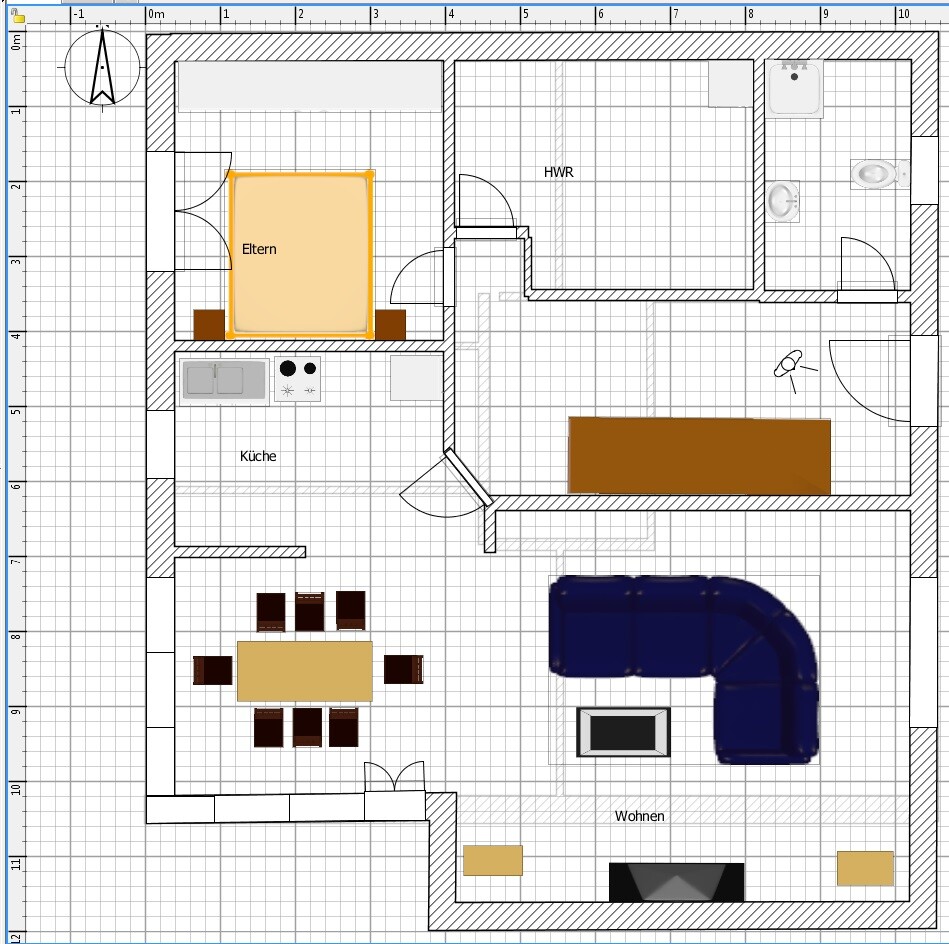
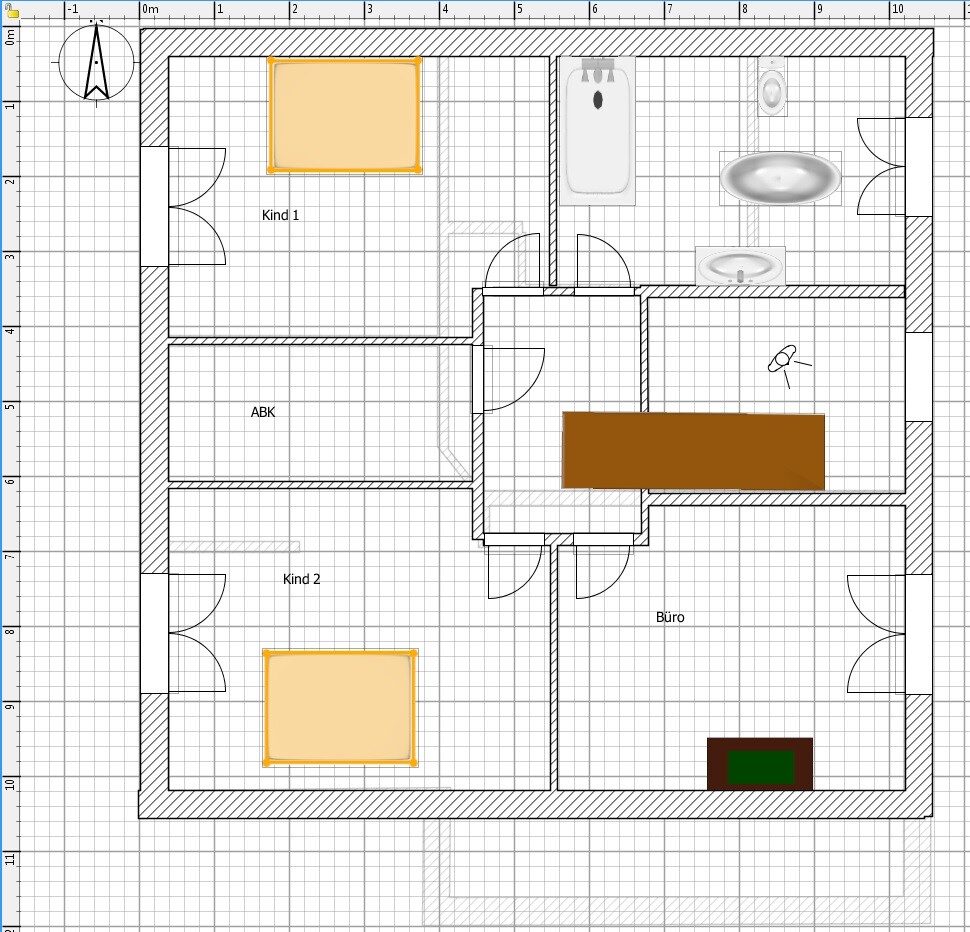
We want to build without a basement. The staircase shown in the software is probably not to scale (here 4m x 1m (13ft x 3ft)). Above the front door, there should be a window of roughly the same size (I know it will be quite a challenge to clean). The roof will probably be a gable roof, starting above the living and dining area and partially extending over the terrace. No windows or chimney will be integrated into the roof, to maximize the available space for the photovoltaic system. The garage (9m long (30ft), planned for the future) will be built on the north side, so a long, narrow window needs to be installed in the utility room, where the air-to-water heat pump will also be located. However, I am not sure yet how to arrange this temporarily without a garage.
The north side is at the top.
Is a building supervisor (BU) just as knowledgeable in these areas as a general contractor (HB)? Will they advise me in my best interest (regarding energy efficiency, cost, and technical aspects) on how to install the underfloor heating? For example, whether to space it 10cm (4 inches) or 20cm (8 inches) apart, and whether to choose a wet or dry system? Or will I still consult a specialist when the planning intensifies?
Here are the floor plans (I hope they make sense):
We want to build without a basement. The staircase shown in the software is probably not to scale (here 4m x 1m (13ft x 3ft)). Above the front door, there should be a window of roughly the same size (I know it will be quite a challenge to clean). The roof will probably be a gable roof, starting above the living and dining area and partially extending over the terrace. No windows or chimney will be integrated into the roof, to maximize the available space for the photovoltaic system. The garage (9m long (30ft), planned for the future) will be built on the north side, so a long, narrow window needs to be installed in the utility room, where the air-to-water heat pump will also be located. However, I am not sure yet how to arrange this temporarily without a garage.
The north side is at the top.
Based on my limited experience: the general contractor hires the builder, and the builder does the work. If you’re unlucky, you might end up with someone who has never installed a waterproofing membrane before, so be careful... but that can also happen if you hire and search on your own. The builder will recommend what they have good experience with – if you get a reliable general contractor, they won’t just go for what’s best for their profit but also what’s best for your house – after all, it doesn’t help them if after the build you tell everyone they did a poor job, especially if they want to stay in the business for a while.
The floor plan is a bit challenging without dimensions.
I wouldn’t like the master bedroom layout: first, the door is right next to the head of the bed; second, you have to pass through the hallway to get to the bathroom at night—or if you have a flu and the daughter is hanging out with her friends in the living room. Also, I’m not sure if you wouldn’t hear the noise from the dishwasher when sitting behind the 115mm (4.5 inch) wall.
Three meters (10 feet) width for the dining room is somewhat tight depending on the size of the dining table.
The sofa looks a bit sad, no view, lots of TV.
Access to the office is questionable!
The storage room (ABK) can fit at most one row of cabinets properly.
What do the exterior views look like?
Hopefully, the bathtub is just a placeholder—though maybe that’s fashionable these days.
The floor plan is a bit challenging without dimensions.
I wouldn’t like the master bedroom layout: first, the door is right next to the head of the bed; second, you have to pass through the hallway to get to the bathroom at night—or if you have a flu and the daughter is hanging out with her friends in the living room. Also, I’m not sure if you wouldn’t hear the noise from the dishwasher when sitting behind the 115mm (4.5 inch) wall.
Three meters (10 feet) width for the dining room is somewhat tight depending on the size of the dining table.
The sofa looks a bit sad, no view, lots of TV.
Access to the office is questionable!
The storage room (ABK) can fit at most one row of cabinets properly.
What do the exterior views look like?
Hopefully, the bathtub is just a placeholder—though maybe that’s fashionable these days.
The wall between the bedroom and the kitchen can definitely be a bit thicker, that’s right. The dishwasher might need to be placed somewhere else, rather than directly next to the bedroom. The kitchen worktop should be 1.80 meters (6 feet) long, with 60 cm (24 inches) shelves on each side and 60 cm (24 inches) walkway. I mismeasured that. Everything else is no problem for us. In the living room, there is a large wide window on the entrance side, and hopefully enough light will come through the glass dining area from the dining room.
We are still unsure about how to design the hallway on the upper floor. We just want to be able to look toward the front door from there, to make the entrance area feel more spacious.
I just placed the bathtub somewhere there was space.
We are still unsure about how to design the hallway on the upper floor. We just want to be able to look toward the front door from there, to make the entrance area feel more spacious.
I just placed the bathtub somewhere there was space.
Your plan includes a staircase with a length of 350cm (11.5 feet). This will result in a rather steep staircase:
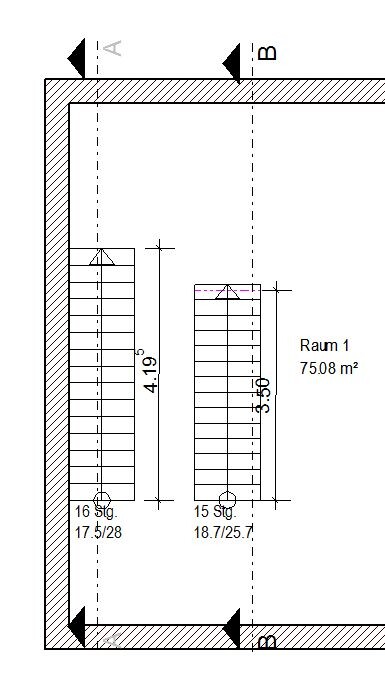
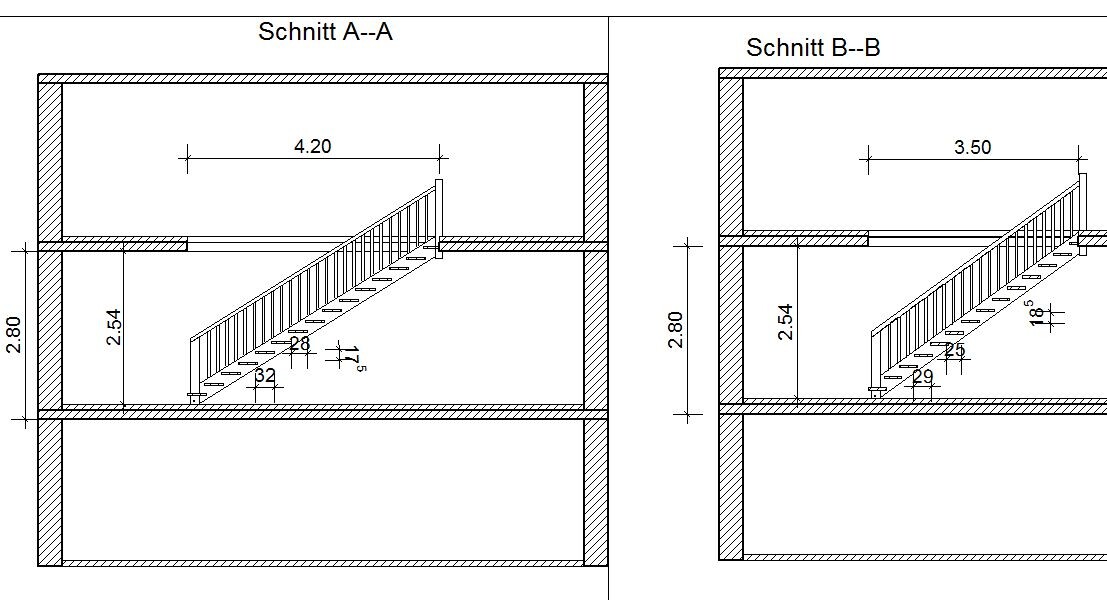
However, once the staircase is properly placed, the layout of the upper floor does not work out. Also consider how the main entrance door to the house opens and where people will stand to welcome guests.
There are missing details regarding the knee wall height on the upper floor and the marking of the 2m (6ft 7in) height line on the upper floor.
I agree with behaelja about the ground floor bedroom and also the location of the bathroom.
The kitchen will be quite small, with limited space for tall cabinets or kitchen furniture.
The office on the upper floor basically cannot be accessed as shown, with only 60cm (2 feet) clearance at the staircase.
However, once the staircase is properly placed, the layout of the upper floor does not work out. Also consider how the main entrance door to the house opens and where people will stand to welcome guests.
There are missing details regarding the knee wall height on the upper floor and the marking of the 2m (6ft 7in) height line on the upper floor.
I agree with behaelja about the ground floor bedroom and also the location of the bathroom.
The kitchen will be quite small, with limited space for tall cabinets or kitchen furniture.
The office on the upper floor basically cannot be accessed as shown, with only 60cm (2 feet) clearance at the staircase.
Similar topics