
Development Plan / Restrictions
Plot size: 630 m² (6,780 sq ft)
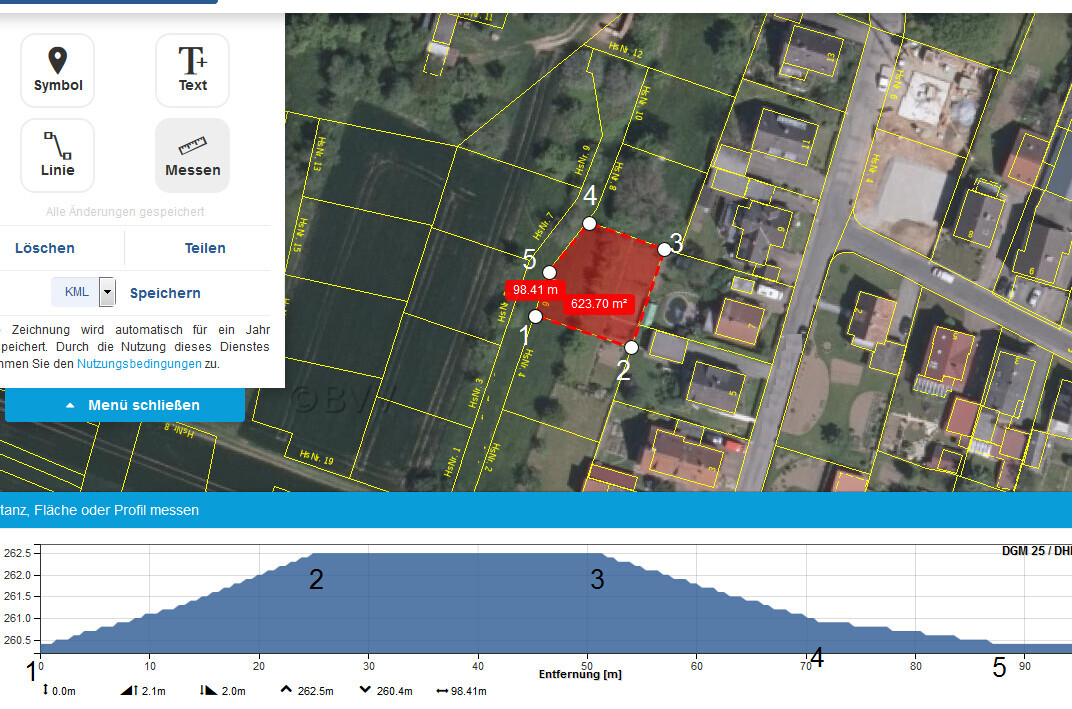
Slope: slight incline toward the street
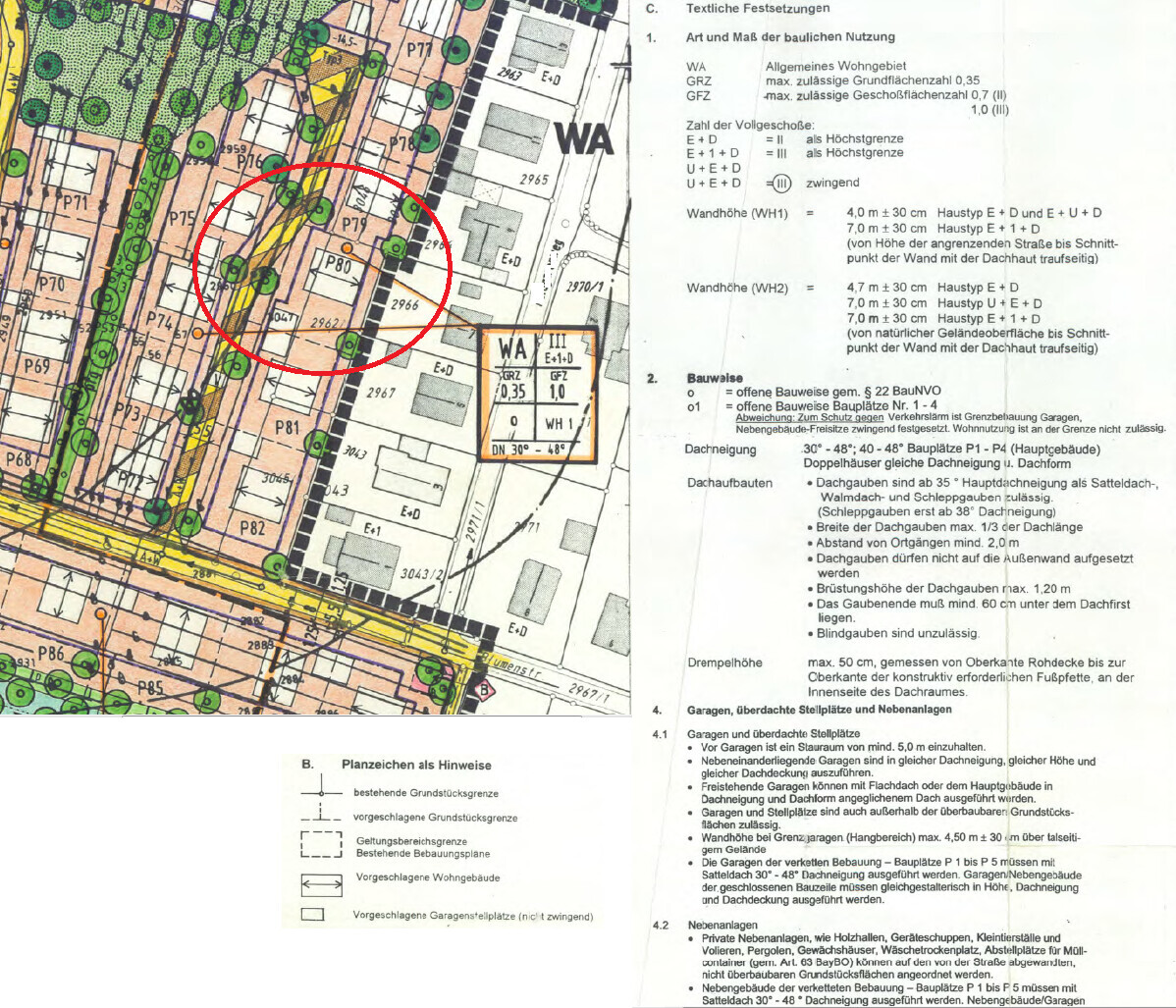
Floor area ratio (FAR): 0.35
Gross floor area ratio (GFAR): 1.0
Edge development: Located centrally in a dead-end street within a new residential development (infrastructure to be completed starting next year). The dead-end street ends to the north. A purely residential area with low traffic, as it is a small village (<2,000 inhabitants).
Number of parking spaces
Number of floors: Ground floor + 1 floor + attic as maximum limit
Roof type: gable roof
Architectural style
Orientation: east-west
Maximum height/limits: 7.0 m ±0.3 m (23 ft ±1 ft)
Additional requirements
Client Requirements
Basement, floors: No basement; 2 floors plus attic (desired knee wall height on upper floor still unclear)
Number of people, ages: Family of four – two children (ages 2 and 5 at move-in)
Space requirements on ground and upper floors
Office: family use or home office? Family use
Guest bedrooms per year: rarely
Open kitchen with island
Number of dining seats: 4
Fireplace: yes (centrally located in the living room with interior chimney or on the exterior wall?)
Music/speaker wall
Balcony, roof terrace: possibly garage roof as terrace; also terrace on the south side adjacent to the living room
Garage, carport:
Vegetable garden, greenhouse: vegetable garden
Photovoltaic system, cistern for garden (possibly also for toilet water use – cost question, still unclear)
House Design
Designed by:
- Do-it-yourself: yes
What do you particularly like? Why? Large living room facing south
What do you dislike? Why?
Estimated price according to architect/planner: €400,000 turnkey, KfW 55 standard prefabricated house with air-to-water heat pump (without garage; including foundation slab)
Personal price limit for house including fixtures: €500,000 including additional building costs
Preferred heating technology: heat pump with horizontal closed loop collector
If you have to give up, which details/upgrades
- can you give up: large garage
- cannot give up:
Why is the design the way it is now? For example:
Based on various prefabricated houses, we designed our own floor plan. The study on the ground floor should be large enough to possibly use as a bedroom. The living room faces south, and the children’s rooms are equally sized. The washing machine would go into the storage room.
What is the most important/basic question about the floor plan in 130 characters?
General room layout and positioning? Which knee wall height (1 m; 1.2 m; 1.6 m) would be optimal for space gain, cost savings, and daylight in the upper floor?
Hello,
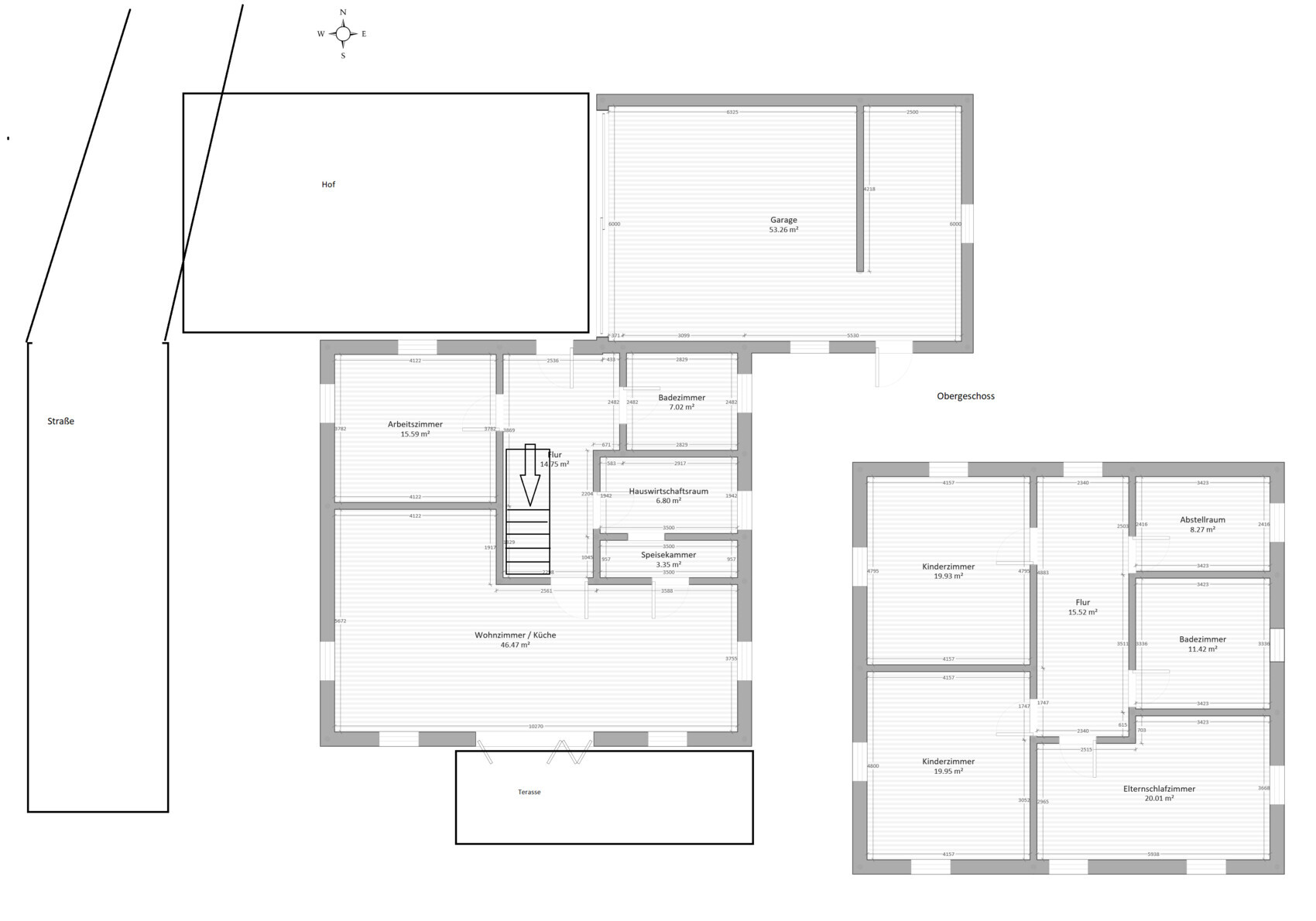
I hope the notes on the drawings are legible and understandable.
According to the development plan, only a knee wall height of 50 cm (20 inches) is allowed, but according to telephone information, deviations are approved as long as the maximum ridge height is not exceeded.
The drawing does not show any furniture.
The staircase should run straight in the hallway on the west side, so it opens in front of the two doors for the children’s rooms and the master bedroom.
Floor-to-ceiling windows are planned in the south-facing living room; all other windows will be "standard."
The kitchen is planned in the southeast corner of the house, hence the passage to the pantry. Originally, no pantry was planned; instead, there was a large utility room. On the advice of the house seller/consultant, a wall was added there so you don’t walk directly from the kitchen into the utility room.
A fireplace either next to the living room door or on the west wall.
Unfortunately, furniture was not included in the export: staircase runs straight in the hallway on the right side (when entering the house), so you reach the doors of the children’s and master bedrooms on the upper floor.
The current floor plan is based on external dimensions of 10.50 m by 11 m (34 ft 5 in by 36 ft 1 in).
If anything is unclear, please ask. Otherwise, feel free to ask questions or critique. I am not here just to receive praise (although that is always nice), but that’s not the purpose of this exercise.
Plot size: 630 m² (6,780 sq ft)
Slope: slight incline toward the street
Floor area ratio (FAR): 0.35
Gross floor area ratio (GFAR): 1.0
Edge development: Located centrally in a dead-end street within a new residential development (infrastructure to be completed starting next year). The dead-end street ends to the north. A purely residential area with low traffic, as it is a small village (<2,000 inhabitants).
Number of parking spaces
Number of floors: Ground floor + 1 floor + attic as maximum limit
Roof type: gable roof
Architectural style
Orientation: east-west
Maximum height/limits: 7.0 m ±0.3 m (23 ft ±1 ft)
Additional requirements
Client Requirements
Basement, floors: No basement; 2 floors plus attic (desired knee wall height on upper floor still unclear)
Number of people, ages: Family of four – two children (ages 2 and 5 at move-in)
Space requirements on ground and upper floors
Office: family use or home office? Family use
Guest bedrooms per year: rarely
Open kitchen with island
Number of dining seats: 4
Fireplace: yes (centrally located in the living room with interior chimney or on the exterior wall?)
Music/speaker wall
Balcony, roof terrace: possibly garage roof as terrace; also terrace on the south side adjacent to the living room
Garage, carport:
Vegetable garden, greenhouse: vegetable garden
Photovoltaic system, cistern for garden (possibly also for toilet water use – cost question, still unclear)
House Design
Designed by:
- Do-it-yourself: yes
What do you particularly like? Why? Large living room facing south
What do you dislike? Why?
Estimated price according to architect/planner: €400,000 turnkey, KfW 55 standard prefabricated house with air-to-water heat pump (without garage; including foundation slab)
Personal price limit for house including fixtures: €500,000 including additional building costs
Preferred heating technology: heat pump with horizontal closed loop collector
If you have to give up, which details/upgrades
- can you give up: large garage
- cannot give up:
Why is the design the way it is now? For example:
Based on various prefabricated houses, we designed our own floor plan. The study on the ground floor should be large enough to possibly use as a bedroom. The living room faces south, and the children’s rooms are equally sized. The washing machine would go into the storage room.
What is the most important/basic question about the floor plan in 130 characters?
General room layout and positioning? Which knee wall height (1 m; 1.2 m; 1.6 m) would be optimal for space gain, cost savings, and daylight in the upper floor?
Hello,
I hope the notes on the drawings are legible and understandable.
According to the development plan, only a knee wall height of 50 cm (20 inches) is allowed, but according to telephone information, deviations are approved as long as the maximum ridge height is not exceeded.
The drawing does not show any furniture.
The staircase should run straight in the hallway on the west side, so it opens in front of the two doors for the children’s rooms and the master bedroom.
Floor-to-ceiling windows are planned in the south-facing living room; all other windows will be "standard."
The kitchen is planned in the southeast corner of the house, hence the passage to the pantry. Originally, no pantry was planned; instead, there was a large utility room. On the advice of the house seller/consultant, a wall was added there so you don’t walk directly from the kitchen into the utility room.
A fireplace either next to the living room door or on the west wall.
Unfortunately, furniture was not included in the export: staircase runs straight in the hallway on the right side (when entering the house), so you reach the doors of the children’s and master bedrooms on the upper floor.
The current floor plan is based on external dimensions of 10.50 m by 11 m (34 ft 5 in by 36 ft 1 in).
If anything is unclear, please ask. Otherwise, feel free to ask questions or critique. I am not here just to receive praise (although that is always nice), but that’s not the purpose of this exercise.

As far as I know, it is very rare for children to continue living with their parents or move back in. Of course, this might change in some cities due to housing shortages. However, it is uncommon for a house to be divided later on to accommodate two separate households. Homeowners only need to ask themselves whether they would want or be able to move back in with their parents instead of building their own home...
Once you live in your own house with a garden, you usually don’t want to tolerate another family, especially not above you.
Once you live in your own house with a garden, you usually don’t want to tolerate another family, especially not above you.