
ᐅ New screed installation after wall opening and demolition with underfloor heating and tile flooring
Created on: 19 Feb 2026 20:52
H
hyperionHello,
we are reorganizing the rooms in our house (turning 2 rooms into 3).
This is the current room layout:

The red areas indicate heating circuits. The blue area is the hallway (it has no separate heating circuit, but the pipes to the rooms run through it). The brown area is the bathroom, where the heating manifold is located. The gray area is the stairwell.
We plan to renovate it as follows:
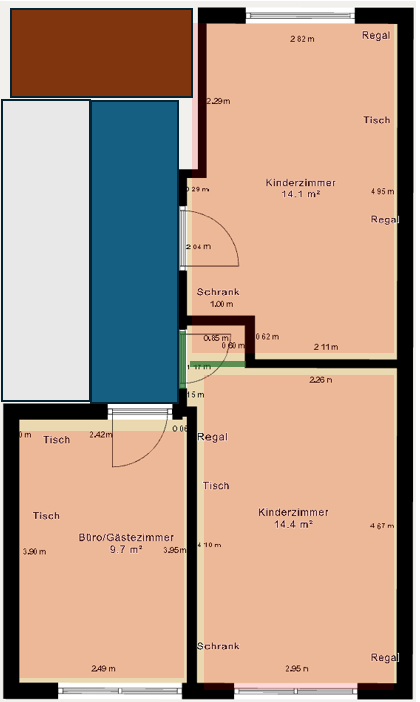
The green walls will be removed, or a door will be added. We want to install tiles throughout all three rooms and the hallway. The bathroom already has tiles. Removing the green walls will of course create a gap that needs to be filled again.
My question is: what is the best way to fill this gap so that tiles (30x150cm (12x6 inches)) can be laid later without worrying about the tiles cracking or coming loose? Especially considering that the heating circuits will no longer perfectly match the room layout. The heating circuit of the upper room extends into the lower room.
As far as I understand, there are several options:
a) Install edge insulation strips all around the green area, then fill with screed. The tiler would then need to install expansion joints wherever there are edge insulation strips. => This results in a less attractive tile layout in that area but avoids the risk of cracking. Does using an uncoupling membrane still make sense here?
b) Install edge insulation strips all around the green area, then fill with screed. Place an uncoupling membrane on top. The tiler can work WITHOUT expansion joints. => No restrictions on tile layout. I am unclear whether an uncoupling membrane alone is sufficient to prevent cracking in this case.
c) Fill with screed, cut in, then connect securely with wave clips and resin bonding. I believe this is the standard when there is NO underfloor heating. However, this solution seems counterproductive if underfloor heating is present, especially if linking the screeds effectively joins two heating circuits under one continuous screed. Would an uncoupling membrane help here?
In all cases a), b), and c), the same insulation under the screed would be used as under the other areas.
What is your opinion and why? How should this be done?
Regards
we are reorganizing the rooms in our house (turning 2 rooms into 3).
This is the current room layout:
The red areas indicate heating circuits. The blue area is the hallway (it has no separate heating circuit, but the pipes to the rooms run through it). The brown area is the bathroom, where the heating manifold is located. The gray area is the stairwell.
We plan to renovate it as follows:
The green walls will be removed, or a door will be added. We want to install tiles throughout all three rooms and the hallway. The bathroom already has tiles. Removing the green walls will of course create a gap that needs to be filled again.
My question is: what is the best way to fill this gap so that tiles (30x150cm (12x6 inches)) can be laid later without worrying about the tiles cracking or coming loose? Especially considering that the heating circuits will no longer perfectly match the room layout. The heating circuit of the upper room extends into the lower room.
As far as I understand, there are several options:
a) Install edge insulation strips all around the green area, then fill with screed. The tiler would then need to install expansion joints wherever there are edge insulation strips. => This results in a less attractive tile layout in that area but avoids the risk of cracking. Does using an uncoupling membrane still make sense here?
b) Install edge insulation strips all around the green area, then fill with screed. Place an uncoupling membrane on top. The tiler can work WITHOUT expansion joints. => No restrictions on tile layout. I am unclear whether an uncoupling membrane alone is sufficient to prevent cracking in this case.
c) Fill with screed, cut in, then connect securely with wave clips and resin bonding. I believe this is the standard when there is NO underfloor heating. However, this solution seems counterproductive if underfloor heating is present, especially if linking the screeds effectively joins two heating circuits under one continuous screed. Would an uncoupling membrane help here?
In all cases a), b), and c), the same insulation under the screed would be used as under the other areas.
What is your opinion and why? How should this be done?
Regards
Similar topics