
Hello,
how did you approach lighting design and when exactly did you plan/implement it?
I still have the option to install Halox P housings with transformer tunnel (€60) for LED recessed spots. I’m not really convinced by spots (focused light + high costs), but what alternatives are there?
how did you approach lighting design and when exactly did you plan/implement it?
I still have the option to install Halox P housings with transformer tunnel (€60) for LED recessed spots. I’m not really convinced by spots (focused light + high costs), but what alternatives are there?

R.Hotzenplotz schrieb:
But even here, the lighting designer says they deliberately chose not to create uniform illumination. A designer must first clarify what their client expects: for example, I might define my standard as "spot-free lighting" (living area), or as "consistent throughout the day" (home office), or as "no sharp contrasts, but without fully waking up" (nighttime path lighting to the bathroom or kitchen). Even "show me how to spend money stylishly on lamps" would be a legitimate brief—just certainly not one I would follow.
https://www.instagram.com/11antgmxde/
https://www.linkedin.com/company/bauen-jetzt/
Considering that apart from our quirky but bright extractor hood light and the 1 meter (3.3 feet) wide under-cabinet lighting, there is otherwise no lighting at all, and the skylight in the form of two spotlights is almost never turned on, I have to say the lighting designer really has room to be creative with your setup.
I agree with @ypg... that seems like an awful lot. Is every small red dot supposed to be a recessed ceiling spotlight?
For the hallway on the ground floor and upper floor, I would especially recommend motion sensors so the lights definitely switch off after a certain time. I personally wouldn’t want to do without that anymore in my small hallway.
Office... I wanted proper lighting above the desk—a daylight lamp that also directs light upwards. Here is a photo from the setup phase in my apartment
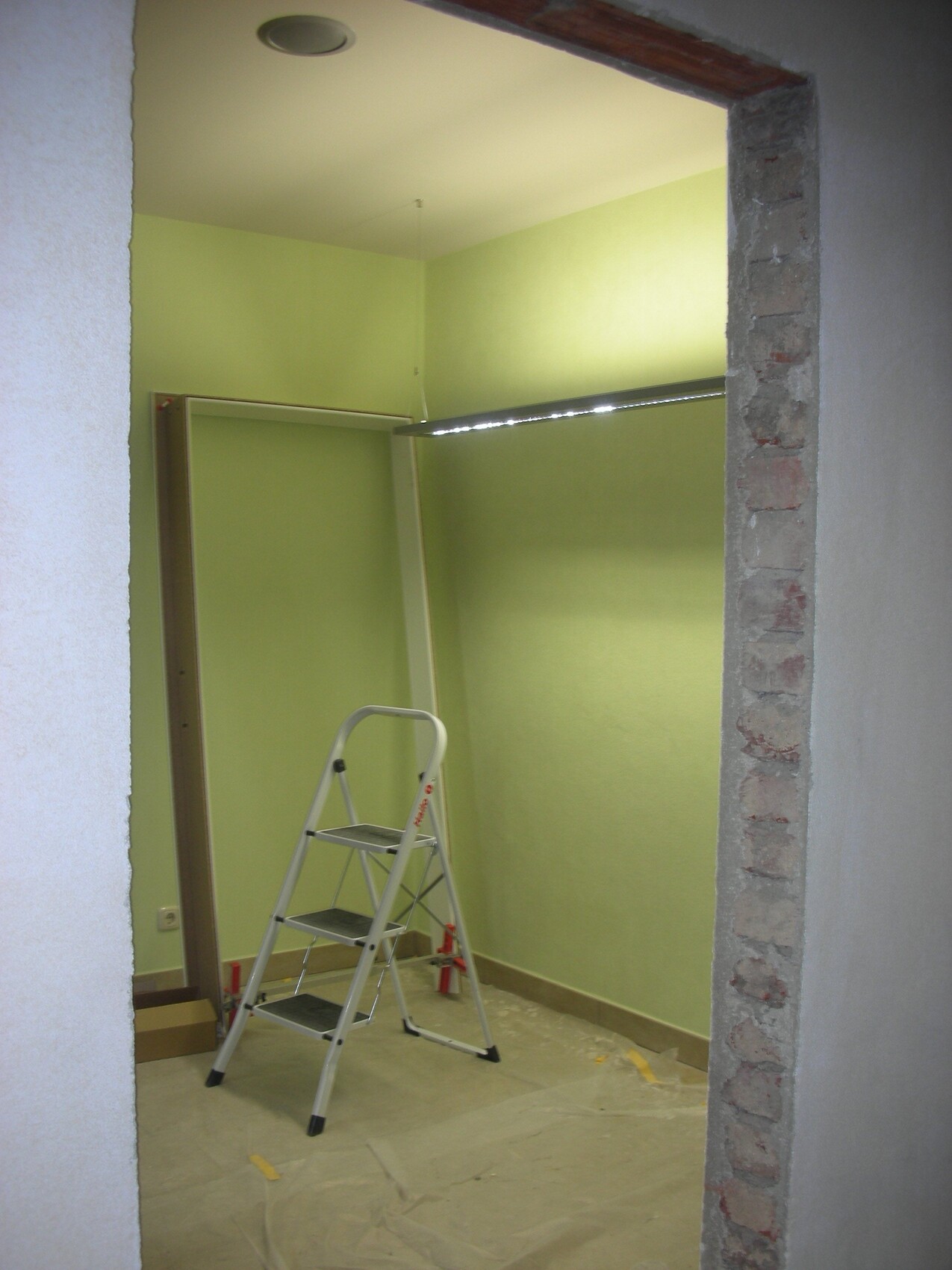
In addition, I have a simple central ceiling light that I probably could have skipped, plus a floor lamp by the sofa. For example, I can hardly think of any situation where the spotlights in the corners of the room — as planned in your setup — would be needed.
Kitchen: I consider the spotlights in the walkway between the wall unit and the peninsula to be unnecessary. Instead, I would plan an extra spotlight below the cooktop on the lower right side and one or two wall outlets or possibly one or two spotlights in the corridor area along the left wall.
Living room: I would plan at least one wall outlet on the upper wall between the windows and on the left wall rather than so many ceiling spotlights.
Upper floor master bathroom: It seems something is missing by the bathtub.
Upper floor master bedroom: Do you really need ceiling spotlights here? For me, it was especially important that bedside lamps and the main light can be switched both from the entrance and from the bed.
Upper floor children’s rooms: Here as well, bedside lights controlled from both the entrance and the bed (= socket) would be important to me, possibly also the main light switchable that way.
Upper floor hallway: Motion detectors would be practical here again, maybe set so that at night the lights don’t come on at full brightness if you just need to go to the toilet. You don’t need optimal hallway lighting then.
R.Hotzenplotz schrieb:
And whether you need emotional/atmospheric lighting in the hallway or rather bright/functional lighting, especially with kids... I think the latter.
For the hallway on the ground floor and upper floor, I would especially recommend motion sensors so the lights definitely switch off after a certain time. I personally wouldn’t want to do without that anymore in my small hallway.
Office... I wanted proper lighting above the desk—a daylight lamp that also directs light upwards. Here is a photo from the setup phase in my apartment
In addition, I have a simple central ceiling light that I probably could have skipped, plus a floor lamp by the sofa. For example, I can hardly think of any situation where the spotlights in the corners of the room — as planned in your setup — would be needed.
Kitchen: I consider the spotlights in the walkway between the wall unit and the peninsula to be unnecessary. Instead, I would plan an extra spotlight below the cooktop on the lower right side and one or two wall outlets or possibly one or two spotlights in the corridor area along the left wall.
Living room: I would plan at least one wall outlet on the upper wall between the windows and on the left wall rather than so many ceiling spotlights.
Upper floor master bathroom: It seems something is missing by the bathtub.
Upper floor master bedroom: Do you really need ceiling spotlights here? For me, it was especially important that bedside lamps and the main light can be switched both from the entrance and from the bed.
Upper floor children’s rooms: Here as well, bedside lights controlled from both the entrance and the bed (= socket) would be important to me, possibly also the main light switchable that way.
Upper floor hallway: Motion detectors would be practical here again, maybe set so that at night the lights don’t come on at full brightness if you just need to go to the toilet. You don’t need optimal hallway lighting then.
R
R.Hotzenplotz23 Feb 2018 23:17The motion detector and the programming for the nighttime dimming of the light intensity are definitely planned as described.
The red dots represent ceiling spotlights, while wall lights are indicated on the walls. There are definitely fewer than in the previous lighting plan (which is linked here). In this plan, it actually seems a bit sparse in some areas. For the hallway, guest bathroom, and possibly also the two bathrooms on the upper floor, I am considering slightly increasing the number of spotlights. I want these three areas to be quite brightly lit.
In the office, the spotlights in the corners are intended to provide even illumination throughout the room. This could be useful for programming lighting scenes.
Bathtub lighting: I will address and clarify this tomorrow.
Spotlights in the master bedroom: I don’t find them bothersome. Of course, a ceiling fixture would also be an option.
The red dots represent ceiling spotlights, while wall lights are indicated on the walls. There are definitely fewer than in the previous lighting plan (which is linked here). In this plan, it actually seems a bit sparse in some areas. For the hallway, guest bathroom, and possibly also the two bathrooms on the upper floor, I am considering slightly increasing the number of spotlights. I want these three areas to be quite brightly lit.
In the office, the spotlights in the corners are intended to provide even illumination throughout the room. This could be useful for programming lighting scenes.
Bathtub lighting: I will address and clarify this tomorrow.
Spotlights in the master bedroom: I don’t find them bothersome. Of course, a ceiling fixture would also be an option.
R.Hotzenplotz schrieb:
...I want it to be quite bright in all three areas.
In the office, the spotlights in the corners should illuminate the room evenly....Then why go through all the fuss with lighting design if you want everything bright? One or two fixtures should be enough for that, of course with dimming options or motion sensors... but I just don’t get it.
Also, this whole mood lighting thing... Light from above or a wall spotlight doesn’t make a room feel cozy at all (which I assume is what you mean by mood). Any brown paper lantern from Ikea for $4.99 at eye level beats that.
I think you’re underestimating lighting a bit.
Our 8sqm (86 sq ft) hallway is lit by two 1.5-watt wall spots pointed upwards... I would get stressed if a brightly lit room greeted me.
Similar topics