
Good morning everyone,
We finally moved into our new build at the beginning of the month.
We are struggling with high indoor humidity, and I am unsure whether this is just residual moisture from construction or if we need to take action.
Here are some key details about the house:
- 113 m2 (1,216 sq ft) detached house without a slope and no basement
- 30 cm (12 inches) aerated concrete blocks, drywall partitions on top
- Underfloor heating
- Heat pump
- Click vinyl flooring in all rooms except the ground floor hallway (which is still without flooring and will be installed once all the boxes are out of the hallway)
- No mechanical ventilation system (we now realize this was unwise, but it never came up during construction, so we never considered it)
In mid-August, we had a small water damage issue on the wall in the guest toilet on the ground floor. Fortunately, the source was quickly found and fixed. Our plumber then turned on the underfloor heating on the ground floor for a week to help dry out the moisture faster.
Currently, I ventilate 5-6 times a day.
The heat pump is still off because all rooms are still above 22°C (72°F).
Despite regular ventilation, the humidity remains consistently above 65%. At night, it rises to 75%.
We bought an electric dehumidifier, which is in the ground floor hallway, but it only manages to reduce the humidity to 60%. As soon as it is turned off, the humidity immediately rises again.
My husband says I should be patient because it’s normal for moisture levels not to drop quickly in a new build. He says to only worry if it hasn’t improved by next year.
However, I am concerned that we might have missed another water damage issue and that mold could develop in the house soon.
Is it worth investigating the cause, or is this really just residual construction moisture?
If this is normal, do we need to do more to control the humidity, or is a winter with high humidity not a problem as long as we continue ventilating regularly?
Best regards,
Sina
We finally moved into our new build at the beginning of the month.
We are struggling with high indoor humidity, and I am unsure whether this is just residual moisture from construction or if we need to take action.
Here are some key details about the house:
- 113 m2 (1,216 sq ft) detached house without a slope and no basement
- 30 cm (12 inches) aerated concrete blocks, drywall partitions on top
- Underfloor heating
- Heat pump
- Click vinyl flooring in all rooms except the ground floor hallway (which is still without flooring and will be installed once all the boxes are out of the hallway)
- No mechanical ventilation system (we now realize this was unwise, but it never came up during construction, so we never considered it)
In mid-August, we had a small water damage issue on the wall in the guest toilet on the ground floor. Fortunately, the source was quickly found and fixed. Our plumber then turned on the underfloor heating on the ground floor for a week to help dry out the moisture faster.
Currently, I ventilate 5-6 times a day.
The heat pump is still off because all rooms are still above 22°C (72°F).
Despite regular ventilation, the humidity remains consistently above 65%. At night, it rises to 75%.
We bought an electric dehumidifier, which is in the ground floor hallway, but it only manages to reduce the humidity to 60%. As soon as it is turned off, the humidity immediately rises again.
My husband says I should be patient because it’s normal for moisture levels not to drop quickly in a new build. He says to only worry if it hasn’t improved by next year.
However, I am concerned that we might have missed another water damage issue and that mold could develop in the house soon.
Is it worth investigating the cause, or is this really just residual construction moisture?
If this is normal, do we need to do more to control the humidity, or is a winter with high humidity not a problem as long as we continue ventilating regularly?
Best regards,
Sina
W
wiltshire24 Sep 2025 14:19Instead of repeatedly airing out the house, just keep it open. You are not losing any heating energy at the moment.
At first, the humidity might be a bit high, and 65% is not really problematic as long as you feel comfortable with it. Days like this do occur in summer. It will stabilize over time. The main thing is that it doesn’t become uncomfortably dry in winter.
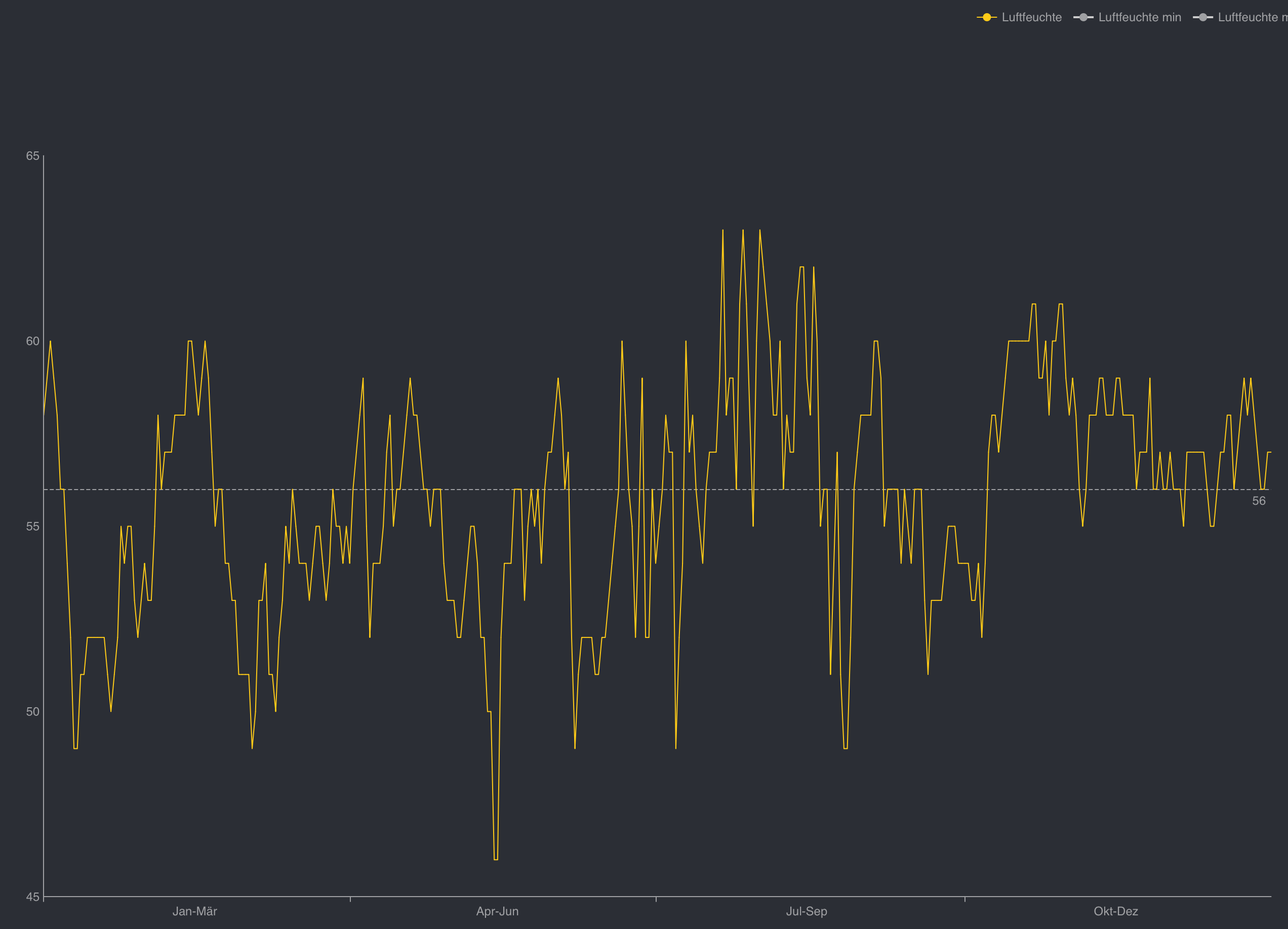
This is how it looked in our home last year – the sharp-looking profile fluctuates between 46 and 63 (and that with low-tech heating and without any special attention from us).
At first, the humidity might be a bit high, and 65% is not really problematic as long as you feel comfortable with it. Days like this do occur in summer. It will stabilize over time. The main thing is that it doesn’t become uncomfortably dry in winter.
This is how it looked in our home last year – the sharp-looking profile fluctuates between 46 and 63 (and that with low-tech heating and without any special attention from us).
wiltshire schrieb:
Instead of constantly ventilating—just leave the house open. You’re not losing any heating energy right now.
It’s true that humidity levels are a bit higher at the beginning, and 65% isn’t really a problem as long as you feel comfortable with it. You get days like that in summer. It balances out over time. The main thing is that it doesn’t get uncomfortably dry in winter.
This is how it looked in our house last year—the jagged-looking graph fluctuates between 46 and 63 (with a low-tech heating system and without any special attention from us). I wouldn’t recommend that as a general rule. In my first year, I always checked the outdoor humidity and converted it according to the current indoor temperature. Depending on that, I ventilated or not. For example, if it’s 26°C (79°F) outside at 65% humidity and 21°C (70°F) inside, leaving the window open all the time can quickly lead to mold.
Regarding the initial question:
This is completely normal in the first year. If you ventilate smartly, it will improve over time. We even had 1 or 2 damp spots in one room during the first year because of residual moisture in the lowest course of masonry. But with a dehumidifier and regular ventilation, that gradually disappeared. I always recommend installing baseboards only after 1–2 years so you can react quickly to any such issues.
Don’t be alarmed by heating costs either; they are always higher in the first year. The house is still drying out and requires more energy. As mentioned, houses used to be left to dry for some time before occupancy, but nowadays nobody can afford that since the mortgage has to be paid off. So this is completely normal.
Also, avoid placing furniture directly against exterior walls; keep some distance to help air circulate better.
Lastly, remember that you moved in during summer when the air is naturally more humid. The house will only really start to dry out during the first winter.
A
Aloha_Lars24 Sep 2025 16:48Wait for the first winter. The cold, dry air will significantly help reduce the moisture. Otherwise, everything is normal for a new build; this will naturally settle during the second year.
Similar topics