
ᐅ Nailing wood panels directly onto old wood panels? Risk of mold?
Created on: 30 Nov 2024 13:04
P
PATPATPATP
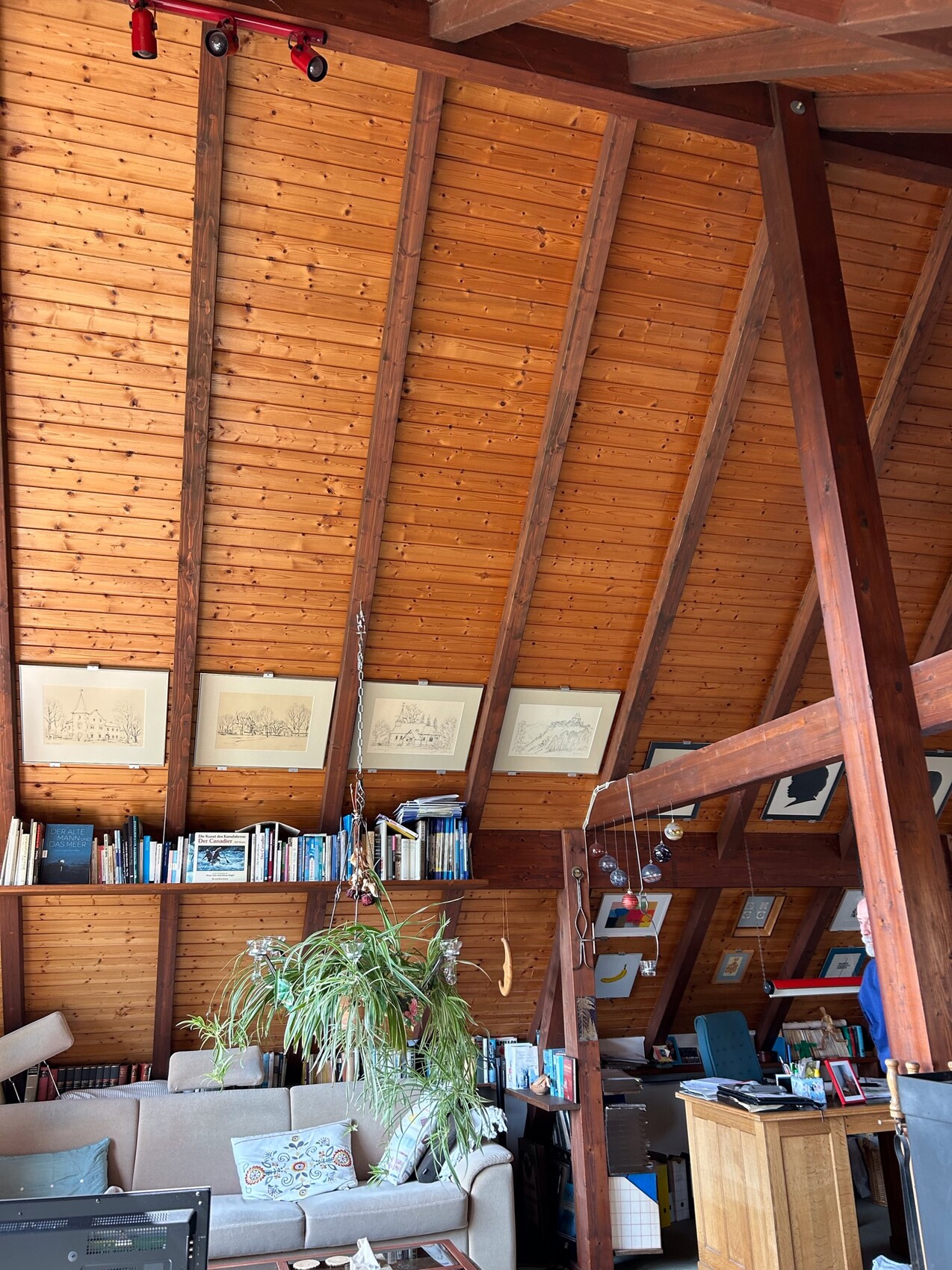
PATPATPAT30 Nov 2024 13:04Hi friends. We have a 5-meter (16-foot) high vaulted wall in the living room. It is lined with wooden panels, with beams running above them at 60cm (24 inches) intervals (see photo). In recent weeks, we have tried to figure out the best way to paint these white. However, this has proven to be very time-consuming—sanding, priming, multiple rounds of sanding… still with the risk of future cracks or spots from the wood expanding and contracting, etc.
Therefore, we are now considering either
1: removing all the beams (since they are just decorative), installing new pre-painted white wooden panels again (on the existing battens), and then reattaching the beams.
2: Or even simpler: leaving everything as is and nailing custom-cut pre-painted wooden panels directly onto the old panels between the beams (without any substructure). A thin strip would be applied as a cover at the joint between the wooden panels and the beams. This would certainly be quick and neat to do… but would this cause a mold problem? What do you generally think about these different approaches? Regards
Therefore, we are now considering either
1: removing all the beams (since they are just decorative), installing new pre-painted white wooden panels again (on the existing battens), and then reattaching the beams.
2: Or even simpler: leaving everything as is and nailing custom-cut pre-painted wooden panels directly onto the old panels between the beams (without any substructure). A thin strip would be applied as a cover at the joint between the wooden panels and the beams. This would certainly be quick and neat to do… but would this cause a mold problem? What do you generally think about these different approaches? Regards
I would consider the following:
Remove the beams, if that is relatively easy to do, leave the boards in place and paint or stain them (depending on the surface and options), then put the newly painted or treated beams back on. Why do you want to use new boards, unless you want a different look?
I wouldn’t just nail new boards on, because you really need to know what’s behind them, and nailed boards might cause problems over time. Also, it won’t be easy to fit each board precisely without ending up with the apparently unwanted dark gaps. The proposed strip would only be used to cover up these unavoidable imperfections; I personally wouldn’t like that.
I could also imagine simply screwing something new over the existing structure that I like. Maybe it would even make sense to add some insulation behind it? That seems like an easy option to me and would offer the possibility to integrate insulation as well as lighting and other features. I’m sure there are many ideas from the community here.
The room is great, so I would take more time and also consider wider options for how to give it a fresh or modern charm.
I can easily picture it spatially because I am currently sitting in a similar gallery myself.
Remove the beams, if that is relatively easy to do, leave the boards in place and paint or stain them (depending on the surface and options), then put the newly painted or treated beams back on. Why do you want to use new boards, unless you want a different look?
I wouldn’t just nail new boards on, because you really need to know what’s behind them, and nailed boards might cause problems over time. Also, it won’t be easy to fit each board precisely without ending up with the apparently unwanted dark gaps. The proposed strip would only be used to cover up these unavoidable imperfections; I personally wouldn’t like that.
I could also imagine simply screwing something new over the existing structure that I like. Maybe it would even make sense to add some insulation behind it? That seems like an easy option to me and would offer the possibility to integrate insulation as well as lighting and other features. I’m sure there are many ideas from the community here.
The room is great, so I would take more time and also consider wider options for how to give it a fresh or modern charm.
I can easily picture it spatially because I am currently sitting in a similar gallery myself.
Are you sure that sanding is necessary?
Either it is an open-pore stain, or the thin clear coat is already quite old and therefore stable. That’s my experience.
As mentioned earlier, I would remove the beams and prime them with a good primer and bonding paint.
Then apply a matte finish. The paneling shouldn’t need to settle or move anymore. The shrinkage process should be finished after about 40 years.
And if it actually does happen (no one can know what might occur), you can quickly touch it up during a commercial break. But I don’t think that will be necessary.
Either it is an open-pore stain, or the thin clear coat is already quite old and therefore stable. That’s my experience.
As mentioned earlier, I would remove the beams and prime them with a good primer and bonding paint.
Then apply a matte finish. The paneling shouldn’t need to settle or move anymore. The shrinkage process should be finished after about 40 years.
And if it actually does happen (no one can know what might occur), you can quickly touch it up during a commercial break. But I don’t think that will be necessary.

PATPATPAT schrieb:
1: Remove all the beams (since they are only decorative), then reinstall new, pre-finished white painted wood panels (onto the existing battens) and screw the beams back on. Have you experienced a situation where the beams were only installed as decoration?
I see load-bearing beams and an open roof structure here.
Before simply removing them, I would consult a structural engineer.
Nida35a schrieb:
Have you experienced when the beams were just shown as decoration?I also assumed that, at least for the thinner “rafters,” they were just decorative. They are half as thick as the central timber framing.However, you can check how the paneling behind behaves, whether it is segmented or continuous.
I consider the central timber framing in the room, as well as the main beam, to be load-bearing.
But you’re right about consulting a structural engineer or a carpenter.
 ateliersiegel15 Dec 2024 12:29
what other options there are to give this one a new or modern charmWhat I consider "just decoration" usually looks unattractive to me. In my opinion, charm, appeal, and beauty come from the feeling that a building has a purpose. Attaching beams somewhere that are completely unnecessary, just to make it look like they have a supporting function, bothers me.
However, I admit that I don’t have a suggestion for what I would do in this situation.
Since this is "resolved for now," that’s fine.
Similar topics