
ᐅ Multi-family house (3 residential units, basement living area, double garage): Planning suggestions
Created on: 10 Dec 2015 20:57
M
MarcWen
Development Plan / Restrictions
Plot Size: approximately 1,700 sqm (18,300 sq ft), parallelogram shape, north-south orientation (entrance on the north)
Slope: none
Development Plan: no, §34 local neighborhood building regulations
Number of Parking Spaces: 1 per residential unit
Client Requirements
Building Type: KfW Energy-saving house 55 standard
Basement, Floors: yes, 2 full floors
Number of Occupants, Age: clients (39 and 33 years old) + daughter (10 months), second child planned, parents-in-law (72 and 58 years old)
Space Requirements in Basement: basement (residential basement) barrier-free, approx. 75 sqm (800 sq ft) separate apartment (for parents-in-law), technical room, utility room, storage room
Space Requirements on Ground Floor: ground floor barrier-free, all daily living areas (including bathroom, bedroom, office)
Space Requirements on Upper Floor: upper floor: 2 children’s rooms + guest room
Office: family use and home office (1-2 days per week)
Guest Overnight Stays per Year: approx. 20
Open or Closed Architecture: both, cost-benefit and practical considerations
Conventional or Modern Style: both, cost-benefit and practical considerations
Open Kitchen, Cooking Island: yes, yes
Number of Dining Seats: 3-4, with guests 6-8
Fireplace: no
Music / Stereo Wall: no
Balcony, Roof Terrace: yes, no (not feasible)
Garage, Carport: yes, no
Utility Garden, Greenhouse: no, no
Additional Wishes / Special Features / Daily Routine:
The requirement was to create two barrier-free apartments. Additionally, the ground floor should include all daily living spaces. Since we currently live in an 85 sqm (915 sq ft), 3-room apartment, the planned ground floor should offer no less than 100 sqm (1,076 sq ft) of living space. The upper floor is planned flexibly with 2 children’s rooms and a separate residential unit. This unit could be rented out, used for caregiving staff, or later occupied by the children. Theoretically, after the children move out, the entire upper floor could also be rented out.
A roof terrace on the double garage is not possible due to boundary building restrictions. We had to weigh between a 3-meter (10 feet) roof terrace with a double garage versus two single garages and chose the double garage.
House Design
Planner: architect
What is Especially Appreciated? The design is mainly based on our specifications, as well as ideas from our architect. Many rooms are simply and practically designed and are modest in size. Some conveniences have been deliberately omitted. There are also certain constraints from the plot (building window) and requirements from the building authority.
What Still Needs to be Changed?
· Move window and door in the garage forward, with door opening outward
· Partially cancel west balcony on ground floor; close “house cutout loggia” on ground floor, create more space in the living area, install window with sill on the west side, large balcony door on the south side similar to basement bedroom; remaining is a small south-facing sun balcony
· Add a third small window in the stairwell on the upper floor, matching the appearance on the north side
Personal Price Limit for the House, Including Equipment: 500,000 euros
Preferred Heating Technology: gas, but dependent on the energy concept
Request: The longer one works on the plans, the harder it becomes to review them objectively. Therefore, we appreciate any further tips and suggestions. The interior layout is not yet final. Decisions on bathroom design and doors are still to be made. It is important that the building is sufficiently finalized so that the building permit / planning permission can be obtained by the end of 2015. The building elevations are naturally still rough (stairs, ramps).
Plot Size: approximately 1,700 sqm (18,300 sq ft), parallelogram shape, north-south orientation (entrance on the north)
Slope: none
Development Plan: no, §34 local neighborhood building regulations
Number of Parking Spaces: 1 per residential unit
Client Requirements
Building Type: KfW Energy-saving house 55 standard
Basement, Floors: yes, 2 full floors
Number of Occupants, Age: clients (39 and 33 years old) + daughter (10 months), second child planned, parents-in-law (72 and 58 years old)
Space Requirements in Basement: basement (residential basement) barrier-free, approx. 75 sqm (800 sq ft) separate apartment (for parents-in-law), technical room, utility room, storage room
Space Requirements on Ground Floor: ground floor barrier-free, all daily living areas (including bathroom, bedroom, office)
Space Requirements on Upper Floor: upper floor: 2 children’s rooms + guest room
Office: family use and home office (1-2 days per week)
Guest Overnight Stays per Year: approx. 20
Open or Closed Architecture: both, cost-benefit and practical considerations
Conventional or Modern Style: both, cost-benefit and practical considerations
Open Kitchen, Cooking Island: yes, yes
Number of Dining Seats: 3-4, with guests 6-8
Fireplace: no
Music / Stereo Wall: no
Balcony, Roof Terrace: yes, no (not feasible)
Garage, Carport: yes, no
Utility Garden, Greenhouse: no, no
Additional Wishes / Special Features / Daily Routine:
The requirement was to create two barrier-free apartments. Additionally, the ground floor should include all daily living spaces. Since we currently live in an 85 sqm (915 sq ft), 3-room apartment, the planned ground floor should offer no less than 100 sqm (1,076 sq ft) of living space. The upper floor is planned flexibly with 2 children’s rooms and a separate residential unit. This unit could be rented out, used for caregiving staff, or later occupied by the children. Theoretically, after the children move out, the entire upper floor could also be rented out.
A roof terrace on the double garage is not possible due to boundary building restrictions. We had to weigh between a 3-meter (10 feet) roof terrace with a double garage versus two single garages and chose the double garage.
House Design
Planner: architect
What is Especially Appreciated? The design is mainly based on our specifications, as well as ideas from our architect. Many rooms are simply and practically designed and are modest in size. Some conveniences have been deliberately omitted. There are also certain constraints from the plot (building window) and requirements from the building authority.
What Still Needs to be Changed?
· Move window and door in the garage forward, with door opening outward
· Partially cancel west balcony on ground floor; close “house cutout loggia” on ground floor, create more space in the living area, install window with sill on the west side, large balcony door on the south side similar to basement bedroom; remaining is a small south-facing sun balcony
· Add a third small window in the stairwell on the upper floor, matching the appearance on the north side
Personal Price Limit for the House, Including Equipment: 500,000 euros
Preferred Heating Technology: gas, but dependent on the energy concept
Request: The longer one works on the plans, the harder it becomes to review them objectively. Therefore, we appreciate any further tips and suggestions. The interior layout is not yet final. Decisions on bathroom design and doors are still to be made. It is important that the building is sufficiently finalized so that the building permit / planning permission can be obtained by the end of 2015. The building elevations are naturally still rough (stairs, ramps).
P
Polle 196711 Dec 2015 22:56Hello, after reading everything already discussed here, one thing is still unclear to me: why do you want a flat, soil-based plot? Wouldn’t a sloped site be more practical? There, you could have the ground floor accessible at ground level, which might be much easier considering your mobility, and place the garage on the ground floor. The entrance to the basement could be set on the side.
You wouldn’t need to excavate the entire plot, which would be a significant cost factor. Just transporting and disposing of the excavated material would probably cost you a fortune.
I’m also not sure if the excavation will be approved by the building authorities without any issues. Moreover, only about two-thirds of basements are allowed to be free-standing with two full stories. You should first consult with the building department, as they might count your three full stories differently.
You wouldn’t need to excavate the entire plot, which would be a significant cost factor. Just transporting and disposing of the excavated material would probably cost you a fortune.
I’m also not sure if the excavation will be approved by the building authorities without any issues. Moreover, only about two-thirds of basements are allowed to be free-standing with two full stories. You should first consult with the building department, as they might count your three full stories differently.
B
Bauexperte11 Dec 2015 23:18Good evening,
The upper floor also has a hallway acting as a distribution point, but the hallway will also be used somewhat privately by the children, for example, when they visit each other. If the children’s rooms were separated in the same way as the granny flat in the basement, they would have their own fully private area; they could, for example, walk naked through the hallway without worrying that someone from the ground floor or the granny flat might see or disturb them. Kids grow up after all and sometimes have visitors at night 😀
Regards, Bauexperte
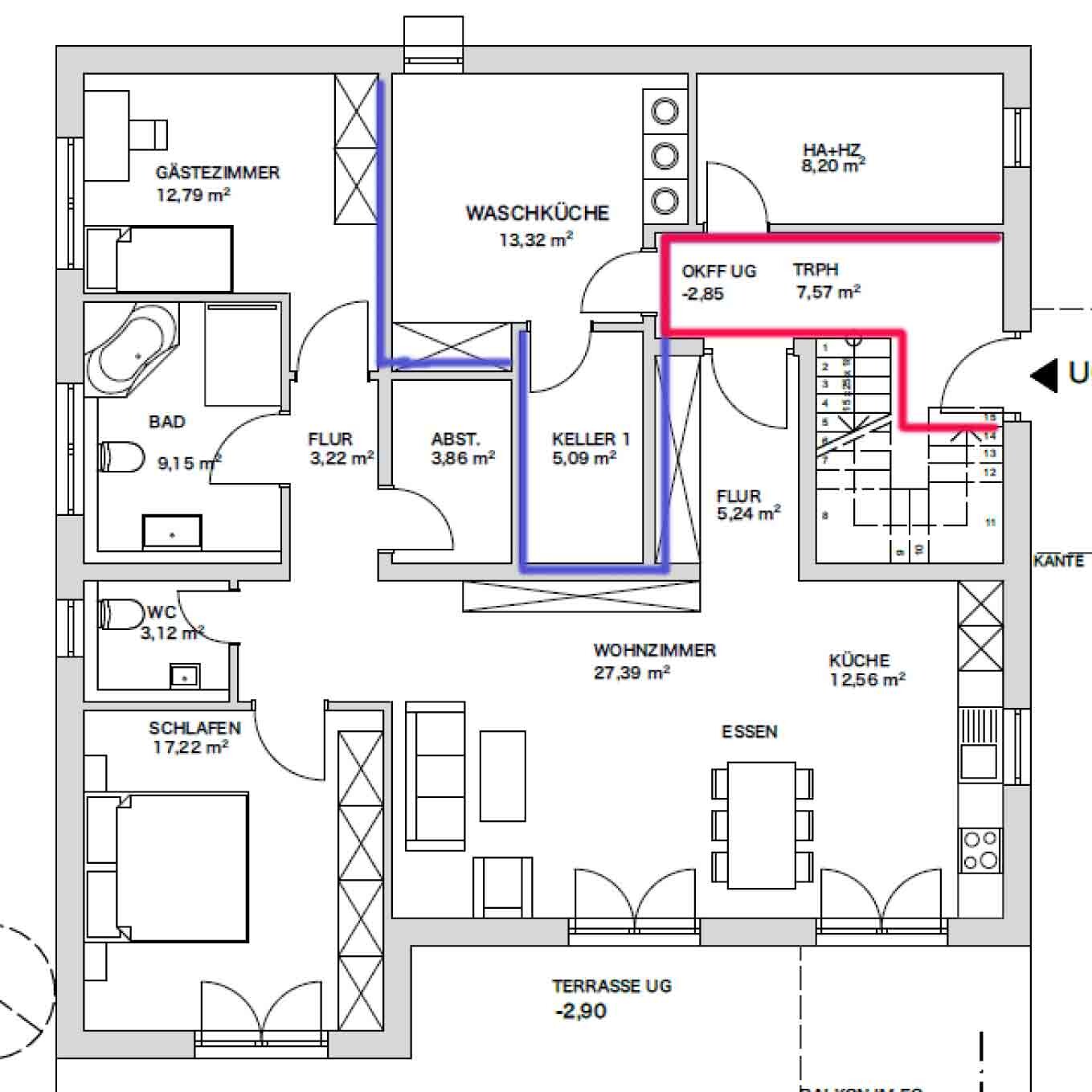
MarcWen schrieb:The basement clearly has distinct, separate areas (see plan). There is a hallway area that provides access to the utility rooms as well as to the granny flat. The only shared space is the hallway. In other words, anyone coming from the ground floor into the utility rooms does not "disturb the in-laws," and vice versa.
What I didn’t fully understand is where you see a difference between the upper floor and the basement.
The upper floor also has a hallway acting as a distribution point, but the hallway will also be used somewhat privately by the children, for example, when they visit each other. If the children’s rooms were separated in the same way as the granny flat in the basement, they would have their own fully private area; they could, for example, walk naked through the hallway without worrying that someone from the ground floor or the granny flat might see or disturb them. Kids grow up after all and sometimes have visitors at night 😀
Regards, Bauexperte

"@w.pickartz: I am a mathematician, not an artist. I probably couldn’t distinguish a house with an 'a-concept' from one without, but I am open to learning.
Alright! So a mathematician. Let’s put aside the discussion about the functional aspects of floor plans for now. An architect is expected to be able to calculate. For a mathematician—attention! inverse assumption!—I expect that they can engage with aesthetics/beauty, with measure/number/proportion (the golden ratio! + the Fibonacci sequence!), beyond the abstract beauty of mathematical proofs, which have already gained some recognition in specialist circles:
“Mathematical beauty can mainly be found on three levels, which are closely connected:
First, the level of surprise. The most fascinating proofs are always those that you only fully understand with the last sentence, and then immediately grasp entirely.
The second level is the elegance and clarity of a mathematical result. Clarity is relieving and generates the feeling of mastering the subject. Often, the degree of elegance and clarity can be surprising.
The third level is structure. Recognizing relationships between objects is the driving force of all science, and probably in no science have structures been demonstrated as clearly and rigorously as in mathematics. This level points to the harmonious cosmos and the transcendental.
A fourth level, which is not scientifically accessible, is that of mystical beauty. Followers of Kabbalah or numerology attribute extended meaning to mathematical objects, especially the seven natural numbers, whose parallel interplay on mathematical and extended levels possesses a fascinating structure and thus a certain form of beauty.”
Explain the aesthetics of the house design, the consistent inner logic of the floor plans, and the delicate proportional relationships of the facade using the tools of your science, and search for a clear answer to the fundamental question: Is this a beautiful house?
Alright! So a mathematician. Let’s put aside the discussion about the functional aspects of floor plans for now. An architect is expected to be able to calculate. For a mathematician—attention! inverse assumption!—I expect that they can engage with aesthetics/beauty, with measure/number/proportion (the golden ratio! + the Fibonacci sequence!), beyond the abstract beauty of mathematical proofs, which have already gained some recognition in specialist circles:
“Mathematical beauty can mainly be found on three levels, which are closely connected:
First, the level of surprise. The most fascinating proofs are always those that you only fully understand with the last sentence, and then immediately grasp entirely.
The second level is the elegance and clarity of a mathematical result. Clarity is relieving and generates the feeling of mastering the subject. Often, the degree of elegance and clarity can be surprising.
The third level is structure. Recognizing relationships between objects is the driving force of all science, and probably in no science have structures been demonstrated as clearly and rigorously as in mathematics. This level points to the harmonious cosmos and the transcendental.
A fourth level, which is not scientifically accessible, is that of mystical beauty. Followers of Kabbalah or numerology attribute extended meaning to mathematical objects, especially the seven natural numbers, whose parallel interplay on mathematical and extended levels possesses a fascinating structure and thus a certain form of beauty.”
Explain the aesthetics of the house design, the consistent inner logic of the floor plans, and the delicate proportional relationships of the facade using the tools of your science, and search for a clear answer to the fundamental question: Is this a beautiful house?

@Polle-1967: At first, we were also considering a plot with a slope. But the problem is that a hillside is usually more of a disadvantage. In addition, finding a plot is difficult enough—size, building envelope, location, orientation. We failed about 90% of the zoning plans. Then there’s the issue of groundwater, which should not be underestimated. If you’re searching in a limited market (Cologne surrounding area), a sloped plot moves far down the list. The current plot suits the planning very well; we would hardly need to excavate. Most likely, we will have to bring in soil for filling.
Ground floor at street level means you drop 2.80 meters (9.2 feet) down to the basement. The idea is, if you stand at street level zero, there’s half a floor down and half a floor up from there. The basement will be a full story; for the upper floor, we’ll be careful not to make it a full story.
(Floor area upper floor: 7.26 x 13.0 + 2.0 x 0.49 + 4.74 x 13.0 = 156.99 square meters (1690 square feet)
ALLOWED: 156.99 sqm x 0.75 = 117.74 sqm (1266 sqft)
CROSS-SECTION AT 2.30 M (7.5 feet) LINE: 117.10 sqm (CAD determined)
117.10 < 117.74)
@Bauexperte: But that’s a bit of a catch-22. You’d only be undisturbed in the basement if the parents-in-law locked themselves in their apartment. The idea is the same—a corridor with 3 doors as a distribution area. You could probably redesign the upper floor so that both children’s rooms are arranged to avoid any impact on the rental apartment below. Or plan the upper floor to remove the shared corridor entirely. But the “problem” only shifts. In the shared staircase, there remains an overlap, not an empty set. So if our daughter walks naked through the staircase at night, since we gave up a children’s bathroom, she could run into our tenant(s) in the stairwell.
@w.pickartz: A really interesting explanation—I like it a lot (and I mean that sincerely). But asked differently, what practical benefit does it bring me? If I said the windows for the ground floor guest WC, bathroom, and office are spaced in the same ratios as the Earth to the Moon and the Sun, then 50% of readers here would say, “Ah, I didn’t even notice that,” and 50% would say, “Great, that means no extra light at night inside the house.” The question whether this is a beautiful house I cannot answer, because I lack a definition of “beautiful.” However, I can very clearly say what I like, what I don’t like, and what I’m indifferent about. We approached the topic differently and planned our ideas in detail, the floors among other things, in Excel. We placed the staircase centrally, slightly toward the front, then tried to bring light into the upper floor. Otherwise, the house is rectangular with a gable roof, simple. Partly because of costs and partly because neighboring buildings are quite plain too. By comparison, we like the current design very much. The idea of a shared corridor on the left (saves unnecessary hallways) or the created entrance area on the ground floor, where you have a covered space without having to worry later about how to attach a proper roof to the house wall without standing in the rain or having mailboxes constantly get wet. My wife has already imagined the eastern extension either painted or brick-clad. Not sure if we’ll do anything distinctive to the exterior look.
Ground floor at street level means you drop 2.80 meters (9.2 feet) down to the basement. The idea is, if you stand at street level zero, there’s half a floor down and half a floor up from there. The basement will be a full story; for the upper floor, we’ll be careful not to make it a full story.
(Floor area upper floor: 7.26 x 13.0 + 2.0 x 0.49 + 4.74 x 13.0 = 156.99 square meters (1690 square feet)
ALLOWED: 156.99 sqm x 0.75 = 117.74 sqm (1266 sqft)
CROSS-SECTION AT 2.30 M (7.5 feet) LINE: 117.10 sqm (CAD determined)
117.10 < 117.74)
@Bauexperte: But that’s a bit of a catch-22. You’d only be undisturbed in the basement if the parents-in-law locked themselves in their apartment. The idea is the same—a corridor with 3 doors as a distribution area. You could probably redesign the upper floor so that both children’s rooms are arranged to avoid any impact on the rental apartment below. Or plan the upper floor to remove the shared corridor entirely. But the “problem” only shifts. In the shared staircase, there remains an overlap, not an empty set. So if our daughter walks naked through the staircase at night, since we gave up a children’s bathroom, she could run into our tenant(s) in the stairwell.
@w.pickartz: A really interesting explanation—I like it a lot (and I mean that sincerely). But asked differently, what practical benefit does it bring me? If I said the windows for the ground floor guest WC, bathroom, and office are spaced in the same ratios as the Earth to the Moon and the Sun, then 50% of readers here would say, “Ah, I didn’t even notice that,” and 50% would say, “Great, that means no extra light at night inside the house.” The question whether this is a beautiful house I cannot answer, because I lack a definition of “beautiful.” However, I can very clearly say what I like, what I don’t like, and what I’m indifferent about. We approached the topic differently and planned our ideas in detail, the floors among other things, in Excel. We placed the staircase centrally, slightly toward the front, then tried to bring light into the upper floor. Otherwise, the house is rectangular with a gable roof, simple. Partly because of costs and partly because neighboring buildings are quite plain too. By comparison, we like the current design very much. The idea of a shared corridor on the left (saves unnecessary hallways) or the created entrance area on the ground floor, where you have a covered space without having to worry later about how to attach a proper roof to the house wall without standing in the rain or having mailboxes constantly get wet. My wife has already imagined the eastern extension either painted or brick-clad. Not sure if we’ll do anything distinctive to the exterior look.
Here is a brief update and the latest plans as requested.
The land registry transfer was completed last week, so we are now officially the owners. Unfortunately, the building permit / planning permission has not been granted yet; we are waiting for it every day so that we can finally proceed.
Attached are the current plan figures:
The plans and images are mostly schematic or indicative:
The plot suits our project very well. Because of a slight east-west slope, we only have to remove about 1.50 meters (5 feet) of soil on the east side (garage) and then probably add fill on the west side so that we can access the garden at ground-floor level. There are neighbors to the east and north. Otherwise, it is a quiet cul-de-sac, a turning area, and a location on the edge of town. To the west, there is a dam adjoining a country road, and to the south, there is an open view far across the fields.
Attached are the site plan, north elevation with terrain profile, and the basement, ground floor, and upper floor plans:
The land registry transfer was completed last week, so we are now officially the owners. Unfortunately, the building permit / planning permission has not been granted yet; we are waiting for it every day so that we can finally proceed.
Attached are the current plan figures:
- Calculation of living and usable areas according to DIN 283 and II.BVO: total usable area 55 sqm (590 sq ft), total living area 322 sqm (3,466 sq ft)
- Gross volume: 1,500 cbm (53,000 cu ft) residential building, 165 cbm (5,825 cu ft) garage
The plans and images are mostly schematic or indicative:
- Bathrooms and service shafts will still be properly planned
- The regulations require that the ground floor entrance has a maximum slope of 6%. The path will therefore either be integrated into the front yard, or we will plan a stairlift/platform lift at the stairs. So, there will be no large ramp installed
- In the basement, there will be a large terrace facing south, approximately 4 x 10 meters (13 x 33 feet), partially covered by our balcony on the east side. Of course, there will also be access to the garden. Since my in-laws (family) will be moving in here, the basement (laundry room) will be shared. Also, there will be no strict separation between the garden and terrace areas. However, a clear boundary was important to us
- On the ground floor, we will plan a proper garden access from our west balcony, no spiral staircase. Ideally, it will be level access. We have about 800 sqm (8,600 sq ft) of undeveloped land on the southwest side for planning and use. Exact plans have not been made yet; we still need ideas or will probably hire a landscape architect. Planned are a terrace, barbecue area, play area, and a low-maintenance garden
- The separate apartment in the attic will likely be rented out. Exactly how is not decided yet. Through friends, we know that in the Cologne-Bonn area many military personnel look for short-term rentals during the week. We have planned a clear separation—washing machine in the bathroom, balcony available, no cellar use. Whether we include garden access will depend on the tenants and mutual agreement
The plot suits our project very well. Because of a slight east-west slope, we only have to remove about 1.50 meters (5 feet) of soil on the east side (garage) and then probably add fill on the west side so that we can access the garden at ground-floor level. There are neighbors to the east and north. Otherwise, it is a quiet cul-de-sac, a turning area, and a location on the edge of town. To the west, there is a dam adjoining a country road, and to the south, there is an open view far across the fields.
Attached are the site plan, north elevation with terrain profile, and the basement, ground floor, and upper floor plans:
Similar topics