
Hello everyone,
we are currently building a single-family house with a basement apartment.
Our initial plan was as follows: You access the basement via a staircase. There is an exterior entrance door at the basement level. When you enter through this door, you come into a kind of hallway. From this hallway, there is one entrance to the 3-room basement apartment and another entrance to the utility room.
However, since one of the basement apartment rooms could not be classified as a quiet/sleeping room due to its orientation, we moved the door of this room to the "outside," meaning to the mentioned hallway, and declared it as a cellar. This left the basement apartment with only 2 rooms, and the hallway now has three entrances: to the apartment, to the cellar, and to the utility room.
We submitted the building permit / planning permission with this setup, and it was approved. In hindsight, we think it would be better to move the door back into the apartment so that the room can be used as a 3rd room for hobbies, work, storage, or similar (not as a quiet/sleeping room). From a financial perspective, a 3-room apartment would be more advantageous than a 2-room apartment.
Would I be able to relocate the door without issues, or would I need to apply for approval again? Getting approval would not be a problem, but I want to avoid losing time since we are already delayed. Also, I’d prefer not to pay unnecessarily. It is basically just one door being moved about 2m (6.5 feet); no other changes are involved.
Thank you in advance.
Best regards
we are currently building a single-family house with a basement apartment.
Our initial plan was as follows: You access the basement via a staircase. There is an exterior entrance door at the basement level. When you enter through this door, you come into a kind of hallway. From this hallway, there is one entrance to the 3-room basement apartment and another entrance to the utility room.
However, since one of the basement apartment rooms could not be classified as a quiet/sleeping room due to its orientation, we moved the door of this room to the "outside," meaning to the mentioned hallway, and declared it as a cellar. This left the basement apartment with only 2 rooms, and the hallway now has three entrances: to the apartment, to the cellar, and to the utility room.
We submitted the building permit / planning permission with this setup, and it was approved. In hindsight, we think it would be better to move the door back into the apartment so that the room can be used as a 3rd room for hobbies, work, storage, or similar (not as a quiet/sleeping room). From a financial perspective, a 3-room apartment would be more advantageous than a 2-room apartment.
Would I be able to relocate the door without issues, or would I need to apply for approval again? Getting approval would not be a problem, but I want to avoid losing time since we are already delayed. Also, I’d prefer not to pay unnecessarily. It is basically just one door being moved about 2m (6.5 feet); no other changes are involved.
Thank you in advance.
Best regards
Ruffy99 schrieb:
In hindsight, we think it would be smarter to move the door back to the granny flat, so the room could be used as a third room for hobbies, work, storage, or similar purposes (not as a quiet/sleeping room). From a financial perspective, a three-room apartment would be better than a two-room apartment.However, a three-room apartment is only considered as such if the third room can actually be used as a proper living space.Otherwise, I recommend posting a floor plan to take a closer look.
I’ve made a sketch.
The focus is on the red door.
The blue door leads into the secondary apartment.
Would it require a new building permit / planning permission to move the red door inward as shown in the sketch?
This room may certainly be used as living space. It can be a common room, but not a bedroom or resting room. For example, I could imagine it being used as a home office.
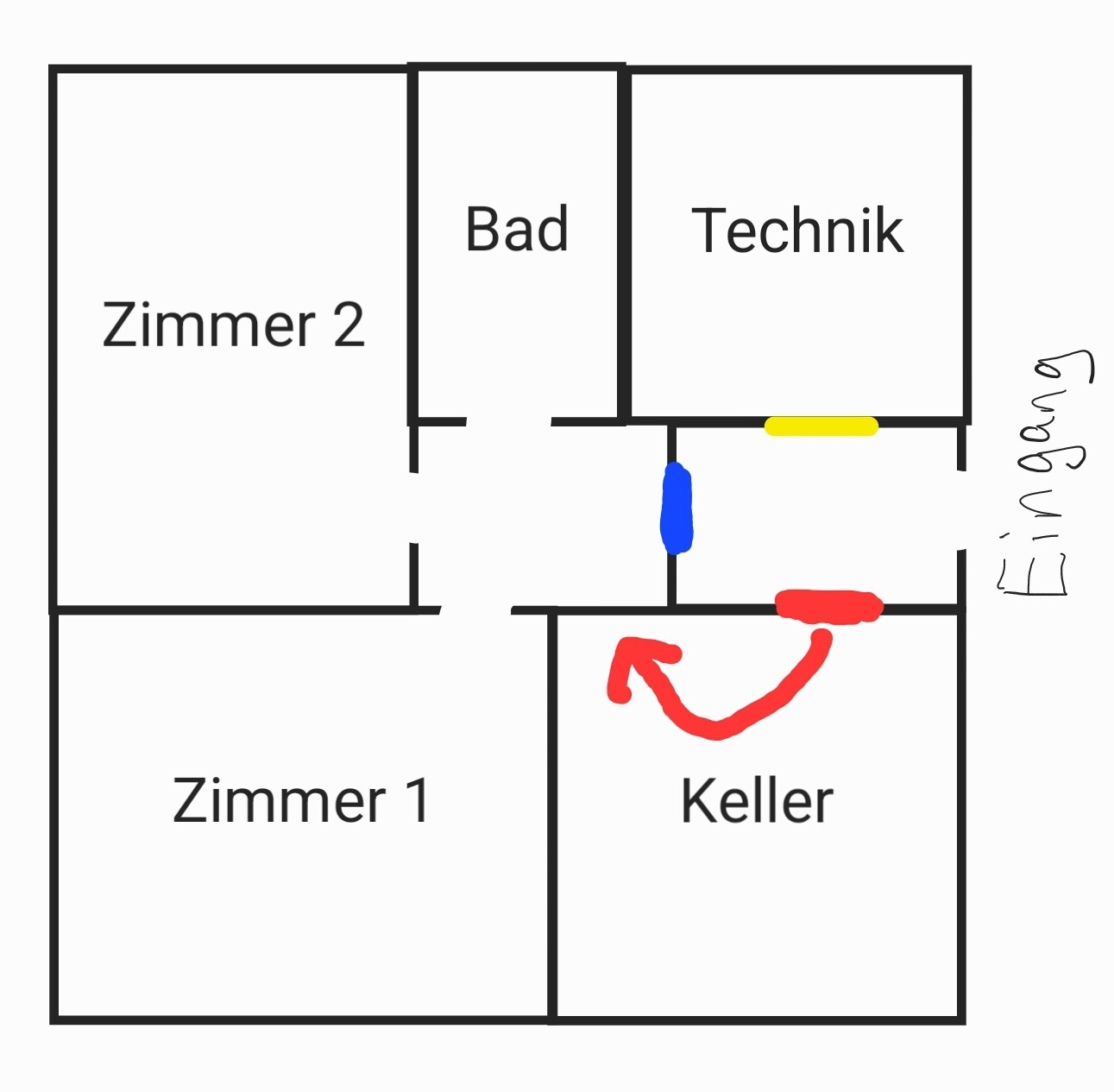
The focus is on the red door.
The blue door leads into the secondary apartment.
Would it require a new building permit / planning permission to move the red door inward as shown in the sketch?
This room may certainly be used as living space. It can be a common room, but not a bedroom or resting room. For example, I could imagine it being used as a home office.
Ruffy99 schrieb:
It can be a living room, just not a bedroom or resting room. For example, I could imagine a study. However, building regulations do not distinguish between a resting room and a bedroom – a room is either recognized as a living space or not.
Regarding rental, it is legally questionable to declare a room as suitable for “working” but not for “sleeping.” Basically, it would be considered a storage room.
In a worst-case scenario, as a landlord, you could end up in a situation you want to avoid.
I assume that there is no appropriate window. To properly assess this, the basement plan must be reviewed, not just a sketch that omits important details.
Regarding your question: since the door is crucial for the secondary apartment, you would be building contrary to the approved permit/planning permission.
A sufficiently large window is also present. However, the orientation of the window was the only reason why this room cannot be classified as a rest or sleeping room. The window of a sleeping room must face the noise-protected side, which was not possible here due to the terrace and other factors.
In fact, a distinction is made between rest/sleeping rooms and living rooms. Originally, the regulation applied to living rooms. This regulation has since been relaxed so that it now applies only to rest/sleeping rooms, not to living rooms.
In fact, a distinction is made between rest/sleeping rooms and living rooms. Originally, the regulation applied to living rooms. This regulation has since been relaxed so that it now applies only to rest/sleeping rooms, not to living rooms.
Could you please quote the specific paragraph from the Baden-Württemberg state building code that makes this distinction? I am not aware of any differentiation between bedrooms and living rooms. I think that perhaps one of the paragraphs below does not apply to your basement room and therefore it cannot be used as a living space, but only as a storage room.
§34
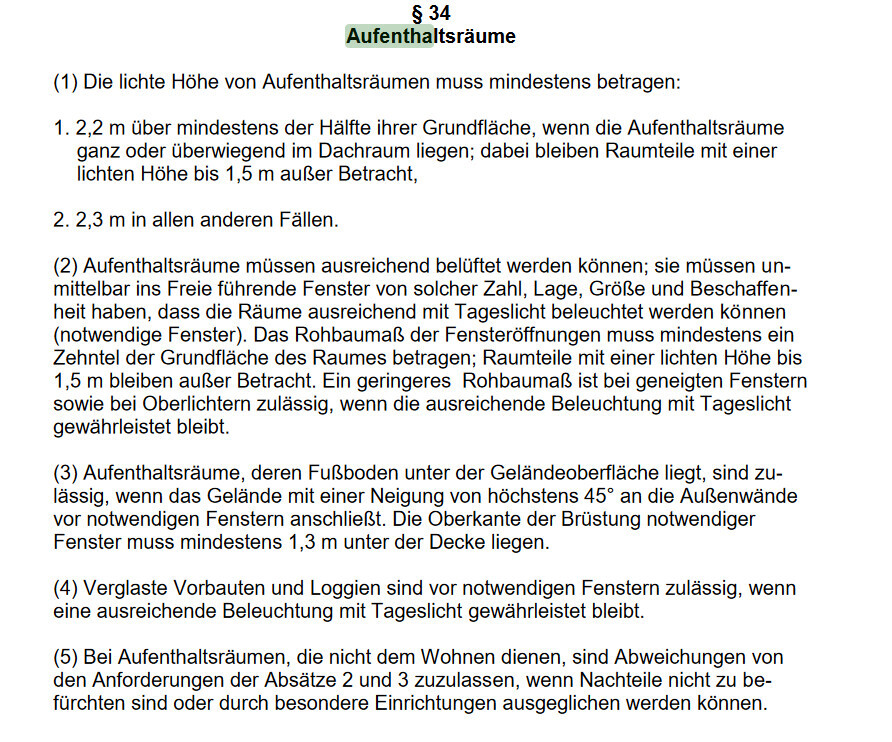
§34
Similar topics