
H
Hausmann197525 Jan 2024 14:46Hello, I’m new to the forum and have a question:
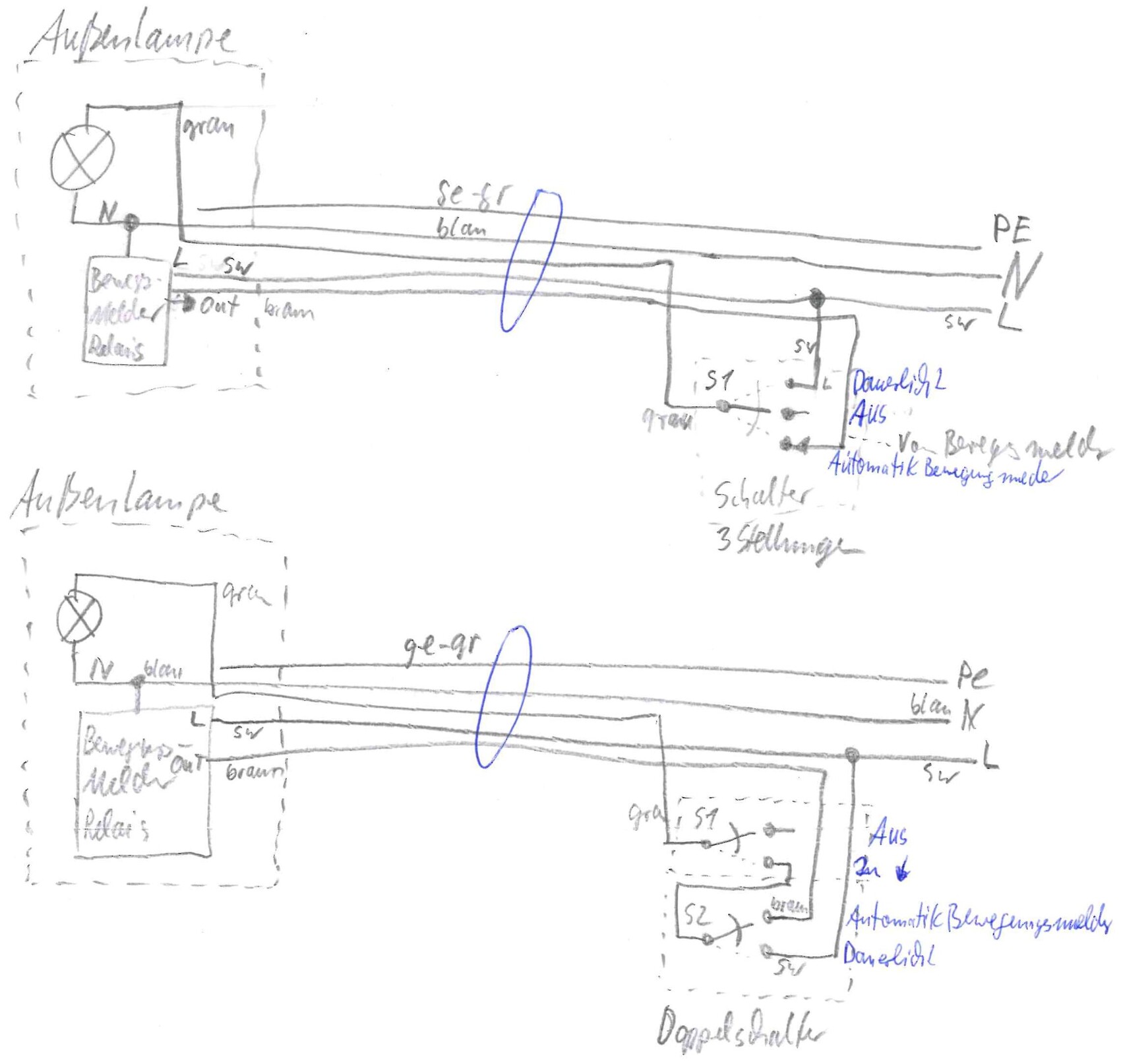
A friend gave me a wiring diagram that allows me to control an outdoor light with a motion sensor from inside the building in three modes.
With the first setup, using a three-position switch, I can:
Position: Middle = OFF,
Up = Constant light,
Down = Automatic via motion sensor
With the second setup, using two single-pole double-throw (SPDT) switches housed together, I can:
S1 Position: Up = OFF,
Down = to S2
S2 Position: Up = Automatic via motion sensor
Down = Constant light
All of this is wired with a 5-core cable to the lamp.
The motion sensor has an internal relay to control the lamp.
Now my electrician told me this is not allowed because in one cable no conductor with voltage may be left unused (unconnected).
He said this would be according to some VDE regulation or similar.
But if a 5-core cable is installed from the bathroom to the mirror cabinet, where one conductor is permanently live and one is switched by the light switches, at least one live conductor in the cable is also unused.
I don’t want to argue with the electrician and would accept the explanation, but I haven’t found anything about this rule.
Can someone help explain the electrician’s point of view?
Thank you very much
A friend gave me a wiring diagram that allows me to control an outdoor light with a motion sensor from inside the building in three modes.
With the first setup, using a three-position switch, I can:
Position: Middle = OFF,
Up = Constant light,
Down = Automatic via motion sensor
With the second setup, using two single-pole double-throw (SPDT) switches housed together, I can:
S1 Position: Up = OFF,
Down = to S2
S2 Position: Up = Automatic via motion sensor
Down = Constant light
All of this is wired with a 5-core cable to the lamp.
The motion sensor has an internal relay to control the lamp.
Now my electrician told me this is not allowed because in one cable no conductor with voltage may be left unused (unconnected).
He said this would be according to some VDE regulation or similar.
But if a 5-core cable is installed from the bathroom to the mirror cabinet, where one conductor is permanently live and one is switched by the light switches, at least one live conductor in the cable is also unused.
I don’t want to argue with the electrician and would accept the explanation, but I haven’t found anything about this rule.
Can someone help explain the electrician’s point of view?
Thank you very much

Similar topics