
ᐅ Moisture in Exterior Wall Insulation in the Stairwell Area
Created on: 16 Apr 2018 19:48
M
Michael-ErichM
Michael-Erich16 Apr 2018 19:48Hello,
I hope to get some advice regarding my problem.
In 2011, our single-family house was repaired after a fire.
During this process, the exterior facade was insulated with 100 mm Rockwool (4 inches).
In the area of the entrance stairs, the insulation was applied up to the step.
This means there is no splash guard between the stairs and the insulation.
Since I was working away from home at that time, I cannot say whether the Rockwool was installed directly to the step or if Styrodur (extruded polystyrene) was used in that area.
For some time now, a damp edge has developed in this area, showing the first signs of plaster bubbles. It is clear to me that the insulation in this area is saturated with moisture. Over time, mold will definitely form and the plaster will start to fall off.
What steps need to be taken to resolve this problem?
Best regards,
Michael
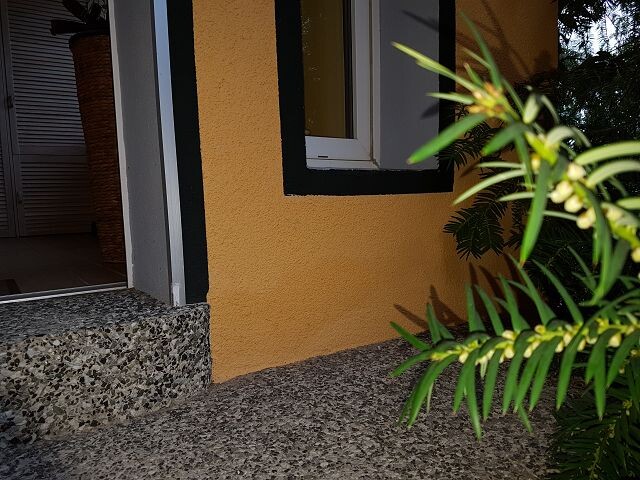
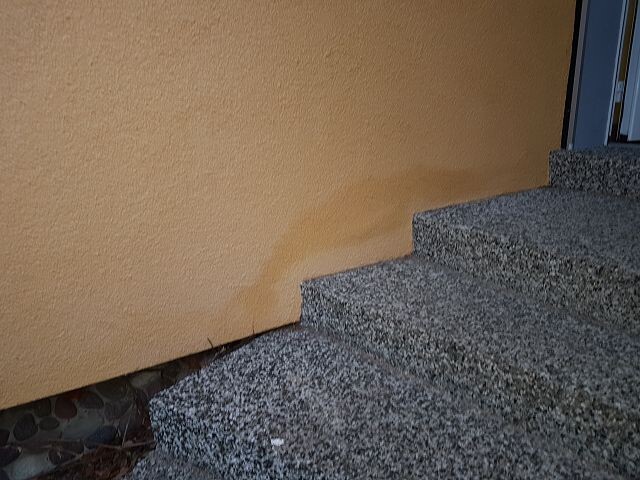
I hope to get some advice regarding my problem.
In 2011, our single-family house was repaired after a fire.
During this process, the exterior facade was insulated with 100 mm Rockwool (4 inches).
In the area of the entrance stairs, the insulation was applied up to the step.
This means there is no splash guard between the stairs and the insulation.
Since I was working away from home at that time, I cannot say whether the Rockwool was installed directly to the step or if Styrodur (extruded polystyrene) was used in that area.
For some time now, a damp edge has developed in this area, showing the first signs of plaster bubbles. It is clear to me that the insulation in this area is saturated with moisture. Over time, mold will definitely form and the plaster will start to fall off.
What steps need to be taken to resolve this problem?
Best regards,
Michael
M
Michael-Erich19 Apr 2018 18:39Hello,
Thank you for your reply. I actually expected to come across experts here.
But it seems that’s not the case. How could I find out if the Rockwool goes all the way down? The only option would be to cut it open. And here I see another problem: how can I then install a profile to support the insulation above?
Best regards, Michael
Thank you for your reply. I actually expected to come across experts here.
But it seems that’s not the case. How could I find out if the Rockwool goes all the way down? The only option would be to cut it open. And here I see another problem: how can I then install a profile to support the insulation above?
Best regards, Michael

Remote assessment is quite difficult.
Normally, expanded polystyrene (EPS) or a similar material should be used there. Rockwool is generally not used, or only in combination with mechanical protection and a waterproofing layer, which is rather uncommon.
Mold is unlikely to develop because the area is well ventilated; however, the plaster will continue to crumble.
The question is also where the water is coming from.
In a typical situation, excavation is done up to the foundation, insulated with extruded polystyrene (XPS) or a similar material, then slurry-coated/sealed, followed by the application of a dimpled membrane or something similar.
Then it is finished with a metal edge trim leading up to the ground floor level, and the insulation—whether Rockwool or external thermal insulation composite system (ETICS)—is installed over that.
In the stairwell area, water tends to penetrate into the wall and insulation, so proper waterproofing would definitely be required there.
Normally, expanded polystyrene (EPS) or a similar material should be used there. Rockwool is generally not used, or only in combination with mechanical protection and a waterproofing layer, which is rather uncommon.
Mold is unlikely to develop because the area is well ventilated; however, the plaster will continue to crumble.
The question is also where the water is coming from.
In a typical situation, excavation is done up to the foundation, insulated with extruded polystyrene (XPS) or a similar material, then slurry-coated/sealed, followed by the application of a dimpled membrane or something similar.
Then it is finished with a metal edge trim leading up to the ground floor level, and the insulation—whether Rockwool or external thermal insulation composite system (ETICS)—is installed over that.
In the stairwell area, water tends to penetrate into the wall and insulation, so proper waterproofing would definitely be required there.
M
Michael-Erich20 Apr 2018 18:43Hello,
Thank you for your message. The staircase is not on the weather-exposed side and is usually dry even when it rains. That’s why I’m quite surprised about where the moisture could be coming from.
Best regards, Michael-Erich
Thank you for your message. The staircase is not on the weather-exposed side and is usually dry even when it rains. That’s why I’m quite surprised about where the moisture could be coming from.
Best regards, Michael-Erich
Similar topics