
We like two-panel windows (without a central mullion). They will probably be made of uPVC. Do such windows make sense at a width of 100 cm (40 inches)? Or are the panels then too narrow and impractical? The same question applies to the patio door: it will be 113 cm (45 inches) wide. Is it possible to have two panels here, or does everything become too narrow?
Best regards, Steffi33
Best regards, Steffi33
Thanks to everyone for your input.
Thanks to Michael... Yes, that helps me a lot.
@ Musketier
Michael says he only has to open the second sash in exceptional cases. In everyday use, one sash is enough.
My conclusion: I have the following impression... those who have a wide sash cannot imagine it being narrower (a hypothetical assumption). But when someone actually has a narrower door, it works very well.
Best regards, Steffi
Thanks to Michael... Yes, that helps me a lot.
@ Musketier
Michael says he only has to open the second sash in exceptional cases. In everyday use, one sash is enough.
My conclusion: I have the following impression... those who have a wide sash cannot imagine it being narrower (a hypothetical assumption). But when someone actually has a narrower door, it works very well.
Best regards, Steffi

I’m not sure if it’s really necessary to restrict yourself so much when building a new house.
As someone who isn’t particularly broad-shouldered and works in an office, I estimate my shoulder width to be about 50–55 cm (20–22 inches). When walking, people usually don’t keep their arms completely straight down, so a body width of around 60 cm (24 inches) is reasonable to consider. For those with broader shoulders than me, passing through a doorway might mean turning sideways (unless the stomach isn’t protruding) or having to open the second door leaf. It’s no coincidence that interior doors have a certain standard width.
As someone who isn’t particularly broad-shouldered and works in an office, I estimate my shoulder width to be about 50–55 cm (20–22 inches). When walking, people usually don’t keep their arms completely straight down, so a body width of around 60 cm (24 inches) is reasonable to consider. For those with broader shoulders than me, passing through a doorway might mean turning sideways (unless the stomach isn’t protruding) or having to open the second door leaf. It’s no coincidence that interior doors have a certain standard width.
Michael doesn't sound like he has to force himself into a tight space.
So... now I had the idea to try this at our patio door.. see picture.. there is a folding ruler spread out to 60cm (24 inches) at the bottom. I noticed that we usually never open our door wider than 60cm (24 inches), because there is always a heavy armchair in the way (on the right in the picture). If you want to open it wider, you always have to move the armchair, which we rarely do. Often we wedge our patio door against the armchair so it doesn't close.. And that works very well for us.
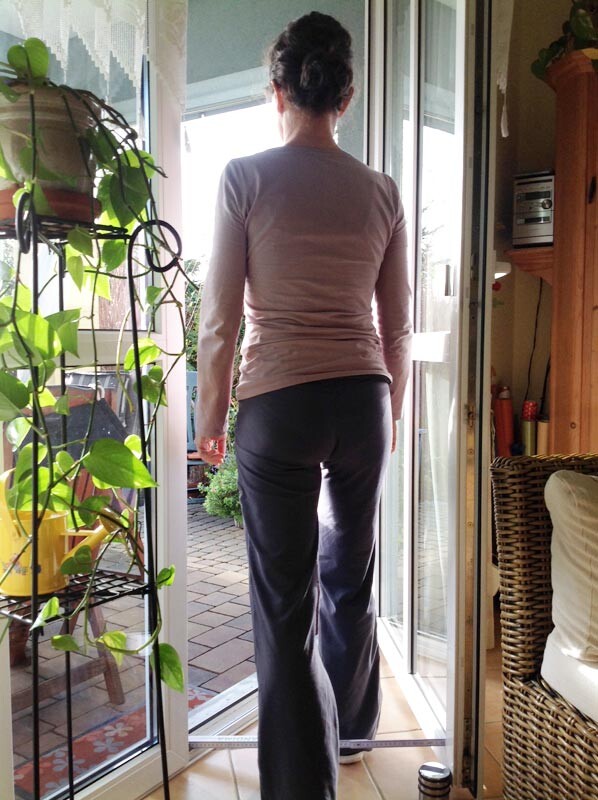
So... now I had the idea to try this at our patio door.. see picture.. there is a folding ruler spread out to 60cm (24 inches) at the bottom. I noticed that we usually never open our door wider than 60cm (24 inches), because there is always a heavy armchair in the way (on the right in the picture). If you want to open it wider, you always have to move the armchair, which we rarely do. Often we wedge our patio door against the armchair so it doesn't close.. And that works very well for us.
Hello Steffi,
Good idea to give that a try. You should let your husband do it as well.
You probably wouldn’t have any issues with our doors. In the end, it has to work for you, not for theoretical people with bodybuilder backs and wide doors.
Of course, you can always plan for the maximum, but that also leads to maximum costs. The trick is to make compromises in the right places. Your window widths seem to be a good example of that.
Best regards,
Michael
Good idea to give that a try. You should let your husband do it as well.
You probably wouldn’t have any issues with our doors. In the end, it has to work for you, not for theoretical people with bodybuilder backs and wide doors.
Of course, you can always plan for the maximum, but that also leads to maximum costs. The trick is to make compromises in the right places. Your window widths seem to be a good example of that.
Best regards,
Michael
That also depends on personal habits. We have a double-leaf door with each leaf about 80cm (31.5 inches) wide, but we only use one of the leaves. However, we have house cats, so the door is currently being closed repeatedly. So far, all people and objects have passed through a single leaf without any issues.
Similar topics