
ᐅ Mineral Wool Insulation vs. Wood Fiber Insulation in Prefabricated Houses
Created on: 17 Sep 2023 19:14
C
Catibu74
Hello dear forum members,
we have planned a prefabricated house with the company Weiss and are currently deciding which wall construction to choose.
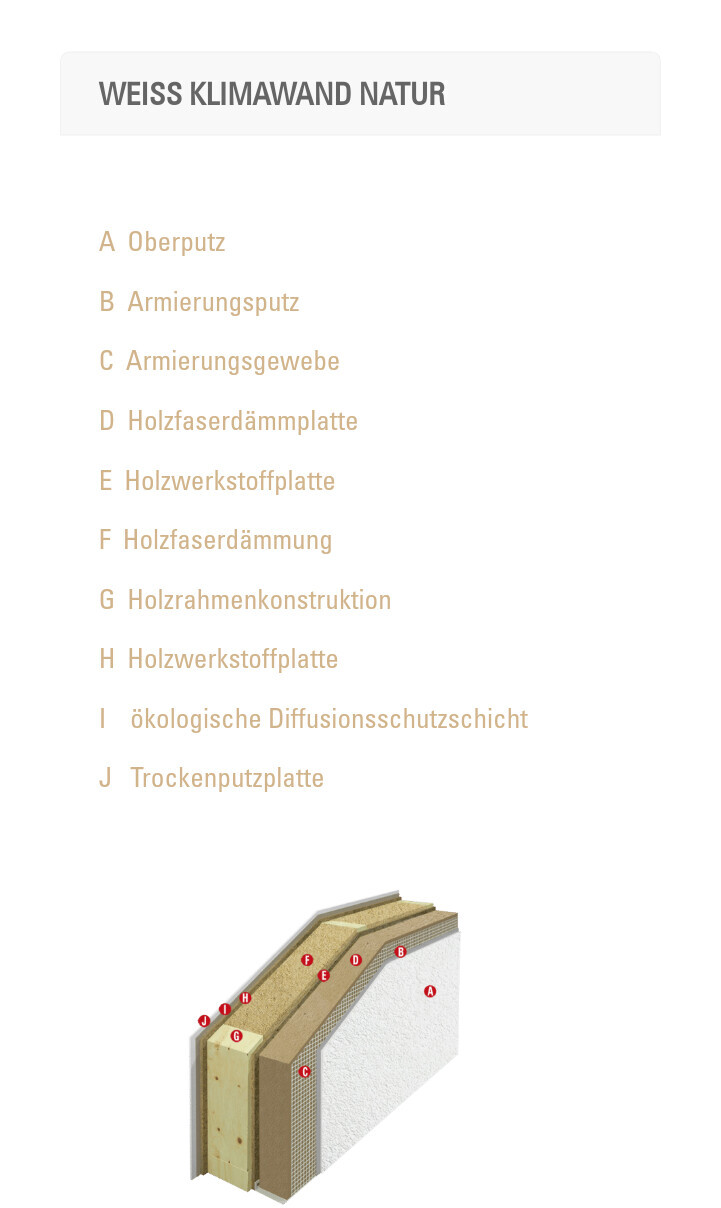
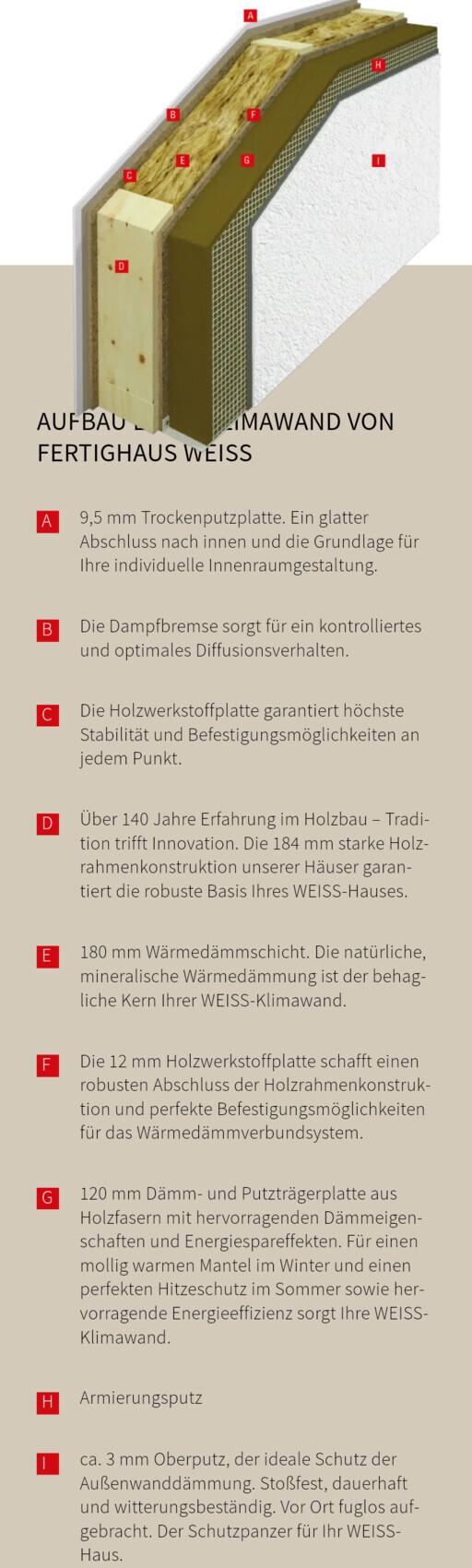
The options are the “Klimawand” or the “Klimawand Natur.”
The difference is that in one case a mineral insulation material is used within the timber frame construction, and in the other a wood fiber insulation board.
What advantages and disadvantages would you see?
Healthy living is important to us.
The Klimawand Natur costs an additional 12€ per m² (12€ per square meter).
Kind regards
we have planned a prefabricated house with the company Weiss and are currently deciding which wall construction to choose.
The options are the “Klimawand” or the “Klimawand Natur.”
The difference is that in one case a mineral insulation material is used within the timber frame construction, and in the other a wood fiber insulation board.
What advantages and disadvantages would you see?
Healthy living is important to us.
The Klimawand Natur costs an additional 12€ per m² (12€ per square meter).
Kind regards
11ant schrieb:
The relevant difference here corresponds more to the U-values of the respective wall assemblies: this indicates the duration it takes for the temperature difference between inside and outside to transfer through, and thus also the phase shift of the outdoor temperature fluctuations.Since mineral wool is presumably used with a thermal conductivity of 0.035 W/(m·K) (WLS035) and wood fiber with 0.036 W/(m·K) (WLS036), the U-value will not differ significantly.
The heat transfer coefficient, U-value, is only part of the equation.
Amplitude attenuation (reduction of temperature peaks during heat transfer under dynamic temperature conditions) and phase shift (the time it takes for the temperature peak to reach the other side) are largely influenced by the thermal mass of the wall.
The specific heat capacity of wood fiber per kilogram is twice as high as that of mineral wool, and the bulk density of the wood fiber insulation boards is three times higher. Overall, the thermal mass is therefore six times higher than that of mineral wool, resulting in significantly greater amplitude attenuation and phase shift.
This is why, for roof insulation, wood fiber is clearly advantageous compared to PUR/PIR rigid foam boards or mineral wool when it comes to summer heat protection—despite having the same U-value.
Due to the existing mass and storage capacity of the outer 12cm (5 inches) wood fiber layer and other wall components, it no longer really matters in this case whether mineral wool or wood fiber is used in the core.
Regarding the different layers, I generally agree with you. However, at least the principle “interior more vapor-tight than exterior” is not violated here, so I would be quite relaxed about that.
Similar topics