
Dear all,
Since I know some of you are experienced and knowledgeable about this, I’m just quickly asking here. I want to identify my biggest energy consumers—and do it properly.
What is more cost-effective and simpler?
Putting a plug-in energy meter on every outlet?
Or measuring in the distribution board? Is it even possible to measure consumption per individual circuit breaker with fine granularity there? Or not?
For example, there is the Shelley 3PM. I still don’t understand whether it can only measure total household consumption, individual circuits, or even more detailed information. Would additional modules be needed?
The reason I’m asking is that I already have several built-in appliances. I can’t easily access the outlets without removing the appliances. Therefore, a solution in the distribution board would be preferable, but only if it is technically feasible and not prohibitively expensive.
Thanks and best regards
Since I know some of you are experienced and knowledgeable about this, I’m just quickly asking here. I want to identify my biggest energy consumers—and do it properly.
What is more cost-effective and simpler?
Putting a plug-in energy meter on every outlet?
Or measuring in the distribution board? Is it even possible to measure consumption per individual circuit breaker with fine granularity there? Or not?
For example, there is the Shelley 3PM. I still don’t understand whether it can only measure total household consumption, individual circuits, or even more detailed information. Would additional modules be needed?
The reason I’m asking is that I already have several built-in appliances. I can’t easily access the outlets without removing the appliances. Therefore, a solution in the distribution board would be preferable, but only if it is technically feasible and not prohibitively expensive.
Thanks and best regards


So, my computer setup uses more power than expected but not an excessive amount. It adds up to about 2-3 kWh per day.
The dryer was just one drying cycle using 3 kWh. However, it doesn’t run daily—on average about once every three days, which is roughly 1 kWh per day.
Now I need to figure out the energy usage of the refrigeration appliances...
I can already see that each device probably uses 1-2 kWh per day, and it all adds up. I definitely have around 10 devices in total.
The dryer was just one drying cycle using 3 kWh. However, it doesn’t run daily—on average about once every three days, which is roughly 1 kWh per day.
Now I need to figure out the energy usage of the refrigeration appliances...
I can already see that each device probably uses 1-2 kWh per day, and it all adds up. I definitely have around 10 devices in total.
This is the current situation for me (May).
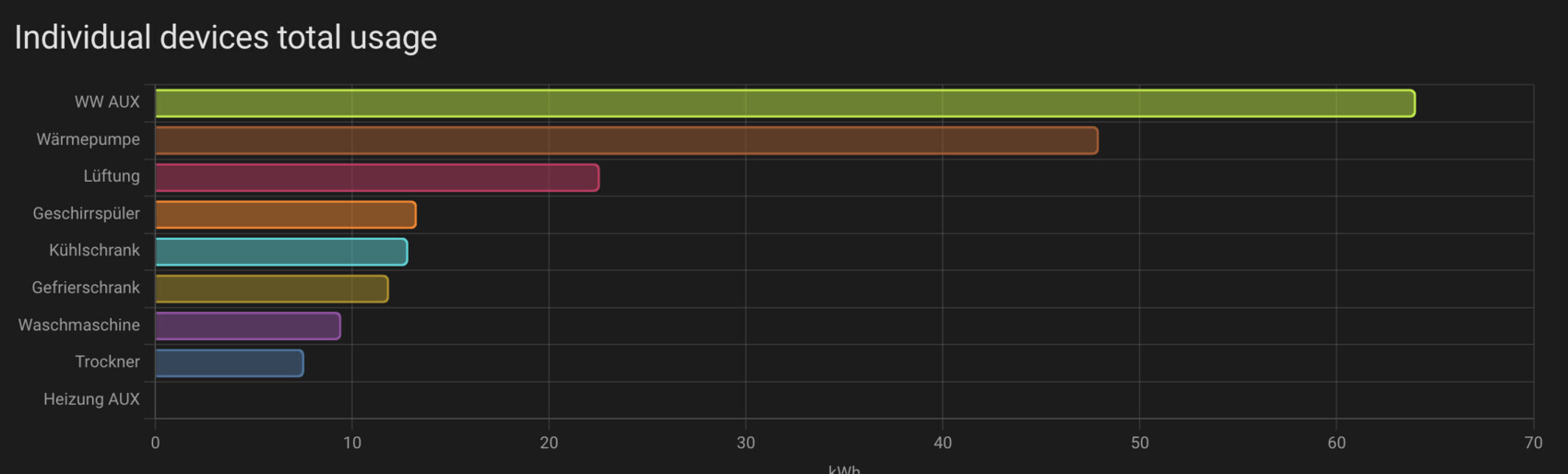
WW AUX is the electric heating element for domestic hot water – I always switch it on when there is surplus photovoltaic power and raise the storage tank temperature to 65°C (149°F).
The heat pump consumption refers to the "normal" outdoor unit.
Heating mode was not in use.
Otherwise, you can clearly see that the central ventilation system consumes almost as much energy as a refrigerator and a freezer combined (both are not very old).
The dryer and washing machine run every 2–3 days.
The dishwasher surprised me a lot. It is a 2-year-old Siemens model and usually runs once a day at about 40°C (104°F).
WW AUX is the electric heating element for domestic hot water – I always switch it on when there is surplus photovoltaic power and raise the storage tank temperature to 65°C (149°F).
The heat pump consumption refers to the "normal" outdoor unit.
Heating mode was not in use.
Otherwise, you can clearly see that the central ventilation system consumes almost as much energy as a refrigerator and a freezer combined (both are not very old).
The dryer and washing machine run every 2–3 days.
The dishwasher surprised me a lot. It is a 2-year-old Siemens model and usually runs once a day at about 40°C (104°F).
@sysrun80 ... what surprised you about the dishwasher? It has run about 17 times, and the energy consumption is absolutely fine, averaging under 1 kWh.
I recently replaced my dishwasher after 18 years with a new Siemens model that can also be controlled via an app. When selecting programs with a prior determination of soil level, it always predicts an approximate consumption. For example, the Eco cycle with all options selected usually consumes just under 0.9 kWh. It runs for almost 5 hours. In contrast, the 70°C (158°F) program, which I use occasionally, consumes 1.45 kWh and lasts just under 3 hours.
I don’t measure the dishwasher’s consumption separately, but I constantly monitor my overall values because of my solar panel system, and I can confirm these predicted consumption figures.
I recently replaced my dishwasher after 18 years with a new Siemens model that can also be controlled via an app. When selecting programs with a prior determination of soil level, it always predicts an approximate consumption. For example, the Eco cycle with all options selected usually consumes just under 0.9 kWh. It runs for almost 5 hours. In contrast, the 70°C (158°F) program, which I use occasionally, consumes 1.45 kWh and lasts just under 3 hours.
I don’t measure the dishwasher’s consumption separately, but I constantly monitor my overall values because of my solar panel system, and I can confirm these predicted consumption figures.
Tolentino schrieb:
So, my computer (workspace) uses more power than expected, but not a huge amount. It adds up to about 2-3 kWh per day. Wow, what kind of equipment are you running?
Out of curiosity, I installed a Shelly device behind my office setup, and my Thinkpad plus UWQHD monitor currently consume a maximum of 0.7 kWh per workday. Last year, with a dual monitor setup, it was just over 1 kWh.
I deliberately excluded the gaming PC from the power measurement, but according to the real-time photovoltaic consumption data, it doesn't use that much either.
Similar topics