
ᐅ Effective Energy Strategy for New Construction KfW70 Without Oil or Gas
Created on: 18 Oct 2014 18:10
U
Username_wahl
Hello,
we are planning to build within the next 1-2 years, approximately 170-190 sqm (1830-2045 sq ft) for 5 people, meeting the KfW 70 standard. We definitely do not want gas or oil heating.
We are considering an air-to-air heat pump with automated ventilation for the house, including heat recovery and domestic hot water heating using waste heat (as seen from a prefabricated house supplier).
Since heating with electricity can be expensive, we would like to combine this system with a photovoltaic (PV) installation.
What do you think about this? How do the initial investment and running costs compare to a conventional heating system?
As additional options, I am also thinking about solar thermal and a wood stove (with a heat storage unit?), but I am skeptical about whether these can be integrated smoothly. Of course, it should also be economically viable in the medium term.
we are planning to build within the next 1-2 years, approximately 170-190 sqm (1830-2045 sq ft) for 5 people, meeting the KfW 70 standard. We definitely do not want gas or oil heating.
We are considering an air-to-air heat pump with automated ventilation for the house, including heat recovery and domestic hot water heating using waste heat (as seen from a prefabricated house supplier).
Since heating with electricity can be expensive, we would like to combine this system with a photovoltaic (PV) installation.
What do you think about this? How do the initial investment and running costs compare to a conventional heating system?
As additional options, I am also thinking about solar thermal and a wood stove (with a heat storage unit?), but I am skeptical about whether these can be integrated smoothly. Of course, it should also be economically viable in the medium term.
D
DerBjoern4 Nov 2014 15:21Illo77 schrieb:
Do you want to, or are you unable to understand? Three heating companies submitted offers, and all three companies proposed exactly the same options: gas with solar, geothermal, geothermal with an air-to-water heat pump, district heating...
Company 1 submitted their offer through the carpenter, while companies 2 and 3 created their offers exactly based on company 1’s proposal...
And you say these cannot be compared? Then no one would need to request anything anywhere or ask any company to provide offers anymore...Well, don’t get upset right away. I actually misunderstood that...
I’ve been meaning to show the collectors (see attachment). At the time of installation, there was 48 sqm (517 sq ft) of collector surface over a 13-meter (43 feet) wide excavation.
And NO, the heat for domestic hot water (showers, etc.) runs through the air source heat pump…
The ground source heat pump operates without electrical backup heating even at very low subzero temperatures (the backup is switched off). The inlet fluid temperature is currently at 8°C (46°F) with an outside temperature of −2°C (28°F). When it gets really cold, it drops to about 3°C (37°F), but that usually only happens at around −10°C (14°F), which we rarely experience.
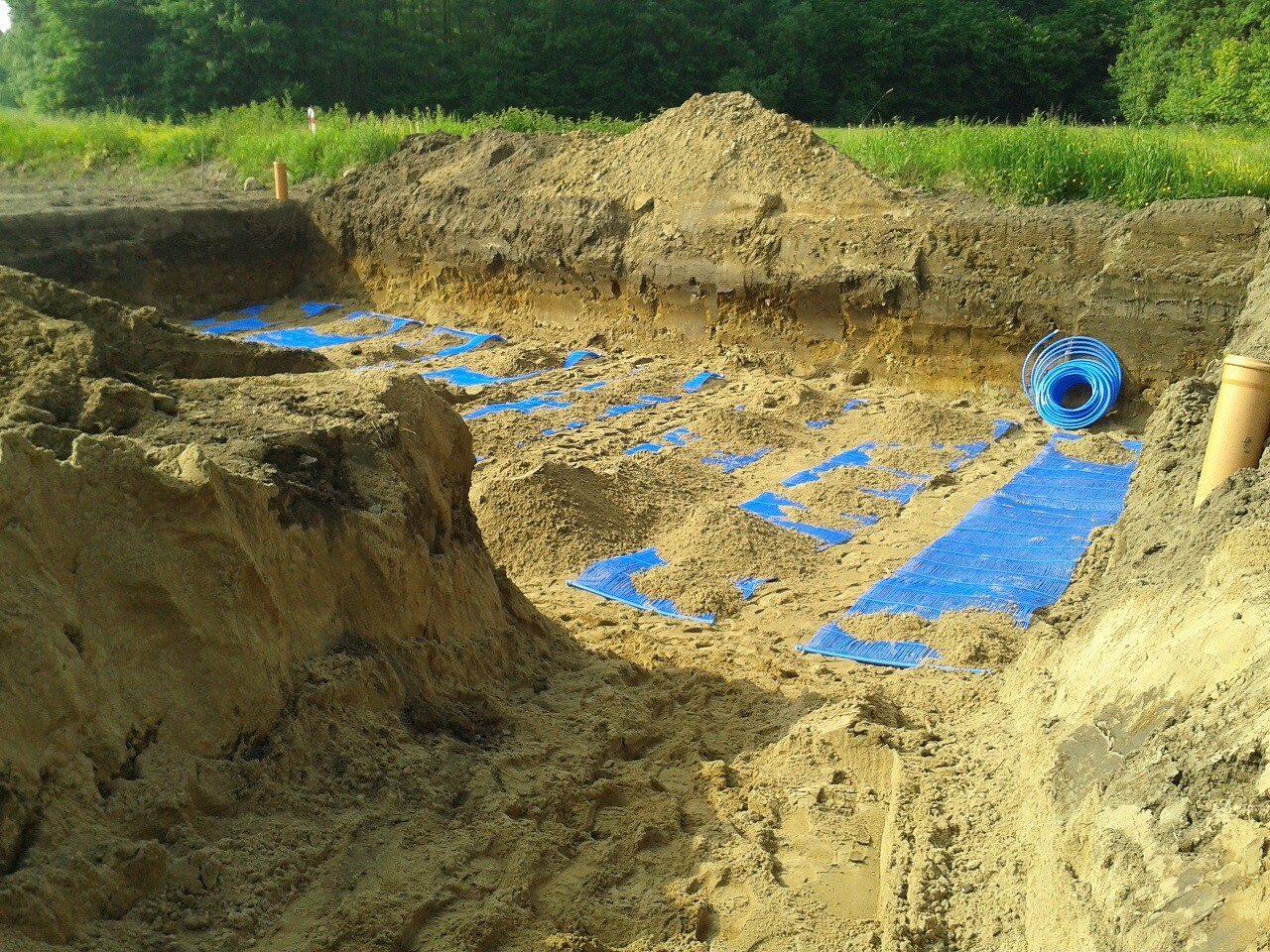
And NO, the heat for domestic hot water (showers, etc.) runs through the air source heat pump…
The ground source heat pump operates without electrical backup heating even at very low subzero temperatures (the backup is switched off). The inlet fluid temperature is currently at 8°C (46°F) with an outside temperature of −2°C (28°F). When it gets really cold, it drops to about 3°C (37°F), but that usually only happens at around −10°C (14°F), which we rarely experience.
Musketier schrieb:
I need to step in here.
I don’t fully understand how you can reduce the collector area so drastically unless you’re using more energy from electricity or other sources (e.g. a wood stove). For our 125 sqm (1,345 sq ft) living area, we estimate a ratio of collector surface to living space of about 1:1. You’re trying to extract energy from 48 sqm (517 sq ft) or 78 sqm (840 sq ft) of collector area for roughly 160 sqm (1,722 sq ft) of living space.
The heat for water and heating is primarily generated by geothermal energy in both your and our cases. Additionally, the heat loss from the heat pump’s condensing dryer also applies to both. The only advantage you have is that you utilize the otherwise wasted heat from the utility room, and maybe your ground source heat pump is operating in somewhat more efficient conditions. But that doesn’t explain the huge difference in the ratio of collector surface.