
ᐅ Mixed materials construction without a basement, with a foundation or plinth, and moisture-resistant insulation
Created on: 23 Sep 2012 12:10
R
rocksack
Hello!
I am planning a timber frame house (without a basement) as an extension to an existing building.
To avoid steps at the transition between the new and existing structures, I need to build at the same level as the existing building. This means the top edge of the new foundation slab will be exactly at ground level!
According to the structural engineer and carpenter, however, the timber frame should not be placed directly on the ground. It needs to have a certain clearance above the ground level (I believe this is even required by regulations – 15 or 30 cm (6 or 12 inches)).
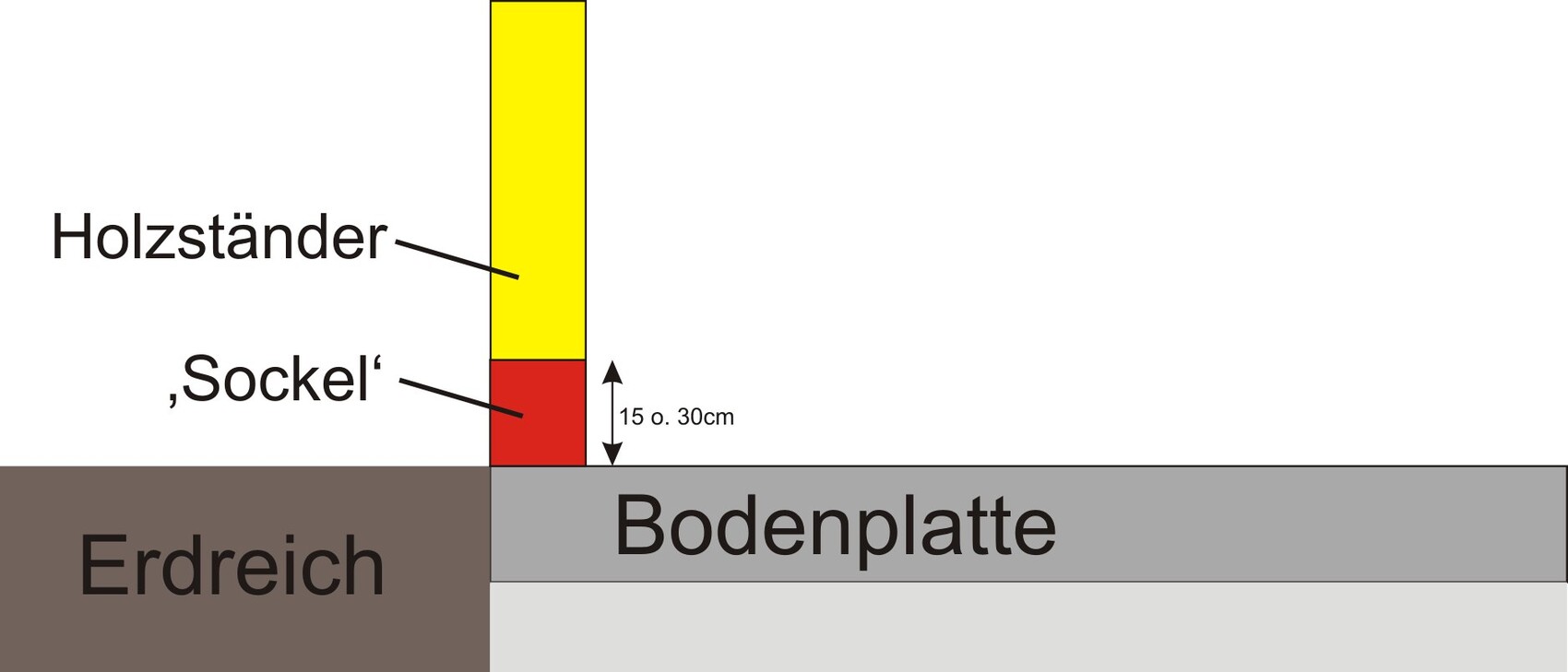
Since the slab is basically at zero level, I could build a solid base wall on top of which the timber frame would be set. That means I would first lay an additional course of bricks or blocks at the outside edge (where the external walls will be), so the timber frame has the desired clearance (15 or 30 cm (6 or 12 inches)?) above ground.
Something like this:

Questions:
Is this a common practice, or are there other options (for example, sealing the timber frame and placing it directly on the ground)?
If the solid base wall is an option, what material is typically used for it? Since I need the wall thickness to remain the same in the end (around 30 cm (12 inches)), how does this "material mix" affect the U-value (which will probably be different) and moisture behavior?
Thanks!
Best regards,
Mike
I am planning a timber frame house (without a basement) as an extension to an existing building.
To avoid steps at the transition between the new and existing structures, I need to build at the same level as the existing building. This means the top edge of the new foundation slab will be exactly at ground level!
According to the structural engineer and carpenter, however, the timber frame should not be placed directly on the ground. It needs to have a certain clearance above the ground level (I believe this is even required by regulations – 15 or 30 cm (6 or 12 inches)).
Since the slab is basically at zero level, I could build a solid base wall on top of which the timber frame would be set. That means I would first lay an additional course of bricks or blocks at the outside edge (where the external walls will be), so the timber frame has the desired clearance (15 or 30 cm (6 or 12 inches)?) above ground.
Something like this:
Questions:
Is this a common practice, or are there other options (for example, sealing the timber frame and placing it directly on the ground)?
If the solid base wall is an option, what material is typically used for it? Since I need the wall thickness to remain the same in the end (around 30 cm (12 inches)), how does this "material mix" affect the U-value (which will probably be different) and moisture behavior?
Thanks!
Best regards,
Mike
jamguy schrieb:
So everything is clear now!I hope that’s really the case. When calculating the wall (using a website that allows you to calculate the U-value and moisture content – the link can’t be shared here without issues :cool ), the dew point now shifts to the middle of the wall. This means condensation forms between the wooden studs and the insulation (see comparison pictures). I believe this is due to the water-impermeable XPS insulation.
So, I’m not entirely sure if this is the optimal solution or if this condensation issue is only theoretical or not critical. I’ll discuss it with my planner and possibly update here (maybe someone else is interested in this topic).
Thanks for now!!
Best regards, Mike
There’s really no need to overdo it! The drywall core can absorb a considerable amount of moisture before your insulation starts to mold. Since you already understand this, you’re aware of the importance of proper room ventilation. A 12.5mm (1/2 inch) drywall board (water-resistant/green) would be another option!
Similar topics