
ᐅ Mixed materials construction without a basement, with a foundation or plinth, and moisture-resistant insulation
Created on: 23 Sep 2012 12:10
R
rocksack
Hello!
I am planning a timber frame house (without a basement) as an extension to an existing building.
To avoid steps at the transition between the new and existing structures, I need to build at the same level as the existing building. This means the top edge of the new foundation slab will be exactly at ground level!
According to the structural engineer and carpenter, however, the timber frame should not be placed directly on the ground. It needs to have a certain clearance above the ground level (I believe this is even required by regulations – 15 or 30 cm (6 or 12 inches)).
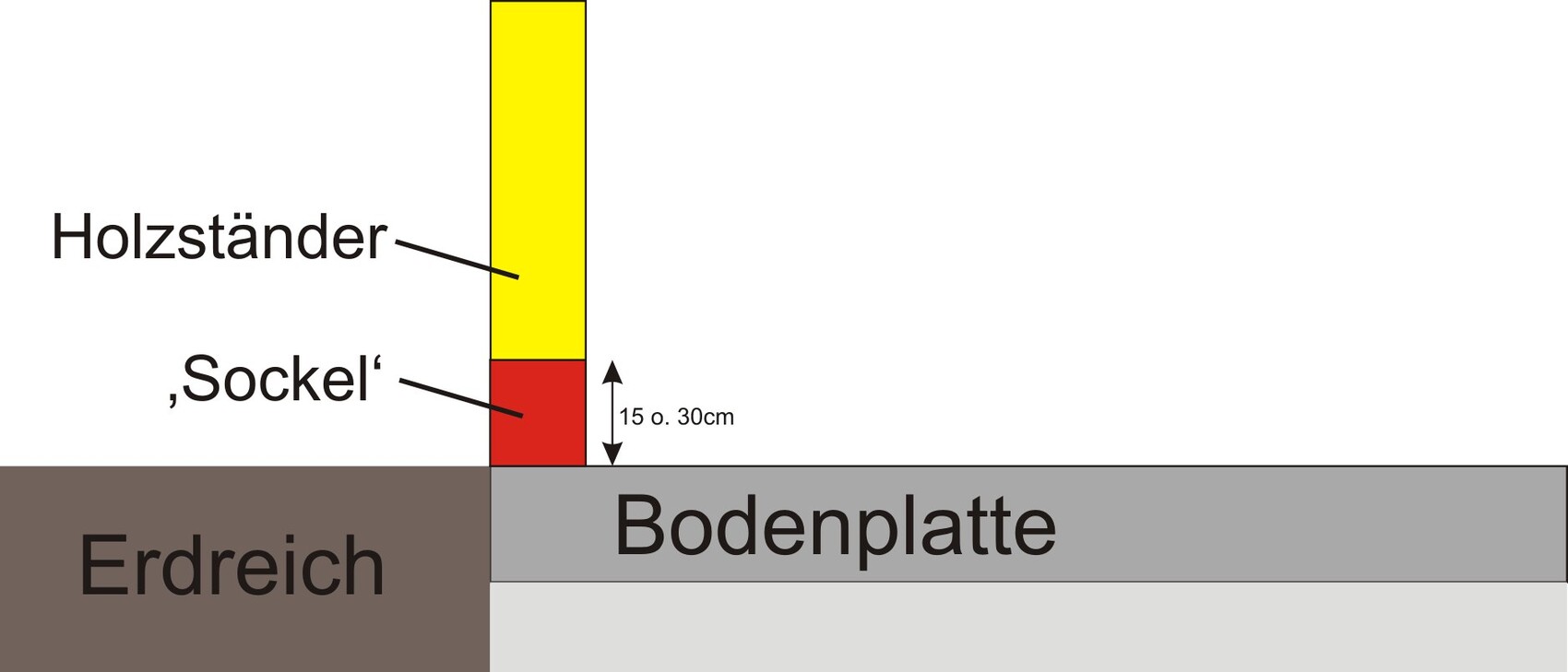
Since the slab is basically at zero level, I could build a solid base wall on top of which the timber frame would be set. That means I would first lay an additional course of bricks or blocks at the outside edge (where the external walls will be), so the timber frame has the desired clearance (15 or 30 cm (6 or 12 inches)?) above ground.
Something like this:

Questions:
Is this a common practice, or are there other options (for example, sealing the timber frame and placing it directly on the ground)?
If the solid base wall is an option, what material is typically used for it? Since I need the wall thickness to remain the same in the end (around 30 cm (12 inches)), how does this "material mix" affect the U-value (which will probably be different) and moisture behavior?
Thanks!
Best regards,
Mike
I am planning a timber frame house (without a basement) as an extension to an existing building.
To avoid steps at the transition between the new and existing structures, I need to build at the same level as the existing building. This means the top edge of the new foundation slab will be exactly at ground level!
According to the structural engineer and carpenter, however, the timber frame should not be placed directly on the ground. It needs to have a certain clearance above the ground level (I believe this is even required by regulations – 15 or 30 cm (6 or 12 inches)).
Since the slab is basically at zero level, I could build a solid base wall on top of which the timber frame would be set. That means I would first lay an additional course of bricks or blocks at the outside edge (where the external walls will be), so the timber frame has the desired clearance (15 or 30 cm (6 or 12 inches)?) above ground.
Something like this:
Questions:
Is this a common practice, or are there other options (for example, sealing the timber frame and placing it directly on the ground)?
If the solid base wall is an option, what material is typically used for it? Since I need the wall thickness to remain the same in the end (around 30 cm (12 inches)), how does this "material mix" affect the U-value (which will probably be different) and moisture behavior?
Thanks!
Best regards,
Mike
rocksack schrieb:
Because of the proximity to the ground, rainwater splashing back from the soil also poses a risk to the base area. It is therefore important to maintain a sufficient distance between the wooden components and the soil. A reliable protection is achieved by keeping the lowest wooden parts at least 30 cm (12 inches) above the ground. This refers to wooden parts that are directly exposed to the weather, such as the facade. Your stud frame is protected, of course. And a facade base must be provided........
rocksack schrieb:
How can the structure be 'protected from the outside' for example, with waterproofing membranes, weather-resistant materials.....
rocksack schrieb:
and what exactly is a 'facade base'? Well, in your drawing you have already included such a base (XPS). By using the term facade base, I just wanted to clarify that I do not mean a masonry base, like the one your structural engineer is suggesting.
E.Curb schrieb:
Well, in your drawing you have already shown a kind of base (XPS). By the term facade base, I just wanted to clarify that I don’t mean a masonry base like your structural engineer wantsFirst of all, THANK YOU!
If I understand correctly, I could theoretically place the wood stud frame directly on the slab (of course properly executed with waterproofing membrane, etc.) and then use a weather-resistant insulation (e.g., XPS) in the lower area (‘base’) instead of the wood fiberboard (bonded with bitumen)?
Something like this?:
That would be exactly the alternative I have been looking for (less warping and cheaper, no ‘material mix’,…).
Best regards, Mike
rocksack schrieb:
First of all, THANK YOU!
If I understand correctly, I could theoretically place the wooden stud frame directly on the concrete slab (of course properly installed with a waterproof membrane, etc.) and then, in the lower area ('base'), instead of using wood fiberboard, simply use weather-resistant insulation (e.g., XPS) (bonded with bitumen)?
Something like this?:
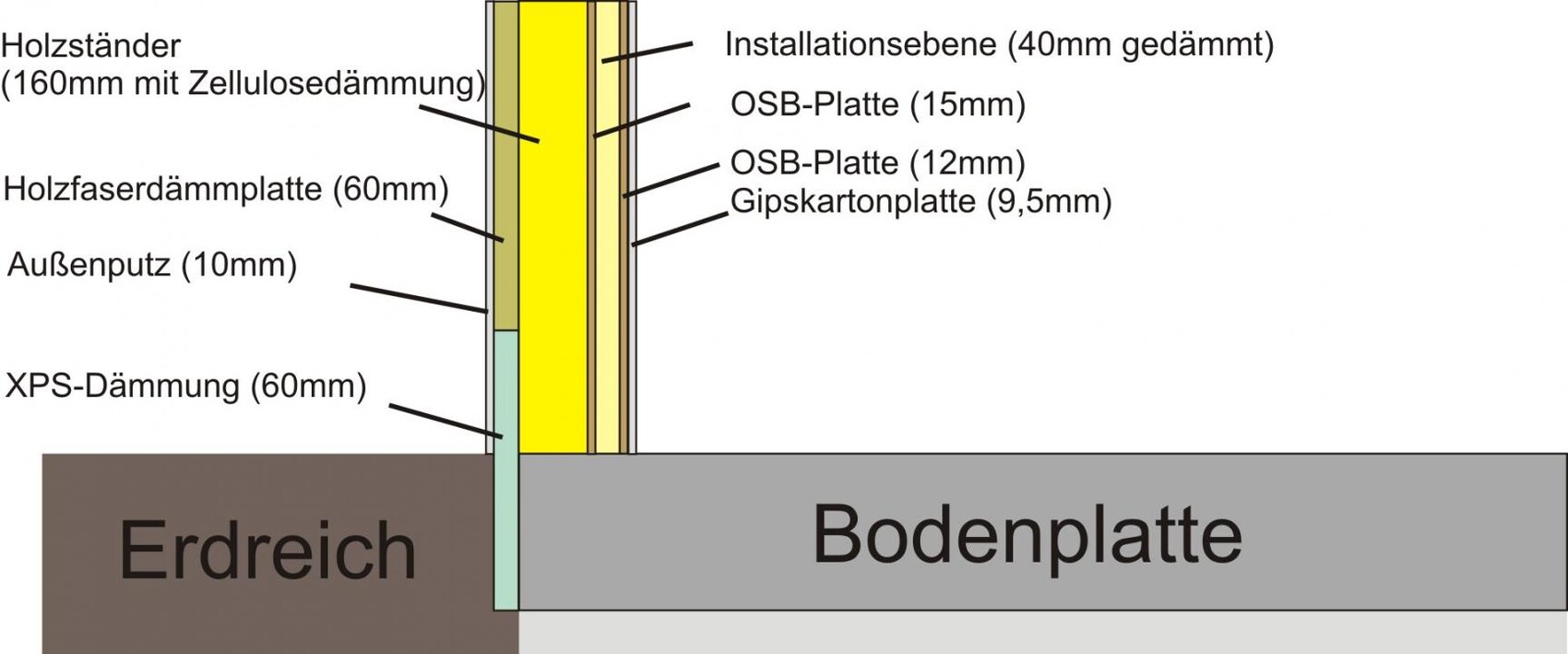
That would exactly be the alternative I’ve been looking for (less warping and cheaper, no 'mixed materials', ...).
Best regards, Mike Now everything is clear!
Similar topics