
ᐅ Make the heating control adjustable and monitor electricity consumption closely
Created on: 12 Feb 2024 20:27
G
grericht
Hello,
we have been living in our new house for almost 3 years now and are generally quite satisfied with many things. The heating and ventilation systems also do not cause us much concern, but there are a few points that I would do differently now. Perhaps with some modifications, we can achieve the same results here.
Facts:
(geothermal/deep drilling) heat pump
27 heating circuits distributed over 4 manifolds on 4 floors
Distances of all pipes are equal and circuit lengths approximately the same
Each room has 2 heating circuits and each bathroom has 1 (there is a plan to possibly connect wall heating in the bathrooms in the future)
Originally, everything was controlled by room thermostats and 27 control valves. I have tried to perform a hydraulic balancing here and remove the control valves and thermostats.
Details:
In the basement, besides 3 heated rooms, there is the heated utility room (HAR)
One floor has a large common room, hallway, and guest WC
Two floors each have 1 bathroom and 2 or 3 small rooms
Problem:
This setup works well, but I have to adjust things on the heating manifold multiple times a year. For example, I partially turn the basement completely off or on. The bathrooms fully off and the bedrooms fully on (when switching from heating to cooling) – this is tolerable because all heating circuits throughout the house are now set manually. Since in the rooms there are double heating circuits compared to the bathrooms, I have to turn down the rooms considerably and still barely manage to keep the bathroom temperatures in a comfortable range. Otherwise, I would have to raise the heating temperatures and then turn the other rooms down even more, which is hardly possible.
Ideally, I would like to switch between as few control valves as possible, preferably switching all rooms on and bathrooms off vs. all rooms off and bathrooms on (or on, if then the lower temperature does not cool down the bathrooms again). Besides the energy consumption of the control valves, the purchasing costs add up, since I currently have only 2W normally closed valves in stock. Opening them that often seems uneconomical to me.
Option 1
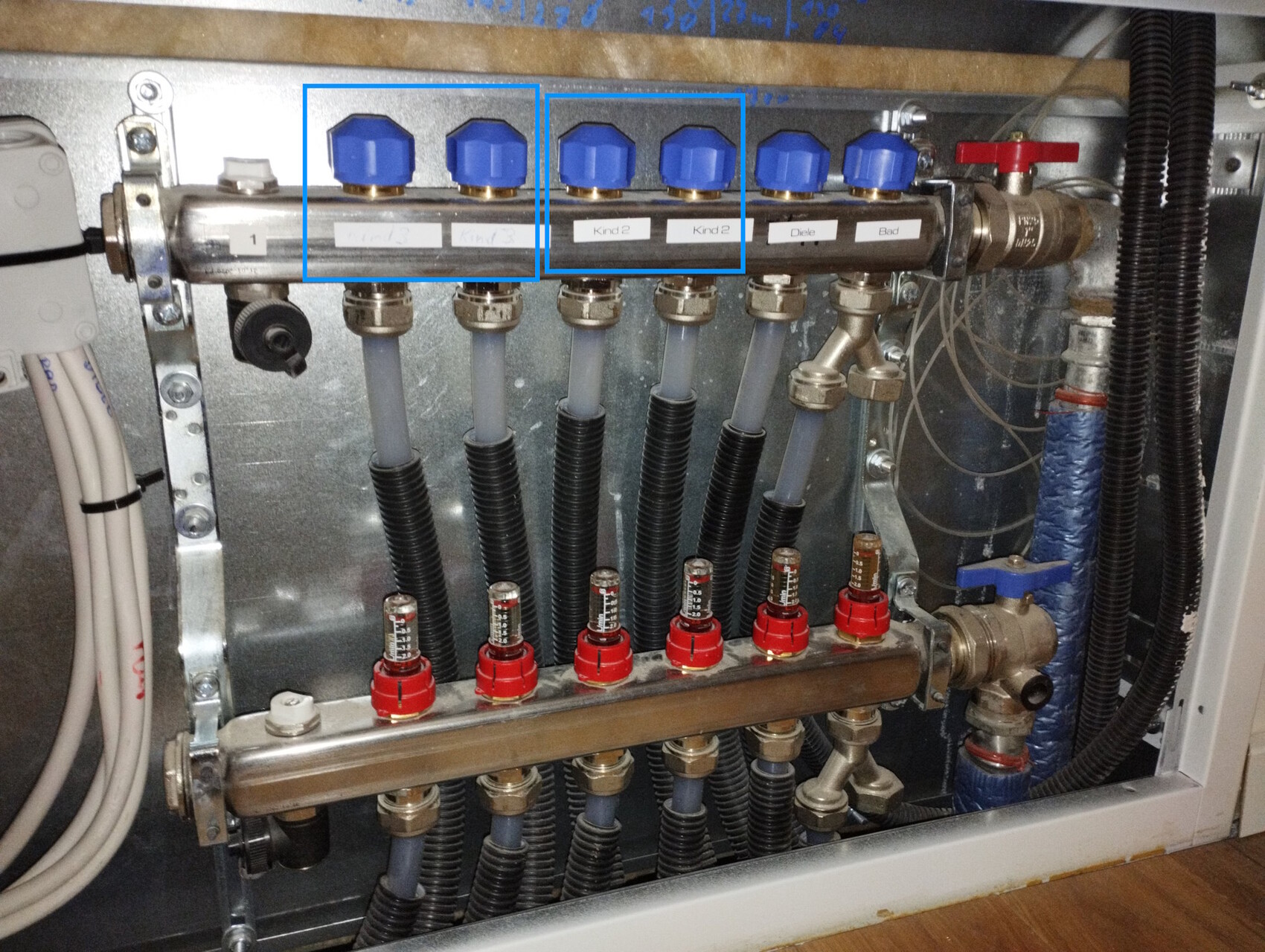
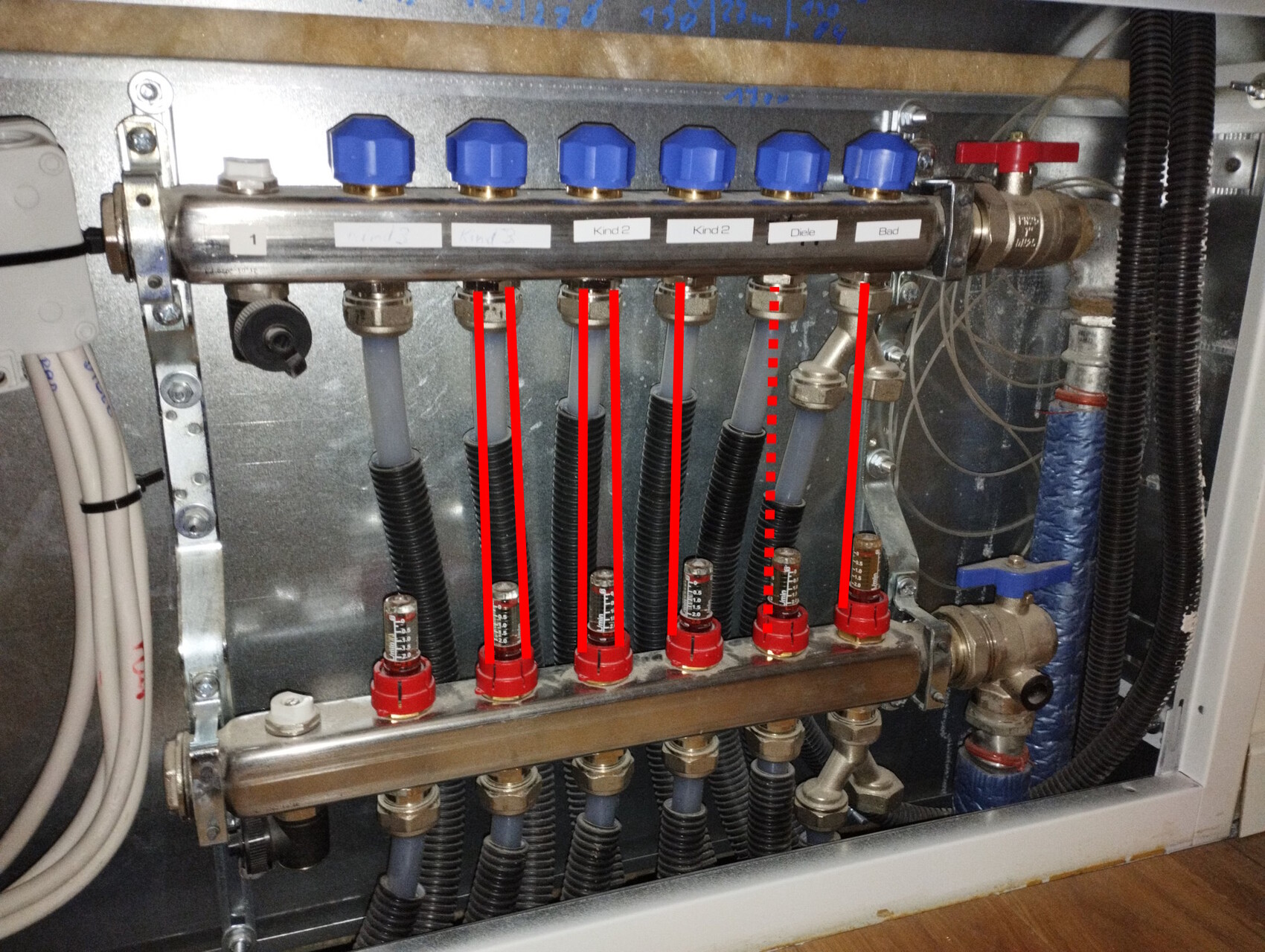
In the picture, you see 1 of 4 heating manifolds. The bathroom has a “doubling” for a potential future wall heating connection. I am thinking of running each room (blue boxes) with such a doubling so that only one control valve per room is necessary. Furthermore, the circulation pump can only provide about half the flow when everything is open, so I can directly limit the flow this way.
The bathroom remains on one circuit, and the wall heating would have its own circuit instead of being connected to the bathroom circuit.
The hallway shall have its own circuit, permanently minimally open without a control valve.
Option 2
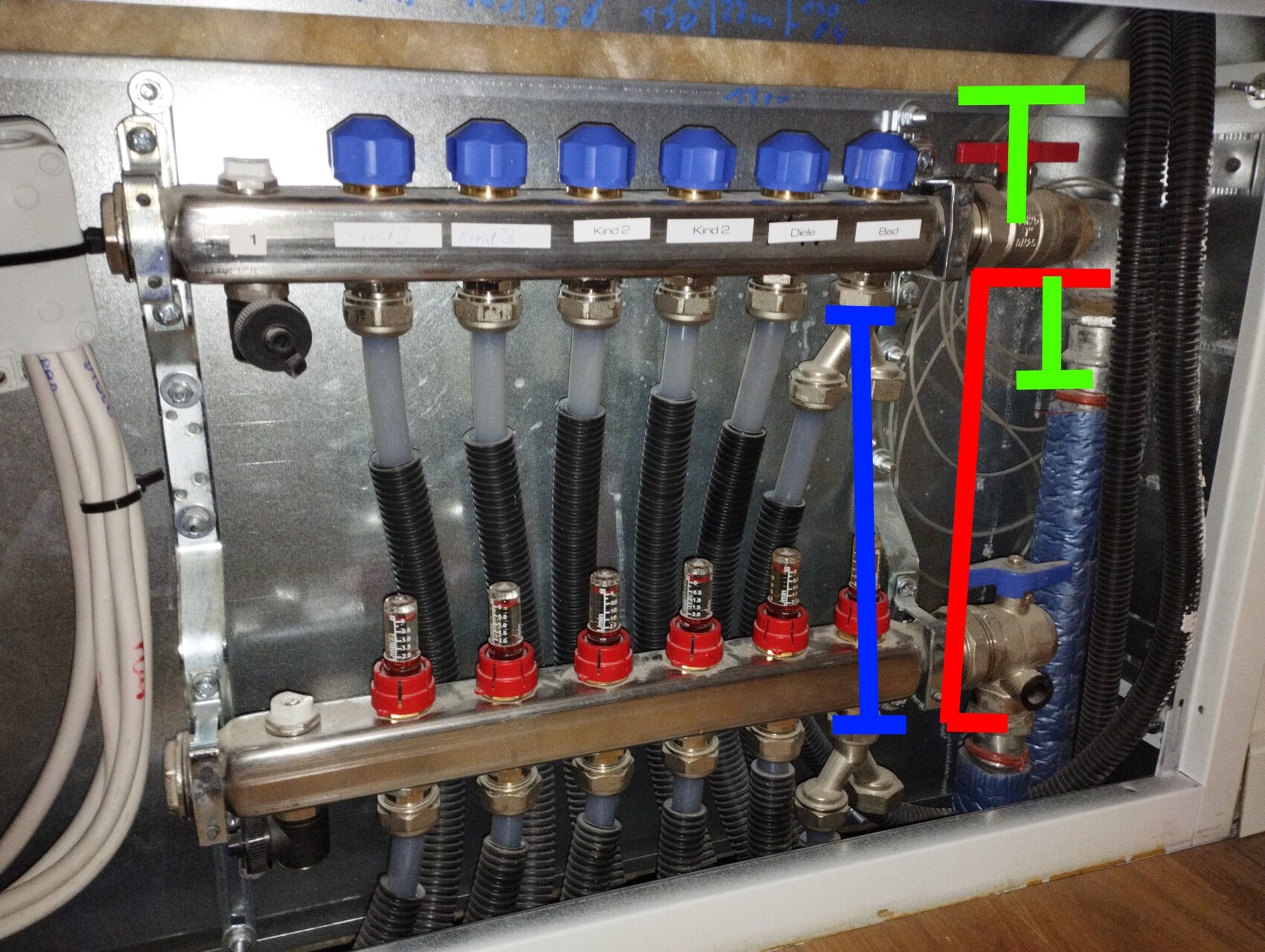
Even better, I would like to connect the bathroom(s) completely to a separate manifold with its own control valve and equip the current manifold with a separate control valve for shutoff (green). But I guess this is not possible, right?
we have been living in our new house for almost 3 years now and are generally quite satisfied with many things. The heating and ventilation systems also do not cause us much concern, but there are a few points that I would do differently now. Perhaps with some modifications, we can achieve the same results here.
Facts:
(geothermal/deep drilling) heat pump
27 heating circuits distributed over 4 manifolds on 4 floors
Distances of all pipes are equal and circuit lengths approximately the same
Each room has 2 heating circuits and each bathroom has 1 (there is a plan to possibly connect wall heating in the bathrooms in the future)
Originally, everything was controlled by room thermostats and 27 control valves. I have tried to perform a hydraulic balancing here and remove the control valves and thermostats.
Details:
In the basement, besides 3 heated rooms, there is the heated utility room (HAR)
One floor has a large common room, hallway, and guest WC
Two floors each have 1 bathroom and 2 or 3 small rooms
Problem:
This setup works well, but I have to adjust things on the heating manifold multiple times a year. For example, I partially turn the basement completely off or on. The bathrooms fully off and the bedrooms fully on (when switching from heating to cooling) – this is tolerable because all heating circuits throughout the house are now set manually. Since in the rooms there are double heating circuits compared to the bathrooms, I have to turn down the rooms considerably and still barely manage to keep the bathroom temperatures in a comfortable range. Otherwise, I would have to raise the heating temperatures and then turn the other rooms down even more, which is hardly possible.
Ideally, I would like to switch between as few control valves as possible, preferably switching all rooms on and bathrooms off vs. all rooms off and bathrooms on (or on, if then the lower temperature does not cool down the bathrooms again). Besides the energy consumption of the control valves, the purchasing costs add up, since I currently have only 2W normally closed valves in stock. Opening them that often seems uneconomical to me.
Option 1
In the picture, you see 1 of 4 heating manifolds. The bathroom has a “doubling” for a potential future wall heating connection. I am thinking of running each room (blue boxes) with such a doubling so that only one control valve per room is necessary. Furthermore, the circulation pump can only provide about half the flow when everything is open, so I can directly limit the flow this way.
The bathroom remains on one circuit, and the wall heating would have its own circuit instead of being connected to the bathroom circuit.
The hallway shall have its own circuit, permanently minimally open without a control valve.
Option 2
Even better, I would like to connect the bathroom(s) completely to a separate manifold with its own control valve and equip the current manifold with a separate control valve for shutoff (green). But I guess this is not possible, right?

grericht schrieb:
Since I’m planning to work with microcontrollers in the heating circuit controller anyway, I’ll probably install normally open control valves on most heating circuits, which I can close, for example, if there’s excessive heating from the sun. Since all the room thermostats are managed through Home Assistant, controlling them won’t be an issue.Why use “microcontrollers” when Home Assistant is involved? Just a switching or PWM heating actuator, and you’re good to go. Besides, your floor only releases heat into the room if the room is cooler. If that’s not the case, the heat simply stays in the pipe because there’s no temperature difference.Have you discussed your plan with a qualified heating engineer or possibly asked in the Rosa forum? It still seems somewhat impractical to me, more like a hydraulically balanced system with the option to shut off.
Unfortunately, I live in an area where you first have to explain to a heating engineer why you want a heat pump in a new build. I don’t really feel confident about getting a professional for a quote or feasibility check here. That’s why I’m asking here, so I only need to look for a heating engineer after having a concrete project.
I understand that a room only absorbs heat when it’s colder. I haven’t really heard that from others before — usually people say you should turn rooms down even when the sun is shining. It’s good to hear that my theory might not be entirely wrong. But that was just an example. For instance, I could imagine closing rooms used for playing or sleeping earlier, so in the evening they cool down slightly more than the other rooms by 0.x degrees. Or having the option to set one room temporarily cooler because it’s not being used at the moment.
PWM and switching heating actuators? I haven’t found much useful information searching for those. Are these the components that control the entire heating circuit and monitor the individual supply and return lines? If so, then I basically want exactly that but built myself as cheaply as possible. Those parts cost more than 500 euros per floor. An ESP32 costs me 2 euros and a relay board 3 euros. Add a few control valves and that’s it. I would think this solution is less prone to failure, easier to repair, and I’m not tied to any cloud service or specific manufacturer?! But I’m open to any suggestions. That’s exactly why I’m asking here. I can fully control my heat pump — on/off, circulation pump, cooling, heating. It’s no problem and runs perfectly. What I’m missing is the option to deliver heat or cooling to individual rooms at certain times or seasons and also to temporarily “overheat” specific rooms (bathrooms). I don’t want the bathrooms at 22–24°C (72–75°F) all day, just long enough in the morning and evening for about an hour to have the tile floor a bit warmer for bare feet.
I understand that a room only absorbs heat when it’s colder. I haven’t really heard that from others before — usually people say you should turn rooms down even when the sun is shining. It’s good to hear that my theory might not be entirely wrong. But that was just an example. For instance, I could imagine closing rooms used for playing or sleeping earlier, so in the evening they cool down slightly more than the other rooms by 0.x degrees. Or having the option to set one room temporarily cooler because it’s not being used at the moment.
PWM and switching heating actuators? I haven’t found much useful information searching for those. Are these the components that control the entire heating circuit and monitor the individual supply and return lines? If so, then I basically want exactly that but built myself as cheaply as possible. Those parts cost more than 500 euros per floor. An ESP32 costs me 2 euros and a relay board 3 euros. Add a few control valves and that’s it. I would think this solution is less prone to failure, easier to repair, and I’m not tied to any cloud service or specific manufacturer?! But I’m open to any suggestions. That’s exactly why I’m asking here. I can fully control my heat pump — on/off, circulation pump, cooling, heating. It’s no problem and runs perfectly. What I’m missing is the option to deliver heat or cooling to individual rooms at certain times or seasons and also to temporarily “overheat” specific rooms (bathrooms). I don’t want the bathrooms at 22–24°C (72–75°F) all day, just long enough in the morning and evening for about an hour to have the tile floor a bit warmer for bare feet.
The motorized ball valve only has open and close positions, right? There is no option to set it to partially open?
I have the same question regarding the control valves. If these were motorized instead of thermal on/off types, I wouldn’t need all the additional equipment around them. But the ones I find are usually much too large to install several side by side?!
I have the same question regarding the control valves. If these were motorized instead of thermal on/off types, I wouldn’t need all the additional equipment around them. But the ones I find are usually much too large to install several side by side?!
Alright, after a long search, I finally found a good commercial offer where I would pay around 4 HVAC zones with approximately 20 actuators about 4*200 + ~400 EUR (4*200 + ~400 USD). Then I found two open-source projects that provide the 4*200 EUR actuators—one as an FHEM project and the other as an ESPHome project. The control valves could also be sourced even cheaper there. So this is going to be the solution.
The only remaining challenge is still to combine two heating circuits per room into one connection. This still saves one control valve per room, and the flow rate is also halved, which should definitely be sufficient.
The only remaining challenge is still to combine two heating circuits per room into one connection. This still saves one control valve per room, and the flow rate is also halved, which should definitely be sufficient.
Similar topics