
ᐅ Make the heating control adjustable and monitor electricity consumption closely
Created on: 12 Feb 2024 20:27
G
grerichtHello,
we have been living in our new house for almost 3 years now and are generally quite satisfied with many things. The heating and ventilation systems also do not cause us much concern, but there are a few points that I would do differently now. Perhaps with some modifications, we can achieve the same results here.
Facts:
(geothermal/deep drilling) heat pump
27 heating circuits distributed over 4 manifolds on 4 floors
Distances of all pipes are equal and circuit lengths approximately the same
Each room has 2 heating circuits and each bathroom has 1 (there is a plan to possibly connect wall heating in the bathrooms in the future)
Originally, everything was controlled by room thermostats and 27 control valves. I have tried to perform a hydraulic balancing here and remove the control valves and thermostats.
Details:
In the basement, besides 3 heated rooms, there is the heated utility room (HAR)
One floor has a large common room, hallway, and guest WC
Two floors each have 1 bathroom and 2 or 3 small rooms
Problem:
This setup works well, but I have to adjust things on the heating manifold multiple times a year. For example, I partially turn the basement completely off or on. The bathrooms fully off and the bedrooms fully on (when switching from heating to cooling) – this is tolerable because all heating circuits throughout the house are now set manually. Since in the rooms there are double heating circuits compared to the bathrooms, I have to turn down the rooms considerably and still barely manage to keep the bathroom temperatures in a comfortable range. Otherwise, I would have to raise the heating temperatures and then turn the other rooms down even more, which is hardly possible.
Ideally, I would like to switch between as few control valves as possible, preferably switching all rooms on and bathrooms off vs. all rooms off and bathrooms on (or on, if then the lower temperature does not cool down the bathrooms again). Besides the energy consumption of the control valves, the purchasing costs add up, since I currently have only 2W normally closed valves in stock. Opening them that often seems uneconomical to me.
Option 1
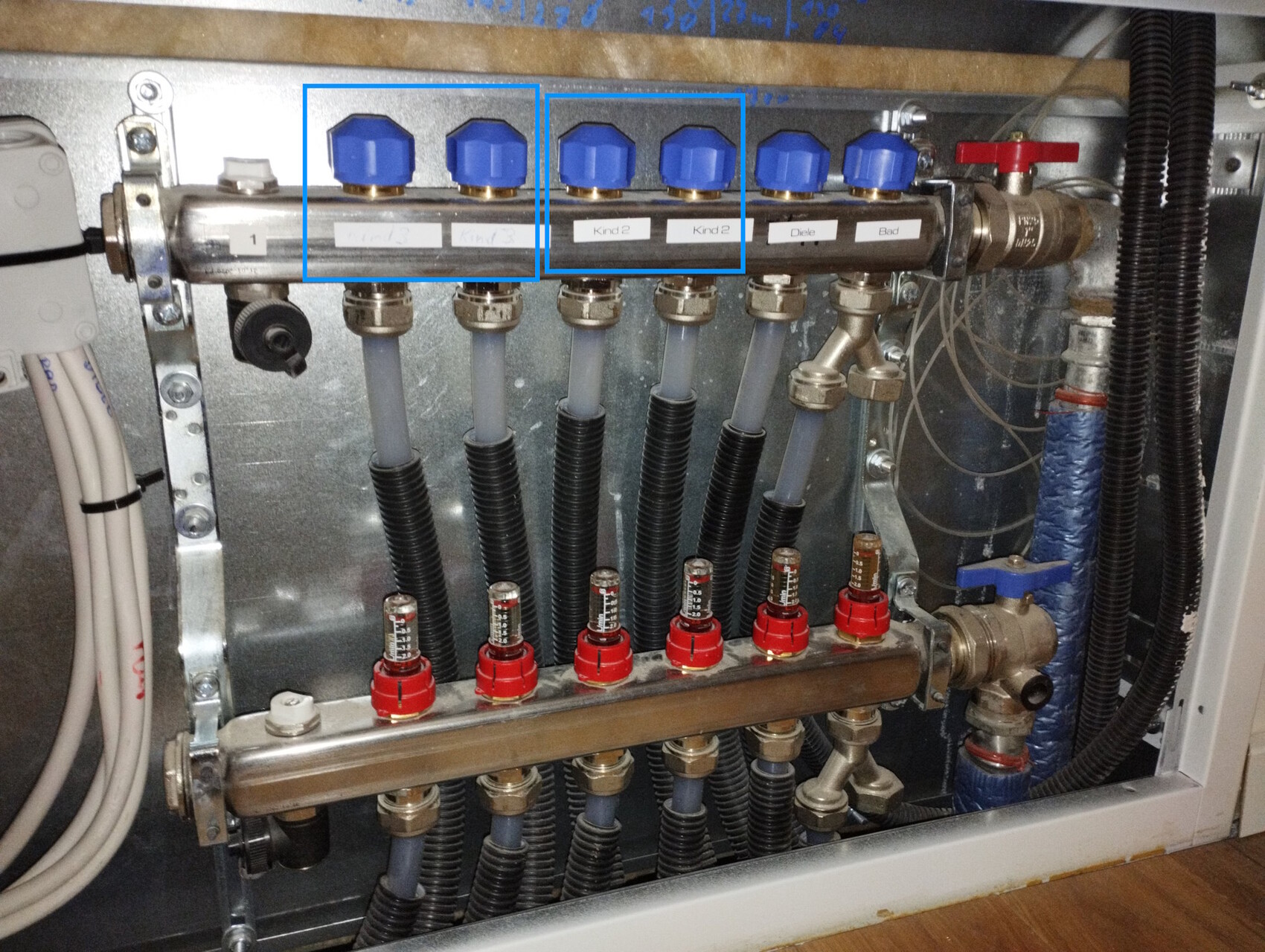
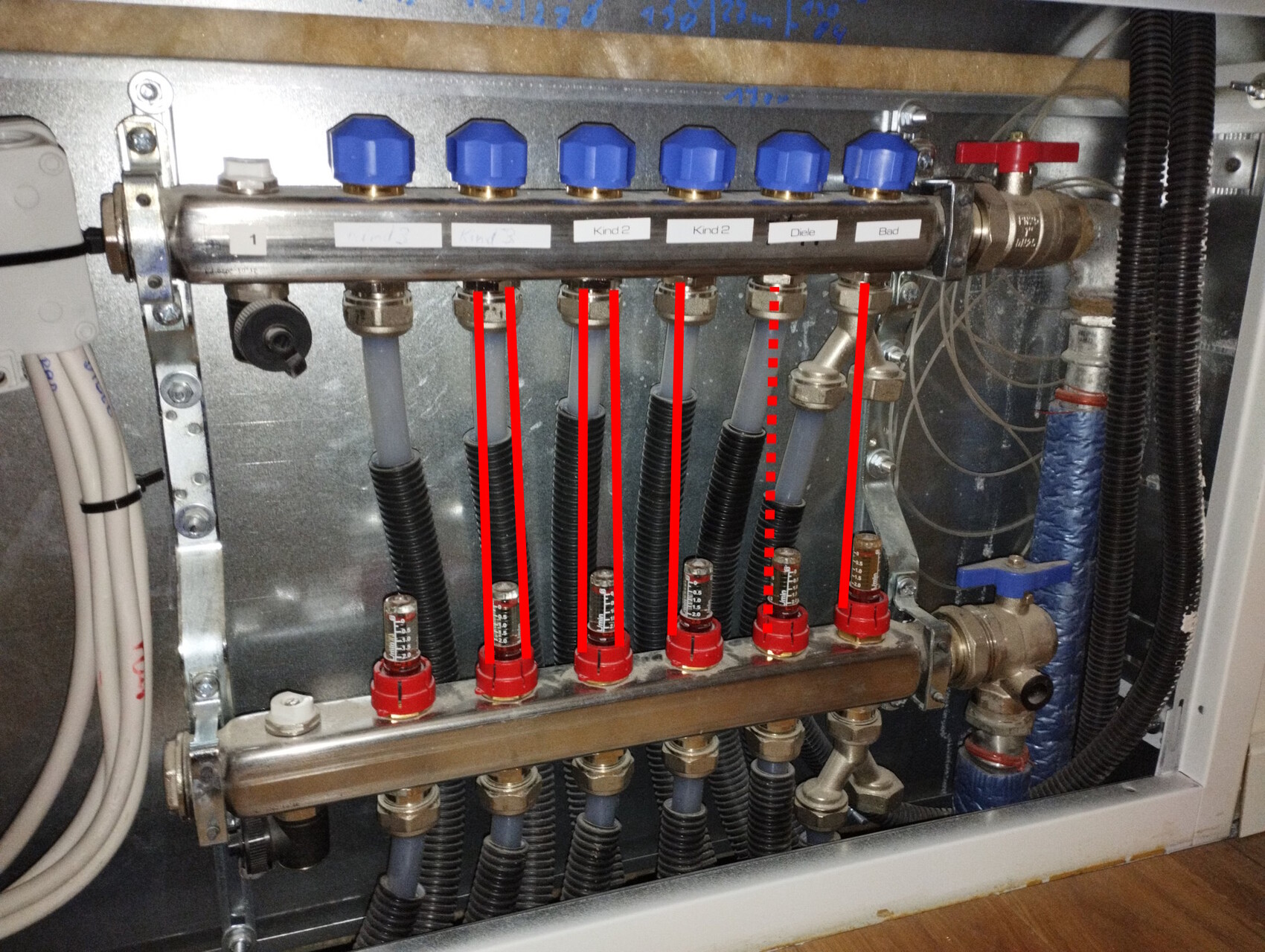
In the picture, you see 1 of 4 heating manifolds. The bathroom has a “doubling” for a potential future wall heating connection. I am thinking of running each room (blue boxes) with such a doubling so that only one control valve per room is necessary. Furthermore, the circulation pump can only provide about half the flow when everything is open, so I can directly limit the flow this way.
The bathroom remains on one circuit, and the wall heating would have its own circuit instead of being connected to the bathroom circuit.
The hallway shall have its own circuit, permanently minimally open without a control valve.
Option 2
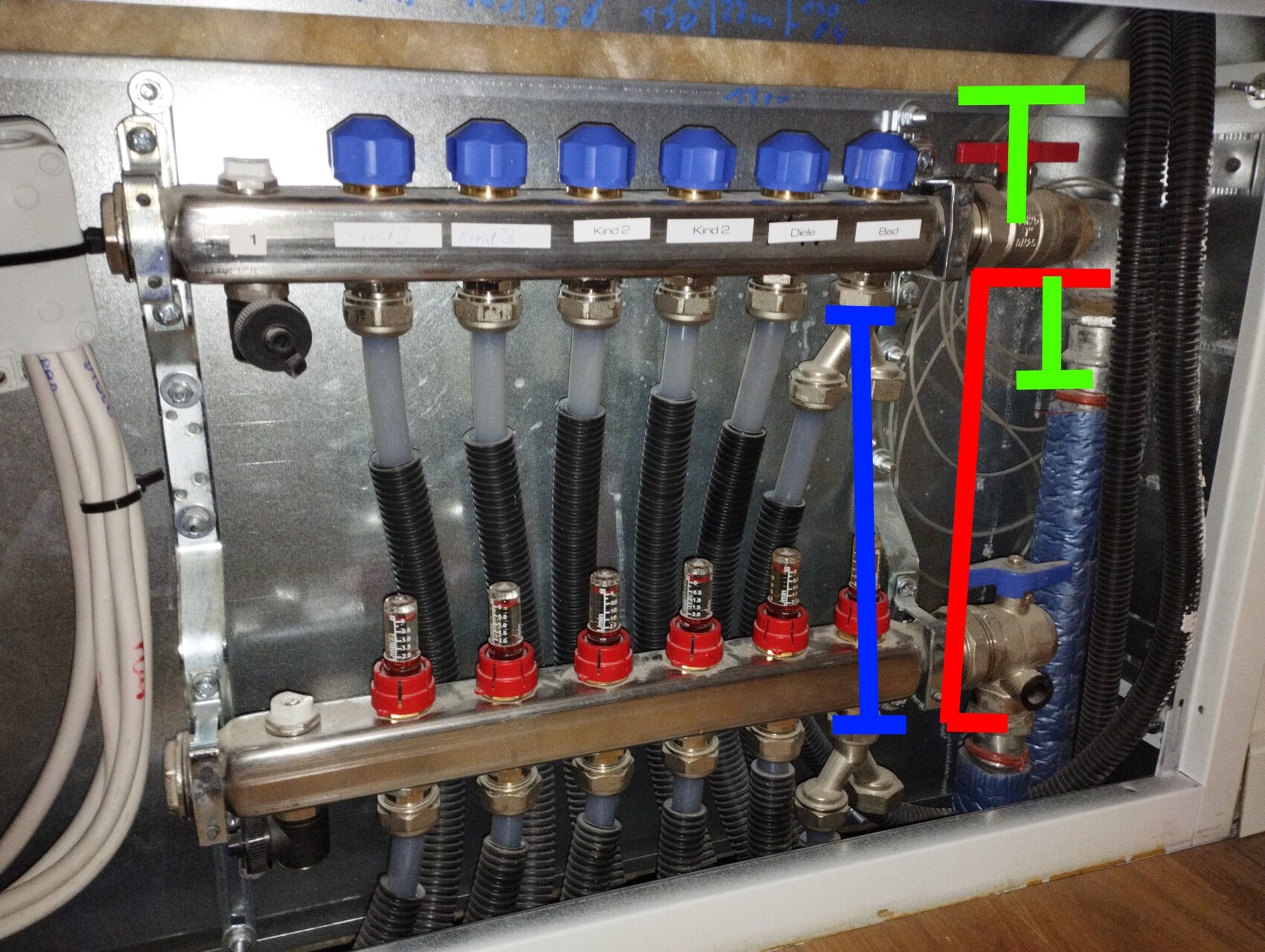
Even better, I would like to connect the bathroom(s) completely to a separate manifold with its own control valve and equip the current manifold with a separate control valve for shutoff (green). But I guess this is not possible, right?
we have been living in our new house for almost 3 years now and are generally quite satisfied with many things. The heating and ventilation systems also do not cause us much concern, but there are a few points that I would do differently now. Perhaps with some modifications, we can achieve the same results here.
Facts:
(geothermal/deep drilling) heat pump
27 heating circuits distributed over 4 manifolds on 4 floors
Distances of all pipes are equal and circuit lengths approximately the same
Each room has 2 heating circuits and each bathroom has 1 (there is a plan to possibly connect wall heating in the bathrooms in the future)
Originally, everything was controlled by room thermostats and 27 control valves. I have tried to perform a hydraulic balancing here and remove the control valves and thermostats.
Details:
In the basement, besides 3 heated rooms, there is the heated utility room (HAR)
One floor has a large common room, hallway, and guest WC
Two floors each have 1 bathroom and 2 or 3 small rooms
Problem:
This setup works well, but I have to adjust things on the heating manifold multiple times a year. For example, I partially turn the basement completely off or on. The bathrooms fully off and the bedrooms fully on (when switching from heating to cooling) – this is tolerable because all heating circuits throughout the house are now set manually. Since in the rooms there are double heating circuits compared to the bathrooms, I have to turn down the rooms considerably and still barely manage to keep the bathroom temperatures in a comfortable range. Otherwise, I would have to raise the heating temperatures and then turn the other rooms down even more, which is hardly possible.
Ideally, I would like to switch between as few control valves as possible, preferably switching all rooms on and bathrooms off vs. all rooms off and bathrooms on (or on, if then the lower temperature does not cool down the bathrooms again). Besides the energy consumption of the control valves, the purchasing costs add up, since I currently have only 2W normally closed valves in stock. Opening them that often seems uneconomical to me.
Option 1
In the picture, you see 1 of 4 heating manifolds. The bathroom has a “doubling” for a potential future wall heating connection. I am thinking of running each room (blue boxes) with such a doubling so that only one control valve per room is necessary. Furthermore, the circulation pump can only provide about half the flow when everything is open, so I can directly limit the flow this way.
The bathroom remains on one circuit, and the wall heating would have its own circuit instead of being connected to the bathroom circuit.
The hallway shall have its own circuit, permanently minimally open without a control valve.
Option 2
Even better, I would like to connect the bathroom(s) completely to a separate manifold with its own control valve and equip the current manifold with a separate control valve for shutoff (green). But I guess this is not possible, right?

I don’t have detailed knowledge about the general adjustability, but I think it should be possible. You’ll probably need a small server and an actuator that is compatible with the control units.
Regarding wall heating, what do you mean exactly? A proper wall heating system with heating loops embedded in the wall (similar to underfloor heating), or a towel radiator? If you mean a towel radiator, it’s better not to integrate it into the hydraulics, but rather to use an electric option (either with a heating element or an infrared panel).
Regarding wall heating, what do you mean exactly? A proper wall heating system with heating loops embedded in the wall (similar to underfloor heating), or a towel radiator? If you mean a towel radiator, it’s better not to integrate it into the hydraulics, but rather to use an electric option (either with a heating element or an infrared panel).
The server is set up, and I will buy the control valves. I have smart thermostats in every room. That part is settled!
I specifically want to focus on the renovation of the heating circuit (HKV). Which of the options is feasible and which is more cost-effective?
By the way, if I ever install a heating system in a house again, I think I will have a second circuit for the bathrooms installed from the heating unit to each floor right away.
I specifically want to focus on the renovation of the heating circuit (HKV). Which of the options is feasible and which is more cost-effective?
By the way, if I ever install a heating system in a house again, I think I will have a second circuit for the bathrooms installed from the heating unit to each floor right away.
EDIT: More specifically:
- Is it possible to replace the shut-off valves for the supply and return lines with a control valve, so that I can basically shut down the entire heating circuit distributor (HCD)?
- Is it possible to branch off a pipe before this control valve of the entire HCD for the bathroom and operate it with a separate control valve?
- Is it possible to install a “bypass” like in the bathroom circuit for the rooms? Can I do this myself by shutting off the supply and return lines and then installing it, or will the heating water flow back towards me?

It’s called a heating circuit manifold!
1. Of course, a motorized ball valve (not a solenoid valve!) and off you go.
1.1 If your heat generator can handle the increased heating load, why not.
2. See 1.1, at some point the system design probably no longer fits, and yes, it will naturally release fluid—about as much as is in that pipe section.
Whether you can do this is up to you. The whole setup doesn’t strike me as particularly well thought out.
1. Of course, a motorized ball valve (not a solenoid valve!) and off you go.
1.1 If your heat generator can handle the increased heating load, why not.
2. See 1.1, at some point the system design probably no longer fits, and yes, it will naturally release fluid—about as much as is in that pipe section.
Whether you can do this is up to you. The whole setup doesn’t strike me as particularly well thought out.
The heat cost allocator must have been the autocorrect error. Thank you very much for the tip about the motorized ball valve; that already helps a lot.
The heat pump currently doesn’t run for even 12 hours at -15 degrees Celsius (5°F). There’s still plenty of room for improvement. Basically, I just want to activate the heat pump twice a day to “flush” only the two bathrooms.
Here’s a brief summary of what I’ve tried so far and what has worked well:
1. (This is how we bought it) On each heating circuit, there was a 2-way normally closed (NC) control valve (27 pieces) with 14 thermostats in the house controlling these actuators. Adjusting the heating circuits like this consumed around 300 kWh per year. Given the annual household electricity consumption of 1500 kWh, that’s a 20% increase. Not to mention that the slow response of the system severely limited the settings, the summer-winter time change was a nightmare, and the settings on the heating system didn’t always align well with those of the thermostats. In short, the system’s annual performance factor suffered significantly. To achieve 2 degrees Celsius (3.6°F) warmer in the bathroom than in other rooms, significantly higher return temperatures were needed all day long, which was difficult to set.
2. All control valves were turned off, and all individual heating circuits were left open and manually adjusted. The annual performance factor is now over 5. That saved 300 kWh. The trade-off is that I have to adjust something on the hydraulic balancing valve (HKV) two to four times a year and, of course, can’t respond well to sudden changes.
Current plan, hoping it will be somewhat more thought-through:
Now I want to basically do the same but shut off the entire hydraulic balancing valve twice a day, opening only the two heating circuits for the bathrooms and increasing the return temperature. After that, the bathrooms close again and the other heating circuits reopen. Since I want to control the HKV with microcontrollers anyway, I will probably install normally open (NO) control valves on most heating circuits, which I can also close if there is excessive heating from the sun, for example. Since all the room thermostats are already controlled via Home Assistant, valve control is no problem. I just need the best way to achieve maximum valve control success with as few structural changes as possible. Since almost all heating circuits currently run at about one-quarter flow, I can probably combine two circuits per room on one HKV connection and save one control valve. After all, I would never turn off only one of two heating circuits in a room, right?
The heat pump currently doesn’t run for even 12 hours at -15 degrees Celsius (5°F). There’s still plenty of room for improvement. Basically, I just want to activate the heat pump twice a day to “flush” only the two bathrooms.
Here’s a brief summary of what I’ve tried so far and what has worked well:
1. (This is how we bought it) On each heating circuit, there was a 2-way normally closed (NC) control valve (27 pieces) with 14 thermostats in the house controlling these actuators. Adjusting the heating circuits like this consumed around 300 kWh per year. Given the annual household electricity consumption of 1500 kWh, that’s a 20% increase. Not to mention that the slow response of the system severely limited the settings, the summer-winter time change was a nightmare, and the settings on the heating system didn’t always align well with those of the thermostats. In short, the system’s annual performance factor suffered significantly. To achieve 2 degrees Celsius (3.6°F) warmer in the bathroom than in other rooms, significantly higher return temperatures were needed all day long, which was difficult to set.
2. All control valves were turned off, and all individual heating circuits were left open and manually adjusted. The annual performance factor is now over 5. That saved 300 kWh. The trade-off is that I have to adjust something on the hydraulic balancing valve (HKV) two to four times a year and, of course, can’t respond well to sudden changes.
Current plan, hoping it will be somewhat more thought-through:
Now I want to basically do the same but shut off the entire hydraulic balancing valve twice a day, opening only the two heating circuits for the bathrooms and increasing the return temperature. After that, the bathrooms close again and the other heating circuits reopen. Since I want to control the HKV with microcontrollers anyway, I will probably install normally open (NO) control valves on most heating circuits, which I can also close if there is excessive heating from the sun, for example. Since all the room thermostats are already controlled via Home Assistant, valve control is no problem. I just need the best way to achieve maximum valve control success with as few structural changes as possible. Since almost all heating circuits currently run at about one-quarter flow, I can probably combine two circuits per room on one HKV connection and save one control valve. After all, I would never turn off only one of two heating circuits in a room, right?
Similar topics