
ᐅ Main Pipeline Layout – Wastewater Drainage and Elevation Planning
Created on: 24 Sep 2020 19:39
T
Tolentino
Hello dear forum members,
I have now received a preliminary draft of the detailed construction plan. This will be adjusted again after the structural engineering calculations are completed, if necessary, and then finalized. Until then, I have time to consider whether everything makes sense as it is.
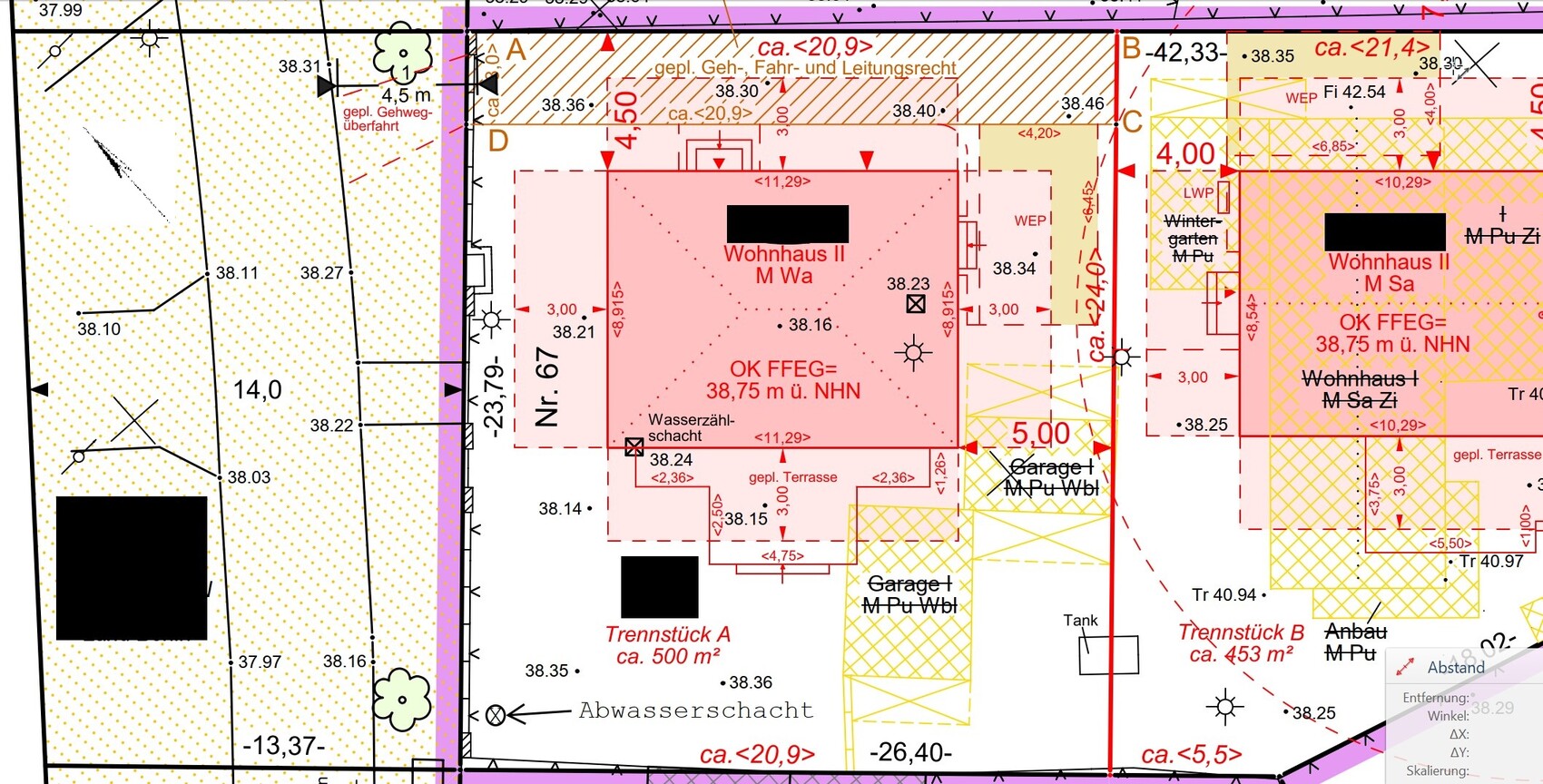
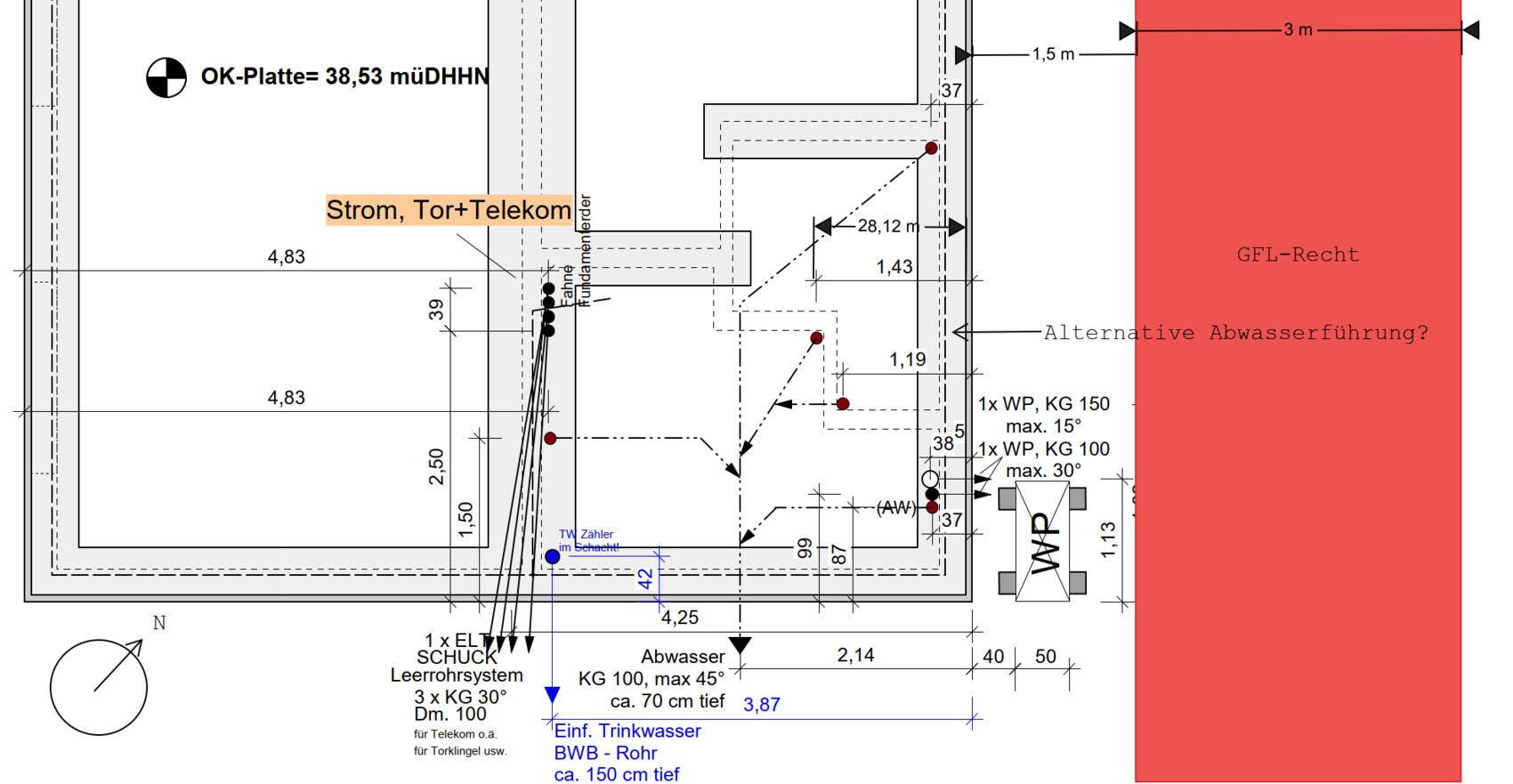
Below you can see first a site plan (from the building permit / planning permission) and a section from the draft ground drainage plan by the construction manager. Please note that the plans have different orientations, but I have added the north arrows anew in each case. In the ground drainage plan, I have marked the natural ground level (GFL) as an orange rectangle.
As you can see, the draft proposes that the wastewater pipes be combined and routed downward on the plan — that is, towards the neighboring property at the back, away from the street. This would require me to make one more directional change. The construction manager’s reasoning was that pipes should always be routed under the foundation slab on the shortest possible path because they are inaccessible afterward. That makes sense. However, looking at where the pipes come down elsewhere, is this really the average shortest route? There are more drainage pipes lying closer to the GFL strip; only the kitchen drain would be further away. Considering the longer pipe run for the main line and the additional required direction change, wouldn’t it be more sensible to route it to the right side of the plan (in the ground drainage plan) or upwards in the site plan?
The second topic is the height of the wastewater pipe. Here, the outlet height from the foundation slab is set at approximately 70 cm (28 inches) — I still need to confirm with respect to which height this refers; I assume the foundation slab’s top or underside. This is generally a standard height for wastewater pipes, but since the intended pipe route runs along the GFL, which also serves as the shared driveway for my neighbor and me, meaning it is a trafficked area, it is recommended to place the pipe deeper — from what I gather, about 150 cm (59 inches). Should I inform the general contractor about this now, or is it possible to add another step before the GFL? Especially because the existing wastewater shaft (see the west corner on the site plan) is to be used, and the pipe will have to cover a good distance of about 40 m (130 feet) to get there, the question about the actually necessary minimum height is important. The wastewater shaft is roughly 1.8 m (71 inches) deep. So, this roughly matches, but only if I can start on my preferred side of the house. If I have to go around the house, I would reach the shaft too low.
Do you have any ideas, suggestions, or remarks?
Thanks and best regards
Tolentino
I have now received a preliminary draft of the detailed construction plan. This will be adjusted again after the structural engineering calculations are completed, if necessary, and then finalized. Until then, I have time to consider whether everything makes sense as it is.
Below you can see first a site plan (from the building permit / planning permission) and a section from the draft ground drainage plan by the construction manager. Please note that the plans have different orientations, but I have added the north arrows anew in each case. In the ground drainage plan, I have marked the natural ground level (GFL) as an orange rectangle.
As you can see, the draft proposes that the wastewater pipes be combined and routed downward on the plan — that is, towards the neighboring property at the back, away from the street. This would require me to make one more directional change. The construction manager’s reasoning was that pipes should always be routed under the foundation slab on the shortest possible path because they are inaccessible afterward. That makes sense. However, looking at where the pipes come down elsewhere, is this really the average shortest route? There are more drainage pipes lying closer to the GFL strip; only the kitchen drain would be further away. Considering the longer pipe run for the main line and the additional required direction change, wouldn’t it be more sensible to route it to the right side of the plan (in the ground drainage plan) or upwards in the site plan?
The second topic is the height of the wastewater pipe. Here, the outlet height from the foundation slab is set at approximately 70 cm (28 inches) — I still need to confirm with respect to which height this refers; I assume the foundation slab’s top or underside. This is generally a standard height for wastewater pipes, but since the intended pipe route runs along the GFL, which also serves as the shared driveway for my neighbor and me, meaning it is a trafficked area, it is recommended to place the pipe deeper — from what I gather, about 150 cm (59 inches). Should I inform the general contractor about this now, or is it possible to add another step before the GFL? Especially because the existing wastewater shaft (see the west corner on the site plan) is to be used, and the pipe will have to cover a good distance of about 40 m (130 feet) to get there, the question about the actually necessary minimum height is important. The wastewater shaft is roughly 1.8 m (71 inches) deep. So, this roughly matches, but only if I can start on my preferred side of the house. If I have to go around the house, I would reach the shaft too low.
Do you have any ideas, suggestions, or remarks?
Thanks and best regards
Tolentino
Should an additional inspection chamber be installed somewhere?
In my opinion, it makes sense at least where your pipe (whether light blue or dark red, which I actually see more as brown) connects with your neighbor’s pipe.
If not, coordination has to start from the furthest connection point. In any case, that would be your neighbor’s finished ground level (FGL) planning.
In summary, this means it’s even more important to plan this with accurate height measurements. If your pipe is too high, your neighbor will have problems. If it’s too low, the issue could ultimately arise at the street connection.
So, if all pipes are coming from your side—that is, installed by you—I would consider bringing a planner on board.
For that, you’ll need the construction details of both houses concerning the foundation slab and height levels to know where the starting height can be set.
The site’s terrain profile is also necessary because the pipe must lie within the frost-protected zone.
The fact that the finished floor level is the same for both houses at least simplifies things.
Is your neighbor using the same construction company?
In my opinion, it makes sense at least where your pipe (whether light blue or dark red, which I actually see more as brown) connects with your neighbor’s pipe.
If not, coordination has to start from the furthest connection point. In any case, that would be your neighbor’s finished ground level (FGL) planning.
In summary, this means it’s even more important to plan this with accurate height measurements. If your pipe is too high, your neighbor will have problems. If it’s too low, the issue could ultimately arise at the street connection.
So, if all pipes are coming from your side—that is, installed by you—I would consider bringing a planner on board.
For that, you’ll need the construction details of both houses concerning the foundation slab and height levels to know where the starting height can be set.
The site’s terrain profile is also necessary because the pipe must lie within the frost-protected zone.
The fact that the finished floor level is the same for both houses at least simplifies things.
Is your neighbor using the same construction company?

matte1987 schrieb:
Should an additional inspection chamber be added somewhere?
In my opinion, it would at least make sense where your pipe [...] connects with your neighbor’s pipe.
If not, coordination must start at the farthest connection point. In any case, that would be your neighbor’s ground level planning. I would consider an inspection chamber useful where the light blue branch meets the dark blue one here. The neighbor only has the right for ground level at the specific strip—so under the owner’s terrace towards the existing chamber, he couldn’t reasonably claim access. At some point, you have to get things moving, meaning I wouldn’t want to wait until the neighbor (hopefully not a cousin of @Shiny86) figures out the details of their house. Is the neighbor’s house still just a placeholder in the plan according to the outlines, or is it at least more or less finalized?
https://www.instagram.com/11antgmxde/
https://www.linkedin.com/company/bauen-jetzt/

Nida35a schrieb:
Definitely DN125/150 (5/6 inches) for the common pipe, no 90-degree bends, use 3x30 or 2x45-degree bends.
Access openings from T-joints with 45-degree, 45-degree elbows, 1m (3 feet) of pipe going up, end cap.
Our driveway is rated for 10 tons (11 US tons) as continuous load for a van/car. Ok, we heard advice that it might be better to install two separate wastewater pipes. That way, if one pipe gets blocked, both houses won’t be affected at once. Or does it make more sense just to increase the size to DN200 (8 inches)?
Especially since the easement (GFL) allows the neighbor to lay their pipes through our land, but does not necessarily grant access to use my pipe. We get along well, but future owners might see things differently.
So, is that a crazy idea or reasonable redundancy? I know that the Berlin water authority requires a minimum 1m (3 feet) separation between wastewater and drinking water lines when laid side by side. What about two wastewater pipes—are there recommended minimum distances to consider?
We actually wanted to pave the driveway only with grass pavers. Is that not sensible with pipes underneath? Or can sufficient gravel under the soil layer provide adequate protection?
matte1987 schrieb:
Is there supposed to be an additional inspection chamber somewhere?
In my opinion, it would at least make sense where your pipe (whether light blue or dark red, which for me looks more brown) connects with your neighbor’s pipe. We would do anything that makes sense. So yes, in the case of a joint connection definitely, and maybe before and after each change of direction?
matte1987 schrieb:
If all the pipes are installed by you (the builder) yourself, I would consider bringing a planner on board.
You need the structural details of both houses regarding the slab and elevation levels to know what height you can start at.
You also need the terrain profile since the pipe must be installed below the frost line. Yes, I already contacted a building services engineering office. Not sure how they handle pipe laying in the terrain. Maybe it would be better to ask a civil engineer specialized in underground construction?
Are the elevation details on the site plan enough for the terrain profile? A lot was demolished there. Should we have it surveyed again afterwards? Or can a civil engineer work with relative measurements?
matte1987 schrieb:
Is your neighbor using the same construction company? Yes.
11ant schrieb:
At some point, you have to get things moving, meaning I didn’t want to wait until the neighbor (hopefully not a cousin of @Shiny86) gets completely decided about the details of their house. Is their house layout still just a placeholder on the plan, or is it at least “fixed” at this point? The neighbor is getting impatient. Here, it’s the Berlin authorities who are dragging their feet.
He submitted his building application before I did, and mine was approved almost two months ago.
My neighbor, with whom I actually get along quite well, is unfortunately the type to do everything himself. I’m now convinced that the pipes should be installed by an experienced civil engineer. Or do you think it can be managed with EL?
More is not always better here. If you simply increase the dimensions without considering the correct slope, the fill level will drop below the required minimum, causing the opposite of what you intend—problems will arise.
Have your joint builder handle the planning based on their specifications for the installation of the pipes. This way, at least the entire planning process comes from one source.
Alternatively, you can hire an MEP (Mechanical, Electrical, and Plumbing) planning firm.
Have your joint builder handle the planning based on their specifications for the installation of the pipes. This way, at least the entire planning process comes from one source.
Alternatively, you can hire an MEP (Mechanical, Electrical, and Plumbing) planning firm.
I think grass pavers in the ground floor level area are a good choice. Does any of you have a 12-ton (approximately 26,500 lbs) motorhome, or what concerns you about the load capacity for driving over it?
In any case, one (of your) pipelines will have to be installed approximately as shown in the drawing to allow placing one or even both next to each other. I assume there is no specific minimum distance required between pipes of the same type. I am somewhat skeptical about increasing the nominal pipe diameter, since the pressure of the flowing volume on deposits decreases with a larger cross-section, which means deposits will be less likely carried away and blockages may become more probable. I consider adding more inspection and flushing openings more useful than increasing the pipe diameter.
Then he should submit it to you as well, so we would know more.
https://www.instagram.com/11antgmxde/
https://www.linkedin.com/company/bauen-jetzt/
Tolentino schrieb:
I know that the Berlin Water Company requires at least 1m (3.3 feet) of separation between sewage and drinking water pipes when laid next to each other. But what about two sewage pipes?
In any case, one (of your) pipelines will have to be installed approximately as shown in the drawing to allow placing one or even both next to each other. I assume there is no specific minimum distance required between pipes of the same type. I am somewhat skeptical about increasing the nominal pipe diameter, since the pressure of the flowing volume on deposits decreases with a larger cross-section, which means deposits will be less likely carried away and blockages may become more probable. I consider adding more inspection and flushing openings more useful than increasing the pipe diameter.
Tolentino schrieb:
He already submitted his building permit / planning permission application before me.
Then he should submit it to you as well, so we would know more.
https://www.instagram.com/11antgmxde/
https://www.linkedin.com/company/bauen-jetzt/
Similar topics