
Okay... the plot isn’t actually that narrow – it measures 17.5 x 72 meters (57 x 236 feet). Since we prefer to keep the house single-story, the planned building stretches lengthwise. We have already presented our self-designed floor plan to two potential builders. Both considered our plan to be "ambitious." They also tried to steer us towards a two-story design to make it more affordable. Is a single-story house significantly more expensive than a two-story one? How would you estimate the cost of the house (location: rural, southeastern Saxony)? Are log beams (about 20cm (8 inches)) more expensive than masonry?
Attached are the floor plan and a video tour:
[MEDIA=YouTube]WwbOQsrIP98[/MEDIA]
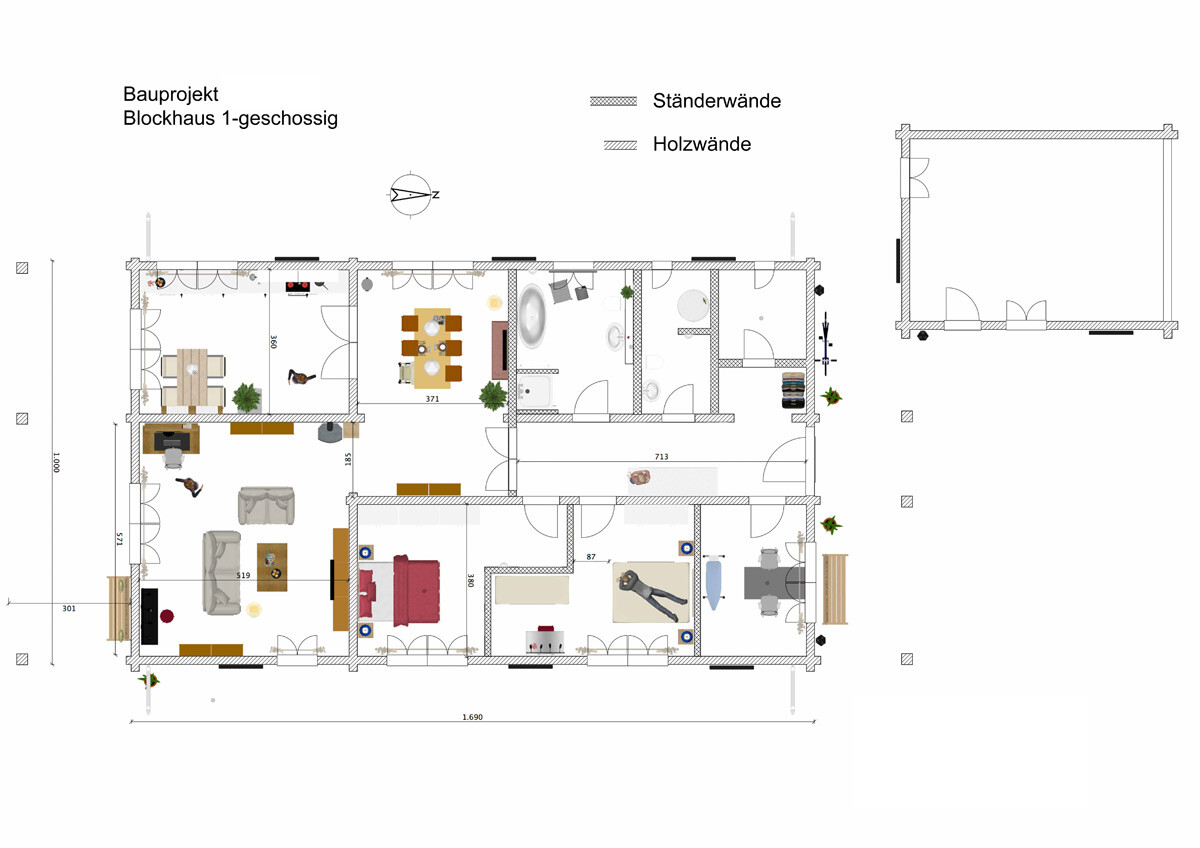
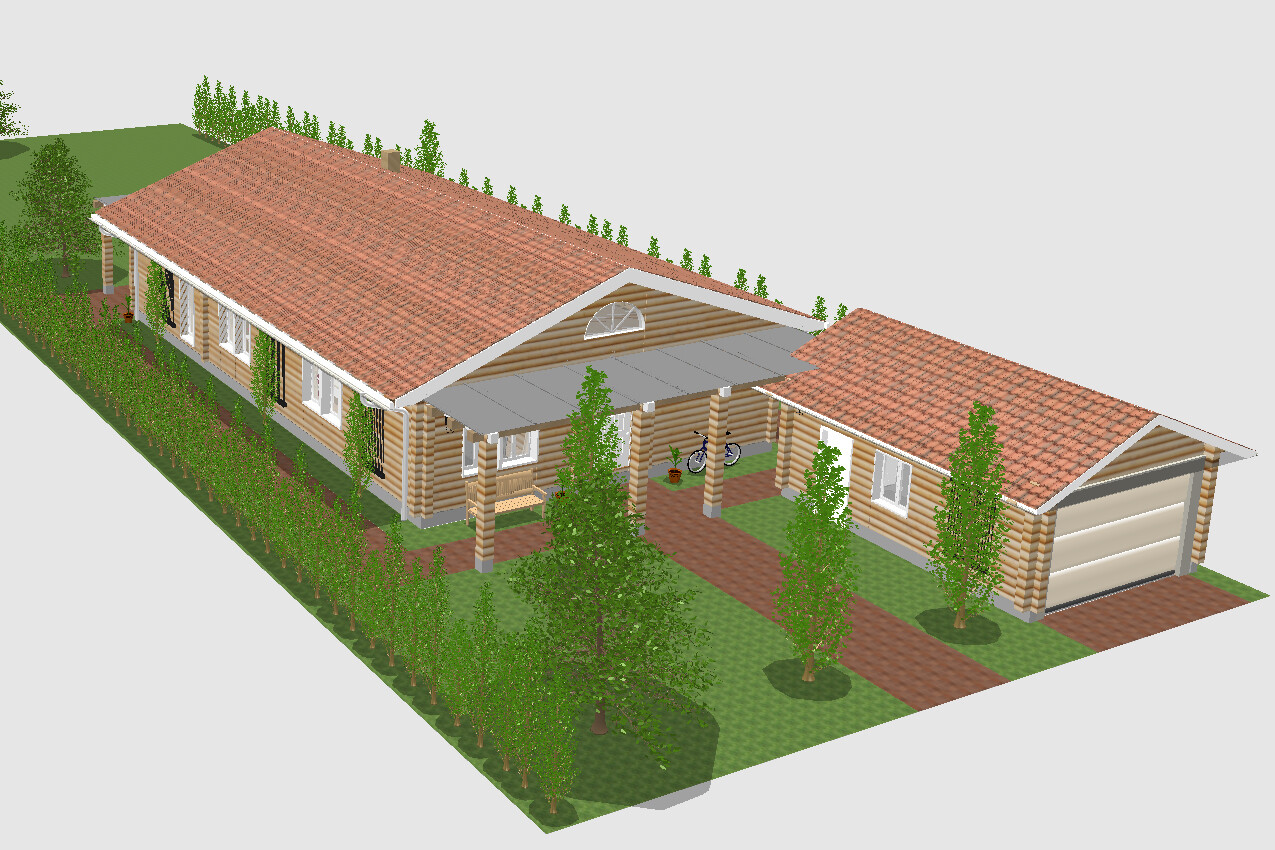
Attached are the floor plan and a video tour:
[MEDIA=YouTube]WwbOQsrIP98[/MEDIA]
I find the two bedrooms on the ground floor awkwardly shaped with their protrusions.
The upper floor feels strange during the walkthrough – is it intended as a storage area with a room at the far end?
You should take a closer look at the staircase – it is shown as very narrow and short.
A width of 3.8 m (12.5 feet) for the bed and wardrobe seems too small in my opinion. With a wardrobe depth of 60 cm (24 inches), you would only have about 60–70 cm (24–28 inches) left on each side of the bed, and you still need access to the wardrobe.
The kitchen unit might be a bit short – it depends on the number of occupants.
An exterior wall thickness of 20 cm (8 inches) is probably not sufficient. You need to meet a minimum insulation value. As far as I know, log houses are typically made of sawn logs with insulation in between.
After 7 m (23 feet), the hallway at the end might be somewhat dark.
I also find it odd to have the utility connections in the guest bathroom.
The upper floor feels strange during the walkthrough – is it intended as a storage area with a room at the far end?
You should take a closer look at the staircase – it is shown as very narrow and short.
A width of 3.8 m (12.5 feet) for the bed and wardrobe seems too small in my opinion. With a wardrobe depth of 60 cm (24 inches), you would only have about 60–70 cm (24–28 inches) left on each side of the bed, and you still need access to the wardrobe.
The kitchen unit might be a bit short – it depends on the number of occupants.
An exterior wall thickness of 20 cm (8 inches) is probably not sufficient. You need to meet a minimum insulation value. As far as I know, log houses are typically made of sawn logs with insulation in between.
After 7 m (23 feet), the hallway at the end might be somewhat dark.
I also find it odd to have the utility connections in the guest bathroom.
I
Irgendwoabaier25 Oct 2014 07:47I don’t think the idea itself is bad. There will certainly be a lot to discuss regarding the floor plan details, and much of it comes down to personal taste. However, wall thicknesses of 20 cm (8 inches) are somewhat thin for exterior walls, at least here in Germany, according to current regulations — even if made of wood.
From an energy efficiency perspective, the concept is not very practical, as it involves a lot of exterior surface area compared to the enclosed volume. Also, in terms of cost: there is a lot of roof and foundation area relative to the living space.
Building services: What is planned, and how much space will actually be needed for the building systems? In our case, I was already surprised that a technical room of about 11 m² (120 ft²), roughly square-shaped, was already quite small. This of course depends on the planned heat generator, ventilation system, photovoltaic setup, other equipment, and any backup options.
Otherwise, unconventional ideas like this should be discussed with architects early on — there are many details that are easy to overlook, which can eventually lead to planning issues...
From an energy efficiency perspective, the concept is not very practical, as it involves a lot of exterior surface area compared to the enclosed volume. Also, in terms of cost: there is a lot of roof and foundation area relative to the living space.
Building services: What is planned, and how much space will actually be needed for the building systems? In our case, I was already surprised that a technical room of about 11 m² (120 ft²), roughly square-shaped, was already quite small. This of course depends on the planned heat generator, ventilation system, photovoltaic setup, other equipment, and any backup options.
Otherwise, unconventional ideas like this should be discussed with architects early on — there are many details that are easy to overlook, which can eventually lead to planning issues...
I think there are still some issues with the floor plan. These L-shaped bedrooms just don’t work. In the master bedroom, that space is wasted, and in the children’s room, it limits your furniture options and makes everything feel cramped.
3.80 meters (12.5 feet) for a double bed plus wardrobe? We have 3.95 meters (13 feet) just for the bed, and there’s no room left for a wardrobe.
A PC in the living room is acceptable in a rented apartment, but in your own house, you should be able to find a better solution.
Also, the huge water tank in the guest bathroom is not acceptable at all. Why have a utility room or a laundry room connection if not for that?
Guest bedroom on the upper floor: I’m fine with the staircase being space-saving. But what I don’t like is that guests have to pass by all your clutter to get there. The route to the bathroom is quite long, too.
A bungalow should also have zoning—that is, separating the private area from the public area. In your layout, everyone has to pass by the bedrooms first.
Why does one room have two beds (one double bed and one single bed)?
And now my usual question: Do you have children? If yes, how many and what ages?
3.80 meters (12.5 feet) for a double bed plus wardrobe? We have 3.95 meters (13 feet) just for the bed, and there’s no room left for a wardrobe.
A PC in the living room is acceptable in a rented apartment, but in your own house, you should be able to find a better solution.
Also, the huge water tank in the guest bathroom is not acceptable at all. Why have a utility room or a laundry room connection if not for that?
Guest bedroom on the upper floor: I’m fine with the staircase being space-saving. But what I don’t like is that guests have to pass by all your clutter to get there. The route to the bathroom is quite long, too.
A bungalow should also have zoning—that is, separating the private area from the public area. In your layout, everyone has to pass by the bedrooms first.
Why does one room have two beds (one double bed and one single bed)?
And now my usual question: Do you have children? If yes, how many and what ages?
Dear Forum, I am really impressed by how quickly and thoroughly I am receiving responses to my post. However, your criticism has made us think carefully... Still, I would like to explain a few considerations first.
----------------------
First, the family situation:
Two of us will live in the house. However, we expect regular visits from our adult children and grandchildren. We also enjoy having friends, relatives, and acquaintances visit during the day. A small office is desired, as we both might work from home.
----------------------
The attic:
It is intended to be just a storage room. The room upstairs (visible in the video) is only a size scenario in case an additional room is needed. But we definitely will not develop it as such. The attic will also not be separately heated. A door will be installed at the top of the stairs to reduce heat loss from the floor below. In theory, a ceiling hatch would have sufficed... but we find that too inconvenient. Therefore, the staircase is planned quite simply. Question: Is a staircase about 80 cm (31.5 inches) wide sufficient for this?
----------------------
The bedroom:
We find this corner solution very successful. On one hand, it creates a cozy retreat for one of the grandchildren in the adjacent guest room. Also, you don’t immediately “fall into bed” when entering the room. On the wall opposite the door, there is space for a hook rack to hang bathrobes, dressing gowns, and various items. Regarding the dimensions: I just measured again... Our current bed has an outer width of 170 cm (67 inches). At the moment, the large wardrobe (60 cm (24 inches) deep) stands exactly 75 cm (30 inches) away from the bed. This fits perfectly and hasn’t caused any problems for over 10 years. If we place it the same way in the new house, there will also be exactly 75 cm (30 inches) to the window side. So everything seems to fit well... admittedly, 10–20 cm (4–8 inches) more would be perfect.
----------------------
The guest room:
The dimensions here are similar to the bedroom. The double bed is for guests, and the single bed (possibly a bunk bed) is for the grandchild. Since the grandchild will often stay overnight or after school without parents, there is also a desk. However, most activities will likely take place in the living/dining area (homework, playing, etc.) J
----------------------
The kitchen:
The length of the countertop is 519 cm (204 inches). After deducting the stove and sink, approximately 360 cm (142 inches) of workspace remains. This is definitely enough; currently, we have much less. If necessary, the breakfast table can also be used.
----------------------
The living room:
We deliberately included a small computer workstation. In the evenings, we often need to work or mess around on the computer for a few hours. We don’t want to be cut off from the rest of family life in a separate room. Although working, we want to stay actively involved in family life, watch some TV occasionally, or listen to conversations. We already have this setup in our current house and want the same arrangement again.
----------------------
Utility room/guest bathroom:
Here, too, we deliberately decided on this combination. Originally, we would have preferred to integrate the heating system into the large bathroom. However, we didn’t find an appealing design solution for that. The reason is that such a heating system always emits heat to the surroundings. In our current house, this is the warmest room. How often have we wished that this waste heat would simply heat our bathroom and not a storage room? Since in the new house the main bathroom is right next to the guest bathroom, we imagine a simple ventilator connection from the guest bathroom to the main bathroom, so that the main bathroom could also benefit from the waste heat. What we cannot yet estimate, however, is how large such a heating system will be. Our current system (district heating with an 80 liter (21 gallon) storage tank) would fit comfortably.
----------------------
20 cm (8 inch) exterior walls made of laminated log beams
This is where we are particularly confused. Both house providers offer the 20 cm (8 inch) laminated wood log wall and advertise its excellent insulation properties:
Here is a picture of the construction:
- 20–25 cm (8–10 inch) thick
- laminated beams
- made from a single material, therefore no additional insulation needed
- absolutely airtight due to high surface contact
- vapor permeable
- excellent thermal insulation properties
- wood moisture approx. 10%
- excellent building physics characteristics
- fire safety certification possible according to B1 (hardly flammable)
One can read:
“…Of course, the low heating costs also contribute to the wellbeing of the homeowners. This is thanks to the excellent insulating property of the 20 cm (8 inch) thick solid wall made of Nordic pine, which insulates better than the calculated value would suggest...”
----------------------
Sorry for writing so much.
Maybe someone is interested and has time to read everything and can give more constructive advice or criticism. Thank you all in advance.
Best regards, Steffi33
----------------------
First, the family situation:
Two of us will live in the house. However, we expect regular visits from our adult children and grandchildren. We also enjoy having friends, relatives, and acquaintances visit during the day. A small office is desired, as we both might work from home.
----------------------
The attic:
It is intended to be just a storage room. The room upstairs (visible in the video) is only a size scenario in case an additional room is needed. But we definitely will not develop it as such. The attic will also not be separately heated. A door will be installed at the top of the stairs to reduce heat loss from the floor below. In theory, a ceiling hatch would have sufficed... but we find that too inconvenient. Therefore, the staircase is planned quite simply. Question: Is a staircase about 80 cm (31.5 inches) wide sufficient for this?
----------------------
The bedroom:
We find this corner solution very successful. On one hand, it creates a cozy retreat for one of the grandchildren in the adjacent guest room. Also, you don’t immediately “fall into bed” when entering the room. On the wall opposite the door, there is space for a hook rack to hang bathrobes, dressing gowns, and various items. Regarding the dimensions: I just measured again... Our current bed has an outer width of 170 cm (67 inches). At the moment, the large wardrobe (60 cm (24 inches) deep) stands exactly 75 cm (30 inches) away from the bed. This fits perfectly and hasn’t caused any problems for over 10 years. If we place it the same way in the new house, there will also be exactly 75 cm (30 inches) to the window side. So everything seems to fit well... admittedly, 10–20 cm (4–8 inches) more would be perfect.
----------------------
The guest room:
The dimensions here are similar to the bedroom. The double bed is for guests, and the single bed (possibly a bunk bed) is for the grandchild. Since the grandchild will often stay overnight or after school without parents, there is also a desk. However, most activities will likely take place in the living/dining area (homework, playing, etc.) J
----------------------
The kitchen:
The length of the countertop is 519 cm (204 inches). After deducting the stove and sink, approximately 360 cm (142 inches) of workspace remains. This is definitely enough; currently, we have much less. If necessary, the breakfast table can also be used.
----------------------
The living room:
We deliberately included a small computer workstation. In the evenings, we often need to work or mess around on the computer for a few hours. We don’t want to be cut off from the rest of family life in a separate room. Although working, we want to stay actively involved in family life, watch some TV occasionally, or listen to conversations. We already have this setup in our current house and want the same arrangement again.
----------------------
Utility room/guest bathroom:
Here, too, we deliberately decided on this combination. Originally, we would have preferred to integrate the heating system into the large bathroom. However, we didn’t find an appealing design solution for that. The reason is that such a heating system always emits heat to the surroundings. In our current house, this is the warmest room. How often have we wished that this waste heat would simply heat our bathroom and not a storage room? Since in the new house the main bathroom is right next to the guest bathroom, we imagine a simple ventilator connection from the guest bathroom to the main bathroom, so that the main bathroom could also benefit from the waste heat. What we cannot yet estimate, however, is how large such a heating system will be. Our current system (district heating with an 80 liter (21 gallon) storage tank) would fit comfortably.
----------------------
20 cm (8 inch) exterior walls made of laminated log beams
This is where we are particularly confused. Both house providers offer the 20 cm (8 inch) laminated wood log wall and advertise its excellent insulation properties:
Here is a picture of the construction:
- 20–25 cm (8–10 inch) thick
- laminated beams
- made from a single material, therefore no additional insulation needed
- absolutely airtight due to high surface contact
- vapor permeable
- excellent thermal insulation properties
- wood moisture approx. 10%
- excellent building physics characteristics
- fire safety certification possible according to B1 (hardly flammable)
One can read:
“…Of course, the low heating costs also contribute to the wellbeing of the homeowners. This is thanks to the excellent insulating property of the 20 cm (8 inch) thick solid wall made of Nordic pine, which insulates better than the calculated value would suggest...”
----------------------
Sorry for writing so much.
Maybe someone is interested and has time to read everything and can give more constructive advice or criticism. Thank you all in advance.
Best regards, Steffi33
But you do want to insulate the roof and not the ceiling below, right? Otherwise, having the door there wouldn’t be a good idea.
A standard double bed is about 1.9 meters (6 feet 3 inches) long, and then there’s no space left at all. Also, you will get older and might need to use a walker, so 75 cm (30 inches) won’t be very generous. Plus, always keep in mind that you might want or need to sell the property someday.
Kitchen: It’s definitely sufficient for 2–3 people. Yes.
A pure cork wall with 20 cm (8 inches) thickness barely meets the insulation requirements – pine wood certainly does not. I would strongly question exactly what will be installed there. According to calculations (source: U-wert.net), pine achieves the energy saving standard only at a thickness of 52 cm (20 inches).
A standard double bed is about 1.9 meters (6 feet 3 inches) long, and then there’s no space left at all. Also, you will get older and might need to use a walker, so 75 cm (30 inches) won’t be very generous. Plus, always keep in mind that you might want or need to sell the property someday.
Kitchen: It’s definitely sufficient for 2–3 people. Yes.
A pure cork wall with 20 cm (8 inches) thickness barely meets the insulation requirements – pine wood certainly does not. I would strongly question exactly what will be installed there. According to calculations (source: U-wert.net), pine achieves the energy saving standard only at a thickness of 52 cm (20 inches).
Similar topics