
ᐅ Log Cabin with Half-Hipped Roof by the Forest – How to Improve the Design?
Created on: 11 Jun 2018 19:45
K
keychain
Hello everyone,
We have been planning and actively reading for over a year now. As our plans become more concrete, we would like to present our design and get your feedback.
First of all: Yes, the house is big. It is our dream, we are doing a lot of the work ourselves, and we know that we cannot extend it further — the situation here is a bit unusual, as strictly speaking this is only officially buildable land for a short time window.
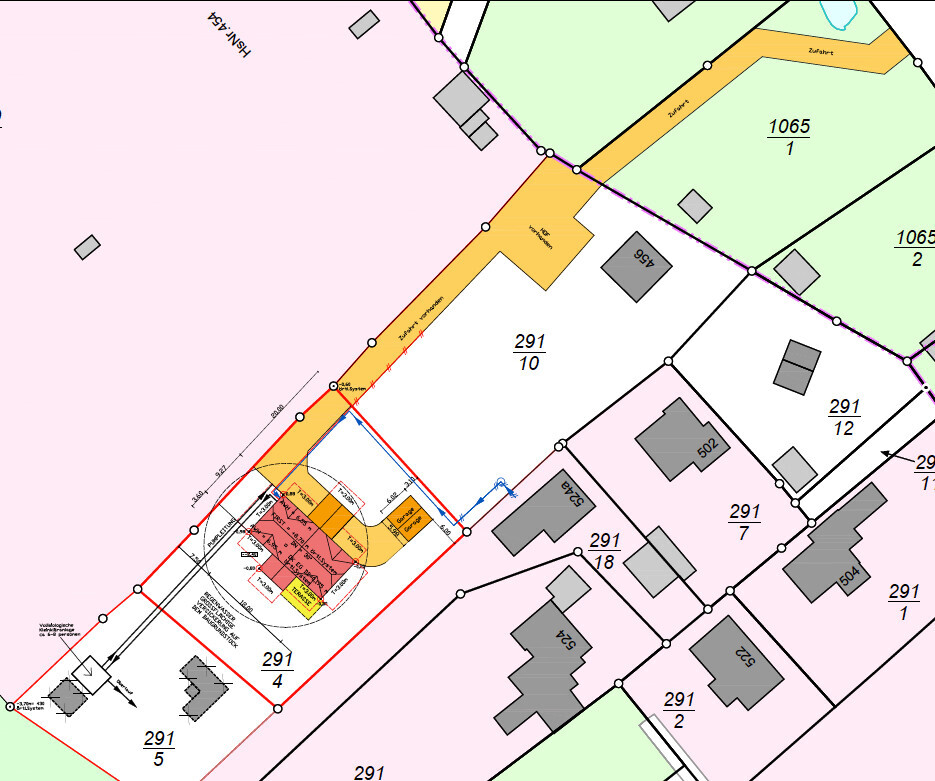
A brief introduction: I am 36 years old and co-owner of an IT company. My partner is 31 and works as a lecturer. About two years ago, we found our dream plot — a little over 2800sqm (about 0.7 acres), with direct forest access and located in the third row. All neighboring plots are, as far as possible, already built on, mostly with former weekend houses or residential homes.
First, the questionnaire:
Building plan / restrictions?
No, there is no building plan, so we are following common local building standards. The neighboring house has two full stories, which we are using as a reference.
Plot size
2800sqm (about 0.7 acres)
Slope
Slight slope; we are on a ridge of the Ore Mountains. The building site has a height difference of max. 60cm (about 2 feet) from northeast to southwest. The entire plot slopes about 1.80m (6 feet) downward to the south along the west boundary. Rocky ground starting at 2.5m (8 feet) depth.
Plot ratio / floor area ratio
No exact figures known; according to the lawyer from the building permit office, we are well within limits.
Building envelope, building line and boundary
None
Boundary setbacks
Do you mean setback distances and boundary construction? If so: 3m (10 feet) all around; boundary construction for sheds and garages is theoretically permitted.
Number of parking spaces
1–2 under the porch + double garage.
Number of floors
2
Roof type
Half-hipped roof (Dutch hip roof).
Architectural style
Hmm... not sure?
Orientation
South-southwest
Maximum height/limits
None
Other requirements
Homeowners’ needs
We want our house to welcome us. Warm wood, natural building materials, lots of light and air — high ceilings, large beams. It should blend well with the environment, be warm and cozy.
Style, roof type, building type
Log house made from glue-laminated beams (probably Finnlog).
Basement, floors
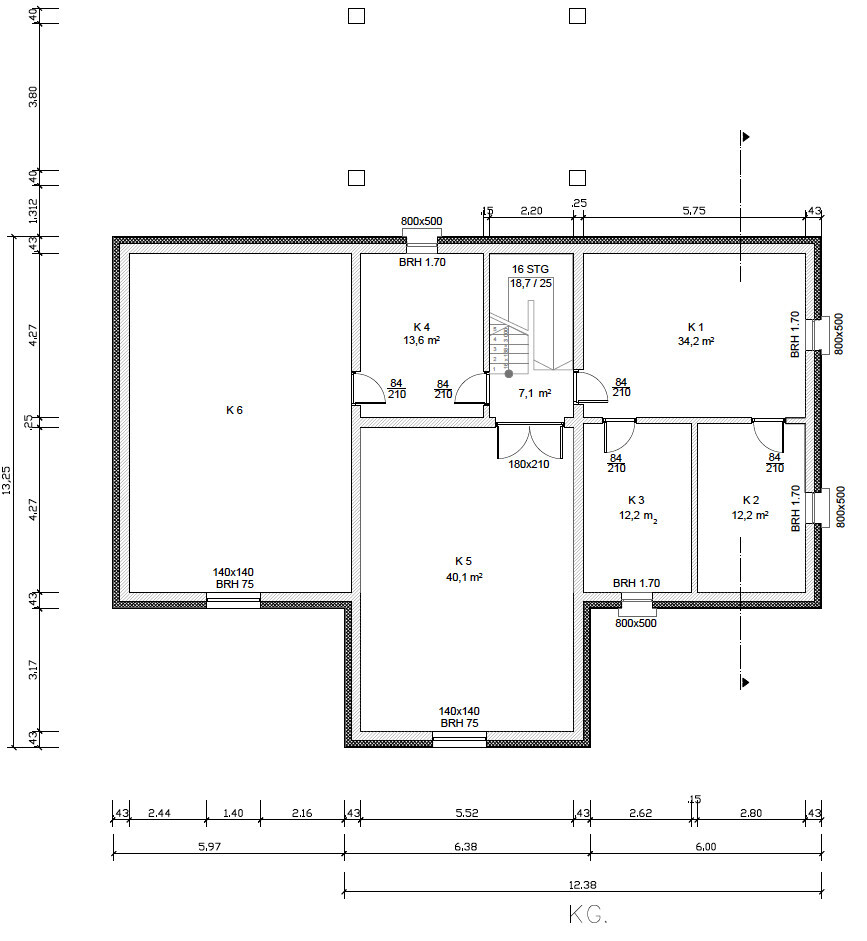
Fully basemented with two full floors.
Number of residents, age
Currently 2 people. Children may come, parents as well.
Space requirements on ground floor and upper floor
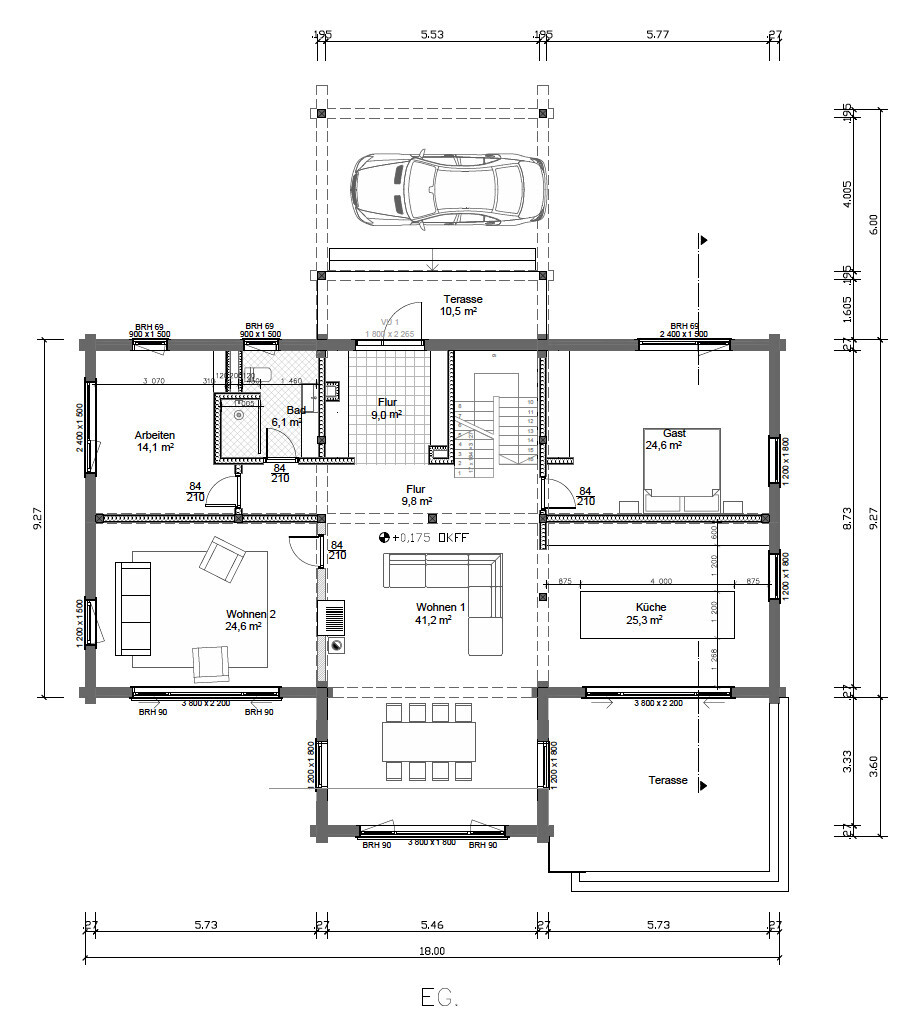
Currently about 300sqm (about 3200 sqft). This seems quite large, but looking at individual rooms (living/dining area) I don’t know where else to put the sound system. Maybe the planning is off or our space expectations are. We don’t have a TV; the fireplace is the central element.
Office: family use or home office?
An office is planned, but only as a fallback. I don’t want to work from home and only need space for private files and a desk.
Guest bedrooms per year
Variable, currently very few. Hopefully many more with the house — then we can accommodate them.
Open or closed architecture
Mixed. I prefer open, but an open void above the living area is not possible if you don’t want all cooking smells in the bedroom.
Traditional or modern construction
Hmm... solid wood house? Traditional.
Open kitchen, cooking island
An open, large kitchen with a big island where more than two people can cook comfortably. No seating in the kitchen, but a huge workspace.
Number of dining seats
10
Fireplace
Yes, a large soapstone stove.
Music / stereo wall
I am considering installating a Sonos system with a music room in the basement.
Balcony, roof terrace
No; we have a garden for that.
Garage, carport
Both; at least the entrance canopy is large enough for one car.
Vegetable garden, greenhouse
We want a greenhouse, a swimming pond, and a fire pit.
Other wishes / special features / daily routine, including reasons why or why not
House design
Who designed it:
The design was created with an architect, based on our drafts.
What do you particularly like? Why?
High ceilings and visible ceiling beams on the upper floor, separated area upstairs for us, the fireplace room as a second retreat, the single-story “extension” for the dining room, the large kitchen, the fireplaces... and especially the abundant wood.
What don’t you like? Why?
The gable windows should get an added triangular top to maximize light. The current window layout feels a bit outdated. We actually wanted an open void, but this can’t be sensibly integrated. Heating is a constant issue and never fully resolved.
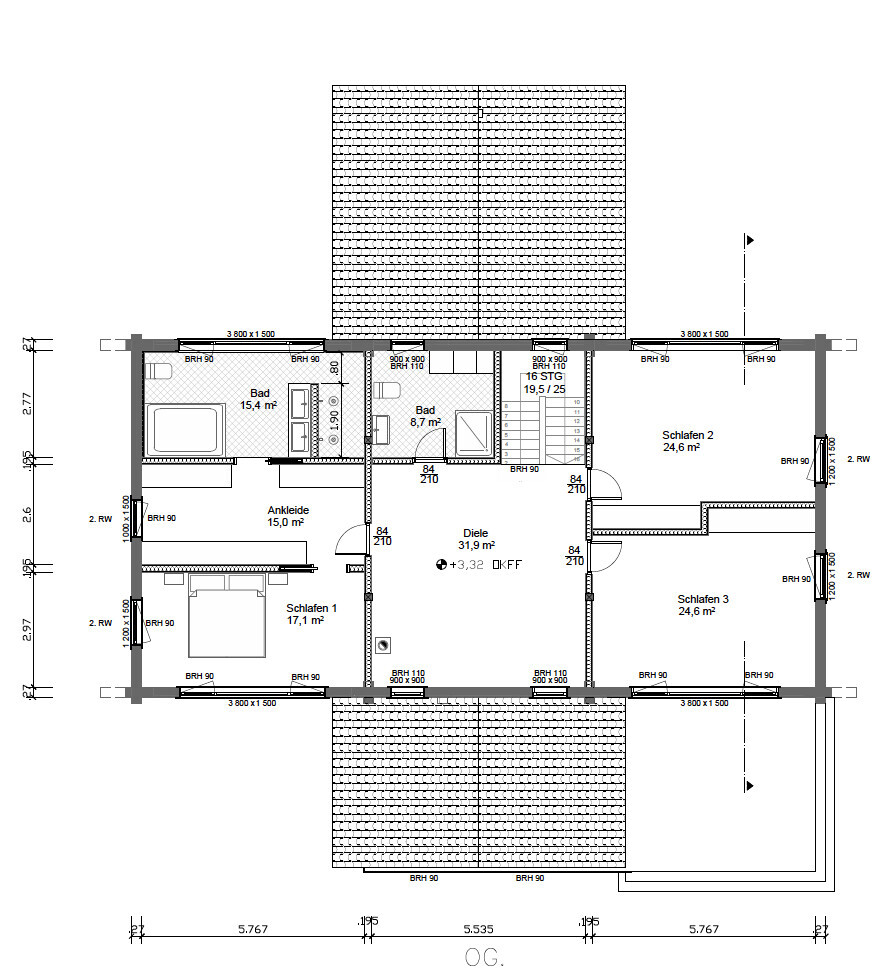
The worst: the master bathroom fixtures. We want a large bathtub and a double shower. Either the bathroom is too small or we lack imagination. It doesn’t look cozy...
Preferred heating system: currently unfortunately natural gas. Solid fuel heating is out for various reasons: a wood gasifier is too expensive and labor-intensive; pellet or woodchip stoves are not economical, plus we can’t reliably get deliveries in winter when the road is snowed in. Natural gas is about 100m (330 feet) away; we are still waiting for connection cost estimates. Heat pumps only make financial sense with geothermal; however, installation and technology would then be more expensive than a current compact car. We do not want oil heating or liquefied gas tanks.
If you have to omit something, which details/extensions
-can you omit:
-can you not omit:
Why is the design like it is now? For example:
The architect received a draft from us, every room was discussed beforehand (use, size, contents), and the design was revised multiple times. We like that it implements nearly everything we wanted and that the house does not look too bulky — due to the half-hipped roof and the gables, it does not seem so on the plans at least.
What is your most important / basic question about the floor plan in 130 characters?
Apart from the effort for plastering: is the floor plan practical? For example: washing machine on the first floor where laundry occurs, bathroom for the children...
Now some free text — our notes:
Some things are already different from the plans:
We have also been thinking about other things:
I think that’s it. Thanks for your opinions!

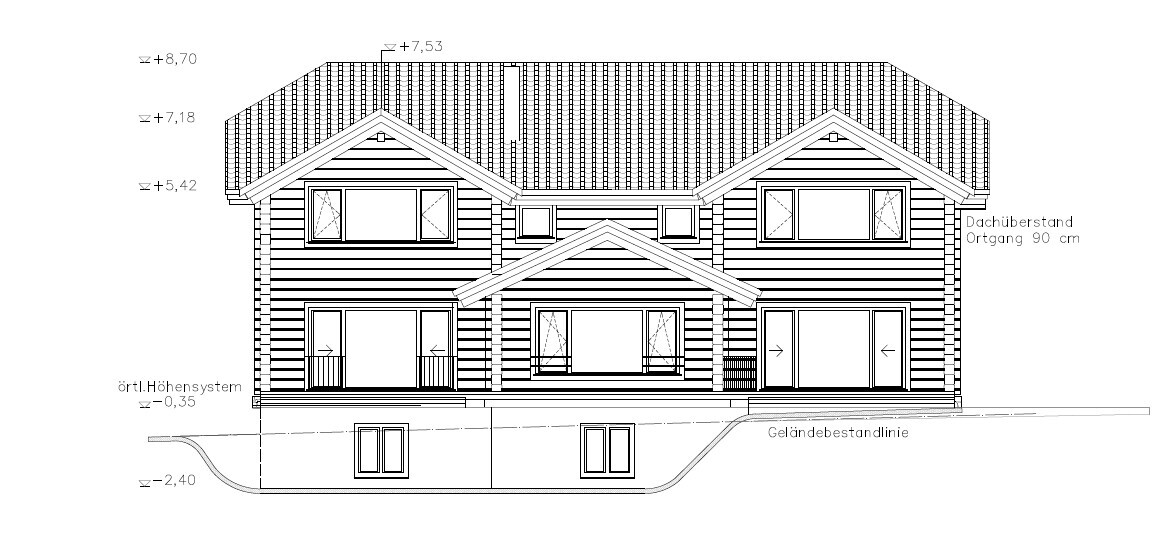
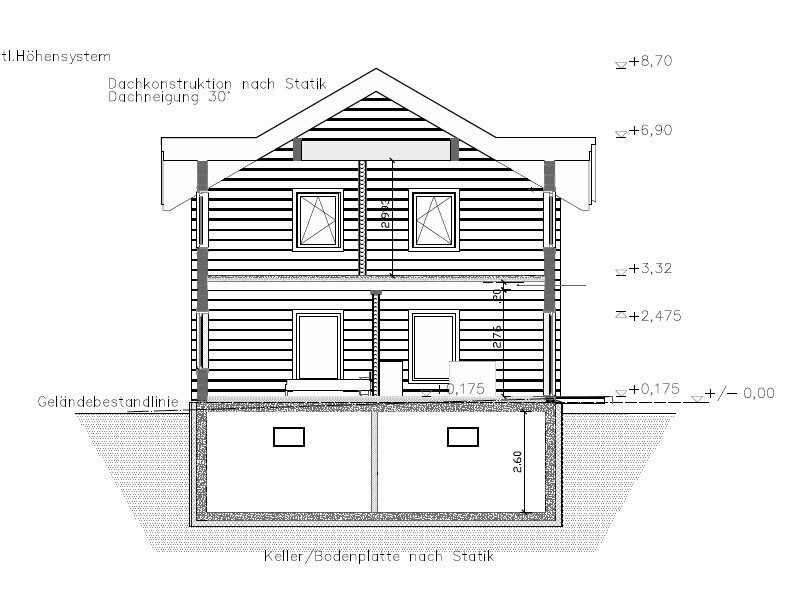
We have been planning and actively reading for over a year now. As our plans become more concrete, we would like to present our design and get your feedback.
First of all: Yes, the house is big. It is our dream, we are doing a lot of the work ourselves, and we know that we cannot extend it further — the situation here is a bit unusual, as strictly speaking this is only officially buildable land for a short time window.
A brief introduction: I am 36 years old and co-owner of an IT company. My partner is 31 and works as a lecturer. About two years ago, we found our dream plot — a little over 2800sqm (about 0.7 acres), with direct forest access and located in the third row. All neighboring plots are, as far as possible, already built on, mostly with former weekend houses or residential homes.
First, the questionnaire:
Building plan / restrictions?
No, there is no building plan, so we are following common local building standards. The neighboring house has two full stories, which we are using as a reference.
Plot size
2800sqm (about 0.7 acres)
Slope
Slight slope; we are on a ridge of the Ore Mountains. The building site has a height difference of max. 60cm (about 2 feet) from northeast to southwest. The entire plot slopes about 1.80m (6 feet) downward to the south along the west boundary. Rocky ground starting at 2.5m (8 feet) depth.
Plot ratio / floor area ratio
No exact figures known; according to the lawyer from the building permit office, we are well within limits.
Building envelope, building line and boundary
None
Boundary setbacks
Do you mean setback distances and boundary construction? If so: 3m (10 feet) all around; boundary construction for sheds and garages is theoretically permitted.
Number of parking spaces
1–2 under the porch + double garage.
Number of floors
2
Roof type
Half-hipped roof (Dutch hip roof).
Architectural style
Hmm... not sure?
Orientation
South-southwest
Maximum height/limits
None
Other requirements
Homeowners’ needs
We want our house to welcome us. Warm wood, natural building materials, lots of light and air — high ceilings, large beams. It should blend well with the environment, be warm and cozy.
Style, roof type, building type
Log house made from glue-laminated beams (probably Finnlog).
Basement, floors
Fully basemented with two full floors.
Number of residents, age
Currently 2 people. Children may come, parents as well.
Space requirements on ground floor and upper floor
Currently about 300sqm (about 3200 sqft). This seems quite large, but looking at individual rooms (living/dining area) I don’t know where else to put the sound system. Maybe the planning is off or our space expectations are. We don’t have a TV; the fireplace is the central element.
Office: family use or home office?
An office is planned, but only as a fallback. I don’t want to work from home and only need space for private files and a desk.
Guest bedrooms per year
Variable, currently very few. Hopefully many more with the house — then we can accommodate them.
Open or closed architecture
Mixed. I prefer open, but an open void above the living area is not possible if you don’t want all cooking smells in the bedroom.
Traditional or modern construction
Hmm... solid wood house? Traditional.
Open kitchen, cooking island
An open, large kitchen with a big island where more than two people can cook comfortably. No seating in the kitchen, but a huge workspace.
Number of dining seats
10
Fireplace
Yes, a large soapstone stove.
Music / stereo wall
I am considering installating a Sonos system with a music room in the basement.
Balcony, roof terrace
No; we have a garden for that.
Garage, carport
Both; at least the entrance canopy is large enough for one car.
Vegetable garden, greenhouse
We want a greenhouse, a swimming pond, and a fire pit.
Other wishes / special features / daily routine, including reasons why or why not
House design
Who designed it:
The design was created with an architect, based on our drafts.
What do you particularly like? Why?
High ceilings and visible ceiling beams on the upper floor, separated area upstairs for us, the fireplace room as a second retreat, the single-story “extension” for the dining room, the large kitchen, the fireplaces... and especially the abundant wood.
What don’t you like? Why?
The gable windows should get an added triangular top to maximize light. The current window layout feels a bit outdated. We actually wanted an open void, but this can’t be sensibly integrated. Heating is a constant issue and never fully resolved.
The worst: the master bathroom fixtures. We want a large bathtub and a double shower. Either the bathroom is too small or we lack imagination. It doesn’t look cozy...
Preferred heating system: currently unfortunately natural gas. Solid fuel heating is out for various reasons: a wood gasifier is too expensive and labor-intensive; pellet or woodchip stoves are not economical, plus we can’t reliably get deliveries in winter when the road is snowed in. Natural gas is about 100m (330 feet) away; we are still waiting for connection cost estimates. Heat pumps only make financial sense with geothermal; however, installation and technology would then be more expensive than a current compact car. We do not want oil heating or liquefied gas tanks.
If you have to omit something, which details/extensions
-can you omit:
-can you not omit:
Why is the design like it is now? For example:
The architect received a draft from us, every room was discussed beforehand (use, size, contents), and the design was revised multiple times. We like that it implements nearly everything we wanted and that the house does not look too bulky — due to the half-hipped roof and the gables, it does not seem so on the plans at least.
What is your most important / basic question about the floor plan in 130 characters?
Apart from the effort for plastering: is the floor plan practical? For example: washing machine on the first floor where laundry occurs, bathroom for the children...
Now some free text — our notes:
Some things are already different from the plans:
- All windows can be opened.
- Sliding doors open outwards, not inwards.
- All dormer windows will not be rectangular but have added triangular tops.
- Between the hallway and living area there is no central post; instead, a large double door is planned.
- The basement has a technical room beside the stairs, designed as a through room. In my opinion, this is a poor solution; we probably also need to plan a separate boiler room.
- Where the embankment is drawn, doors will be installed. This will allow the large rooms to get natural daylight and be usable living space.
- The stair step projecting into the hallway is bad and will definitely be removed.
We have also been thinking about other things:
- The hallway upstairs is planned as a “library.” To bring in light, we intend to use two light wells with diameters of 30–35cm (12–14 inches). The advantage: it will never be completely dark at night when someone needs to use the bathroom.
- The fireplace will be a soapstone stove; no plan exists yet. Strictly speaking, it will not stand against a wall but form the wall itself. We also planned a second connection in the fireplace room; originally we wanted a tunnel fireplace but were convinced it’s not a good idea as a room divider.
- The children’s rooms are not ideal — one faces north, the other south. We could make two narrow, elongated rooms and a corridor so both face south, but we consider that clearly suboptimal.
- All doors on the ground floor will be 1m (3.3 feet) wide to at least accommodate wheelchair access reasonably.
I think that’s it. Thanks for your opinions!
The balcony is approximately 2.50 meters deep (8 feet). Ceiling height on the ground floor is 3 meters (10 feet), and on the upper floor it ranges between 2.40 meters (8 feet) and about 5 meters (16 feet). In summer, shading is almost completely provided on both floors by the balcony and the overhanging roof of similar depth. Reducing this and then installing blinds, shutters, or other shading solutions seems contradictory to me.
On the ground floor, the ceilings will not be constructed with exposed timber framing—you will only see individual load-bearing beams, while the rest of the ceiling will be painted white.
On the ground floor, the ceilings will not be constructed with exposed timber framing—you will only see individual load-bearing beams, while the rest of the ceiling will be painted white.

A depth of 2.50 meters (8 feet) is quite large for a balcony, but not if it is meant to replace a garden. Especially when, as in this case, you have a huge plot of land. Then the family simply won’t have to squeeze together on just 2.50 meters (8 feet) of width. Why would you want to do that?
As already mentioned here: you have a dream property, you obviously have the financial means to afford something “bigger,” and yet you want to live with the feeling of a terraced house?
From experience: if someone has a garden, they will use the balcony (or balconies) at most to hang laundry or store seldom-used items. If the balcony is attached to the bedroom, beds might occasionally be aired out there. But that’s about it.
You have all the possibilities to create something truly amazing there, but you limit yourself to (and poorly planned) basic, everyday design.
I just can’t understand that anymore….
As already mentioned here: you have a dream property, you obviously have the financial means to afford something “bigger,” and yet you want to live with the feeling of a terraced house?
From experience: if someone has a garden, they will use the balcony (or balconies) at most to hang laundry or store seldom-used items. If the balcony is attached to the bedroom, beds might occasionally be aired out there. But that’s about it.
You have all the possibilities to create something truly amazing there, but you limit yourself to (and poorly planned) basic, everyday design.
I just can’t understand that anymore….
I really like large houses. I also think you will create something great there.
However, I’d like to suggest a small idea; maybe it’s something to consider—or maybe not. How about having a kitchen on the ground floor, next to an entrance hall with a large table and a corner bench? That’s how we planned it. The hall table comfortably seats about 12 people, and right next to it is the 25m² (270 ft²) kitchen with access to the pantry and direct access to the outdoor seating area. The living room is on the upper floor.
However, I’d like to suggest a small idea; maybe it’s something to consider—or maybe not. How about having a kitchen on the ground floor, next to an entrance hall with a large table and a corner bench? That’s how we planned it. The hall table comfortably seats about 12 people, and right next to it is the 25m² (270 ft²) kitchen with access to the pantry and direct access to the outdoor seating area. The living room is on the upper floor.
A balcony depth of 250 cm (98 inches) feels neither here nor there. I have 360 cm (142 inches) and find that very comfortable.
A roof overhang of 250 cm (98 inches) on the south side is not really necessary in summer because the sun is high in the sky. However, in winter, autumn, and spring, it tends to block the sun from entering the rooms, so you don’t make good use of its energy. I’m speaking from experience in my South-facing living room in the Ore Mountains without any roof overhang or blinds, etc.
A roof overhang of 250 cm (98 inches) on the south side is not really necessary in summer because the sun is high in the sky. However, in winter, autumn, and spring, it tends to block the sun from entering the rooms, so you don’t make good use of its energy. I’m speaking from experience in my South-facing living room in the Ore Mountains without any roof overhang or blinds, etc.
@kbt09
Starting at a depth of 280cm (110 inches), we will need to support the balcony. I think I would prefer to see that support only on part of it, otherwise it looks too massive to me. Maybe we should check out in the Erzgebirge autumn how the shading actually works.
According to our purely theoretical calculations, the sun should start shining into the rooms again from autumn onwards and in winter, with its low angle, also help to heat the rooms. On the other hand, in my office I always try to block out the sun somehow because it gets too bright and warm... good question.
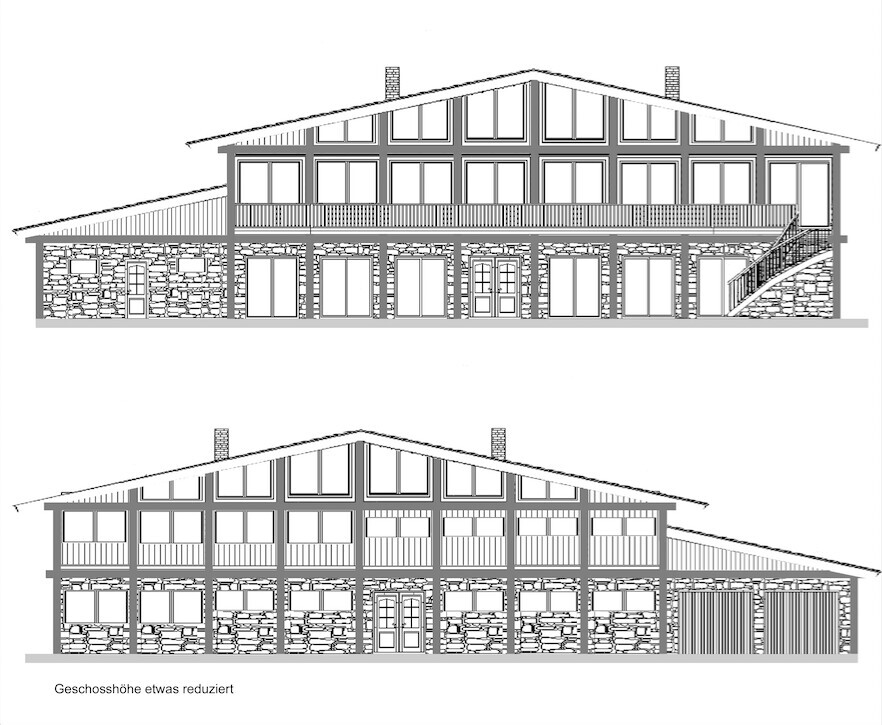
Attached are two recently approved views of the houses. To anticipate critics: These are preliminary sketches and do not claim to be perfect. We tried to show the effect of different knee wall heights here: In the top image, 2.88m (9 ft 5 in); in the bottom image, 2.58m (8 ft 6 in). You can also see in the garden view the balcony with stairs, the natural stone cladding, and the still divided windows, which hopefully won’t be split for much longer. For now, this still seems to be an issue.
Starting at a depth of 280cm (110 inches), we will need to support the balcony. I think I would prefer to see that support only on part of it, otherwise it looks too massive to me. Maybe we should check out in the Erzgebirge autumn how the shading actually works.
According to our purely theoretical calculations, the sun should start shining into the rooms again from autumn onwards and in winter, with its low angle, also help to heat the rooms. On the other hand, in my office I always try to block out the sun somehow because it gets too bright and warm... good question.
Attached are two recently approved views of the houses. To anticipate critics: These are preliminary sketches and do not claim to be perfect. We tried to show the effect of different knee wall heights here: In the top image, 2.88m (9 ft 5 in); in the bottom image, 2.58m (8 ft 6 in). You can also see in the garden view the balcony with stairs, the natural stone cladding, and the still divided windows, which hopefully won’t be split for much longer. For now, this still seems to be an issue.
Similar topics