
ᐅ Location of a city villa or detached single-family house on a 500 m² rectangular plot
Created on: 17 Jan 2020 18:03
T
Tolentino
Dear all,
after sharing the floor plans of my possible hamster cage with you in the other thread , here comes the next thread (thanks again for all the constructive suggestions there).
Just so you know, the semi-detached house is not off the table yet, as this plot of land is highly sought after and it’s not clear whether it will work out. But this one would be my favorite.
Now to this plot. For now, I’m mainly concerned with where and roughly how the house should be positioned on this plot.
Development plan / restrictions
Plot size: 500 m² (5400 sq ft)
Slope: none
Site coverage ratio: 0.2
Floor area ratio: 0.4
Building envelope, building line and boundary: 5 m (16 ft) from the street, 3 m (10 ft) from neighbors
Edge development: allowed for garages and sheds, none existing on the plot
Number of parking spaces: 1-2
Number of floors: 1.5–2.5
Roof shape: no preference
Architectural style: no preference
Orientation: aligned parallel to the street
Maximum heights / limits: ridge height max. 9 m (30 ft)
Below are the site plans I created myself based on the details from the listing.
This is a rough overview of the plot with building boundaries and dimensions.
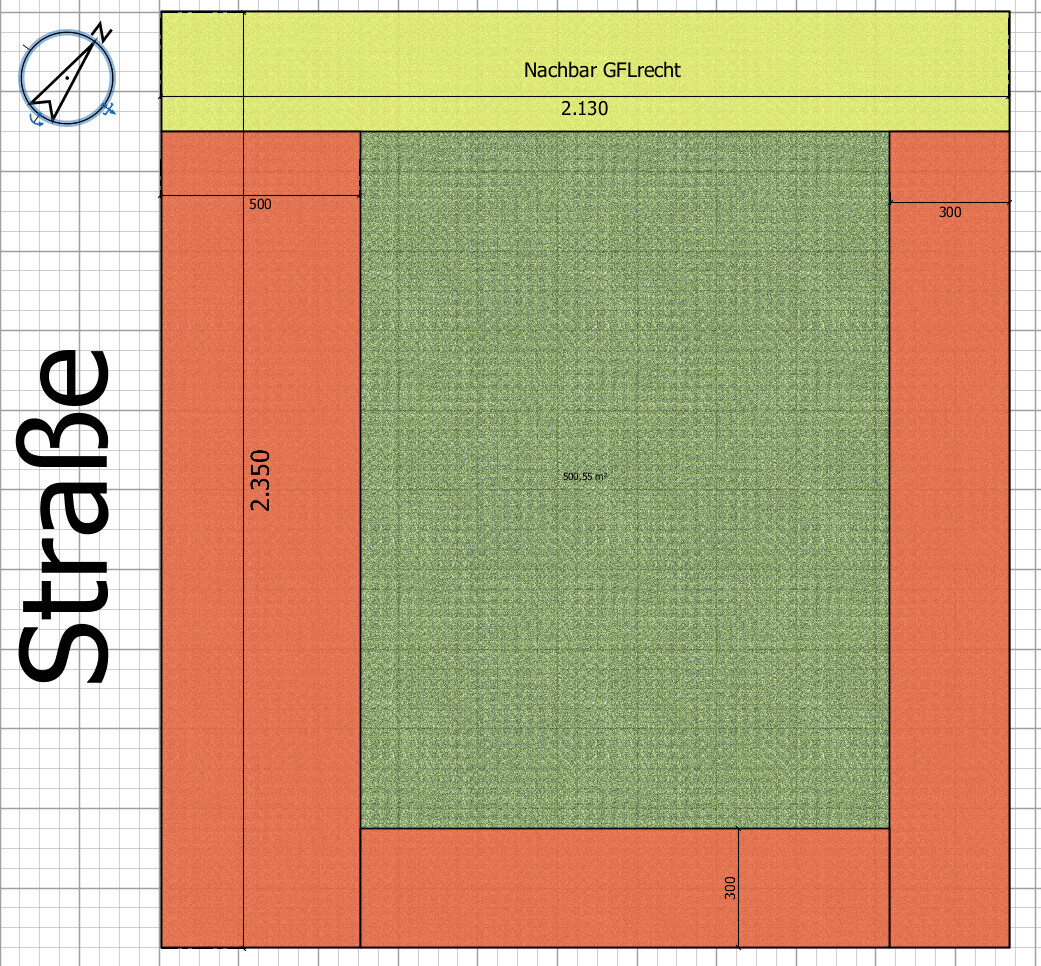
My question is: where to put the house?
The broker suggests placing it towards the back, since you already have the 5 m (16 ft) setback at the front and would “gain” about 3 m (10 ft) of garden. My partner doesn’t like this because of the visibility from the street. I say: privacy screen! But I also think, a fence too high might create a prison-yard feel.
But even if you follow this suggestion, I wonder if a more square floor plan (-> town villa style) would be better?
Like this, for example:
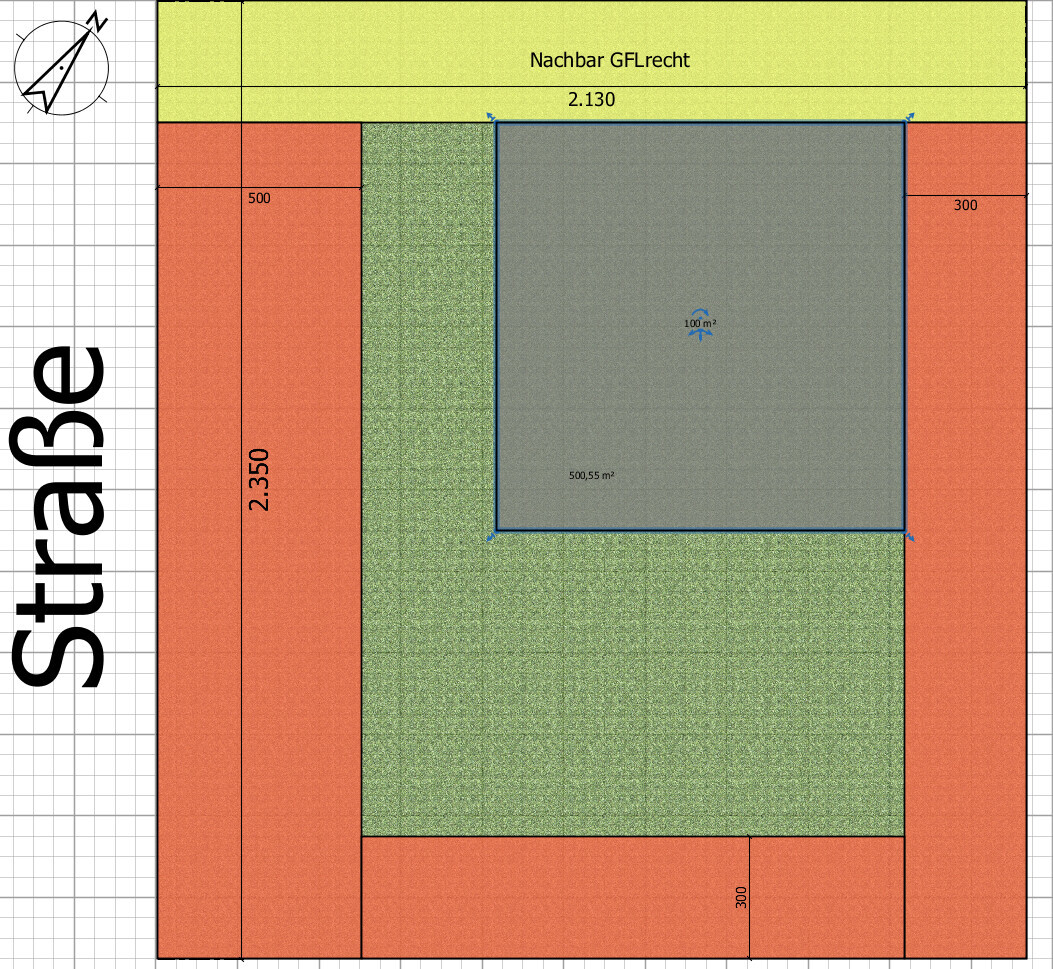
Then parking space might be tricky, right?
Or upright like this?
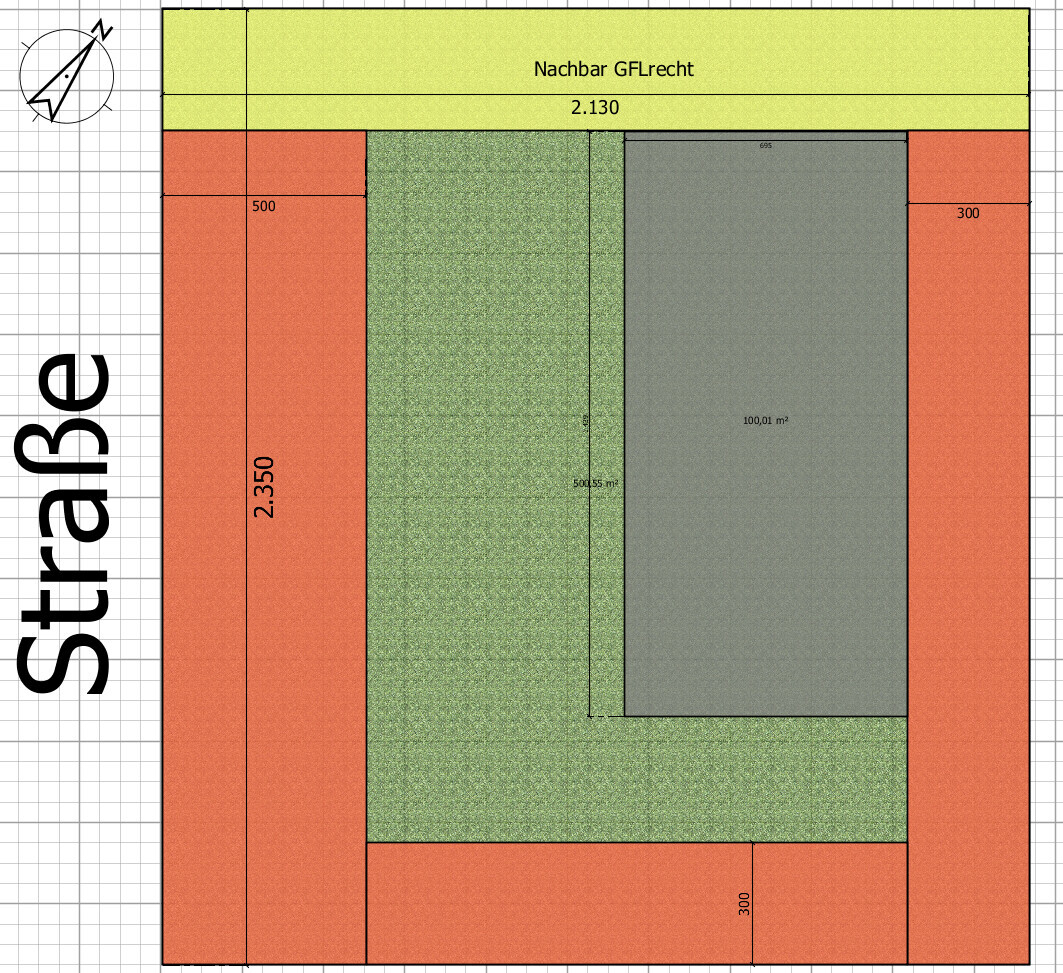
I really want as much of a west-facing view and garden as possible. I tend to be an evening person and that side is less built up, due to the road. So I think more light comes through.
But the narrow floor plan caused lots of problems with the semi-detached house already. Well, here you could build longer instead.
What do you think?
Best regards
Tolentino
after sharing the floor plans of my possible hamster cage with you in the other thread , here comes the next thread (thanks again for all the constructive suggestions there).
Just so you know, the semi-detached house is not off the table yet, as this plot of land is highly sought after and it’s not clear whether it will work out. But this one would be my favorite.
Now to this plot. For now, I’m mainly concerned with where and roughly how the house should be positioned on this plot.
Development plan / restrictions
Plot size: 500 m² (5400 sq ft)
Slope: none
Site coverage ratio: 0.2
Floor area ratio: 0.4
Building envelope, building line and boundary: 5 m (16 ft) from the street, 3 m (10 ft) from neighbors
Edge development: allowed for garages and sheds, none existing on the plot
Number of parking spaces: 1-2
Number of floors: 1.5–2.5
Roof shape: no preference
Architectural style: no preference
Orientation: aligned parallel to the street
Maximum heights / limits: ridge height max. 9 m (30 ft)
Below are the site plans I created myself based on the details from the listing.
This is a rough overview of the plot with building boundaries and dimensions.
My question is: where to put the house?
The broker suggests placing it towards the back, since you already have the 5 m (16 ft) setback at the front and would “gain” about 3 m (10 ft) of garden. My partner doesn’t like this because of the visibility from the street. I say: privacy screen! But I also think, a fence too high might create a prison-yard feel.
But even if you follow this suggestion, I wonder if a more square floor plan (-> town villa style) would be better?
Like this, for example:
Then parking space might be tricky, right?
Or upright like this?
I really want as much of a west-facing view and garden as possible. I tend to be an evening person and that side is less built up, due to the road. So I think more light comes through.
But the narrow floor plan caused lots of problems with the semi-detached house already. Well, here you could build longer instead.
What do you think?
Best regards
Tolentino

11ant schrieb:
I had overlooked that or thought it was a clearly designated unit price. In my view, the difference in cost is so small that I wouldn’t want to involve another supplier (and another party responsible for warranties) over it.Yes, it was originally included in the fixed price. Honestly, I expected it to be much less. The issue is that it’s no longer a single-source contract, and then the general contractor might blame the trade if there are leaks or issues. On the other hand, each shutter costs 800 EUR (about $880) more with him, and he doesn’t want to make it 232.5 cm (7 feet 8 inches) high at first. It might be that the window manufacturer will do it anyway, especially since I was charged extra for the large stairwell window (1,650 EUR, about $1,820), but I suspect there will also be a considerable surcharge for six floor-level windows.
The general contractor has also prepared the structure to allow for the later installation of a box-type shutter casing so that it can be installed flush with the facade, rather than in front of the window glass. You mentioned that this shouldn’t be a problem with monolithic construction.
All these factors are what made me ask about the possible credit amount in the first place.
Another option has come up recently to discuss installing empty shutter boxes, but I don’t know the additional cost for that yet.
Anyway, my future father-in-law is a window manufacturer. He’s now putting together a quote. Based on his rough estimate with better standards (security glass, shutters included, lockable handles), the material alone would be about half the price. Installation would be extra. He’ll have to check on that. I think it would be too much work just with me helping out, but he can get others involved who, of course, will expect to be paid.
He’s not afraid of potential warranty conflicts and is confident that he would do good work.
I’m waiting to see how the conversations with the window manufacturer and the general contractor go.
Best regards
Tolentino
So, everyone, the work of carefully selecting trades continues.
A quick update: I will probably take the windows out myself and handle them with my father-in-law.
In the end, with the amount from the credit note, I’ll get all the windows in RC2 (which also automatically means better sound insulation) with external roller shutters on the upper floor and venetian blinds on the ground floor.
In the meantime, we also attended the selection appointment with the interior door manufacturer and the staircase builder.
Additional costs for our requests with the door specialist: 1500 EUR. That doesn't sound like much, but I would get a credit of 2900 EUR for 10 doors. Here too, I would have to cover about two-thirds of the costs with my father-in-law.
The staircase builder really shocked me. They want nearly 4500 EUR extra for our special requests (white lacquer finish, ash wood instead of beech, risers). That’s more than the entire cost of a standard beech staircase. I already asked a local staircase builder elsewhere, and a complete staircase in white costs between 5000 and 6000 EUR, around 1000 EUR less.
It looks like I have to remove one trade after another from my fixed-price contract because the extra costs would otherwise make me broke.
What do you think I should especially watch out for going forward, particularly regarding warranty handovers, interfaces, etc.?
So, topics like which trade is generally responsible for certain tasks such as silicone/acrylic joints, waterproofing, connections, and so on?
Thanks and best regards
Tolentino
A quick update: I will probably take the windows out myself and handle them with my father-in-law.
In the end, with the amount from the credit note, I’ll get all the windows in RC2 (which also automatically means better sound insulation) with external roller shutters on the upper floor and venetian blinds on the ground floor.
In the meantime, we also attended the selection appointment with the interior door manufacturer and the staircase builder.
Additional costs for our requests with the door specialist: 1500 EUR. That doesn't sound like much, but I would get a credit of 2900 EUR for 10 doors. Here too, I would have to cover about two-thirds of the costs with my father-in-law.
The staircase builder really shocked me. They want nearly 4500 EUR extra for our special requests (white lacquer finish, ash wood instead of beech, risers). That’s more than the entire cost of a standard beech staircase. I already asked a local staircase builder elsewhere, and a complete staircase in white costs between 5000 and 6000 EUR, around 1000 EUR less.
It looks like I have to remove one trade after another from my fixed-price contract because the extra costs would otherwise make me broke.
What do you think I should especially watch out for going forward, particularly regarding warranty handovers, interfaces, etc.?
So, topics like which trade is generally responsible for certain tasks such as silicone/acrylic joints, waterproofing, connections, and so on?
Thanks and best regards
Tolentino
Interesting update:
The housing authority, which decides on the application for change of use, called me after I sent back a permit.
Since I am not yet the official owner registered in the land registry, I cannot be the applicant and need a power of attorney from the owner listed in the land registry. I had actually assumed (and also clarified with the notary) that the construction preparation power of attorney in the notarized purchase contract would be sufficient for this.
The housing authority is being uncooperative. So, I have to obtain a power of attorney again.
The planned subdivision of the property makes things more complicated because, in the external relationship, only one of the new owners can take on the obligation to provide replacement housing. This is actually already fulfilled by the new construction project, but it also involves agreeing to a maximum rent. This means that if, during the construction phase, for whatever reason it becomes necessary to rent out the new building after completion, it can only be done under a rent cap.
Last glimmer of hope: The bungalow might not meet today’s minimum standards for living space. In that case, the entire application would be void.
I’m going to take photos and measure the ceiling height today...
The housing authority, which decides on the application for change of use, called me after I sent back a permit.
Since I am not yet the official owner registered in the land registry, I cannot be the applicant and need a power of attorney from the owner listed in the land registry. I had actually assumed (and also clarified with the notary) that the construction preparation power of attorney in the notarized purchase contract would be sufficient for this.
The housing authority is being uncooperative. So, I have to obtain a power of attorney again.
The planned subdivision of the property makes things more complicated because, in the external relationship, only one of the new owners can take on the obligation to provide replacement housing. This is actually already fulfilled by the new construction project, but it also involves agreeing to a maximum rent. This means that if, during the construction phase, for whatever reason it becomes necessary to rent out the new building after completion, it can only be done under a rent cap.
Last glimmer of hope: The bungalow might not meet today’s minimum standards for living space. In that case, the entire application would be void.
I’m going to take photos and measure the ceiling height today...

It's hard to believe, but we even export our bureaucracy to more countries than our cars *LOL*
https://www.instagram.com/11antgmxde/
https://www.linkedin.com/company/bauen-jetzt/
https://www.instagram.com/11antgmxde/
https://www.linkedin.com/company/bauen-jetzt/
P
pagoni202010 Jul 2020 12:2011ant schrieb:
It's hard to believe, but we actually export our bureaucracy to even more countries than our cars *LOL*Believe me; after several stays abroad, I have come to appreciate our bureaucracy, even though that might sound almost odd and I still get frustrated with it quite often here. In other places, they have perfected it to the point of self-destruction, and compared to that, we in Germany are orphans.Hello everyone,
I’m back from measuring. I hope the Berlin bureaucracy is reliable and that the housing authority bases its decision on whether a living space qualifies as such according to the Berlin building regulations. These require a minimum ceiling height of 2.50 m (8 ft 2 in) for living rooms in “non-attic spaces.” The bungalow doesn’t meet this anywhere, with ceiling heights ranging between 2.30 m (7 ft 7 in) and 2.44 m (8 ft).
I have sent relevant photos and an email to the responsible office and am hoping for the best...
I’m back from measuring. I hope the Berlin bureaucracy is reliable and that the housing authority bases its decision on whether a living space qualifies as such according to the Berlin building regulations. These require a minimum ceiling height of 2.50 m (8 ft 2 in) for living rooms in “non-attic spaces.” The bungalow doesn’t meet this anywhere, with ceiling heights ranging between 2.30 m (7 ft 7 in) and 2.44 m (8 ft).
I have sent relevant photos and an email to the responsible office and am hoping for the best...
Similar topics