
ᐅ Load-Bearing Capacity of L-Blocks and Water Drainage on a 45° Slope
Created on: 3 May 2022 15:39
N
Nixwill2
Hello everyone,
We are planning to build a retaining wall with 2-meter (6.5-foot) tall L-shaped concrete blocks on the south side of our property. To quickly raise the ground level from 300 meters (984 feet) to 305 meters (1,001 feet) above sea level (the development plan allows a 2-meter (6.5-foot) high retaining wall), we intend to add a slope on top of the wall.
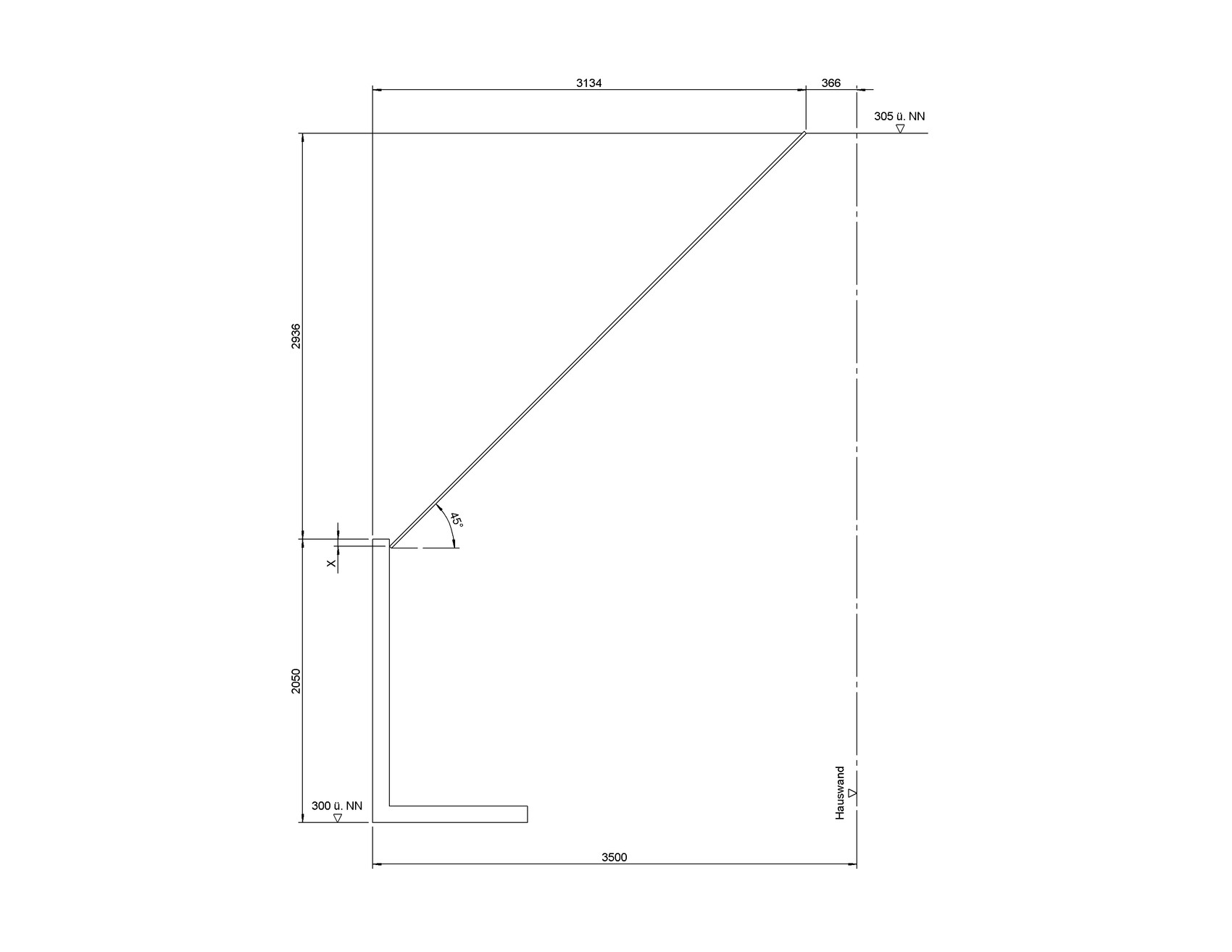
I have attached a simple sketch. It shows a 2-meter (6.5-foot) high L-block at around 300 meters (984 feet) above sea level. To the right is a dashed line representing the house wall, roughly 3.5 meters (11.5 feet) away from the retaining wall. At the top right, the ground floor level of the single-family house is marked at 305 meters (1,001 feet) above sea level. The 45-degree line indicates the slope. I hope this helps to visualize the situation.
Now to my two questions.
We have had a few earthwork contractors inspect the site, and none of them saw any issues. Yesterday, however, I received a preliminary notice from the local building authority that a neighbor downhill has filed an objection. The objection is not against the wall itself but demands that the wall be constructed as a solid concrete structure for static (structural) reasons. Additionally, the neighbor insists that surface water from our property must not flow onto theirs. According to the authority, he cannot enforce the demand for a massive concrete wall, so that request was denied. I fully understand the water issue, which is why it will be part of my second question.
Since this neighbor, who appears to be a builder himself, is already questioning the structural stability, we should expect a thorough review of our wall’s engineering. Therefore, I want to be fully prepared.
As I said, the earthwork contractors see no problem with a 2-meter (6.5-foot) high L-block wall with a 45° slope behind it. What concerns me is that when I searched online, I couldn’t find any L-shaped concrete blocks 2 meters (6.5 feet) high that are certified for a slope steeper than 30 degrees behind them. Is there anyone here who can confirm that such blocks exist? I trust the contractors, but it’s important for me to have some documented proof if needed.
Moving on to question two.
This concerns the water that will certainly run over the remaining part of the wall during heavy rain because of the slope. In my sketch, I marked a dimension ‘X’ at the top end of the L-block. How far down do you think I have to go here to ensure that no water will overflow?
By the way, the scenario in the sketch represents the steepest point. The slope of the property and the wall actually run in the same direction, so in other areas, a much gentler slope will suffice, and I could even create a kind of drainage channel.
The plan is to cover the slope with ground cover plants and hopefully some bushes as well, if they take root. I will create a dedicated thread on this topic in due course.
Do a few plants on the slope provide enough resistance to prevent water from overflowing or at least significantly reduce flow velocity?
We intend to consult a professional landscaper about this issue after the house is built, but for budget reasons, this will have to wait.
I would appreciate any advice or experiences you can share...
We are planning to build a retaining wall with 2-meter (6.5-foot) tall L-shaped concrete blocks on the south side of our property. To quickly raise the ground level from 300 meters (984 feet) to 305 meters (1,001 feet) above sea level (the development plan allows a 2-meter (6.5-foot) high retaining wall), we intend to add a slope on top of the wall.
I have attached a simple sketch. It shows a 2-meter (6.5-foot) high L-block at around 300 meters (984 feet) above sea level. To the right is a dashed line representing the house wall, roughly 3.5 meters (11.5 feet) away from the retaining wall. At the top right, the ground floor level of the single-family house is marked at 305 meters (1,001 feet) above sea level. The 45-degree line indicates the slope. I hope this helps to visualize the situation.
Now to my two questions.
We have had a few earthwork contractors inspect the site, and none of them saw any issues. Yesterday, however, I received a preliminary notice from the local building authority that a neighbor downhill has filed an objection. The objection is not against the wall itself but demands that the wall be constructed as a solid concrete structure for static (structural) reasons. Additionally, the neighbor insists that surface water from our property must not flow onto theirs. According to the authority, he cannot enforce the demand for a massive concrete wall, so that request was denied. I fully understand the water issue, which is why it will be part of my second question.
Since this neighbor, who appears to be a builder himself, is already questioning the structural stability, we should expect a thorough review of our wall’s engineering. Therefore, I want to be fully prepared.
As I said, the earthwork contractors see no problem with a 2-meter (6.5-foot) high L-block wall with a 45° slope behind it. What concerns me is that when I searched online, I couldn’t find any L-shaped concrete blocks 2 meters (6.5 feet) high that are certified for a slope steeper than 30 degrees behind them. Is there anyone here who can confirm that such blocks exist? I trust the contractors, but it’s important for me to have some documented proof if needed.
Moving on to question two.
This concerns the water that will certainly run over the remaining part of the wall during heavy rain because of the slope. In my sketch, I marked a dimension ‘X’ at the top end of the L-block. How far down do you think I have to go here to ensure that no water will overflow?
By the way, the scenario in the sketch represents the steepest point. The slope of the property and the wall actually run in the same direction, so in other areas, a much gentler slope will suffice, and I could even create a kind of drainage channel.
The plan is to cover the slope with ground cover plants and hopefully some bushes as well, if they take root. I will create a dedicated thread on this topic in due course.
Do a few plants on the slope provide enough resistance to prevent water from overflowing or at least significantly reduce flow velocity?
We intend to consult a professional landscaper about this issue after the house is built, but for budget reasons, this will have to wait.
I would appreciate any advice or experiences you can share...

@x0rzx0rz
Thanks for the tips, I’ll take a closer look when I have some quiet time.
@haydee
Pictures 5-7 show the original site as it currently exists. (Everything is harder to visualize and represent in 2D).
That’s probably the right way to put it…
That would mean we’d have to plan a 3m (10 ft) staircase to get from the house to the garden.
Unfortunately, that’s not permitted here.
What!?!?!?!? Do you call your garden cistern a dam and your pond a reservoir!?
(You have about 70,000 liters (18,500 gallons) more volume than we planned.)
You’re definitely right there, but I don’t want to accuse us of laziness. Everyone, absolutely everyone, keeps telling us we’re too early, overthinking it, etc. The house should come next spring, the basement in November/December, and we thought it made sense to do the retaining wall beforehand. Talking about the garden this early just causes another eye roll…
The bottom right corner is almost exactly at 302m (991 ft) and that’s the floor level of the basement, so half of the south and east sides are open.
As mentioned, we are not allowed to connect to the sewer.
Thanks for the tips, I’ll take a closer look when I have some quiet time.
@haydee
Pictures 5-7 show the original site as it currently exists. (Everything is harder to visualize and represent in 2D).
rick2018 schrieb:
It seems you have a financial issue.
That’s probably the right way to put it…
rick2018 schrieb:
I would keep the site a bit lower than the wall.
That would mean we’d have to plan a 3m (10 ft) staircase to get from the house to the garden.
rick2018 schrieb:
Connect the overflow to the sewer. That was allowed for us.
Unfortunately, that’s not permitted here.
rick2018 schrieb:
We have a 76,000-liter (20,000-gallon) cistern.
What!?!?!?!? Do you call your garden cistern a dam and your pond a reservoir!?
(You have about 70,000 liters (18,500 gallons) more volume than we planned.)
rick2018 schrieb:
I’m afraid you were badly advised and no one told you what the earthworks and landscaping would cost…
You’re definitely right there, but I don’t want to accuse us of laziness. Everyone, absolutely everyone, keeps telling us we’re too early, overthinking it, etc. The house should come next spring, the basement in November/December, and we thought it made sense to do the retaining wall beforehand. Talking about the garden this early just causes another eye roll…
rick2018 schrieb:
Are you planning with a basement? Why not dig out more and have daylight in the lower ground floor? That way, you wouldn’t have such a steep slope.
The bottom right corner is almost exactly at 302m (991 ft) and that’s the floor level of the basement, so half of the south and east sides are open.
rick2018 schrieb:
As an alternative to the overflow, you could also use the cistern pump to pump water into a higher-level sewer once it reaches a certain level. Wilo offers suitable pumps, controls, etc., but don’t ask about the prices.
As mentioned, we are not allowed to connect to the sewer.
Without a sewer connection, draining the wall will be difficult since the cistern needs to be emptied somehow.
You will likely need some data regarding rainfall amounts and feedback from the soil survey concerning slope and groundwater to be able to calculate or estimate a volume here.
The worst-case scenario (using my higher regional court example) is slow undermining of the wall over years due to lack of drainage.
You mentioned that the neighbors above you also have 2-meter (6.5-foot) L-shaped retaining walls? Do you know how they solved the drainage issue?
If everyone on the slope has to manage drainage on their own property, the lower properties will effectively bear more load—depending, of course, on how much slope water or groundwater flows here.
Have you planned a drainage system above your house? Sort of as a "protection" against runoff from the upper neighbor?
You will likely need some data regarding rainfall amounts and feedback from the soil survey concerning slope and groundwater to be able to calculate or estimate a volume here.
The worst-case scenario (using my higher regional court example) is slow undermining of the wall over years due to lack of drainage.
You mentioned that the neighbors above you also have 2-meter (6.5-foot) L-shaped retaining walls? Do you know how they solved the drainage issue?
If everyone on the slope has to manage drainage on their own property, the lower properties will effectively bear more load—depending, of course, on how much slope water or groundwater flows here.
Have you planned a drainage system above your house? Sort of as a "protection" against runoff from the upper neighbor?

Then you have planned the rainwater cistern far too small if you really want to use it for garden irrigation.
For example, lawns require 15-20 liters per m2 per week. Add to that hedges, shrubs, trees, flower beds...
Let's assume you have 200m2 of lawn. That amounts to 12,000–16,000 liters per month. In summer, it might not rain for a whole month. So after one to two weeks, you either start wasting valuable fresh water or parts of your newly and expensively landscaped garden suffer damage. You can save water by choosing certain plants and grass seeds, but only up to a certain point. I don't understand planners who consider a 6,000-liter cistern to be large.
We don't have a pond, only a pool, but it is self-sufficient.
Then consider using rainwater inside the house. That water can then go into the sewer (drain). However, they never calculate this.
Otherwise, you might need to build a large soakaway system. You must then demonstrate or ensure the necessary infiltration capacity.
Building the wall in front of the house makes sense. Otherwise, how would you get large equipment there?
If you size the cistern large enough, the overflow should not be a problem. Here, you have to consider rainfall volumes and surface areas.
For example, lawns require 15-20 liters per m2 per week. Add to that hedges, shrubs, trees, flower beds...
Let's assume you have 200m2 of lawn. That amounts to 12,000–16,000 liters per month. In summer, it might not rain for a whole month. So after one to two weeks, you either start wasting valuable fresh water or parts of your newly and expensively landscaped garden suffer damage. You can save water by choosing certain plants and grass seeds, but only up to a certain point. I don't understand planners who consider a 6,000-liter cistern to be large.
We don't have a pond, only a pool, but it is self-sufficient.
Then consider using rainwater inside the house. That water can then go into the sewer (drain). However, they never calculate this.
Otherwise, you might need to build a large soakaway system. You must then demonstrate or ensure the necessary infiltration capacity.
Building the wall in front of the house makes sense. Otherwise, how would you get large equipment there?
If you size the cistern large enough, the overflow should not be a problem. Here, you have to consider rainfall volumes and surface areas.
@x0rzx0rz emptying can also be done by pump. But I agree with you that a sewer connection would be very practical. I would recommend discussing this with the local authorities. For a large cistern, the overflow is hardly ever used. Therefore, they will most likely approve the sewer connection.
W
WilderSueden4 May 2022 10:59
You’re definitely right about that, but I wouldn’t want us to be accused of laziness here. Everyone, absolutely everyone, tells us every time that we’re starting too early, that we’re overthinking it, and so on.
The house is planned for next spring, the basement for November/December, and we thought it would make sense to build the retaining wall beforehand. Talking about the garden already caused more eye-rolling… You have to plan the garden along with the house to get a sensible result. However, many home builders prefer to close the deal quickly since the landscaping is generally considered the builder’s responsibility but is ultimately the owner’s problem 😉
rick2018 schrieb:
For example, lawns require 15–20 liters per m2 per week. Then there are hedges, bushes, trees, flower beds… Maybe for golf courses. You can also let the area grow more naturally. The only thing that absolutely needs watering is the vegetable garden. Trees and shrubs only during their establishment phase. The lawn at my parents’ place was never watered but still handled three playing children and even supported two rabbits with homegrown hay 😉
Similar topics