
ᐅ Load-Bearing Capacity of L-Blocks and Water Drainage on a 45° Slope
Created on: 3 May 2022 15:39
N
Nixwill2
Hello everyone,
We are planning to build a retaining wall with 2-meter (6.5-foot) tall L-shaped concrete blocks on the south side of our property. To quickly raise the ground level from 300 meters (984 feet) to 305 meters (1,001 feet) above sea level (the development plan allows a 2-meter (6.5-foot) high retaining wall), we intend to add a slope on top of the wall.
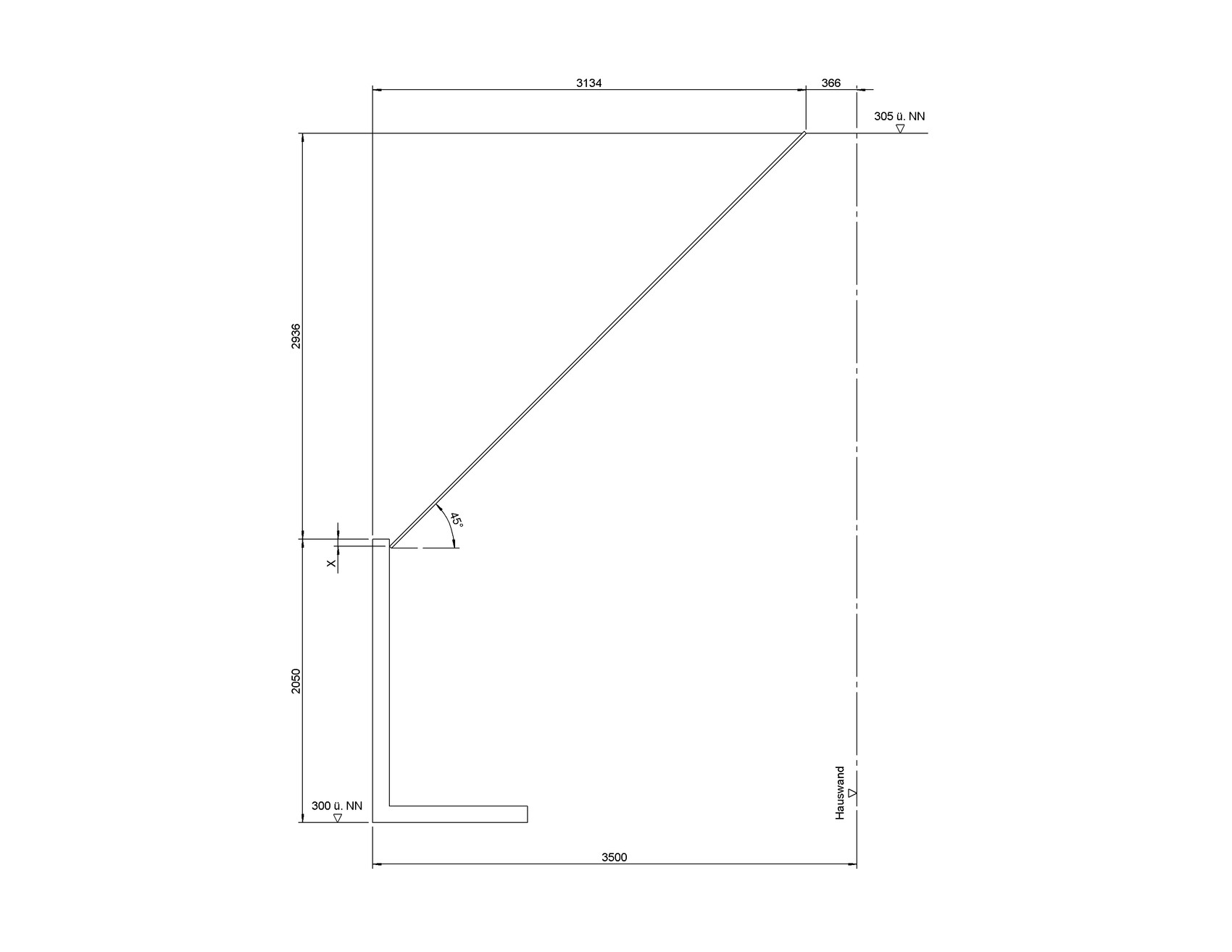
I have attached a simple sketch. It shows a 2-meter (6.5-foot) high L-block at around 300 meters (984 feet) above sea level. To the right is a dashed line representing the house wall, roughly 3.5 meters (11.5 feet) away from the retaining wall. At the top right, the ground floor level of the single-family house is marked at 305 meters (1,001 feet) above sea level. The 45-degree line indicates the slope. I hope this helps to visualize the situation.
Now to my two questions.
We have had a few earthwork contractors inspect the site, and none of them saw any issues. Yesterday, however, I received a preliminary notice from the local building authority that a neighbor downhill has filed an objection. The objection is not against the wall itself but demands that the wall be constructed as a solid concrete structure for static (structural) reasons. Additionally, the neighbor insists that surface water from our property must not flow onto theirs. According to the authority, he cannot enforce the demand for a massive concrete wall, so that request was denied. I fully understand the water issue, which is why it will be part of my second question.
Since this neighbor, who appears to be a builder himself, is already questioning the structural stability, we should expect a thorough review of our wall’s engineering. Therefore, I want to be fully prepared.
As I said, the earthwork contractors see no problem with a 2-meter (6.5-foot) high L-block wall with a 45° slope behind it. What concerns me is that when I searched online, I couldn’t find any L-shaped concrete blocks 2 meters (6.5 feet) high that are certified for a slope steeper than 30 degrees behind them. Is there anyone here who can confirm that such blocks exist? I trust the contractors, but it’s important for me to have some documented proof if needed.
Moving on to question two.
This concerns the water that will certainly run over the remaining part of the wall during heavy rain because of the slope. In my sketch, I marked a dimension ‘X’ at the top end of the L-block. How far down do you think I have to go here to ensure that no water will overflow?
By the way, the scenario in the sketch represents the steepest point. The slope of the property and the wall actually run in the same direction, so in other areas, a much gentler slope will suffice, and I could even create a kind of drainage channel.
The plan is to cover the slope with ground cover plants and hopefully some bushes as well, if they take root. I will create a dedicated thread on this topic in due course.
Do a few plants on the slope provide enough resistance to prevent water from overflowing or at least significantly reduce flow velocity?
We intend to consult a professional landscaper about this issue after the house is built, but for budget reasons, this will have to wait.
I would appreciate any advice or experiences you can share...
We are planning to build a retaining wall with 2-meter (6.5-foot) tall L-shaped concrete blocks on the south side of our property. To quickly raise the ground level from 300 meters (984 feet) to 305 meters (1,001 feet) above sea level (the development plan allows a 2-meter (6.5-foot) high retaining wall), we intend to add a slope on top of the wall.
I have attached a simple sketch. It shows a 2-meter (6.5-foot) high L-block at around 300 meters (984 feet) above sea level. To the right is a dashed line representing the house wall, roughly 3.5 meters (11.5 feet) away from the retaining wall. At the top right, the ground floor level of the single-family house is marked at 305 meters (1,001 feet) above sea level. The 45-degree line indicates the slope. I hope this helps to visualize the situation.
Now to my two questions.
We have had a few earthwork contractors inspect the site, and none of them saw any issues. Yesterday, however, I received a preliminary notice from the local building authority that a neighbor downhill has filed an objection. The objection is not against the wall itself but demands that the wall be constructed as a solid concrete structure for static (structural) reasons. Additionally, the neighbor insists that surface water from our property must not flow onto theirs. According to the authority, he cannot enforce the demand for a massive concrete wall, so that request was denied. I fully understand the water issue, which is why it will be part of my second question.
Since this neighbor, who appears to be a builder himself, is already questioning the structural stability, we should expect a thorough review of our wall’s engineering. Therefore, I want to be fully prepared.
As I said, the earthwork contractors see no problem with a 2-meter (6.5-foot) high L-block wall with a 45° slope behind it. What concerns me is that when I searched online, I couldn’t find any L-shaped concrete blocks 2 meters (6.5 feet) high that are certified for a slope steeper than 30 degrees behind them. Is there anyone here who can confirm that such blocks exist? I trust the contractors, but it’s important for me to have some documented proof if needed.
Moving on to question two.
This concerns the water that will certainly run over the remaining part of the wall during heavy rain because of the slope. In my sketch, I marked a dimension ‘X’ at the top end of the L-block. How far down do you think I have to go here to ensure that no water will overflow?
By the way, the scenario in the sketch represents the steepest point. The slope of the property and the wall actually run in the same direction, so in other areas, a much gentler slope will suffice, and I could even create a kind of drainage channel.
The plan is to cover the slope with ground cover plants and hopefully some bushes as well, if they take root. I will create a dedicated thread on this topic in due course.
Do a few plants on the slope provide enough resistance to prevent water from overflowing or at least significantly reduce flow velocity?
We intend to consult a professional landscaper about this issue after the house is built, but for budget reasons, this will have to wait.
I would appreciate any advice or experiences you can share...
