
ᐅ Living Room Lighting for 47 m² with Philips Hue Slim 90 mm – Is the Grid Too Dense or Appropriate?
Created on: 7 Jan 2026 14:52
G
GeomanneHello everyone,
this is my first post in this forum, and I haven’t read along here yet. On the recommendation of a user from another forum, I would like to start a discussion here with my question and hope for practical assessments and your support. After almost nine months of renovating my own home by myself, I will likely be able to contribute on other topics in the future as well.
Regarding the topic:
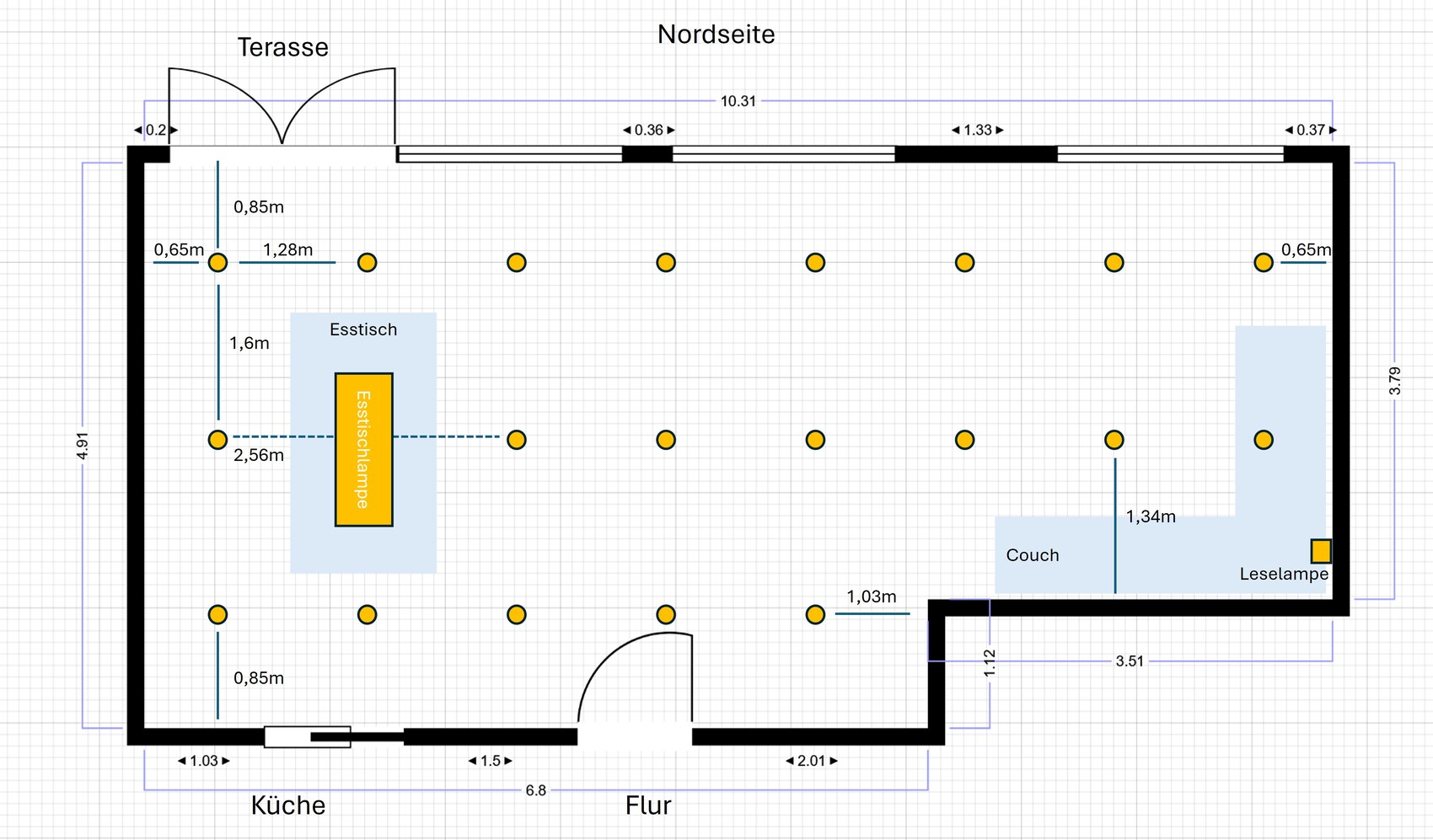
We are currently planning the ceiling lighting for our living room (approx. 47 m² (505 sq ft), ceiling height 2.45–2.50 m (8.0–8.2 ft)) using Philips Hue Slim 90 mm (White & Color Ambiance). I have attached a sketch with the room geometry, distances, and lamp positions.
Current design (general lighting):
The setup shown is a first draft.
The spacing was researched and put together based on various guides, examples, and user experiences found online. That is why my question: Does this look like the right approach, or is it already too dense?
We would like to keep the basic concept of three rows unless there is a fundamental reason not to.
Regarding the appearance:
If the proposed solution is considered oversized, we are thinking about removing one or two spots per row, for example:
I look forward to constructive criticism, experiences especially with the Philips Hue Slim 90 mm, as well as suggestions on whether you would stick to the current number or tend towards one of the reduced variants.
Thank you very much and best regards
this is my first post in this forum, and I haven’t read along here yet. On the recommendation of a user from another forum, I would like to start a discussion here with my question and hope for practical assessments and your support. After almost nine months of renovating my own home by myself, I will likely be able to contribute on other topics in the future as well.
Regarding the topic:
We are currently planning the ceiling lighting for our living room (approx. 47 m² (505 sq ft), ceiling height 2.45–2.50 m (8.0–8.2 ft)) using Philips Hue Slim 90 mm (White & Color Ambiance). I have attached a sketch with the room geometry, distances, and lamp positions.
Current design (general lighting):
- 3 rows of downlights
- currently 20 spots in total
- Row 1: 8
- Row 2: 7 (one position omitted due to a pendant light above the dining table)
- Row 3 (shorter area): 5
- Distances and distances from the walls are shown in the sketch
The setup shown is a first draft.
The spacing was researched and put together based on various guides, examples, and user experiences found online. That is why my question: Does this look like the right approach, or is it already too dense?
We would like to keep the basic concept of three rows unless there is a fundamental reason not to.
Regarding the appearance:
- Ceiling white
- Spots also white
- The Hue Slim are very flat and have a white light surface when switched off → The goal is a discreet ceiling appearance when the lights are off.
If the proposed solution is considered oversized, we are thinking about removing one or two spots per row, for example:
- 7-6-4
- or 6-6-4 (without the extra “gap” above the dining table, since the spacing in row 2 is sufficient for the pendant light anyway)
- There are three separately switchable light circuits:
- Left – dining area
- Middle
- Right – living area
- Additionally, of course, Hue scene control
- A separate circuit switches only the dining table pendant (possibly with subtle dimmed background lighting when seated)
- The other two circuits switch the spots (living area as well as middle/left)
- even general lighting
- mostly dimmed use
- "Hue moods"
- clear zoning (dining / living)
- no “light ceiling,” but also no dark zones
I look forward to constructive criticism, experiences especially with the Philips Hue Slim 90 mm, as well as suggestions on whether you would stick to the current number or tend towards one of the reduced variants.
Thank you very much and best regards
N
nordanney7 Jan 2026 14:59My points against it (overall):
But in the end: your personal taste decides. I would assume here in the forum that most responses will have a "that’s definitely too much" tone. Just a feeling...
- Outdated
- Uncomfortable
- Expensive
- Unnecessary
- Ugly
- Where and when do I need which type of light ==> resulting in a combination of
- direct lighting
- indirect lighting
- spot lighting
- accent lighting
- ceiling fixtures
- floor lamps
- wall lamps
- table or windowsill lamps
- candles
But in the end: your personal taste decides. I would assume here in the forum that most responses will have a "that’s definitely too much" tone. Just a feeling...
nordanney schrieb:
that all answers will have "that is definitely too much" as the main pointNothing more to add to that.Perhaps someone can offer constructive support to help me, as a lighting layperson, achieve proper lighting. I have outlined my thoughts, questions, and conditions above. I look forward to helpful contributions. In my opinion, these would definitely be worth adding. Many thanks and best regards
N
nordanney7 Jan 2026 18:38nordanney schrieb:
Where and when do I need which kind of lightingGeomanne schrieb:
Maybe someone can offer constructive supportThen answer—first calmly for yourself and afterwards for us in the forum—the question about your needs. Where and when do I need what kind of lighting? Atmosphere, pictures, or similar. For accent lighting, where do you need bright light (for example, over the kitchen countertop, dining table), does it need to be bright over the coffee table or is a nice floor lamp enough, and so on.
What you don’t need and what also doesn’t work is controlling everything with spotlights. For example, I have three ceiling fixtures in the hallway for bright light and two lamps for cozy, continuous lighting. In the bathroom, spotlights where it needs to be bright and additionally backlit mirrors. In the entrance hallway, there’s a small mood light on the windowsill. In the living area, a ceiling light, a room divider with shelves and integrated spotlights (effect lighting), a floor lamp by the couch, two large candle holders on one wall, indirect lighting behind the TV, two spotlights over a window seat, and so on.
Everything has to make sense.
Geomanne schrieb:
Maybe someone can offer constructive support This here:
nordanney schrieb:
Otherwise, it’s important to carry out comprehensive lighting planning instead of just covering the ceiling with lots of fixtures like in the early to mid-2010s.
- Where do I need what kind of light and when
==> and thus a combination of…
... is already very constructive!
Geomanne schrieb:
Lighting novice See! Some people here have built multiple times or lived longer in a home and know that room lighting is more than just covering the ceiling with lights or installing a single weak fixture in the ceiling.
@nordanney has already explained and summarized it quite well.
Similar topics