
ᐅ Lighting Design for Spotlights on Exposed Beams / Sloped Ceilings
Created on: 30 Dec 2018 12:10
M
matrixx88M
matrixx8830 Dec 2018 12:10Hello everyone,
We will start building our new single-family home next March.
At the moment, I am working on the lighting design. Here are the conditions and preferences:
- Recessed spotlights/downlights should be used throughout for general lighting
- In the dining/living/kitchen area, we will have a white-washed exposed beam/board ceiling (the purlin runs along the length of the room)
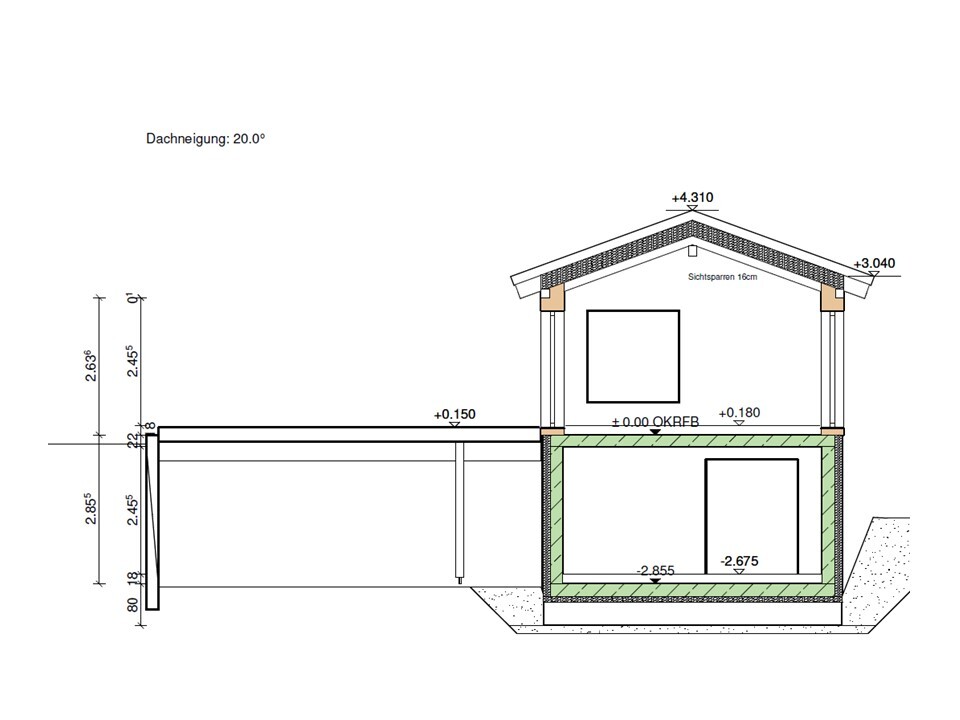
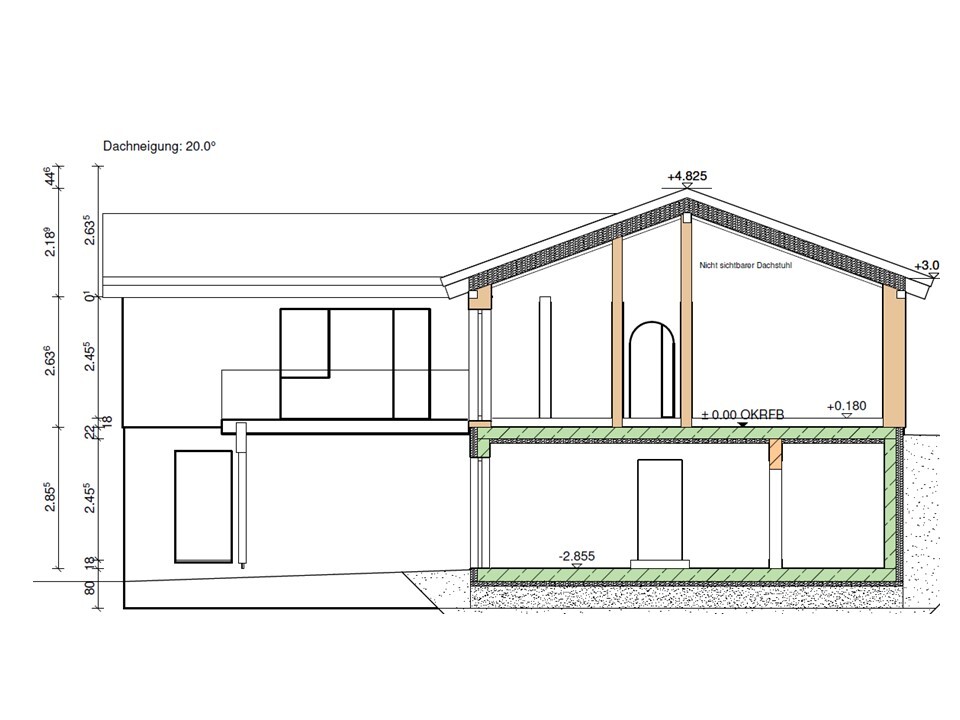
- In the rest of the house, there is also a sloped ceiling up to the roof. It will not be suspended.
I have already prepared a rough first lighting plan. Due to the limited installation depth, my current favorite are the new Paulmann coins with 110° beam angle and 460lm (white, matte), requiring a 68mm (2.7 inches) cutout.
Question to experienced lighting planners and experts: What do you think about this plan?
The yellow dots indicate the spotlights, the orange ones are additional pendant lights.
Regarding the light output, I aimed for about 300lm in the bathroom and kitchen, and 100-150lm elsewhere.
Since the ceiling is higher and angled at 20°, I expect somewhat less light compared to a standard 2.5m (8 ft) ceiling height. That’s why I chose adjustable beam angles for the fixtures. Is that necessary?
Finally, as a supplement and to illuminate the beam ceiling, I plan to install LED strips of 7m (23 ft) and 5m (16 ft) along the purlin, hidden from view. What do you think about this? Would it be a good addition or part of the general lighting, or rather choose either downlights or the purlin lighting? For example, dimmed to about 25% in the evening while watching TV.
I look forward to your tips and opinions.
Good luck
Konstantin
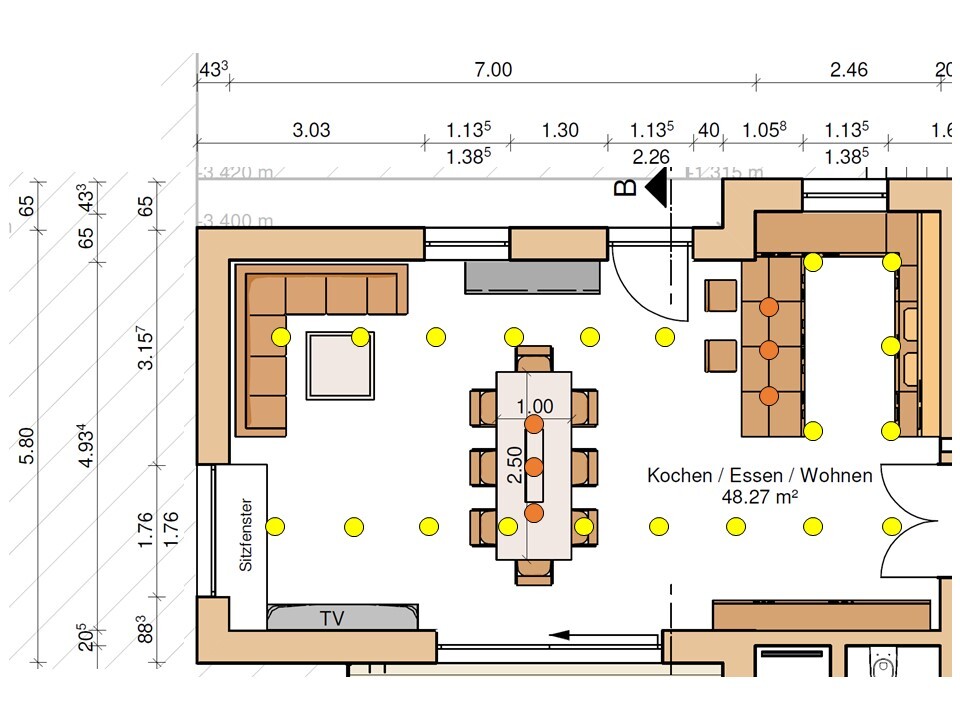
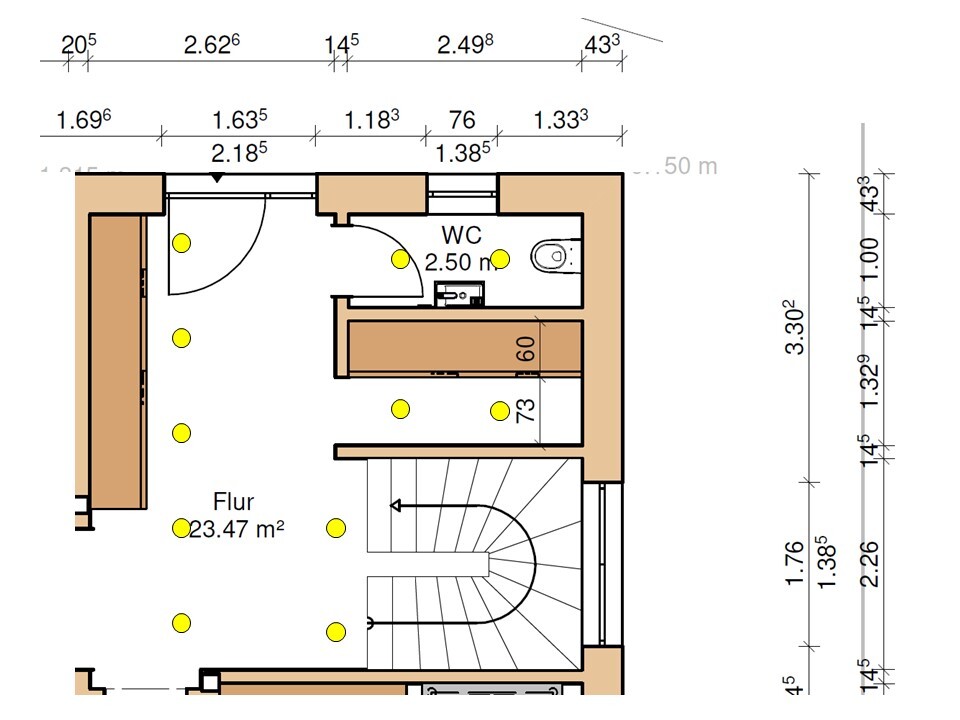

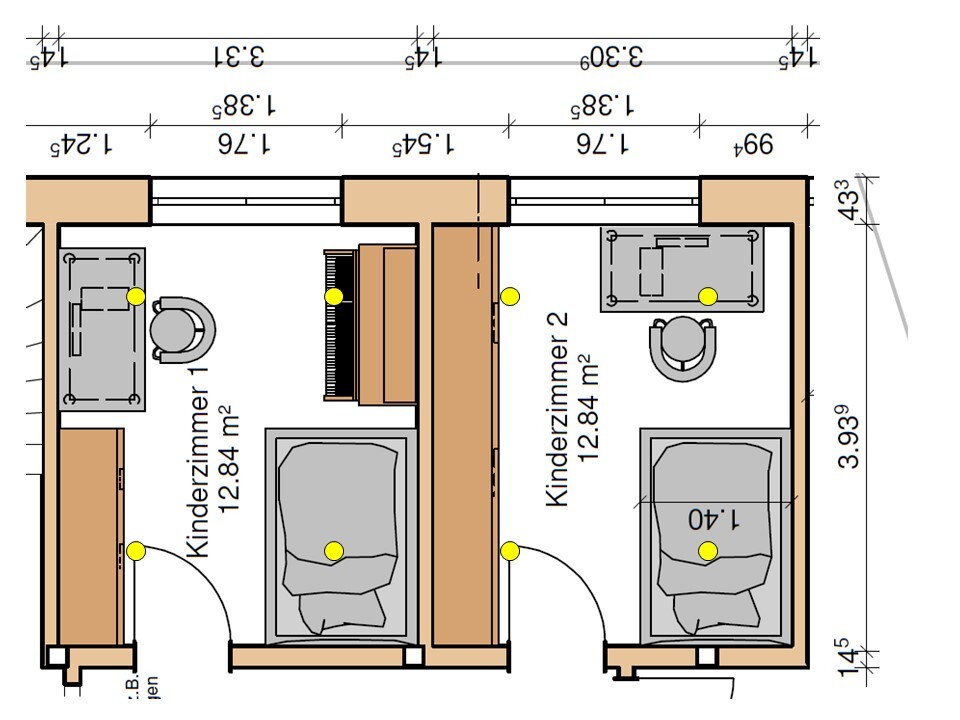
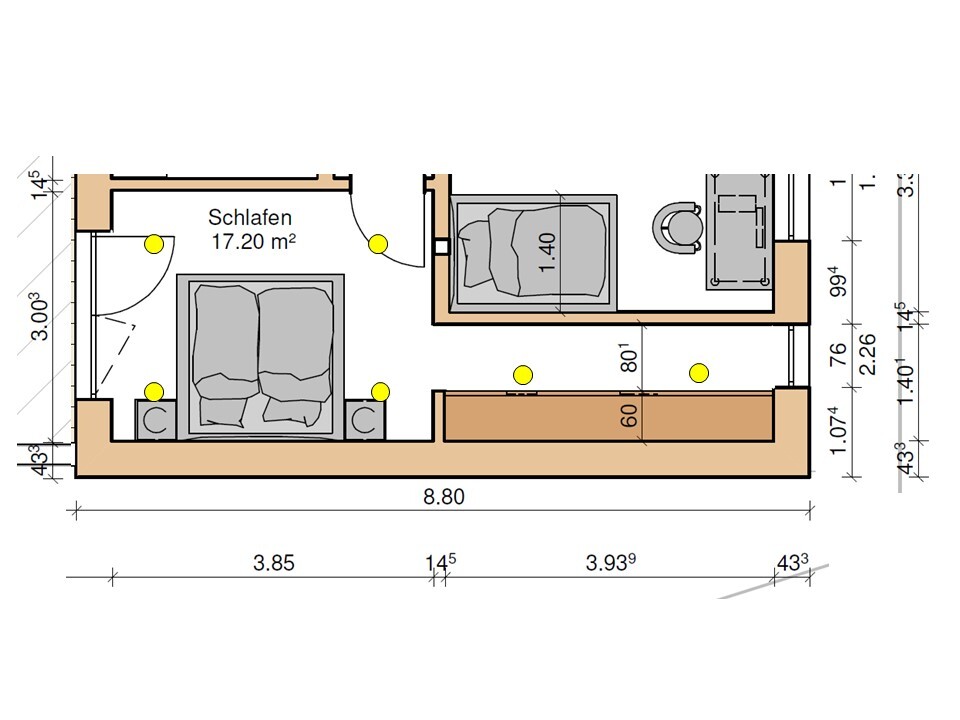
We will start building our new single-family home next March.
At the moment, I am working on the lighting design. Here are the conditions and preferences:
- Recessed spotlights/downlights should be used throughout for general lighting
- In the dining/living/kitchen area, we will have a white-washed exposed beam/board ceiling (the purlin runs along the length of the room)
- In the rest of the house, there is also a sloped ceiling up to the roof. It will not be suspended.
I have already prepared a rough first lighting plan. Due to the limited installation depth, my current favorite are the new Paulmann coins with 110° beam angle and 460lm (white, matte), requiring a 68mm (2.7 inches) cutout.
Question to experienced lighting planners and experts: What do you think about this plan?
The yellow dots indicate the spotlights, the orange ones are additional pendant lights.
Regarding the light output, I aimed for about 300lm in the bathroom and kitchen, and 100-150lm elsewhere.
Since the ceiling is higher and angled at 20°, I expect somewhat less light compared to a standard 2.5m (8 ft) ceiling height. That’s why I chose adjustable beam angles for the fixtures. Is that necessary?
Finally, as a supplement and to illuminate the beam ceiling, I plan to install LED strips of 7m (23 ft) and 5m (16 ft) along the purlin, hidden from view. What do you think about this? Would it be a good addition or part of the general lighting, or rather choose either downlights or the purlin lighting? For example, dimmed to about 25% in the evening while watching TV.
I look forward to your tips and opinions.
Good luck
Konstantin
Hello,
we also have an open roof structure with a single-pitch roof, the highest point just under 5 meters (16 feet). Please reconsider the spotlight arrangement. We also have spotlights, for example, in the bathroom and kitchen. Here, we wanted deliberately even lighting without shadows. I see spotlights as a design feature. We have used many wall lights. They create great lighting and, if you want, can provide visual accentuation.
Tip: Your spotlights don’t work well with the furniture. This needs to be carefully coordinated (spacing). Otherwise, it won’t work or will look awkward.
Best regards
we also have an open roof structure with a single-pitch roof, the highest point just under 5 meters (16 feet). Please reconsider the spotlight arrangement. We also have spotlights, for example, in the bathroom and kitchen. Here, we wanted deliberately even lighting without shadows. I see spotlights as a design feature. We have used many wall lights. They create great lighting and, if you want, can provide visual accentuation.
Tip: Your spotlights don’t work well with the furniture. This needs to be carefully coordinated (spacing). Otherwise, it won’t work or will look awkward.
Best regards
M
matrixx8830 Dec 2018 19:06Hello Michert,
thank you very much for your suggestions. Could you send me a sketch or image of your layout so I can better visualize it? What exactly do you mean by distances to the furniture? Are there any guidelines or preferences I can refer to?
In your opinion, do the kitchen, bathroom, and hallway fit well?
I would really appreciate being able to incorporate some of your experience!
Thanks and best regards
thank you very much for your suggestions. Could you send me a sketch or image of your layout so I can better visualize it? What exactly do you mean by distances to the furniture? Are there any guidelines or preferences I can refer to?
In your opinion, do the kitchen, bathroom, and hallway fit well?
I would really appreciate being able to incorporate some of your experience!
Thanks and best regards
michert schrieb:
We have worked a lot with wall lights. They create great lighting and, if you want, can provide visual accents.
Regards Could you give me one or two names of your lights? What exactly are they, and where did you buy them?
I also have an exposed roof truss and am looking everywhere for wall lights because I just can’t figure out exactly how to light it...
Thank you!
P.S.: to the original poster: this is a real "spotlight overload." Have you checked how much a spotlight costs? Four spotlights just in the bedroom? Nobody uses that many; better to have a lamp on the bedside table or a pendant light hanging from the ceiling plus a wall light for illumination...
… and especially in the bedroom, don’t forget to install two-way switches, so you can turn off the main ceiling light or other general lighting from the bed, and turn off the bedside lamp from the door. Because in the morning, getting up, turning on the bedside lamp, gathering your clothes, leaving the room—this setup is very practical.
I also think there are too many recessed lights. Bathrooms and kitchens are fine. But otherwise, you should have a clear idea of how you want to furnish the space and what you actually want to illuminate with the recessed lights. In living areas, you usually don’t want full-area lighting but rather ambient lighting or targeted reading lights, for example.
I also think there are too many recessed lights. Bathrooms and kitchens are fine. But otherwise, you should have a clear idea of how you want to furnish the space and what you actually want to illuminate with the recessed lights. In living areas, you usually don’t want full-area lighting but rather ambient lighting or targeted reading lights, for example.
M
matrixx8830 Dec 2018 23:54Hello everyone,
I will definitely reduce the number of recessed spotlights. However, these spots are meant for general lighting, not ambient lighting. They will be installed discreetly across the ceiling. In the living room, I have now reduced the number of spots next to the kitchen to 8-9. Since the spots have a beam angle of 110° and frosted glass, they don’t resemble the halogen spots my parents have at home.
I have already ordered a set for testing purposes, and these can be dimmed in three stages without the need for a built-in dimmer. Each lamp costs about 20 EUR (approximately 22 USD). They are matte white, good quality, and have a low installation depth for ceiling cavities. I really like them.
For ambient or reading lighting, floor lamps and pendant lights will be used. My wife does not like wall lamps, so those are completely excluded (except for outdoor areas). So, there will be a floor lamp near the sofa, a small table lamp in the seating window, or a string of lights at Christmas, connected via a switchable socket. Above the dining table, there will be three pendant lights, and the same lighting will be installed separately as task lighting above the kitchen counter.
What I have followed as a guideline is a minimum of 300 lumens per square meter (lx) in the bathroom and kitchen, and 100 lumens per square meter (lx) in the living areas. Following this, I will also reduce to two fixtures in the bedroom. In the children’s room, there will be three spots; the one above the bed will be removed.
Two-way switches with push buttons will be used almost everywhere, including at the bedside tables.
I will upload the updated plans tomorrow.
What do you think about the 100 lumens per square meter? If I stick to this, the spotlight setup should not get out of hand?
Thanks and good luck.
I will definitely reduce the number of recessed spotlights. However, these spots are meant for general lighting, not ambient lighting. They will be installed discreetly across the ceiling. In the living room, I have now reduced the number of spots next to the kitchen to 8-9. Since the spots have a beam angle of 110° and frosted glass, they don’t resemble the halogen spots my parents have at home.
I have already ordered a set for testing purposes, and these can be dimmed in three stages without the need for a built-in dimmer. Each lamp costs about 20 EUR (approximately 22 USD). They are matte white, good quality, and have a low installation depth for ceiling cavities. I really like them.
For ambient or reading lighting, floor lamps and pendant lights will be used. My wife does not like wall lamps, so those are completely excluded (except for outdoor areas). So, there will be a floor lamp near the sofa, a small table lamp in the seating window, or a string of lights at Christmas, connected via a switchable socket. Above the dining table, there will be three pendant lights, and the same lighting will be installed separately as task lighting above the kitchen counter.
What I have followed as a guideline is a minimum of 300 lumens per square meter (lx) in the bathroom and kitchen, and 100 lumens per square meter (lx) in the living areas. Following this, I will also reduce to two fixtures in the bedroom. In the children’s room, there will be three spots; the one above the bed will be removed.
Two-way switches with push buttons will be used almost everywhere, including at the bedside tables.
I will upload the updated plans tomorrow.
What do you think about the 100 lumens per square meter? If I stick to this, the spotlight setup should not get out of hand?
Thanks and good luck.
Similar topics