
Good evening,
we have made progress on our building project and have completed the planning with the electrician. (=> here you can find our general floor plan thread)
He gave us a proposal regarding lighting and ceiling spotlights. After reading various threads here on the house building forum, the consensus seems to be that spotlights should be used sparingly and supplemented with different (indirect) light sources.
We have tried to create a mix of "standard" ceiling outlets, LED spotlights, LED strips, and floor lamps.
Now we are wondering if the plan really makes sense and would appreciate your opinions and suggestions. Additionally, I am uncertain about the number and illumination of the LED spots in the corridor and would also welcome your thoughts on this.
Now to the details:
For the spots and LED strips, the following fixtures have currently been planned (not finalized):
Spots: CIVILIGHT HALED Downlight 10W 2700K-2100K DTW 600lm 36° 230V white
LED strips: LED light coving 25W per meter (25W/m) 2700K warm white, 2000lm/m & RGB LED light strip (I don’t have more information on this)
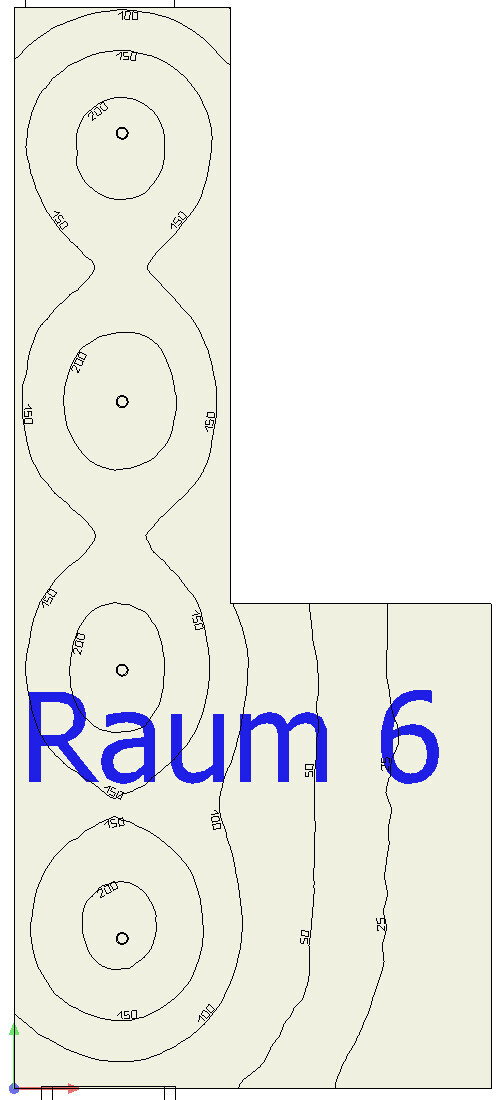
Basement - Corridor
Here, 4 spots were planned at intervals of 1.8m (5.9 feet) and an LED light strip in white above the built-in wardrobe. The ceiling height in the basement is 2.39m (7.84 feet) (final measurement).
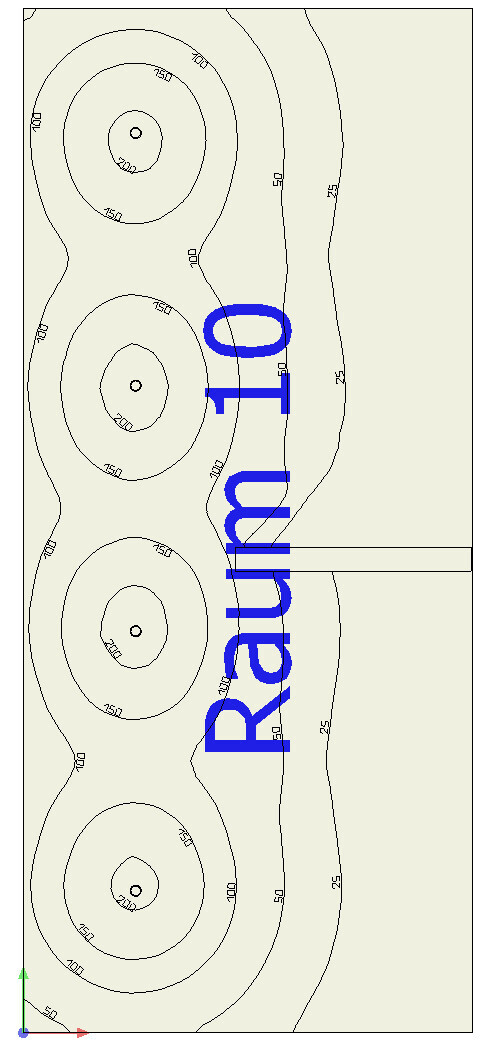
Because of the 36° beam angle and the rather long corridor, we considered increasing to 5 spots to create a more even illumination. Or perhaps increasing the beam angle of the spotlights? Also, according to a Dialux calculation (without the LED strip!), the illumination is currently about 90 lux in the corridor, which seems relatively low even for a corridor?
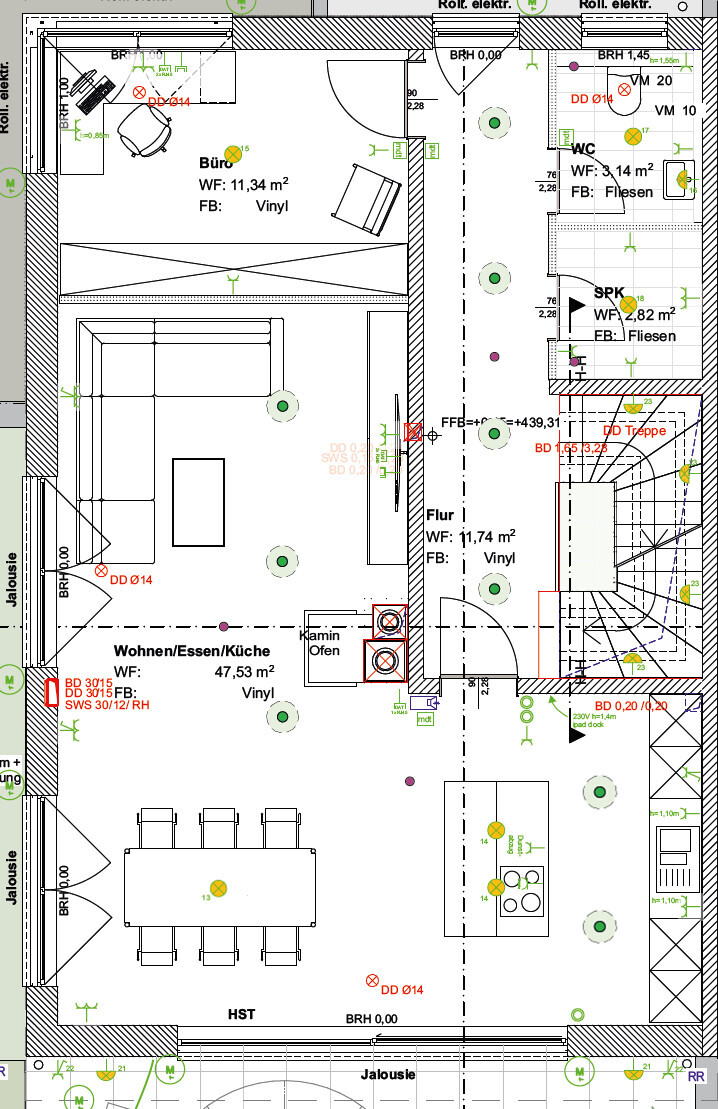
Ground Floor - Corridor
Here again, 4 spots were planned at intervals of 1.8m (5.9 feet). Ceiling height on the ground floor is 2.50m (8.20 feet) (final measurement).
The question is whether the number of spots is sufficient or if adding a 5th spot or increasing the beam angle would create a more uniform lighting. Or would the corridor then be too bright? Dialux currently shows an average of about 115 lux.
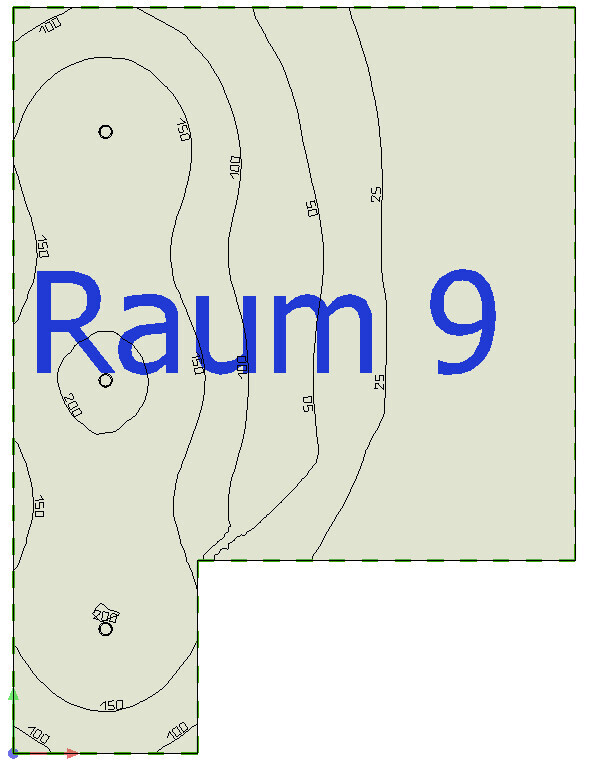
Ground Floor - Living Room/Kitchen
On the back wall of the kitchen niche, 4 spots will be installed under the tall cabinets to illuminate the countertop.
On the kitchen island, we plan 2 ceiling outlets and want to use narrower beam angles to highlight the work surface.
Our electrician also suggested placing two spots between the island and back wall (dimmable) for the option of brighter lighting when needed.
In the dining area, there will be only one ceiling outlet for a 3- or 4-light fixture.
In the living room, we want to primarily use indirect lighting. We are planning a floor lamp (exact position to be determined) and possibly decorative lighting on the lowboard. Our electrician also suggested three dimmable spotlights between the living and dining areas that could be dimmed strongly and used either as low-level “residual lighting” or as pathway lighting toward the kitchen/corridor. Does this make sense?
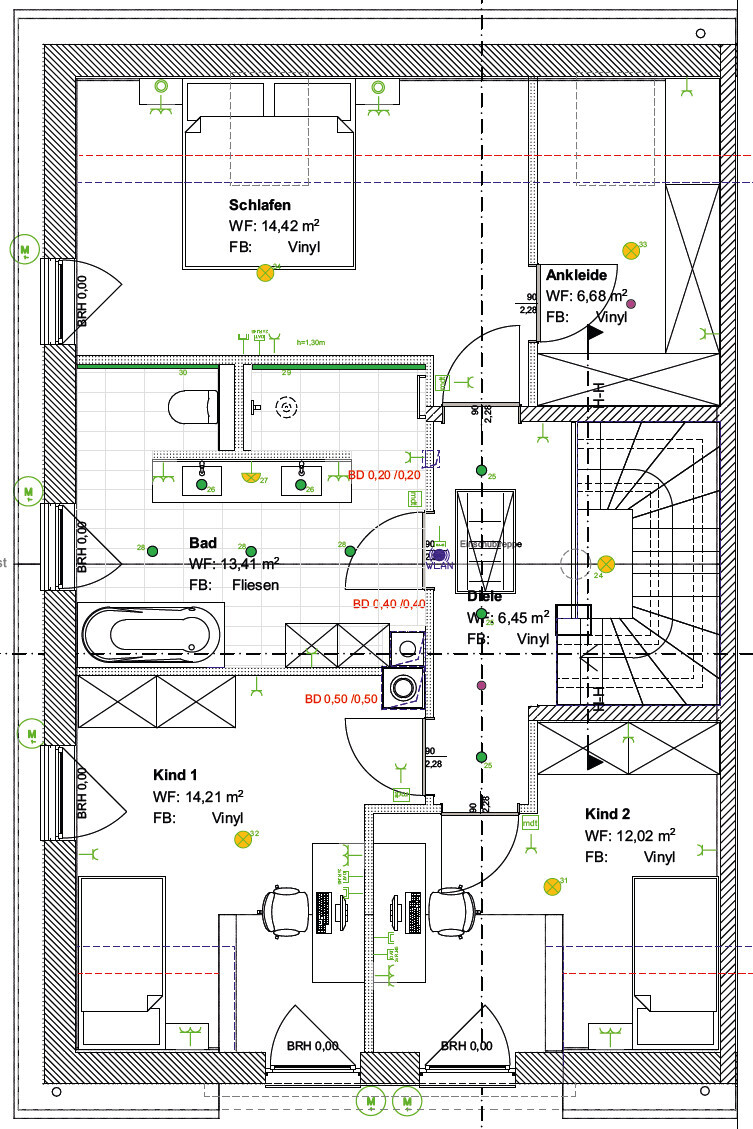
Upper Floor - Corridor
Above the staircase opening, we want to place a lamp that shines down through the stairwell.
For the corridor, we have planned 3 dimmable spots. The ceiling height on the upper floor is 2.65m (8.69 feet) (final measurement).
Would three combined up/down wall lights perhaps create a nicer light or would that be too dark for the room?
Upper Floor - Bathroom
The bathroom will use multiple light sources.
In the center of the room, three dimmable LED spots for general lighting are planned.
Above the washbasins, there will be one LED spot each to illuminate the basins (bright light if needed or dimmed as singular bathroom lighting). On the wall, we plan a backlit mirror.
In the shower and toilet, a light coving with a warm white and an RGBW light strip will be installed.
Here too, we wonder if this setup makes sense or if it would be better to replace the spots with a second LED strip along the bathtub side?
I have the feeling that the brightness in the corridors is too low and the beam angle of the spots is too narrow. We will soon need to specify the exact positions for the concrete ceiling, so I am grateful for any comments. We look forward to your opinions and thank you very much for your support!
PS: I know that at this stage a lighting design would be the best option
PPS: In Dialux I didn’t find the exact LED spots and used the closest available with a 40° beam angle and similar values
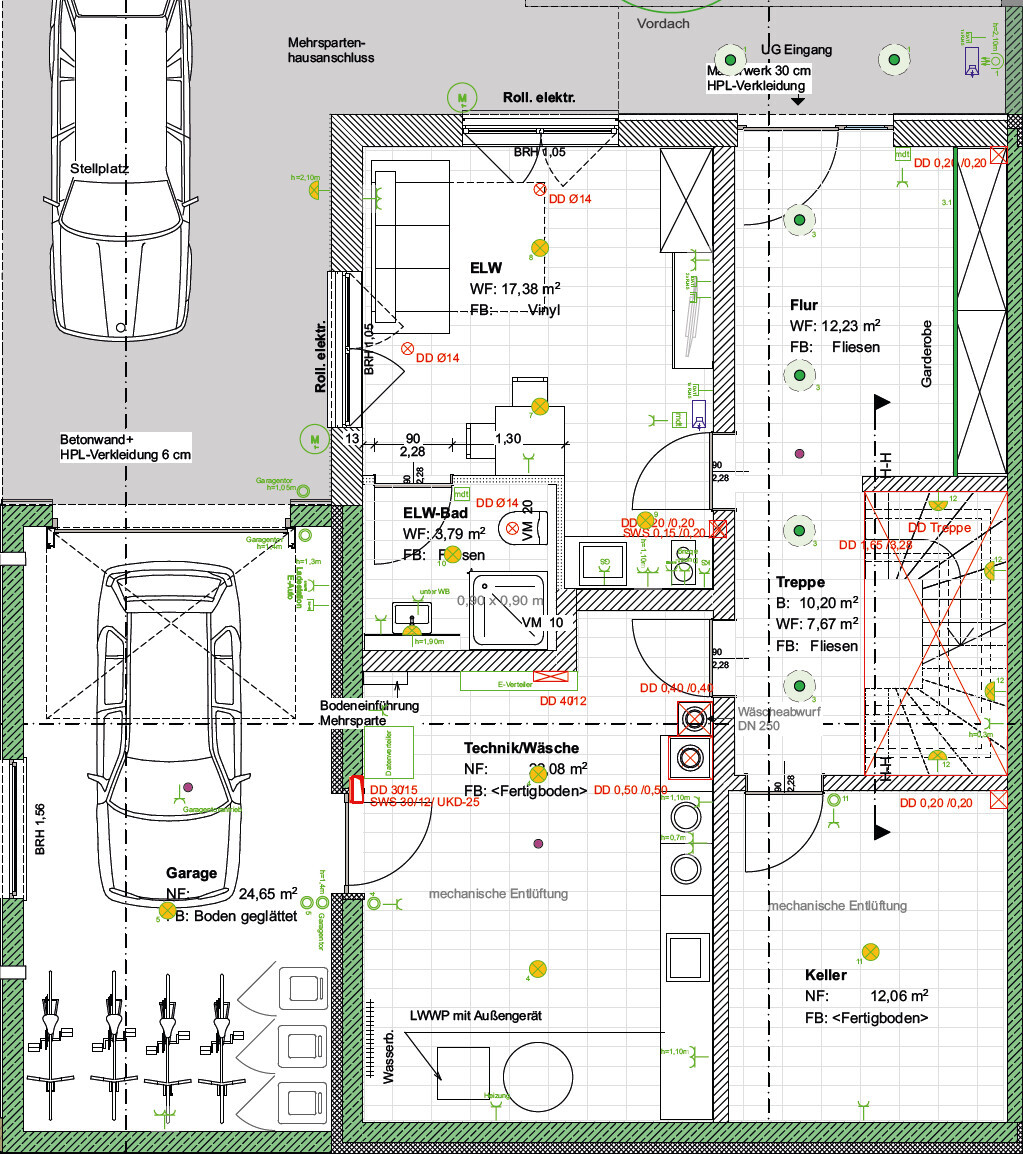
we have made progress on our building project and have completed the planning with the electrician. (=> here you can find our general floor plan thread)
He gave us a proposal regarding lighting and ceiling spotlights. After reading various threads here on the house building forum, the consensus seems to be that spotlights should be used sparingly and supplemented with different (indirect) light sources.
We have tried to create a mix of "standard" ceiling outlets, LED spotlights, LED strips, and floor lamps.
Now we are wondering if the plan really makes sense and would appreciate your opinions and suggestions. Additionally, I am uncertain about the number and illumination of the LED spots in the corridor and would also welcome your thoughts on this.
Now to the details:
For the spots and LED strips, the following fixtures have currently been planned (not finalized):
Spots: CIVILIGHT HALED Downlight 10W 2700K-2100K DTW 600lm 36° 230V white
LED strips: LED light coving 25W per meter (25W/m) 2700K warm white, 2000lm/m & RGB LED light strip (I don’t have more information on this)
Basement - Corridor
Here, 4 spots were planned at intervals of 1.8m (5.9 feet) and an LED light strip in white above the built-in wardrobe. The ceiling height in the basement is 2.39m (7.84 feet) (final measurement).
Because of the 36° beam angle and the rather long corridor, we considered increasing to 5 spots to create a more even illumination. Or perhaps increasing the beam angle of the spotlights? Also, according to a Dialux calculation (without the LED strip!), the illumination is currently about 90 lux in the corridor, which seems relatively low even for a corridor?
Ground Floor - Corridor
Here again, 4 spots were planned at intervals of 1.8m (5.9 feet). Ceiling height on the ground floor is 2.50m (8.20 feet) (final measurement).
The question is whether the number of spots is sufficient or if adding a 5th spot or increasing the beam angle would create a more uniform lighting. Or would the corridor then be too bright? Dialux currently shows an average of about 115 lux.
Ground Floor - Living Room/Kitchen
On the back wall of the kitchen niche, 4 spots will be installed under the tall cabinets to illuminate the countertop.
On the kitchen island, we plan 2 ceiling outlets and want to use narrower beam angles to highlight the work surface.
Our electrician also suggested placing two spots between the island and back wall (dimmable) for the option of brighter lighting when needed.
In the dining area, there will be only one ceiling outlet for a 3- or 4-light fixture.
In the living room, we want to primarily use indirect lighting. We are planning a floor lamp (exact position to be determined) and possibly decorative lighting on the lowboard. Our electrician also suggested three dimmable spotlights between the living and dining areas that could be dimmed strongly and used either as low-level “residual lighting” or as pathway lighting toward the kitchen/corridor. Does this make sense?
Upper Floor - Corridor
Above the staircase opening, we want to place a lamp that shines down through the stairwell.
For the corridor, we have planned 3 dimmable spots. The ceiling height on the upper floor is 2.65m (8.69 feet) (final measurement).
Would three combined up/down wall lights perhaps create a nicer light or would that be too dark for the room?
Upper Floor - Bathroom
The bathroom will use multiple light sources.
In the center of the room, three dimmable LED spots for general lighting are planned.
Above the washbasins, there will be one LED spot each to illuminate the basins (bright light if needed or dimmed as singular bathroom lighting). On the wall, we plan a backlit mirror.
In the shower and toilet, a light coving with a warm white and an RGBW light strip will be installed.
Here too, we wonder if this setup makes sense or if it would be better to replace the spots with a second LED strip along the bathtub side?
I have the feeling that the brightness in the corridors is too low and the beam angle of the spots is too narrow. We will soon need to specify the exact positions for the concrete ceiling, so I am grateful for any comments. We look forward to your opinions and thank you very much for your support!
PS: I know that at this stage a lighting design would be the best option
PPS: In Dialux I didn’t find the exact LED spots and used the closest available with a 40° beam angle and similar values
H
hampshire20 Aug 2021 23:53Converting lumens to lux is not that straightforward, even though it is often simplified this way online, because we are dealing with fixtures that do not emit light omnidirectionally but are directional, using reflectors, baffles, lenses, diffusers, and so on. The values can give a misleading sense of certainty to non-experts. When choosing lighting fixtures, don’t forget to rely on your own perception. You can see the light and the illuminated areas, which helps a lot.

hampshire schrieb:
Converting lumens to lux isn’t that straightforward, even though it’s often oversimplified online.I am fully aware of that, and my knowledge isn’t based on random info sites on the internet. Still, the difference between the simplified calculation and the measured values seems too large to me. Especially with directional lights, the calculation should actually be closer to reality rather than further away. 😉 However, of course, the stated lumen values might be quite optimistic, and not everyone has an integrating sphere at home to verify that.Similar topics