
Good evening,
we have made progress on our building project and have completed the planning with the electrician. (=> here you can find our general floor plan thread)
He gave us a proposal regarding lighting and ceiling spotlights. After reading various threads here on the house building forum, the consensus seems to be that spotlights should be used sparingly and supplemented with different (indirect) light sources.
We have tried to create a mix of "standard" ceiling outlets, LED spotlights, LED strips, and floor lamps.
Now we are wondering if the plan really makes sense and would appreciate your opinions and suggestions. Additionally, I am uncertain about the number and illumination of the LED spots in the corridor and would also welcome your thoughts on this.
Now to the details:
For the spots and LED strips, the following fixtures have currently been planned (not finalized):
Spots: CIVILIGHT HALED Downlight 10W 2700K-2100K DTW 600lm 36° 230V white
LED strips: LED light coving 25W per meter (25W/m) 2700K warm white, 2000lm/m & RGB LED light strip (I don’t have more information on this)
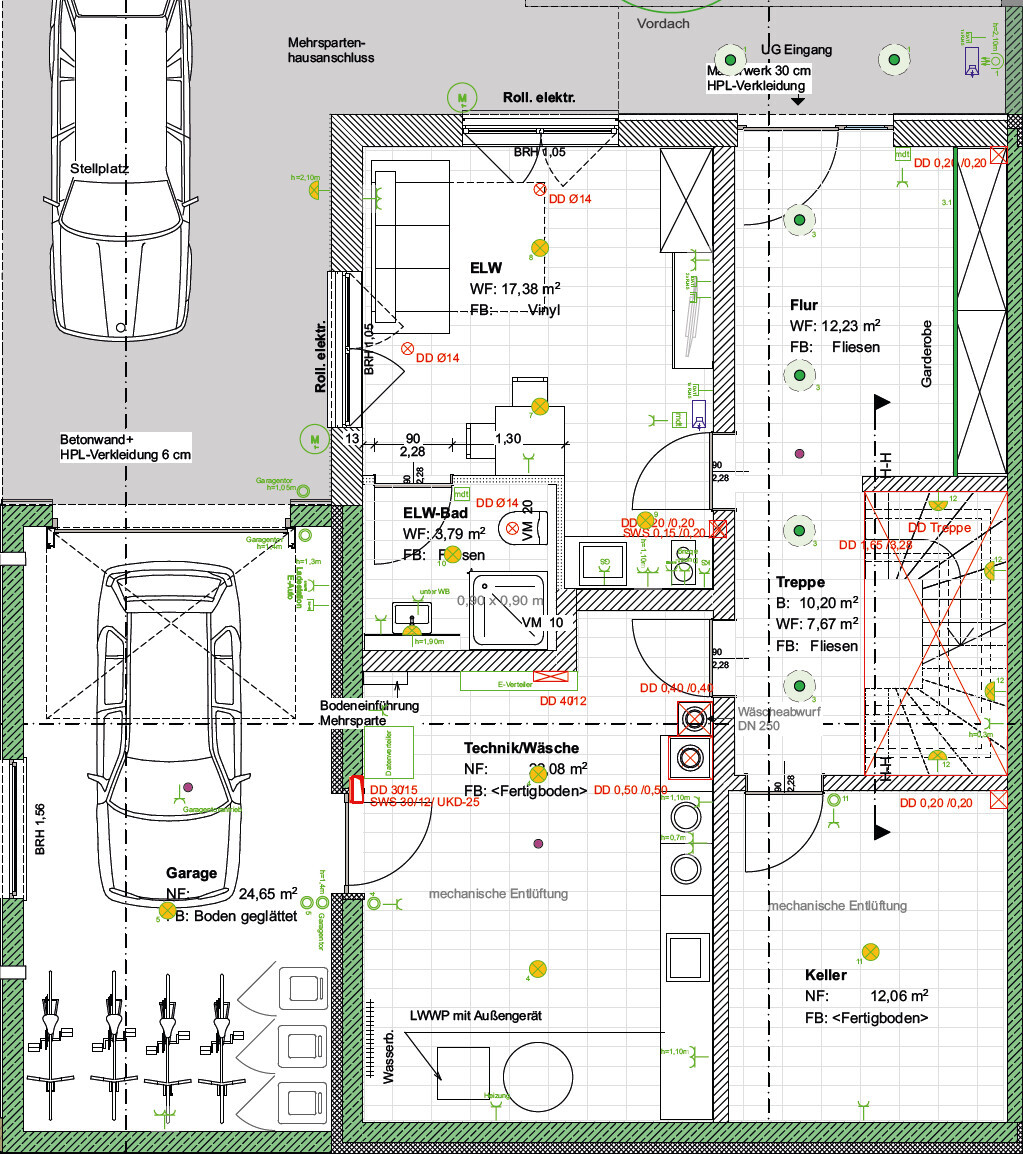
Basement - Corridor
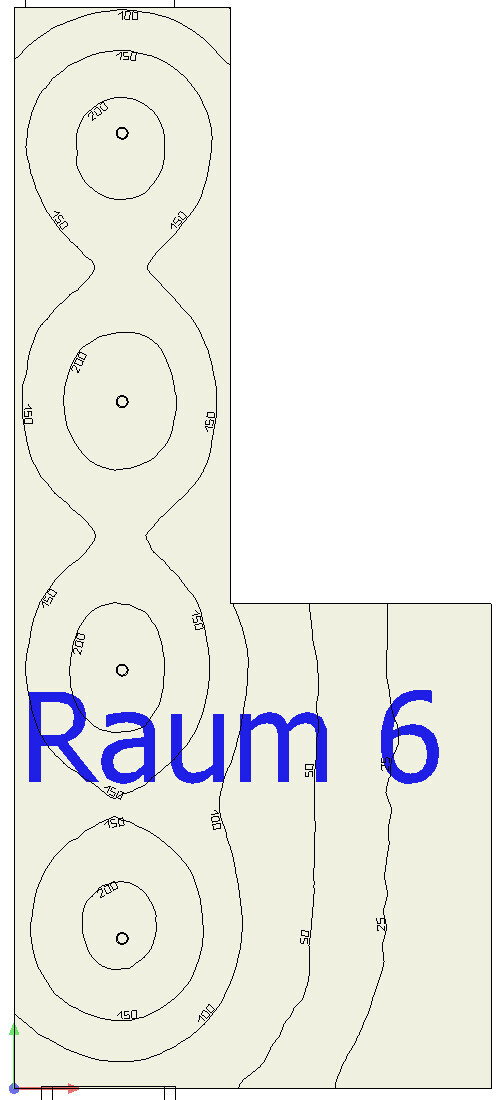
Here, 4 spots were planned at intervals of 1.8m (5.9 feet) and an LED light strip in white above the built-in wardrobe. The ceiling height in the basement is 2.39m (7.84 feet) (final measurement).
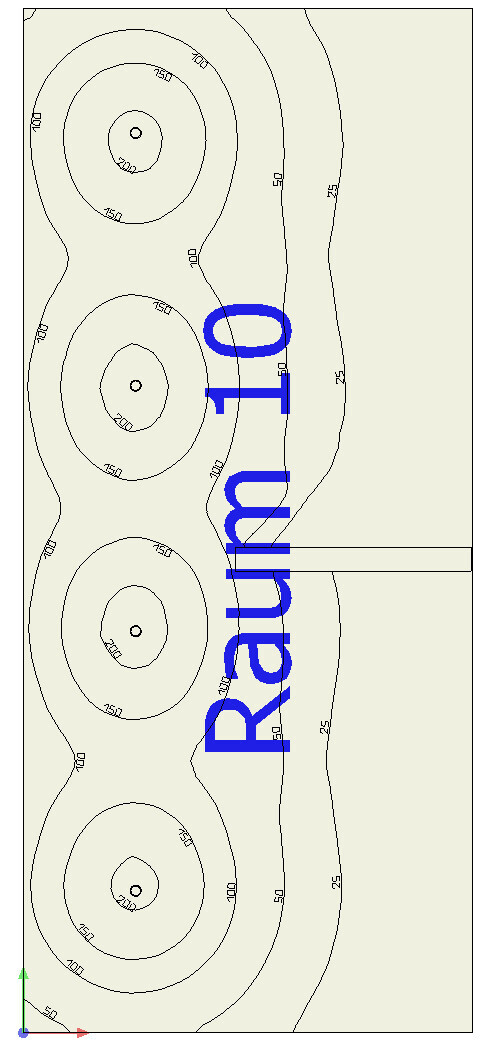
Because of the 36° beam angle and the rather long corridor, we considered increasing to 5 spots to create a more even illumination. Or perhaps increasing the beam angle of the spotlights? Also, according to a Dialux calculation (without the LED strip!), the illumination is currently about 90 lux in the corridor, which seems relatively low even for a corridor?
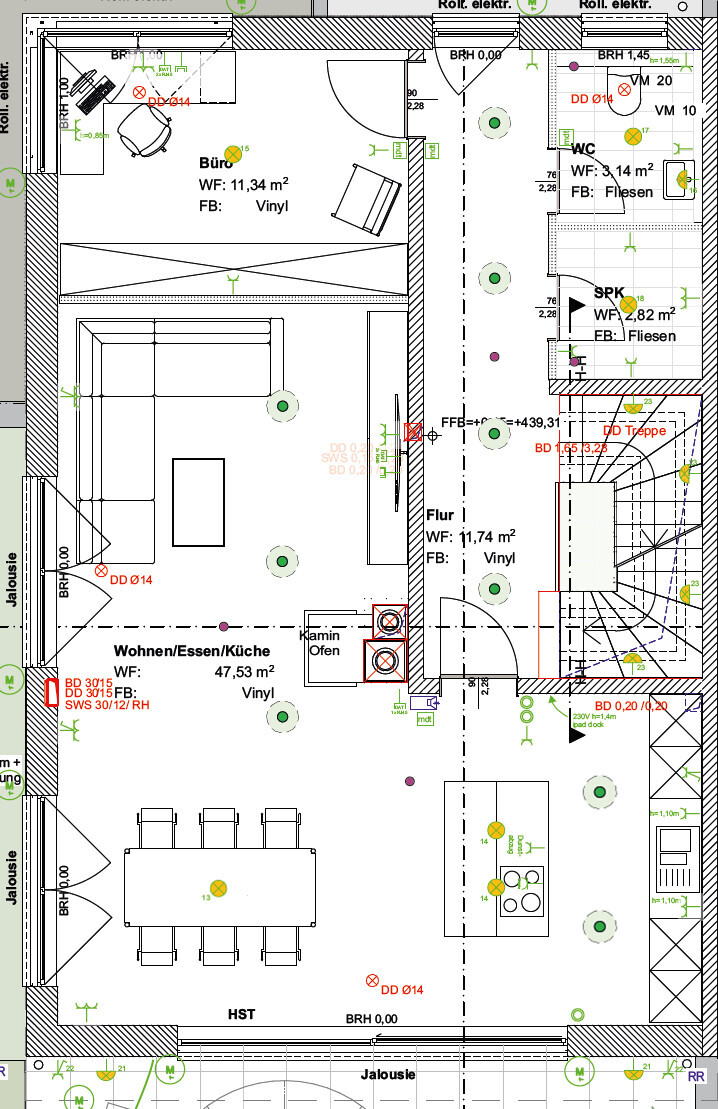
Ground Floor - Corridor
Here again, 4 spots were planned at intervals of 1.8m (5.9 feet). Ceiling height on the ground floor is 2.50m (8.20 feet) (final measurement).
The question is whether the number of spots is sufficient or if adding a 5th spot or increasing the beam angle would create a more uniform lighting. Or would the corridor then be too bright? Dialux currently shows an average of about 115 lux.
Ground Floor - Living Room/Kitchen
On the back wall of the kitchen niche, 4 spots will be installed under the tall cabinets to illuminate the countertop.
On the kitchen island, we plan 2 ceiling outlets and want to use narrower beam angles to highlight the work surface.
Our electrician also suggested placing two spots between the island and back wall (dimmable) for the option of brighter lighting when needed.
In the dining area, there will be only one ceiling outlet for a 3- or 4-light fixture.
In the living room, we want to primarily use indirect lighting. We are planning a floor lamp (exact position to be determined) and possibly decorative lighting on the lowboard. Our electrician also suggested three dimmable spotlights between the living and dining areas that could be dimmed strongly and used either as low-level “residual lighting” or as pathway lighting toward the kitchen/corridor. Does this make sense?
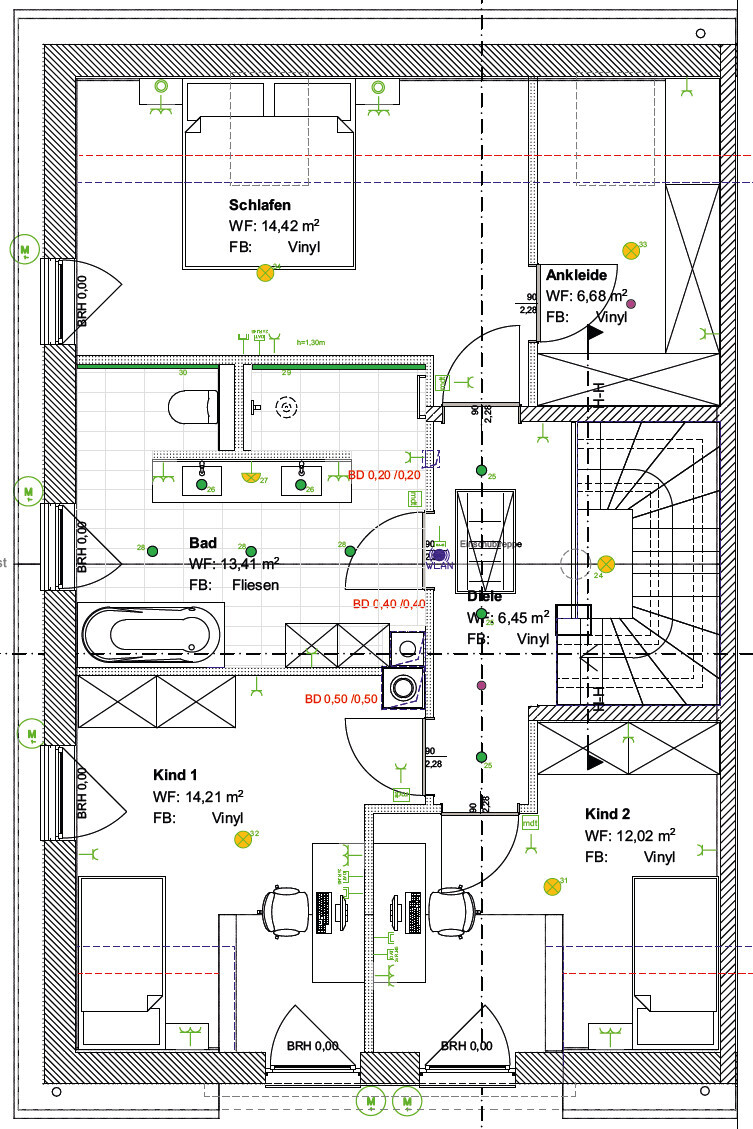
Upper Floor - Corridor
Above the staircase opening, we want to place a lamp that shines down through the stairwell.
For the corridor, we have planned 3 dimmable spots. The ceiling height on the upper floor is 2.65m (8.69 feet) (final measurement).
Would three combined up/down wall lights perhaps create a nicer light or would that be too dark for the room?
Upper Floor - Bathroom
The bathroom will use multiple light sources.
In the center of the room, three dimmable LED spots for general lighting are planned.
Above the washbasins, there will be one LED spot each to illuminate the basins (bright light if needed or dimmed as singular bathroom lighting). On the wall, we plan a backlit mirror.
In the shower and toilet, a light coving with a warm white and an RGBW light strip will be installed.
Here too, we wonder if this setup makes sense or if it would be better to replace the spots with a second LED strip along the bathtub side?
I have the feeling that the brightness in the corridors is too low and the beam angle of the spots is too narrow. We will soon need to specify the exact positions for the concrete ceiling, so I am grateful for any comments. We look forward to your opinions and thank you very much for your support!
PS: I know that at this stage a lighting design would be the best option
PPS: In Dialux I didn’t find the exact LED spots and used the closest available with a 40° beam angle and similar values

we have made progress on our building project and have completed the planning with the electrician. (=> here you can find our general floor plan thread)
He gave us a proposal regarding lighting and ceiling spotlights. After reading various threads here on the house building forum, the consensus seems to be that spotlights should be used sparingly and supplemented with different (indirect) light sources.
We have tried to create a mix of "standard" ceiling outlets, LED spotlights, LED strips, and floor lamps.
Now we are wondering if the plan really makes sense and would appreciate your opinions and suggestions. Additionally, I am uncertain about the number and illumination of the LED spots in the corridor and would also welcome your thoughts on this.
Now to the details:
For the spots and LED strips, the following fixtures have currently been planned (not finalized):
Spots: CIVILIGHT HALED Downlight 10W 2700K-2100K DTW 600lm 36° 230V white
LED strips: LED light coving 25W per meter (25W/m) 2700K warm white, 2000lm/m & RGB LED light strip (I don’t have more information on this)
Basement - Corridor
Here, 4 spots were planned at intervals of 1.8m (5.9 feet) and an LED light strip in white above the built-in wardrobe. The ceiling height in the basement is 2.39m (7.84 feet) (final measurement).
Because of the 36° beam angle and the rather long corridor, we considered increasing to 5 spots to create a more even illumination. Or perhaps increasing the beam angle of the spotlights? Also, according to a Dialux calculation (without the LED strip!), the illumination is currently about 90 lux in the corridor, which seems relatively low even for a corridor?
Ground Floor - Corridor
Here again, 4 spots were planned at intervals of 1.8m (5.9 feet). Ceiling height on the ground floor is 2.50m (8.20 feet) (final measurement).
The question is whether the number of spots is sufficient or if adding a 5th spot or increasing the beam angle would create a more uniform lighting. Or would the corridor then be too bright? Dialux currently shows an average of about 115 lux.
Ground Floor - Living Room/Kitchen
On the back wall of the kitchen niche, 4 spots will be installed under the tall cabinets to illuminate the countertop.
On the kitchen island, we plan 2 ceiling outlets and want to use narrower beam angles to highlight the work surface.
Our electrician also suggested placing two spots between the island and back wall (dimmable) for the option of brighter lighting when needed.
In the dining area, there will be only one ceiling outlet for a 3- or 4-light fixture.
In the living room, we want to primarily use indirect lighting. We are planning a floor lamp (exact position to be determined) and possibly decorative lighting on the lowboard. Our electrician also suggested three dimmable spotlights between the living and dining areas that could be dimmed strongly and used either as low-level “residual lighting” or as pathway lighting toward the kitchen/corridor. Does this make sense?
Upper Floor - Corridor
Above the staircase opening, we want to place a lamp that shines down through the stairwell.
For the corridor, we have planned 3 dimmable spots. The ceiling height on the upper floor is 2.65m (8.69 feet) (final measurement).
Would three combined up/down wall lights perhaps create a nicer light or would that be too dark for the room?
Upper Floor - Bathroom
The bathroom will use multiple light sources.
In the center of the room, three dimmable LED spots for general lighting are planned.
Above the washbasins, there will be one LED spot each to illuminate the basins (bright light if needed or dimmed as singular bathroom lighting). On the wall, we plan a backlit mirror.
In the shower and toilet, a light coving with a warm white and an RGBW light strip will be installed.
Here too, we wonder if this setup makes sense or if it would be better to replace the spots with a second LED strip along the bathtub side?
I have the feeling that the brightness in the corridors is too low and the beam angle of the spots is too narrow. We will soon need to specify the exact positions for the concrete ceiling, so I am grateful for any comments. We look forward to your opinions and thank you very much for your support!
PS: I know that at this stage a lighting design would be the best option
PPS: In Dialux I didn’t find the exact LED spots and used the closest available with a 40° beam angle and similar values
 untergasse4320 Aug 2021 12:07
Nida35a schrieb:
LED floodlights with 4000 lumens, dimmable, 3000K,
that is definitely sufficient as lightingWhich ones exactly?(just a few more characters)

H
hampshire20 Aug 2021 15:41erazorlll schrieb:
Because of the 36° beam angle and the relatively long hallway, we also considered using 5 spots to achieve a more even lighting.Your consideration is good but incomplete. If uniformity is important to you, you can’t just choose any fixture; you should check the light beam shape that the fixture produces before purchasing. Often, non-uniformity is already built in—artifacts, donut holes, strange edges...erazorlll schrieb:
LED light strip 25W per meter 2700K warm white, 2000lm/m2000 lumens per meter is quite high. Plan for a dimming function.Note on color temperature: Unfortunately, the number alone does not give a reference for the appearance of the light. 2700K fixtures from different manufacturers can look very different. This is partly because the color rendering usually varies—illuminated materials can appear very different despite the same color temperature. Although there is a Color Rendering Index (CRI), which is preferably chosen to be high (90+), this does not guarantee identical light appearance. Therefore, visually match the fixtures if uniformity (see above) is important.

Basement:
Garage:
I would reconsider the lighting here.
Place one LED panel on each side of the car to illuminate the walkways.
One LED panel horizontally around the middle of the trash bins. This way, you will have enough light in this area.
I would want the garage to be nice and bright.
Currently, in my 36sqm (387 sq ft) garage, I have six temporary lights with 4000 lumens each, resulting in about 400 lux.
Basement apartment:
Position the light source above the work desk to avoid casting shadows.
Consider additional lighting above the kitchenette.
Technical room:
Possibly add extra lighting above the laundry area.
Hallway:
Is a mirror planned in the hallway? If yes, consider additional mirror lighting with a separate switch.
Our hallway on the ground floor is 1.8m (5 ft 11 in) wide with a ceiling height of 2.7m (8 ft 10 in). I installed GU10 recessed spotlights with a 60° beam angle, CRI=98, and 480 lumens spaced about 1.1m (3 ft 7 in) apart. A 60° beam angle works perfectly for our hallway. I can measure the actual lux levels if needed. I have also used Dialux for planning and measured after installation; Dialux is quite accurate.
As K1300S already mentioned, with replaceable bulbs (at least GU10), 500 to 600 lumens is usually the max, and most have only a 40° beam angle.
High-quality models naturally offer a “nicer, more even light,” but unfortunately, they are very expensive.
Stairs: Are these surface-mounted lights?
Ground Floor:
Office:
Definitely add proper lighting at the workstation.
A single light source in the center of the room is not sufficient.
Living room:
Although I am a fan of recessed spotlights and find them attractive, I would avoid using them in the living room.
I would rather go for a floor lamp, dimmable wall lights, or pendant lamps.
Pantry:
No window? I am glad we planned for a window.
If possible, I would avoid rooms without windows.
Upper Floor:
Bedroom:
Bedside lamps?
Dressing room:
Mirror with lighting?
Bathroom:
I would consider adding pleasant ambient lighting as well.
We have three lighting groups in our bathroom:
1) General lighting with recessed spotlights
2) Mirror lighting with a separate switch
3) Cozy lighting with wall and pendant lamps
Children’s room:
Definitely add extra lighting at the workstation.
At the bed, a wall, pendant, or floor lamp.
A switch near the bed to turn off the main light.
Overall, you have already put a lot of thought into the lighting plan. Excellent!
I’ve seen very different plans here before.
Garage:
I would reconsider the lighting here.
Place one LED panel on each side of the car to illuminate the walkways.
One LED panel horizontally around the middle of the trash bins. This way, you will have enough light in this area.
I would want the garage to be nice and bright.
Currently, in my 36sqm (387 sq ft) garage, I have six temporary lights with 4000 lumens each, resulting in about 400 lux.
Basement apartment:
Position the light source above the work desk to avoid casting shadows.
Consider additional lighting above the kitchenette.
Technical room:
Possibly add extra lighting above the laundry area.
Hallway:
Is a mirror planned in the hallway? If yes, consider additional mirror lighting with a separate switch.
Our hallway on the ground floor is 1.8m (5 ft 11 in) wide with a ceiling height of 2.7m (8 ft 10 in). I installed GU10 recessed spotlights with a 60° beam angle, CRI=98, and 480 lumens spaced about 1.1m (3 ft 7 in) apart. A 60° beam angle works perfectly for our hallway. I can measure the actual lux levels if needed. I have also used Dialux for planning and measured after installation; Dialux is quite accurate.
As K1300S already mentioned, with replaceable bulbs (at least GU10), 500 to 600 lumens is usually the max, and most have only a 40° beam angle.
High-quality models naturally offer a “nicer, more even light,” but unfortunately, they are very expensive.
Stairs: Are these surface-mounted lights?
Ground Floor:
Office:
Definitely add proper lighting at the workstation.
A single light source in the center of the room is not sufficient.
Living room:
Although I am a fan of recessed spotlights and find them attractive, I would avoid using them in the living room.
I would rather go for a floor lamp, dimmable wall lights, or pendant lamps.
Pantry:
No window? I am glad we planned for a window.
If possible, I would avoid rooms without windows.
Upper Floor:
Bedroom:
Bedside lamps?
Dressing room:
Mirror with lighting?
Bathroom:
I would consider adding pleasant ambient lighting as well.
We have three lighting groups in our bathroom:
1) General lighting with recessed spotlights
2) Mirror lighting with a separate switch
3) Cozy lighting with wall and pendant lamps
Children’s room:
Definitely add extra lighting at the workstation.
At the bed, a wall, pendant, or floor lamp.
A switch near the bed to turn off the main light.
Overall, you have already put a lot of thought into the lighting plan. Excellent!
I’ve seen very different plans here before.

AMNE3IA schrieb:
At the moment, I have 6 temporary lights on 36sqm (387 sqft), each with 4000 lumens, resulting in about 400 lux.How is that possible? Six lights add up to 24,000 lumens, divided by 36sqm (387 sqft) equals 750 lux. Okay, it might not be perfectly even, but then some areas might be at 400 lux while others reach 1100 lux. That would already be sufficient for precision mechanical work. 😳K1300S schrieb:
How does that work? The six lights provide a total of 24,000 lumens, divided by 36 square meters gives 750 lux. Okay, it might not be perfectly even, but some areas could be around 400 lux, while others might reach 1100 lux. That’s already enough for precision mechanical work. 😳 Exactly!! That’s 24,000 lm. It does sound like a lot, but it doesn’t feel that way in reality. In my small workshop, I have about 700 lux.
Since I often work in the garage, I need proper lighting there. The current lights will later be replaced by LED panels that will be at least as bright.
I also do hobby photography and work with flashes, so I have a light meter that can measure illuminance.
I just measured again. On average, I get 350–400 lux at about 0.9 m (3 feet) above finished floor level.
I should mention that the walls are still gray and the garage is quite cluttered.
Once tidied up with white walls, I should get higher values.
Similar topics