
E
erazorlll3 Aug 2021 23:32Good evening,
we have made progress on our building project and have completed the planning with the electrician. (=> here you can find our general floor plan thread)
He gave us a proposal regarding lighting and ceiling spotlights. After reading various threads here on the house building forum, the consensus seems to be that spotlights should be used sparingly and supplemented with different (indirect) light sources.
We have tried to create a mix of "standard" ceiling outlets, LED spotlights, LED strips, and floor lamps.
Now we are wondering if the plan really makes sense and would appreciate your opinions and suggestions. Additionally, I am uncertain about the number and illumination of the LED spots in the corridor and would also welcome your thoughts on this.
Now to the details:
For the spots and LED strips, the following fixtures have currently been planned (not finalized):
Spots: CIVILIGHT HALED Downlight 10W 2700K-2100K DTW 600lm 36° 230V white
LED strips: LED light coving 25W per meter (25W/m) 2700K warm white, 2000lm/m & RGB LED light strip (I don’t have more information on this)
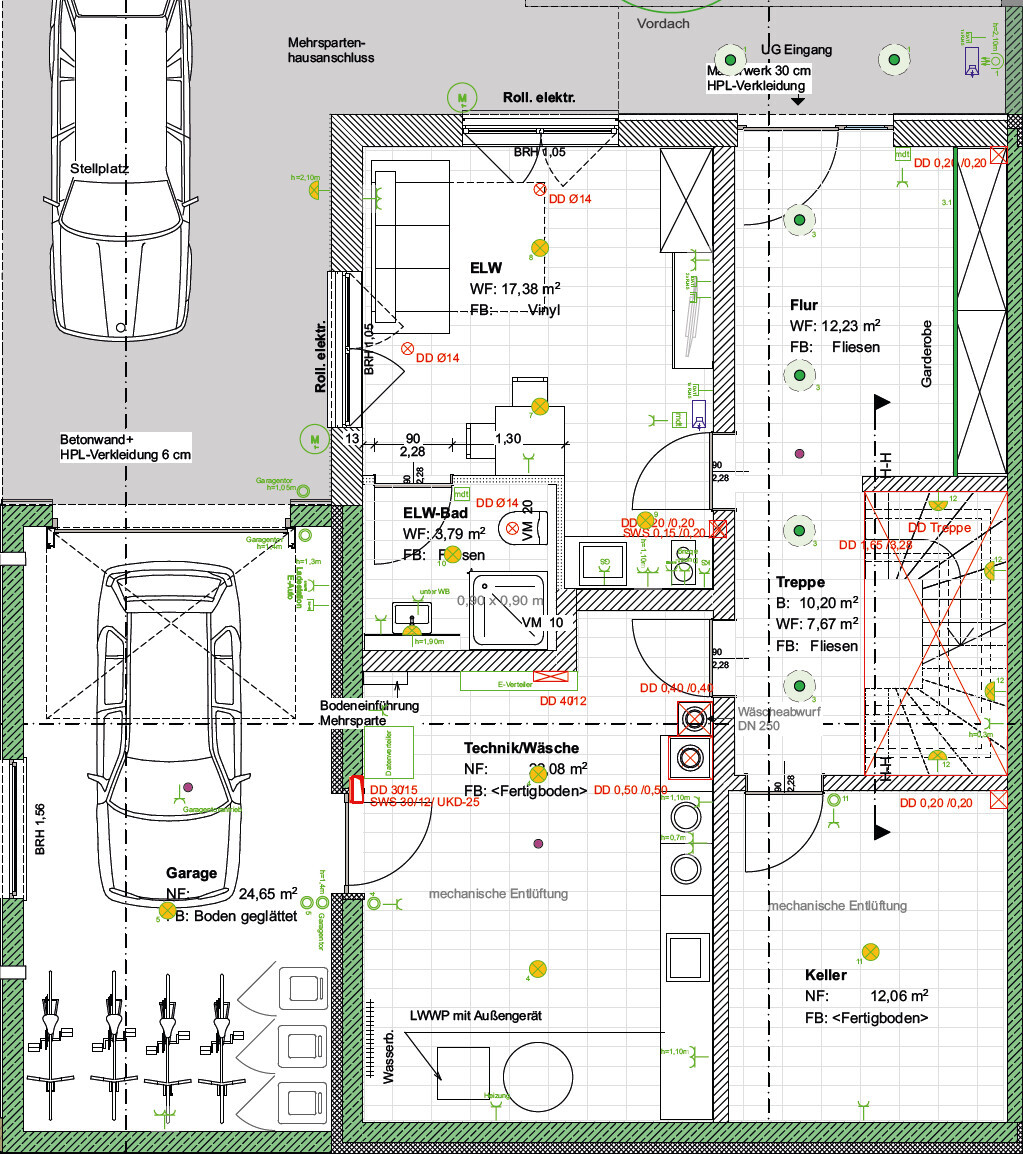
Basement - Corridor
Here, 4 spots were planned at intervals of 1.8m (5.9 feet) and an LED light strip in white above the built-in wardrobe. The ceiling height in the basement is 2.39m (7.84 feet) (final measurement).
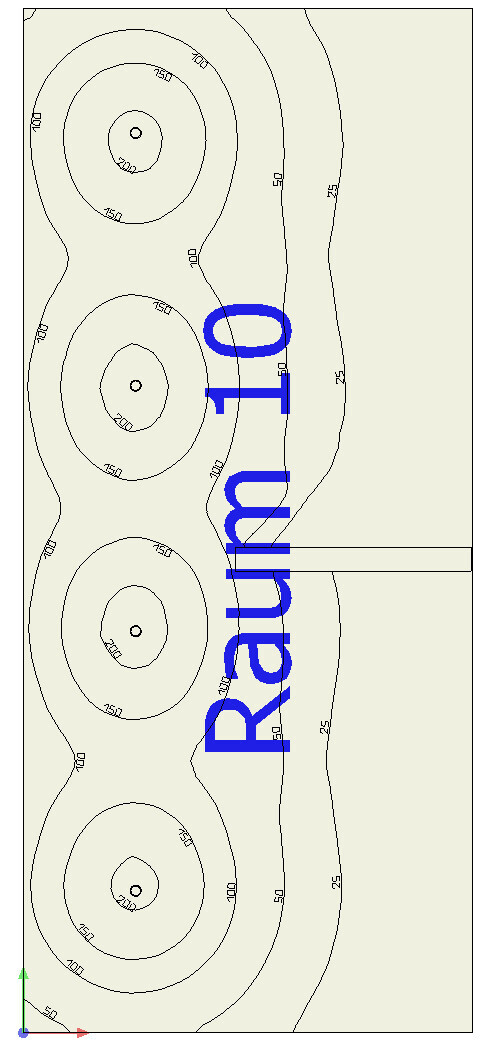
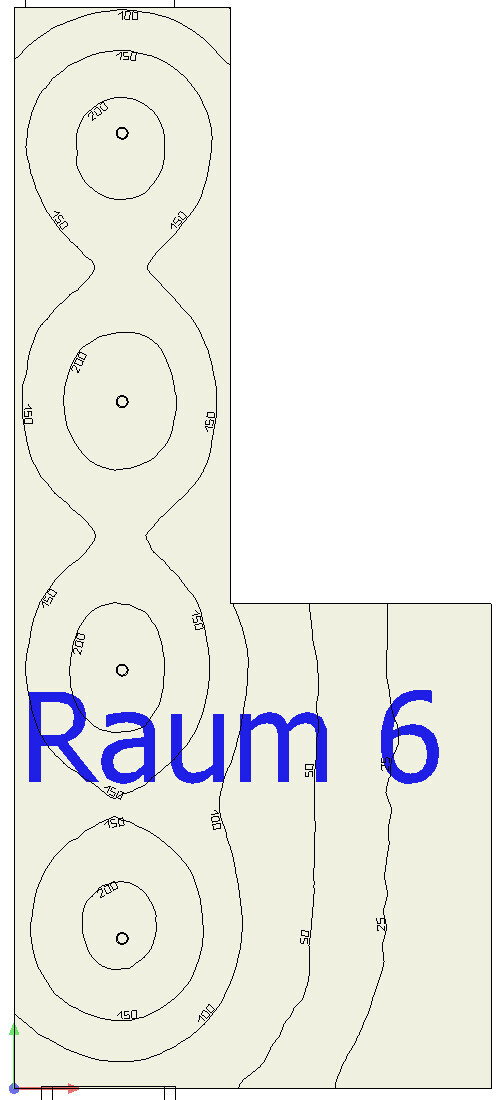
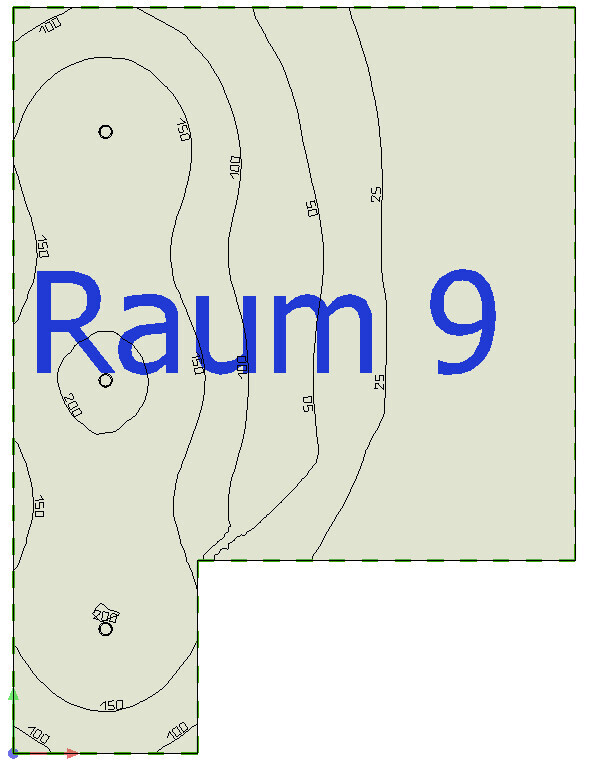
Because of the 36° beam angle and the rather long corridor, we considered increasing to 5 spots to create a more even illumination. Or perhaps increasing the beam angle of the spotlights? Also, according to a Dialux calculation (without the LED strip!), the illumination is currently about 90 lux in the corridor, which seems relatively low even for a corridor?
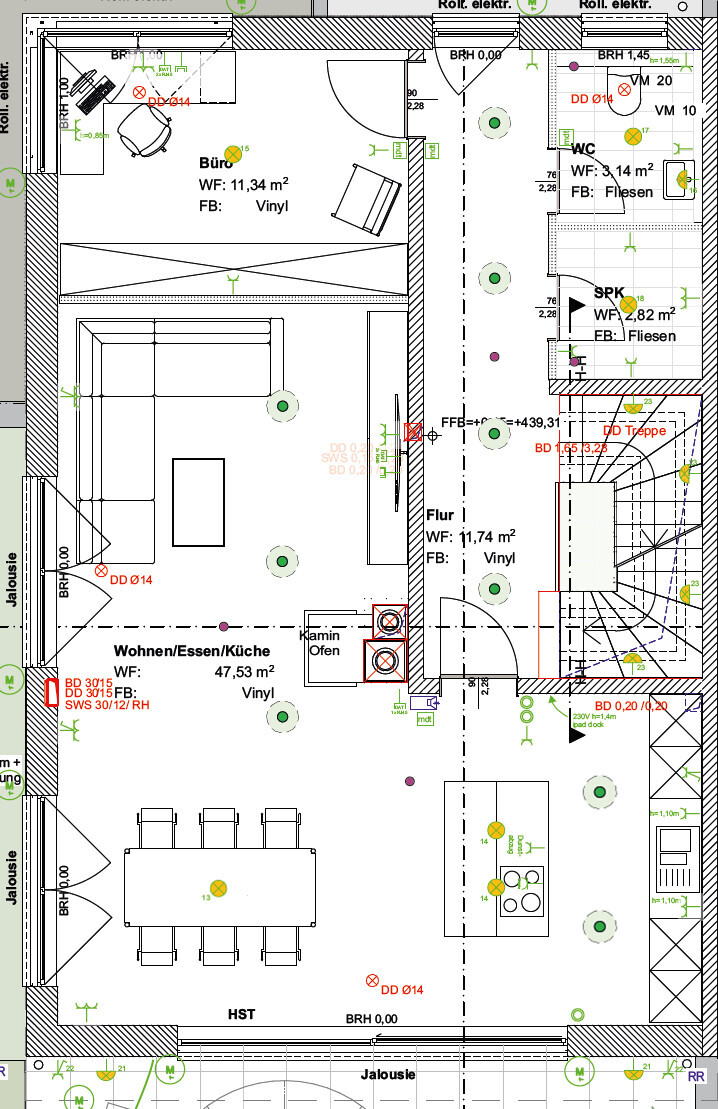
Ground Floor - Corridor
Here again, 4 spots were planned at intervals of 1.8m (5.9 feet). Ceiling height on the ground floor is 2.50m (8.20 feet) (final measurement).
The question is whether the number of spots is sufficient or if adding a 5th spot or increasing the beam angle would create a more uniform lighting. Or would the corridor then be too bright? Dialux currently shows an average of about 115 lux.
Ground Floor - Living Room/Kitchen
On the back wall of the kitchen niche, 4 spots will be installed under the tall cabinets to illuminate the countertop.
On the kitchen island, we plan 2 ceiling outlets and want to use narrower beam angles to highlight the work surface.
Our electrician also suggested placing two spots between the island and back wall (dimmable) for the option of brighter lighting when needed.
In the dining area, there will be only one ceiling outlet for a 3- or 4-light fixture.
In the living room, we want to primarily use indirect lighting. We are planning a floor lamp (exact position to be determined) and possibly decorative lighting on the lowboard. Our electrician also suggested three dimmable spotlights between the living and dining areas that could be dimmed strongly and used either as low-level “residual lighting” or as pathway lighting toward the kitchen/corridor. Does this make sense?
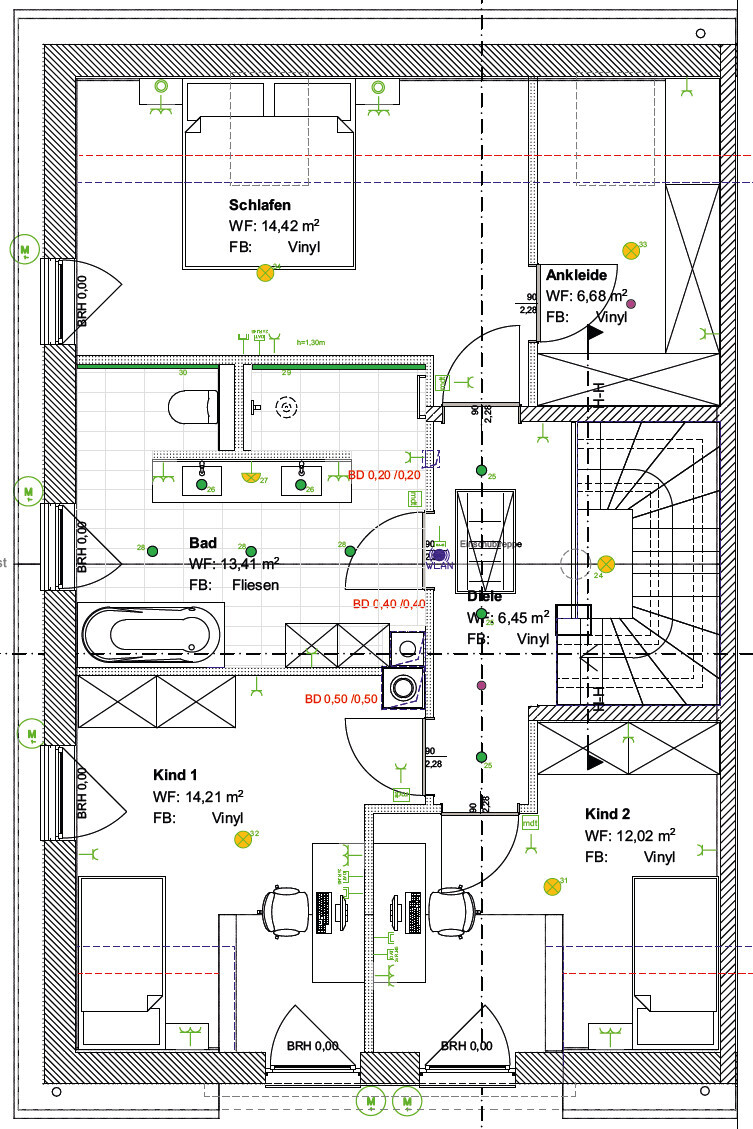
Upper Floor - Corridor
Above the staircase opening, we want to place a lamp that shines down through the stairwell.
For the corridor, we have planned 3 dimmable spots. The ceiling height on the upper floor is 2.65m (8.69 feet) (final measurement).
Would three combined up/down wall lights perhaps create a nicer light or would that be too dark for the room?
Upper Floor - Bathroom
The bathroom will use multiple light sources.
In the center of the room, three dimmable LED spots for general lighting are planned.
Above the washbasins, there will be one LED spot each to illuminate the basins (bright light if needed or dimmed as singular bathroom lighting). On the wall, we plan a backlit mirror.
In the shower and toilet, a light coving with a warm white and an RGBW light strip will be installed.
Here too, we wonder if this setup makes sense or if it would be better to replace the spots with a second LED strip along the bathtub side?
I have the feeling that the brightness in the corridors is too low and the beam angle of the spots is too narrow. We will soon need to specify the exact positions for the concrete ceiling, so I am grateful for any comments. We look forward to your opinions and thank you very much for your support!
PS: I know that at this stage a lighting design would be the best option
PPS: In Dialux I didn’t find the exact LED spots and used the closest available with a 40° beam angle and similar values
we have made progress on our building project and have completed the planning with the electrician. (=> here you can find our general floor plan thread)
He gave us a proposal regarding lighting and ceiling spotlights. After reading various threads here on the house building forum, the consensus seems to be that spotlights should be used sparingly and supplemented with different (indirect) light sources.
We have tried to create a mix of "standard" ceiling outlets, LED spotlights, LED strips, and floor lamps.
Now we are wondering if the plan really makes sense and would appreciate your opinions and suggestions. Additionally, I am uncertain about the number and illumination of the LED spots in the corridor and would also welcome your thoughts on this.
Now to the details:
For the spots and LED strips, the following fixtures have currently been planned (not finalized):
Spots: CIVILIGHT HALED Downlight 10W 2700K-2100K DTW 600lm 36° 230V white
LED strips: LED light coving 25W per meter (25W/m) 2700K warm white, 2000lm/m & RGB LED light strip (I don’t have more information on this)
Basement - Corridor
Here, 4 spots were planned at intervals of 1.8m (5.9 feet) and an LED light strip in white above the built-in wardrobe. The ceiling height in the basement is 2.39m (7.84 feet) (final measurement).
Because of the 36° beam angle and the rather long corridor, we considered increasing to 5 spots to create a more even illumination. Or perhaps increasing the beam angle of the spotlights? Also, according to a Dialux calculation (without the LED strip!), the illumination is currently about 90 lux in the corridor, which seems relatively low even for a corridor?
Ground Floor - Corridor
Here again, 4 spots were planned at intervals of 1.8m (5.9 feet). Ceiling height on the ground floor is 2.50m (8.20 feet) (final measurement).
The question is whether the number of spots is sufficient or if adding a 5th spot or increasing the beam angle would create a more uniform lighting. Or would the corridor then be too bright? Dialux currently shows an average of about 115 lux.
Ground Floor - Living Room/Kitchen
On the back wall of the kitchen niche, 4 spots will be installed under the tall cabinets to illuminate the countertop.
On the kitchen island, we plan 2 ceiling outlets and want to use narrower beam angles to highlight the work surface.
Our electrician also suggested placing two spots between the island and back wall (dimmable) for the option of brighter lighting when needed.
In the dining area, there will be only one ceiling outlet for a 3- or 4-light fixture.
In the living room, we want to primarily use indirect lighting. We are planning a floor lamp (exact position to be determined) and possibly decorative lighting on the lowboard. Our electrician also suggested three dimmable spotlights between the living and dining areas that could be dimmed strongly and used either as low-level “residual lighting” or as pathway lighting toward the kitchen/corridor. Does this make sense?
Upper Floor - Corridor
Above the staircase opening, we want to place a lamp that shines down through the stairwell.
For the corridor, we have planned 3 dimmable spots. The ceiling height on the upper floor is 2.65m (8.69 feet) (final measurement).
Would three combined up/down wall lights perhaps create a nicer light or would that be too dark for the room?
Upper Floor - Bathroom
The bathroom will use multiple light sources.
In the center of the room, three dimmable LED spots for general lighting are planned.
Above the washbasins, there will be one LED spot each to illuminate the basins (bright light if needed or dimmed as singular bathroom lighting). On the wall, we plan a backlit mirror.
In the shower and toilet, a light coving with a warm white and an RGBW light strip will be installed.
Here too, we wonder if this setup makes sense or if it would be better to replace the spots with a second LED strip along the bathtub side?
I have the feeling that the brightness in the corridors is too low and the beam angle of the spots is too narrow. We will soon need to specify the exact positions for the concrete ceiling, so I am grateful for any comments. We look forward to your opinions and thank you very much for your support!
PS: I know that at this stage a lighting design would be the best option
PPS: In Dialux I didn’t find the exact LED spots and used the closest available with a 40° beam angle and similar values

erazorlll schrieb:
Or maybe it would be better to increase the beam angle of the spotlights? Without going into all the details here: If you increase the beam angle, the brightness on the floor decreases, but you illuminate a larger area—at 36 degrees and a ceiling height of 2.50 m (8.2 ft), that corresponds to about 1.60 m (5.2 ft) in diameter, so a 1.8 m (5.9 ft) spacing is somewhat tight. For that reason, I would place the lights closer together, which automatically increases the number of fixtures and thus the total luminous flux.
Otherwise, as always: There are other types of fixtures besides spotlights—or more accurately, downlights—and the general problem I have with the more affordable options in this category is that they are usually so weak that you need to install larger quantities to achieve proper and reasonably even lighting. That’s why I recommend looking at higher-quality models, which can often deliver 1000+ lumens per fixture. In that case, a wider beam angle makes more sense. For example: In a hallway in our house, downlights with nearly 6000 lumens each (dimmable of course) are installed, where the arrangement is based only on the illuminated area and not the required luminous flux. You would need about ten fixtures for your space, and the ceiling would look like it had been hit with a shotgun. (We could have gotten by with a fixture half that powerful, but the principle stays the same.)
erazorlll schrieb:
PPS: I couldn’t find the exact LED spots in Dialux, so I used the closest options with a 40° beam angle and similar specifications With better manufacturers, you can usually download the photometric data to use the exact fixture with its characteristics in Dialux.
F
fach1werk4 Aug 2021 08:26I would also relate brightness to age. As you get older, you need more brightness to perceive the same as a younger person. We had a lighting plan done; coming from an older building, everything initially seemed too bright to me. We only used part of it. Five years later, we need it.

E
erazorlll4 Aug 2021 09:39K1300S schrieb:
Without going into all the details: If you increase the beam angle, the brightness on the floor decreases, but you illuminate a larger floor area – in the case of 36 degrees and a ceiling height of 2.50 meters (8 feet), about 1.60 meters (5.25 feet) in diameter, so the 1.8-meter (6 feet) spacing is a bit too wide. Therefore, I would place the fixtures closer together, which automatically increases the quantity and thus the total luminous flux. Thank you for your feedback; I also had the concern that the spotlights might be too few or the light output too low.
K1300S schrieb:
That’s why I like to suggest looking at higher quality models, which can deliver 1000+ lumens per spotlight. Then a wider beam angle makes more sense. Just as an example: In a hallway at our place, recessed spotlights with nearly 6000 lumens are installed (of course dimmable), where the layout is based only on the illuminated area and not the required luminous flux. Could you provide me with examples of high-quality spotlights or what you have installed? I’d be happy to check them out.
fach1werk schrieb:
I would also relate the brightness requirements to age. As you get older, you need more light to perceive the same as a younger person. We had a lighting plan done; coming from an old building, everything seemed too bright at first. We only used part of it. Five years later, we need the full amount. Thank you, that’s a very good point. That is another reason I think it is currently too dark.
Nida35a schrieb:
LED panel lights with 4000 lumens, dimmable, 3000K, are more than sufficient for lighting. We actually wanted to use flush-mounted solutions. I will check if there is something comparable available for that.
Feel free to share more experiences and comments on our planning.
Several suppliers offer LED recessed downlights, but the more powerful models are usually quite large, which not everyone prefers and can also be expensive to install (especially in a concrete ceiling without a suspended frame). If you want something very compact and robust, take a look at Illuxtron. Their standard size for flush-mount junction boxes delivers easily twice the amount of light with selectable beam angles. With this level of output, they definitely need to be properly dimmable; otherwise, you’ll regularly need sunglasses. 😀
Similar topics