
ᐅ Lighting design for new single-family home construction – potential for improvement?
Created on: 8 Jan 2025 18:56
M
MC123456
Hello,
due to the many interesting discussions here, we have decided to share our thoughts with the experts and to get further useful suggestions for the lighting planning of our new single-family home.
We are building a solid house approximately 10x11 m (33x36 ft). KfW 55 standard, conventional electrical installation (no smart home system, KNX, etc.). Ceiling height on the ground floor about 2.4 m (8 ft), no suspended ceiling; on the upper floor the ceiling will be suspended to about 2.4 m (8 ft) as well; ceiling height in the basement about 2.3 m (7.5 ft), no suspended ceiling.
We are currently in the planning phase for the electrical work, especially lighting, which is slowly but surely driving us crazy. For our considerations, we initially referred to houses of parents, friends, acquaintances, but hardly any modern new builds were available as references.
Overall, we have planned relatively few recessed spots. On the one hand, we don’t like a flood of recessed spots across the entire ceilings of the rooms; on the other hand, recessed spots (especially in the concrete ceiling) are very inflexible.
Therefore, they will only be installed on the ground floor kitchen in the concrete ceiling and in the bathroom on the upper floor in the suspended drywall ceiling.
In most other rooms and corridors, we initially opted for one or more classic electrical outlets (ceiling boxes) where a ceiling lamp will be installed.
The large room in the basement will initially be used as a hobby room but could be converted in the future into a small apartment for relatives (for care purposes). For this reason, only two outlets for ceiling lights are planned here (switched separately).
In the stairwell, we would provide wall lamps at about half the height of the stairs, controlled together with the ceiling lamp in the upper floor corridor and basement corridor.
The large living/dining area, however, is causing us some difficulties:
- We planned a ceiling lamp with 2-3 adjustable spotlights in the area between kitchen and dining table to illuminate this transition zone.
- Then a classic pendant lamp (probably triple) above the dining table.
- In the living room area, centrally a ceiling light to provide basic illumination.
Additionally, a combination of a floor lamp (possibly with integrated reading light) next to the sofa, wall lamps at the fireplace and behind the dining table, as well as background lighting for the TV or TV unit. These would be connected so that a cozy atmosphere can be created when relaxing on the sofa in the evening.
What do you think? Could this roughly work, or are there major planning errors?
We would be very grateful for tips, suggestions and improvements.
We look forward to many responses.
Kind regards
Attached are the floor plan sketches
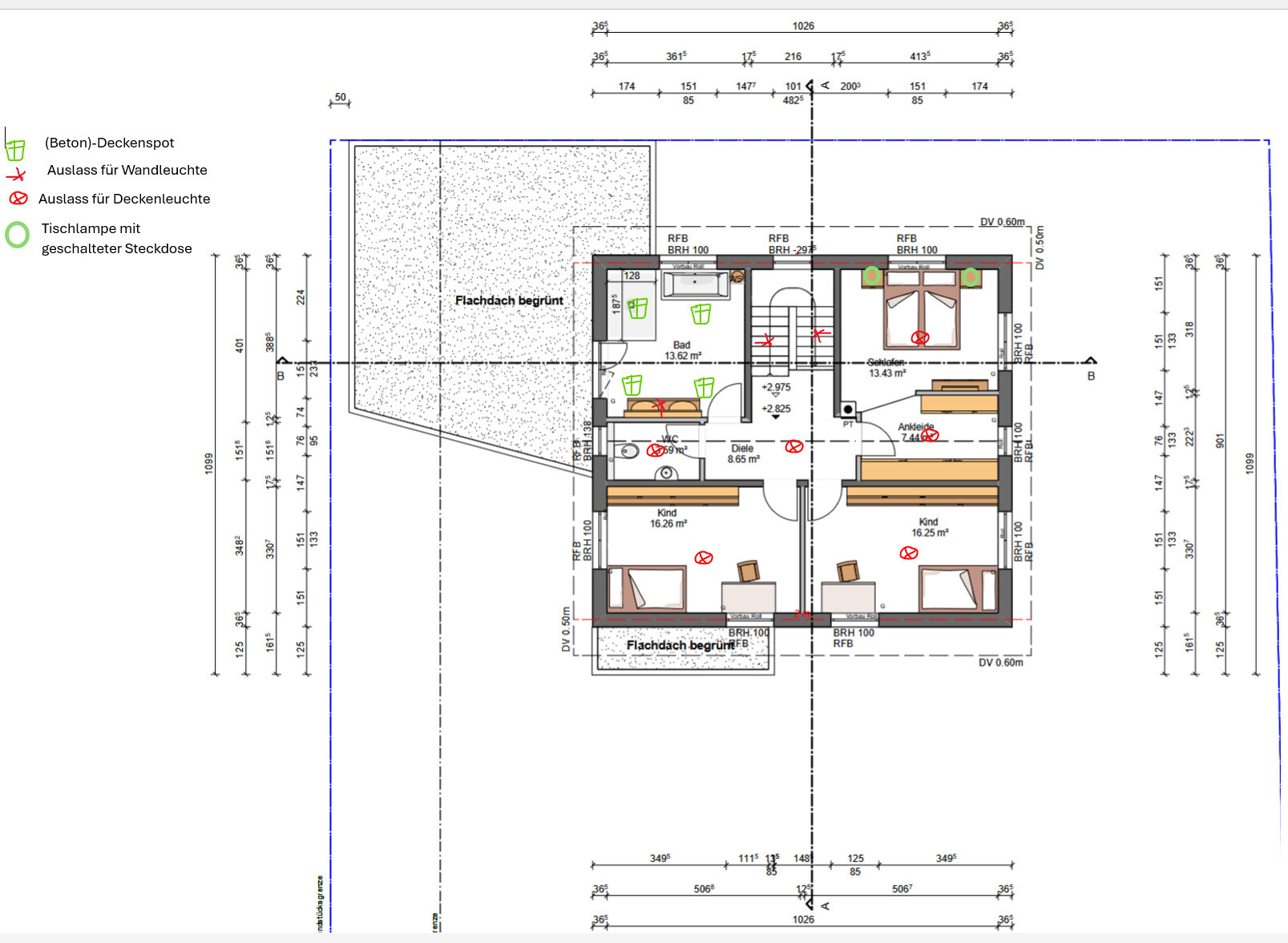
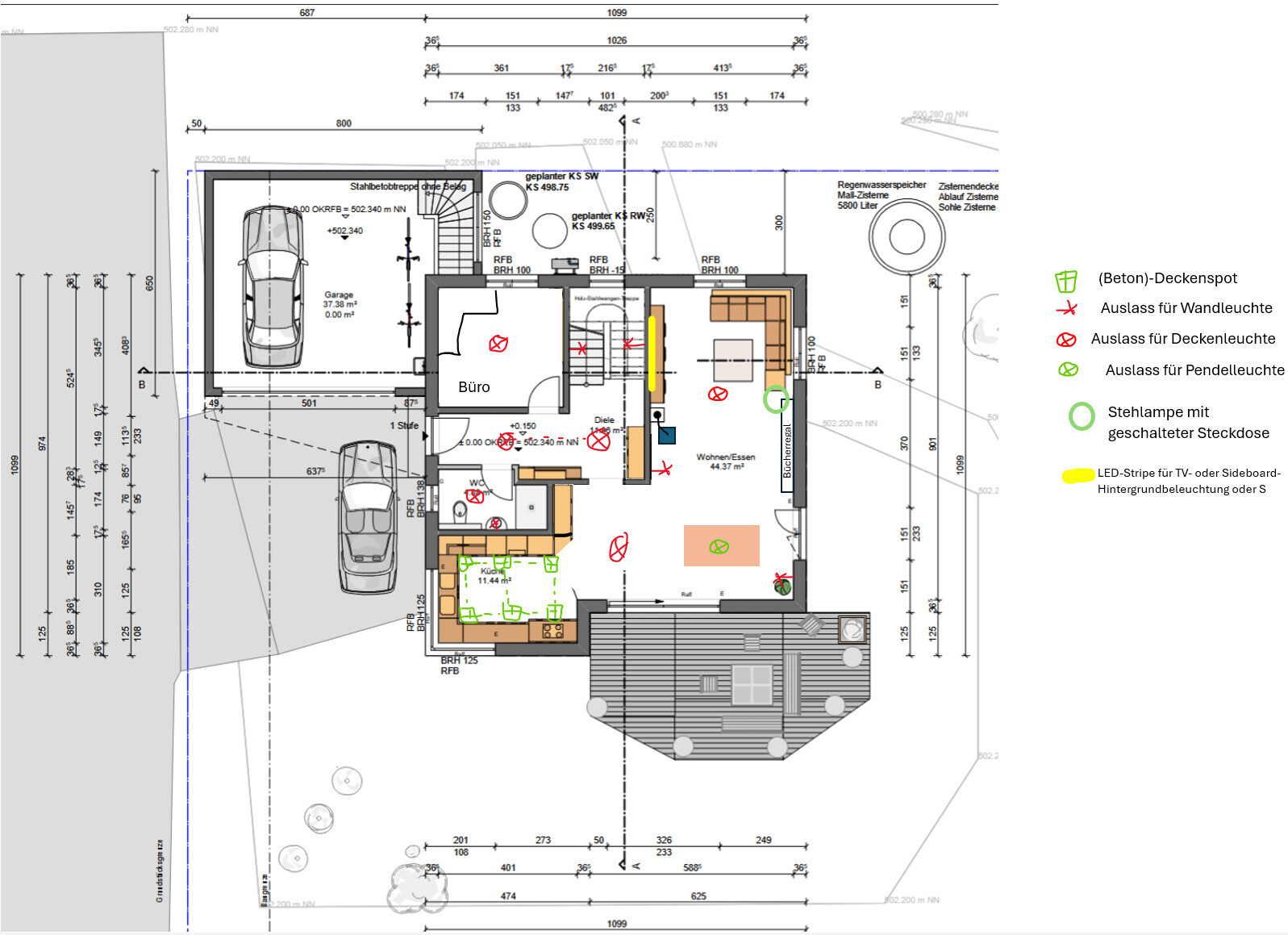
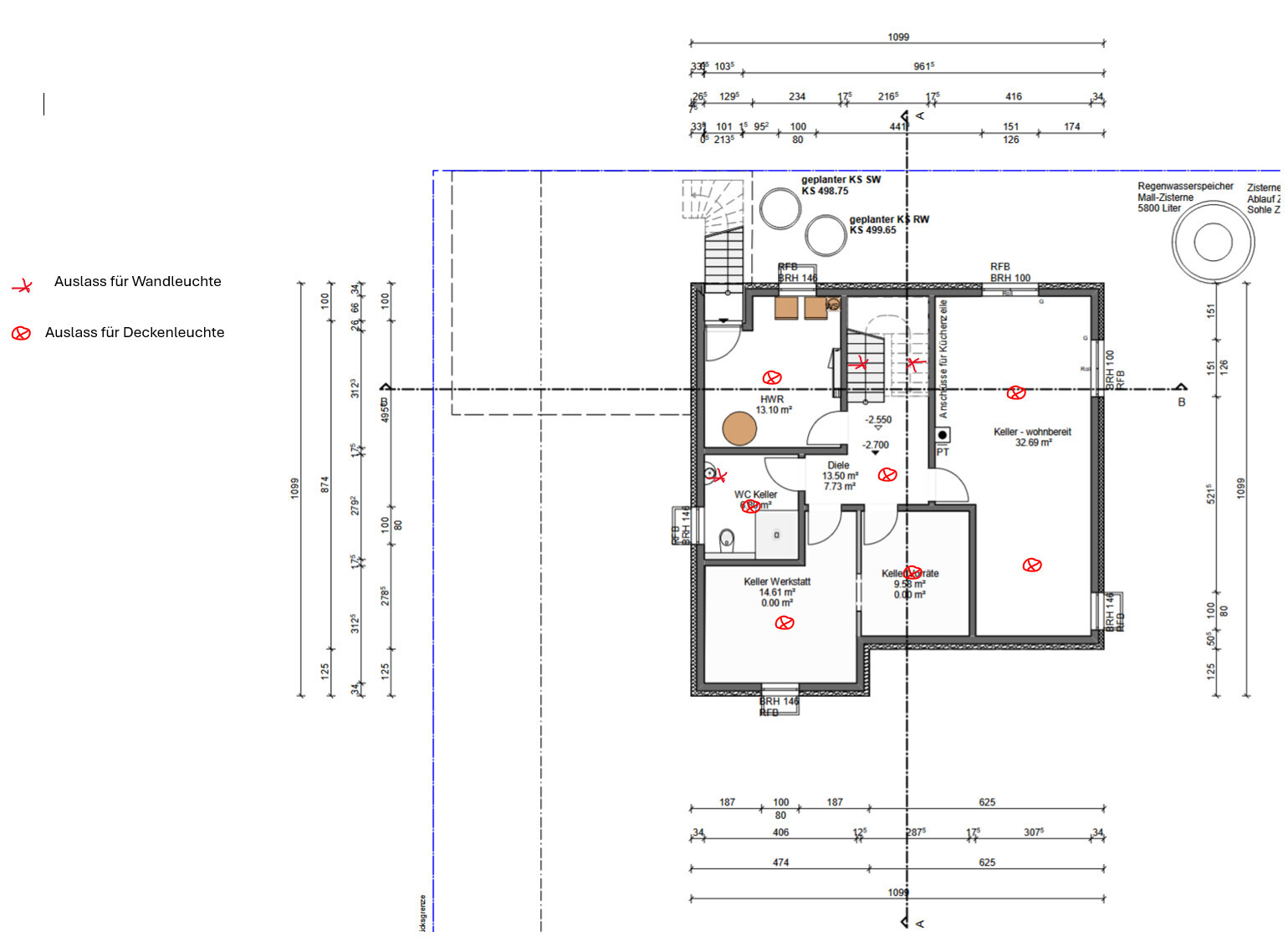
due to the many interesting discussions here, we have decided to share our thoughts with the experts and to get further useful suggestions for the lighting planning of our new single-family home.
We are building a solid house approximately 10x11 m (33x36 ft). KfW 55 standard, conventional electrical installation (no smart home system, KNX, etc.). Ceiling height on the ground floor about 2.4 m (8 ft), no suspended ceiling; on the upper floor the ceiling will be suspended to about 2.4 m (8 ft) as well; ceiling height in the basement about 2.3 m (7.5 ft), no suspended ceiling.
We are currently in the planning phase for the electrical work, especially lighting, which is slowly but surely driving us crazy. For our considerations, we initially referred to houses of parents, friends, acquaintances, but hardly any modern new builds were available as references.
Overall, we have planned relatively few recessed spots. On the one hand, we don’t like a flood of recessed spots across the entire ceilings of the rooms; on the other hand, recessed spots (especially in the concrete ceiling) are very inflexible.
Therefore, they will only be installed on the ground floor kitchen in the concrete ceiling and in the bathroom on the upper floor in the suspended drywall ceiling.
In most other rooms and corridors, we initially opted for one or more classic electrical outlets (ceiling boxes) where a ceiling lamp will be installed.
The large room in the basement will initially be used as a hobby room but could be converted in the future into a small apartment for relatives (for care purposes). For this reason, only two outlets for ceiling lights are planned here (switched separately).
In the stairwell, we would provide wall lamps at about half the height of the stairs, controlled together with the ceiling lamp in the upper floor corridor and basement corridor.
The large living/dining area, however, is causing us some difficulties:
- We planned a ceiling lamp with 2-3 adjustable spotlights in the area between kitchen and dining table to illuminate this transition zone.
- Then a classic pendant lamp (probably triple) above the dining table.
- In the living room area, centrally a ceiling light to provide basic illumination.
Additionally, a combination of a floor lamp (possibly with integrated reading light) next to the sofa, wall lamps at the fireplace and behind the dining table, as well as background lighting for the TV or TV unit. These would be connected so that a cozy atmosphere can be created when relaxing on the sofa in the evening.
What do you think? Could this roughly work, or are there major planning errors?
We would be very grateful for tips, suggestions and improvements.
We look forward to many responses.
Kind regards
Attached are the floor plan sketches
wiltshire schrieb:
Sometimes I pull over the less'n'more "Jules Verne" cordless floor lamp. Then it works perfectly. I stuck a Lidl LED light under the wall shelf so I can see into the food processor bowl. Luckily, we have a strip window and above it wall cabinets with an illuminated base.
Applying makeup is basically the same: none of the ceiling lights help; it's either lighting from the front or from the front.
MC123456 schrieb:
The ceiling spotlights are installed at the height of the countertop edge or slightly further toward the wall, so that no shadows are cast.You should rather position them more centered above the countertop, so with a countertop depth of about 60cm (24 inches), approximately 30cm (12 inches) away from the wall. This way, the work surface is properly illuminated rather than the slightly bent-over head.After reconsidering and taking your comments into account, I have revised the lighting plan for the open living area/kitchen.
I really like the flexible track system, but my wife doesn’t like it at all... so unfortunately, it’s not an option.
Therefore, here’s the proposed solution:
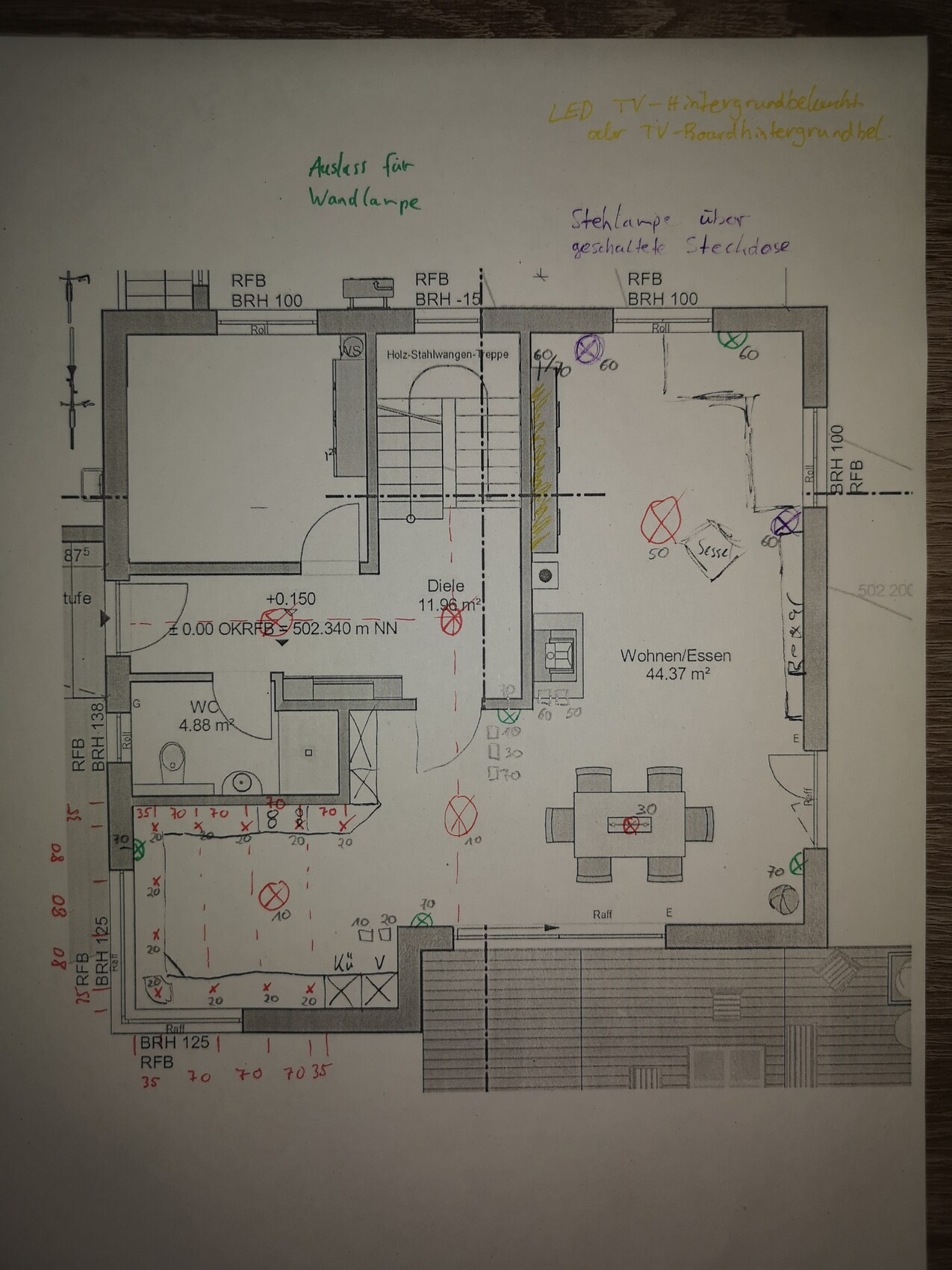
**Kitchen:** Only the countertop work lighting will be done with recessed spotlights. Initially planned with a beam angle of 60°, but I’ve now arranged the spacing so that it should also work with 38° light sources (spotlight spacing 70 or 80 cm (27.5 or 31.5 inches); distance from the wall 35 cm (14 inches), so that even open drawers are illuminated). If the 38° option produces too narrow a light beam (which I have read about several times), the planned 60° light sources should definitely work. General room lighting will be via a central ceiling outlet using a ceiling fixture with 2-4 spotlights (my wife prefers this over the track solution).
Similar to the image here
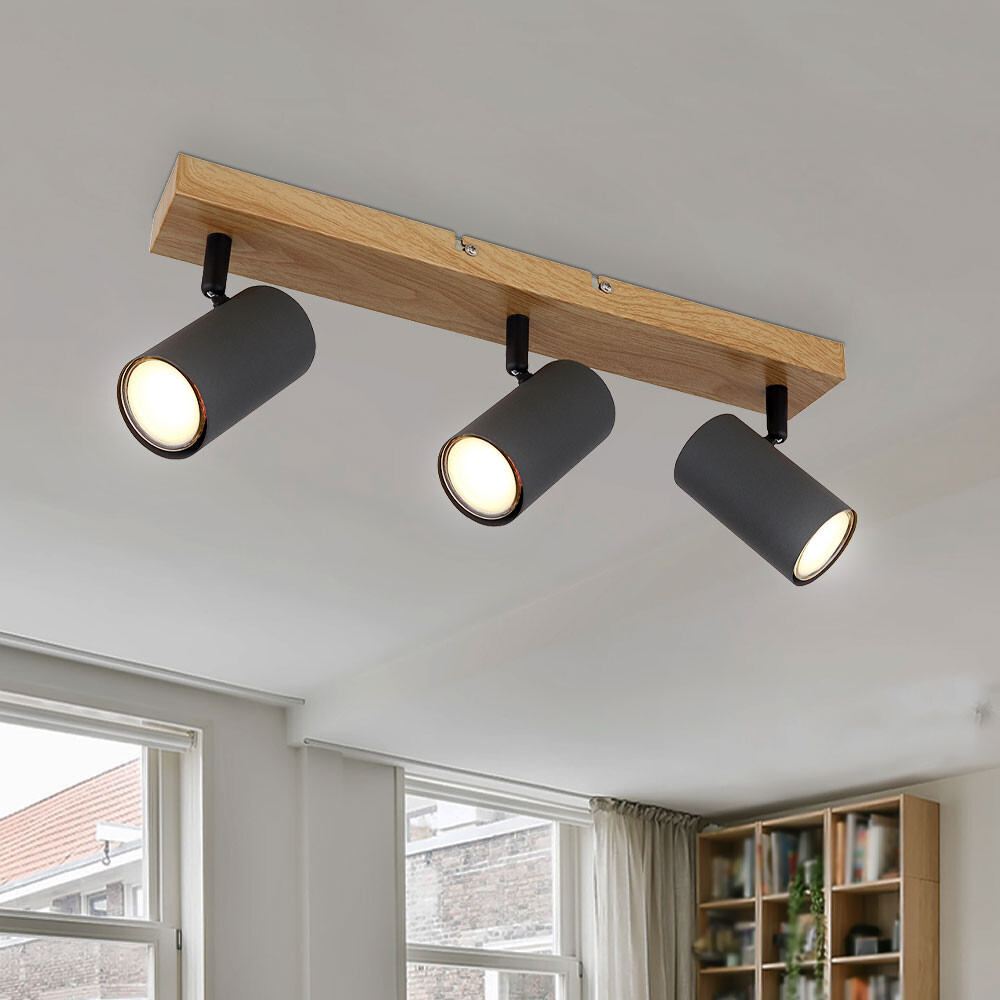
The area between the kitchen and dining table will also be lit with a similar ceiling fixture and will be connected to the kitchen ceiling lighting. Why? Because part of the tall kitchen cabinets is somewhat “moved out” into this area. We thought to store dishes (plates, bowls, etc.) there for easy access near the dining table.
**Dining area:** Classic pendant light with 3-4 light elements above the table.
**Living area:** Central ceiling fixture for basic lighting (probably used rarely). Cozy lighting (circuit group 60) via wall lamp, 2 floor lamps controlled by a switched outlet, and LED backlighting of the TV or TV unit. Possibly an additional lighting element in the fireplace area, but that is still undecided.
**Open living area:** We also considered adding subtle orientation/ambient lighting throughout the open living area (switch group 70) using wall lamps, etc. Why? The idea is that after food and drinks with company at the dining table, the kitchen and living areas could be softly illuminated or highlighted. Otherwise, you’d either have to turn on the main lighting (which is actually unnecessary) or sit in darkness (which is unpleasant).
Technical question related to this: Is it possible to connect the LED lighting of the TV to two different circuits? (i.e., once as part of the cozy living room lighting; switch group 60, and also for the ambient lighting of the open living area; switch group 70)
**Hallway:** We would install 2 outlets for basic lighting using ceiling fixtures with 2-3 spotlights (like in the kitchen and the area between kitchen and dining table).
For the lighting switch groups, the most important lights are always listed first. Lights used less frequently are listed at the bottom.
Please feel free to give feedback on what you think of this solution or if you have further improvement suggestions.
Thanks in advance and have a nice Sunday!
Best regards,
M.
Attached is a hand sketch:
I really like the flexible track system, but my wife doesn’t like it at all... so unfortunately, it’s not an option.
Therefore, here’s the proposed solution:
**Kitchen:** Only the countertop work lighting will be done with recessed spotlights. Initially planned with a beam angle of 60°, but I’ve now arranged the spacing so that it should also work with 38° light sources (spotlight spacing 70 or 80 cm (27.5 or 31.5 inches); distance from the wall 35 cm (14 inches), so that even open drawers are illuminated). If the 38° option produces too narrow a light beam (which I have read about several times), the planned 60° light sources should definitely work. General room lighting will be via a central ceiling outlet using a ceiling fixture with 2-4 spotlights (my wife prefers this over the track solution).
Similar to the image here
The area between the kitchen and dining table will also be lit with a similar ceiling fixture and will be connected to the kitchen ceiling lighting. Why? Because part of the tall kitchen cabinets is somewhat “moved out” into this area. We thought to store dishes (plates, bowls, etc.) there for easy access near the dining table.
**Dining area:** Classic pendant light with 3-4 light elements above the table.
**Living area:** Central ceiling fixture for basic lighting (probably used rarely). Cozy lighting (circuit group 60) via wall lamp, 2 floor lamps controlled by a switched outlet, and LED backlighting of the TV or TV unit. Possibly an additional lighting element in the fireplace area, but that is still undecided.
**Open living area:** We also considered adding subtle orientation/ambient lighting throughout the open living area (switch group 70) using wall lamps, etc. Why? The idea is that after food and drinks with company at the dining table, the kitchen and living areas could be softly illuminated or highlighted. Otherwise, you’d either have to turn on the main lighting (which is actually unnecessary) or sit in darkness (which is unpleasant).
Technical question related to this: Is it possible to connect the LED lighting of the TV to two different circuits? (i.e., once as part of the cozy living room lighting; switch group 60, and also for the ambient lighting of the open living area; switch group 70)
**Hallway:** We would install 2 outlets for basic lighting using ceiling fixtures with 2-3 spotlights (like in the kitchen and the area between kitchen and dining table).
For the lighting switch groups, the most important lights are always listed first. Lights used less frequently are listed at the bottom.
Please feel free to give feedback on what you think of this solution or if you have further improvement suggestions.
Thanks in advance and have a nice Sunday!
Best regards,
M.
Attached is a hand sketch:
MC123456 schrieb:
The idea was to have soft lighting highlighting the kitchen and living areas while sitting together at the dining table after eating and drinking. Without this, you would always have to turn on the main lighting (which doesn’t really make sense) or switch the lights off and look into a kind of "black hole" (which is also unpleasant).I already mentioned table and floor lamps. You like cozy, don’t you?!ypg schrieb:
Wall lamps are basically no longer used. They interfere with furniture placement. Instead, people usually put a sideboard or a buffet, and then place a table lamp on it. There are so many beautiful ones—it’s easy to get carried away buying them. Is that really the case? We didn’t have any before, but now in our new house we have several really nice ones, at least in our opinion. We switch them on alternately with the stair step lighting, which provides sufficient ambient lighting. We also don’t have tall furniture that could cause such a conflict. Table lamps can be used similarly, but you would at least have to wire them together partially so you don’t have to turn on three of them one after the other. It’s reassuring that, in terms of lamp philosophy, we seem to be operating outside the mainstream in a harmless way—and we like it that way.Arauki11 schrieb:
Is that really so?
We didn’t have any before, now in the new house we have several really nice examples of them, You yourself say that there are no tall pieces of furniture (for two people).
We have our open stairwell, almost like a living space with wall-mounted lights. In the hallway area, we have now lost the option to place a wardrobe. Also, dividing it off with a loft door is not an option because it looks strange. In families, I actually see that over the years people limit their options. The days of having torches and mallorcan roof tiles on the walls are over.
In addition, lights placed (too) high are simply not cozy. But in the end, everyone has to decide that for themselves.
Similar topics