
Hello everyone,
I want to level the floor in a room (living room/open kitchen) of about 35m² (380 sq ft) because it is very uneven and sloped. I marked the height reference line from the hallway floor and transferred it to the living room using a leveling laser. The results can be seen in the sketch. There are height differences between 8mm (0.3 inches) and 60mm (2.4 inches).
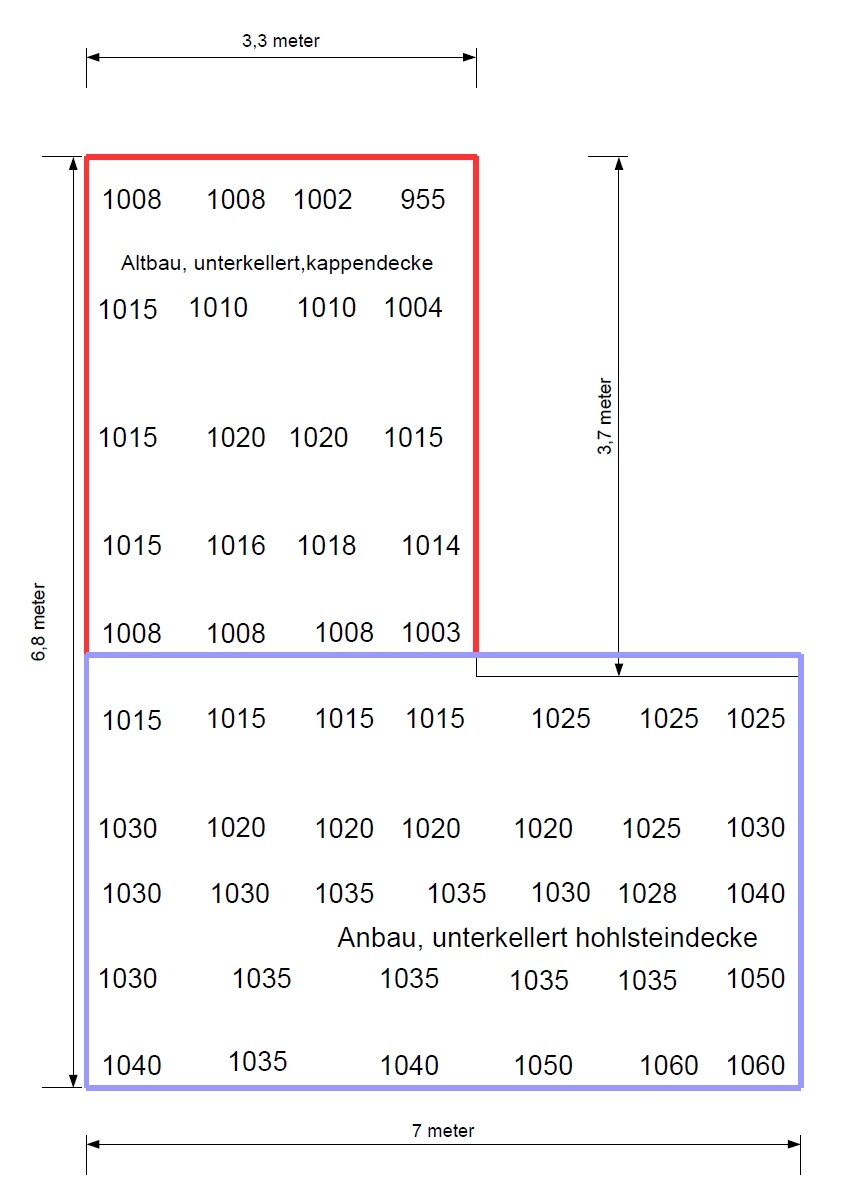
Part of the floor is a beam-and-joist ceiling (built around 1900) and the other part (extension from the mid-1970s) is a hollow block ceiling. On the beam-and-joist ceiling, there is 2cm (0.8 inches) of screed with 2cm (0.8 inches) of polystyrene underneath and some kind of firm fill below that. This area also gives slightly along the edges. The house has a full basement.
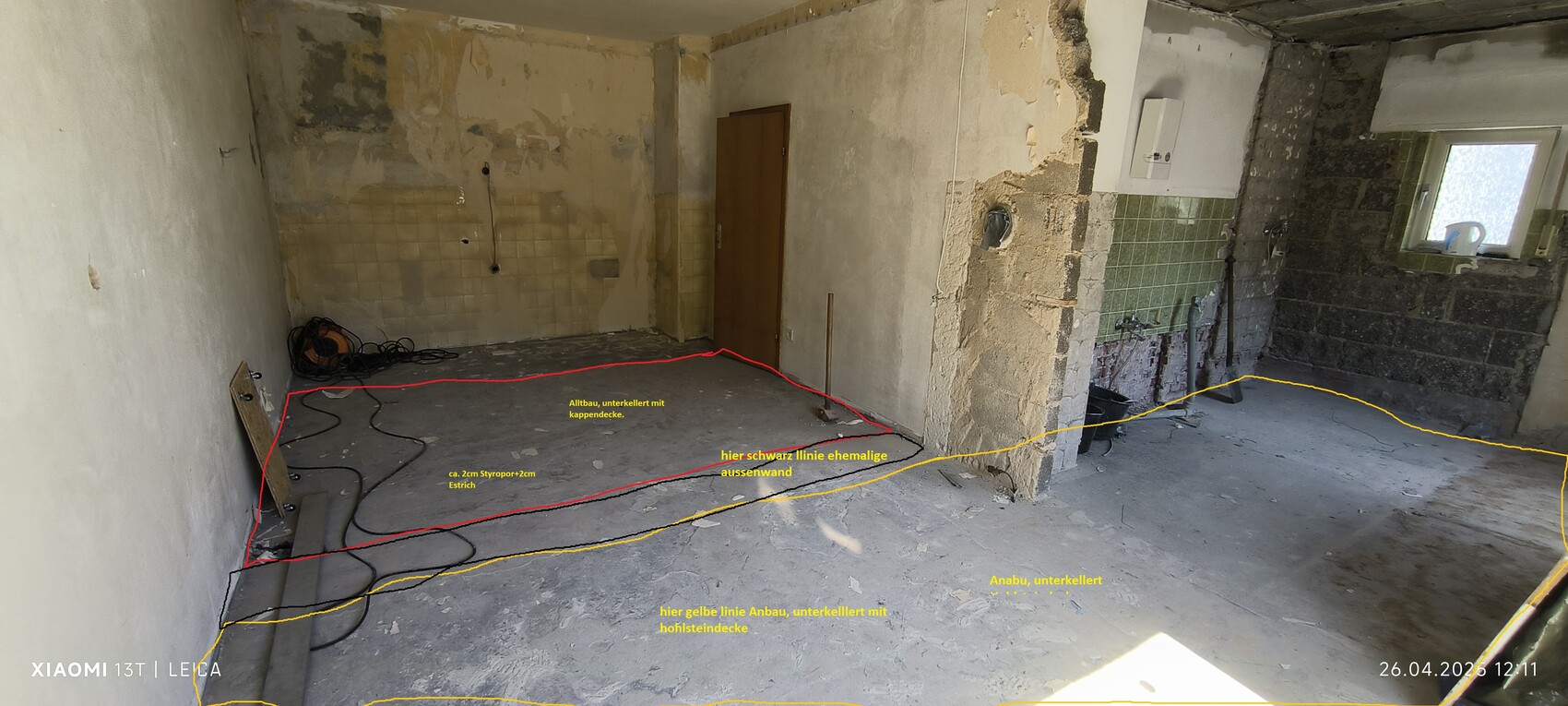
Because leveling compound is very expensive and I need to keep costs under control, I am looking for alternatives.
Initially, my idea was to cover the entire floor with 25mm (1 inch) OSB boards on wooden battens. However, I had to abandon this plan because some areas deviate only 15mm (0.6 inches) from the height reference. I also know that there are dry screed systems on dry or bonded fill, but these build up too high.
Now I am considering whether to remove the old floor layer of 2cm (0.8 inches) screed and 2cm (0.8 inches) polystyrene and then pour a bonded self-leveling screed over the entire room floor.
Is this a sensible idea? Should I be concerned about structural issues? Or are there other alternatives?
The floor does not necessarily have to be perfectly flush with the hallway floor at the end, but it should be level to avoid cabinets and similar furniture standing unevenly 🙂
The final floor covering will be click vinyl or glue-down vinyl.
I want to level the floor in a room (living room/open kitchen) of about 35m² (380 sq ft) because it is very uneven and sloped. I marked the height reference line from the hallway floor and transferred it to the living room using a leveling laser. The results can be seen in the sketch. There are height differences between 8mm (0.3 inches) and 60mm (2.4 inches).
Part of the floor is a beam-and-joist ceiling (built around 1900) and the other part (extension from the mid-1970s) is a hollow block ceiling. On the beam-and-joist ceiling, there is 2cm (0.8 inches) of screed with 2cm (0.8 inches) of polystyrene underneath and some kind of firm fill below that. This area also gives slightly along the edges. The house has a full basement.
Because leveling compound is very expensive and I need to keep costs under control, I am looking for alternatives.
Initially, my idea was to cover the entire floor with 25mm (1 inch) OSB boards on wooden battens. However, I had to abandon this plan because some areas deviate only 15mm (0.6 inches) from the height reference. I also know that there are dry screed systems on dry or bonded fill, but these build up too high.
Now I am considering whether to remove the old floor layer of 2cm (0.8 inches) screed and 2cm (0.8 inches) polystyrene and then pour a bonded self-leveling screed over the entire room floor.
Is this a sensible idea? Should I be concerned about structural issues? Or are there other alternatives?
The floor does not necessarily have to be perfectly flush with the hallway floor at the end, but it should be level to avoid cabinets and similar furniture standing unevenly 🙂
The final floor covering will be click vinyl or glue-down vinyl.
Similar topics