
Hello,
we are currently considering the best way to install patio slabs and how thick they should be. The tiler told us that they could be laid on pedestal supports with open joints, which might feel a bit unstable. Alternatively, they could be placed directly on crushed stone with the joints filled with jointing sand. However, this method would probably result in sandy feet, right? How did you do it, and how wide are your joints? What slab thickness did you choose? What is the best way to install them?
Best regards,
Sabine
we are currently considering the best way to install patio slabs and how thick they should be. The tiler told us that they could be laid on pedestal supports with open joints, which might feel a bit unstable. Alternatively, they could be placed directly on crushed stone with the joints filled with jointing sand. However, this method would probably result in sandy feet, right? How did you do it, and how wide are your joints? What slab thickness did you choose? What is the best way to install them?
Best regards,
Sabine
Weed membrane, mineral mix, gravel, slabs, no joint sand at all. We did it this way at my parents' house 5 years ago, and nothing wobbles or tilts. We will do it the same way again now.
Our slabs are 80x20x7 cm (31.5x7.9x2.8 inches) concrete.
My parents had 4 cm (1.6 inches) thick slabs, porcelain slabs are usually thinner, around 2 cm (0.8 inches) thick.
Our slabs are 80x20x7 cm (31.5x7.9x2.8 inches) concrete.
My parents had 4 cm (1.6 inches) thick slabs, porcelain slabs are usually thinner, around 2 cm (0.8 inches) thick.
haydee schrieb:
Weed control fabric, mineral mix, gravel, slabs, very tight with no jointing sand.I recently read on the website of a major paving manufacturer that terrace slabs should never be installed without joints of 3-5mm (1/8–3/16 inch). Unfortunately, they did not explain why this is the case. Maybe someone here knows? It would obviously be better without all that sand, since you end up with it on your feet all the time.
Best regards
Sabine
H
hemali20032 Jul 2018 09:14We installed 2cm (0.8 inch) thick slabs in a gravel bed. We left a 3mm (0.1 inch) joint and swept jointing sand generously into it, making sure it didn’t reach the surface.
My husband initially started without leaving joints, but everywhere online you read that this carries a high risk of cracking or chipping in winter. With joints, it also looks much better and allows for slight differences in the gravel layer.
However, this was my husband’s first time doing it, and he was extremely meticulous. Some slabs wobble slightly when stepped on. We don’t have long-term experience yet. We’re not sure if this wobbling could theoretically lead to breaking with these thin slabs...
My husband initially started without leaving joints, but everywhere online you read that this carries a high risk of cracking or chipping in winter. With joints, it also looks much better and allows for slight differences in the gravel layer.
However, this was my husband’s first time doing it, and he was extremely meticulous. Some slabs wobble slightly when stepped on. We don’t have long-term experience yet. We’re not sure if this wobbling could theoretically lead to breaking with these thin slabs...
S
Selbstbau2 Jul 2018 09:41We have 60x40x4 cm (24x16x1.5 inches) patio slabs with 3 mm (0.1 inches) joints.
Before installation, I spoke with a friendly lady from the manufacturer who explained that the corners are likely to break during laying. She also mentioned that without joints, rainwater cannot drain properly, which will result in wet edges around the joints.
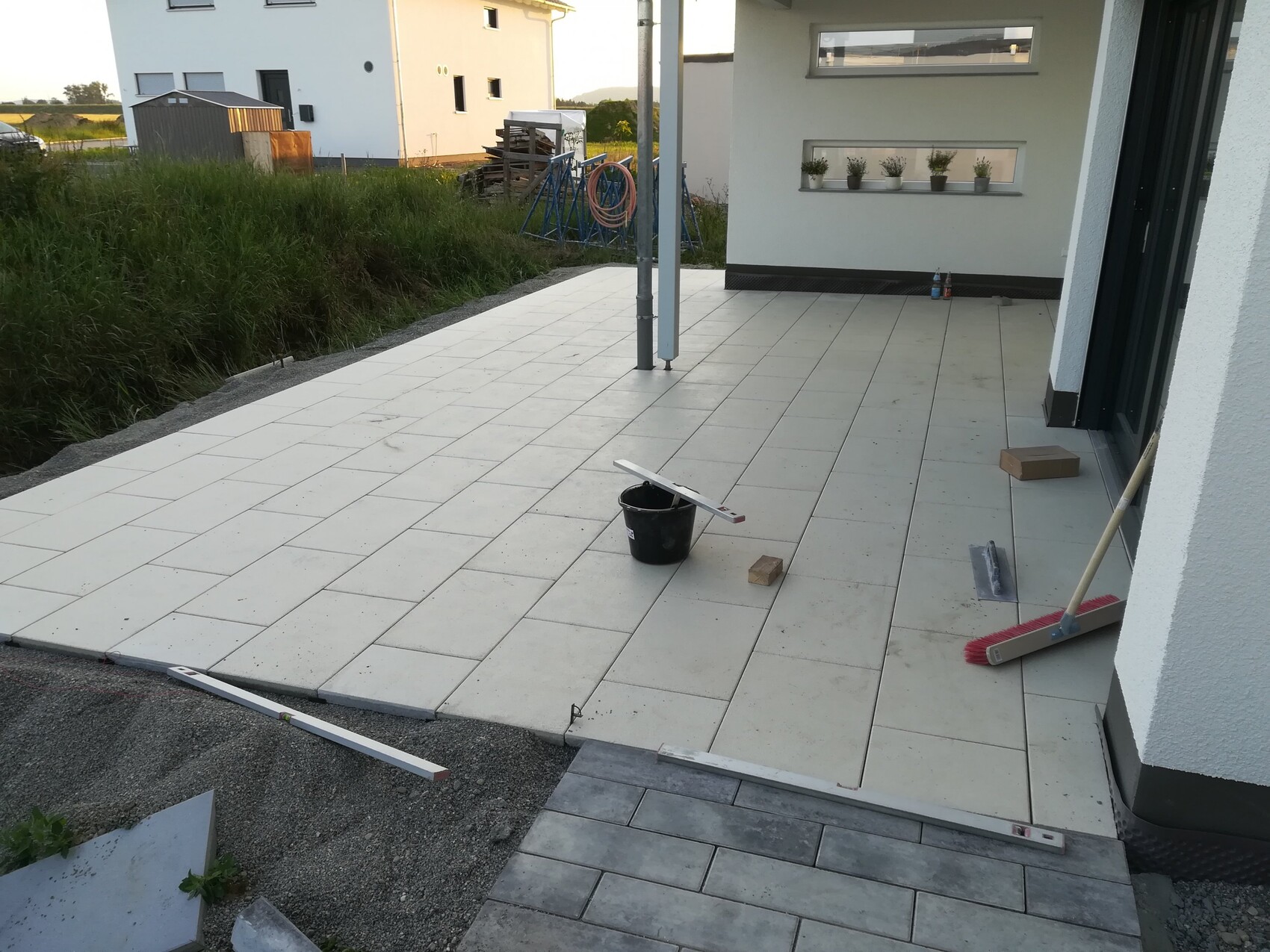
Before installation, I spoke with a friendly lady from the manufacturer who explained that the corners are likely to break during laying. She also mentioned that without joints, rainwater cannot drain properly, which will result in wet edges around the joints.
A completely joint-free installation isn’t possible, as the concrete slabs have small lips and the lifting aid also needs to fit through. We didn’t leave any joints like the ones used in tile installations. After five winters (and we have frost and snow), nothing has chipped or cracked.
The new terrace will have a slope. It faces the weather side and features an almost threshold-free door.
What else is possible, however, must be quite fiddly work—using cement in plastic bags and aligning the slabs on top. Nobody I know has tried this yet. The cement must not be too hard or too runny, and the slabs must not be subjected to any pressure after alignment until the cement has fully cured.
The new terrace will have a slope. It faces the weather side and features an almost threshold-free door.
What else is possible, however, must be quite fiddly work—using cement in plastic bags and aligning the slabs on top. Nobody I know has tried this yet. The cement must not be too hard or too runny, and the slabs must not be subjected to any pressure after alignment until the cement has fully cured.
Similar topics