
ᐅ Laying of electrical conduit pipes on the unfinished floor (screed with underfloor heating)
Created on: 28 Oct 2025 13:53
I
IPM_1985
Hello everyone,
I am currently renovating my house (built in 1983) and installing a new underfloor heating system with screed.
The heating company has laid two pipes for two existing radiators (in rooms where underfloor heating is not possible, see picture below). I would like to do the same for cables in each floor (instead of routing them along the wall).
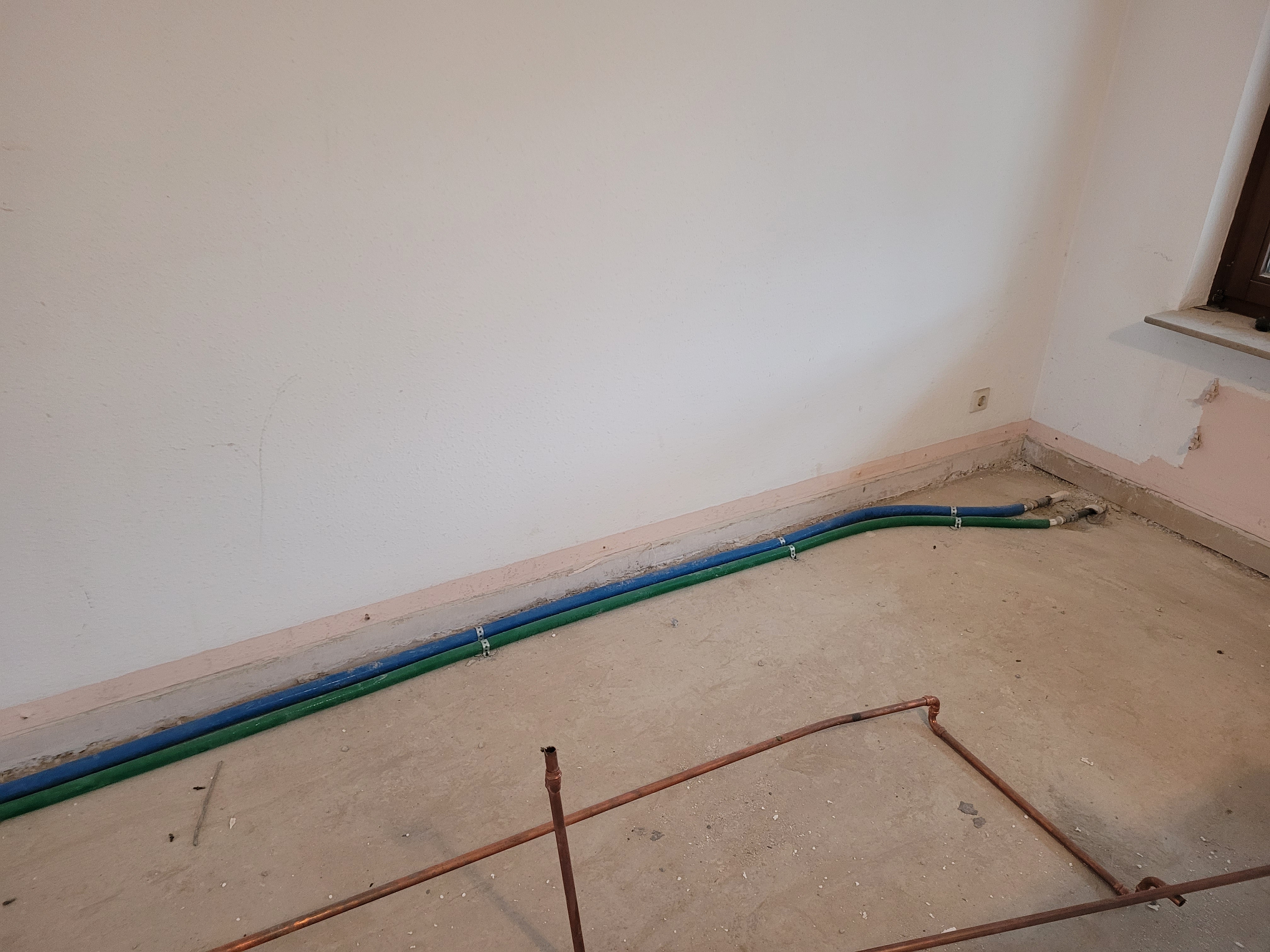
I believe there is a standard for pipe installation that requires a 20 cm (8 inches) distance from the wall. However, my screed installer said it would be better not to lay any pipes at all, but if pipes are installed, then as close to the edge as possible. This is quite confusing to me.
I want to discuss this topic here with experts to understand what is possible and what is not, based on the layout of the new screed.
Some information about the screed and installation height:
The total available installation height (from the raw floor to the top screed level where the tiles will be laid) is approximately 9.5 cm (3.7 inches).
Ground floor (GF)
1. PE film 0.2 mm (200 microns) as a moisture barrier, laid in a single overlapping layer on raw concrete slabs
2. PUR-aluminum insulation boards, 40 mm (1.6 inches) thick, made of polyurethane foam (thermal conductivity WLG 024), gas diffusion-tight on both sides with aluminum foil according to DIN 18 164 T1/B2
3. Grid film
4. Calcium sulfate flowing screed for underfloor heating, 50 mm (2 inches) nominal thickness, CA-C25-F5, pH ≥7 (EN 13813), installed as a floating screed over the heating system in accordance with DIN 18 560
Upper/middle floors (UF/MF)
1. Styropor- PS 20 SE insulation boards, 20 mm (0.8 inches) thick, thermal conductivity WLG 040, made of polystyrene according to DIN 18 164 T1/B1, delivered and installed in staggered joints
2. System panel 25/20 mm for underfloor heating, made of polystyrene (PS-TK/SE), thickness 25/20 mm (1/0.8 inches), impact sound and thermal insulation boards (WLG 045), stiffness group: 20 MN/m³; according to DIN 16 164 T. 2, fire protection class B1, factory-laminated with grid covering foil, for live loads up to 3.5 kN/m², delivered and installed including necessary edge strips
3. Calcium sulfate flowing screed for underfloor heating, 50 mm (2 inches) nominal thickness, CA-C25-F5, pH ≥7 (EN 13813), installed as a floating screed over the heating system in accordance with DIN 18 560
In my case, it does not exactly meet the standard because the pipes are not below the insulation boards.
Instead,
[IMG width="390px"]https://www.sanier.de/wp-content/uploads/images/estrich-rohrleitungen-ausgleichsschicht-grafik-Nebenkosten.jpg[/IMG]
it would look like this...

My questions:
1. Can I lay the pipes as planned directly on the raw floor? Would you recommend this, or do you see any risks (thermal bridges, etc.)?
2. Do I have to maintain a 20 cm (8 inches) distance from the wall, or can I place them exactly along the edges?
3. How does the insulation board fit with this pipe? Since the pipe and insulation board are at the same level, the pipe cuts through the insulation board. The underfloor heating pipes would be installed above anyway, correct?
4. What is the maximum allowable pipe diameter? I assume it should not exceed the thickness of the insulation boards—so 40 mm (1.6 inches) for the ground floor and 20 mm (0.8 inches) for upper/middle floors?
Thank you very much.
I am currently renovating my house (built in 1983) and installing a new underfloor heating system with screed.
The heating company has laid two pipes for two existing radiators (in rooms where underfloor heating is not possible, see picture below). I would like to do the same for cables in each floor (instead of routing them along the wall).
I believe there is a standard for pipe installation that requires a 20 cm (8 inches) distance from the wall. However, my screed installer said it would be better not to lay any pipes at all, but if pipes are installed, then as close to the edge as possible. This is quite confusing to me.
I want to discuss this topic here with experts to understand what is possible and what is not, based on the layout of the new screed.
Some information about the screed and installation height:
The total available installation height (from the raw floor to the top screed level where the tiles will be laid) is approximately 9.5 cm (3.7 inches).
Ground floor (GF)
1. PE film 0.2 mm (200 microns) as a moisture barrier, laid in a single overlapping layer on raw concrete slabs
2. PUR-aluminum insulation boards, 40 mm (1.6 inches) thick, made of polyurethane foam (thermal conductivity WLG 024), gas diffusion-tight on both sides with aluminum foil according to DIN 18 164 T1/B2
3. Grid film
4. Calcium sulfate flowing screed for underfloor heating, 50 mm (2 inches) nominal thickness, CA-C25-F5, pH ≥7 (EN 13813), installed as a floating screed over the heating system in accordance with DIN 18 560
Upper/middle floors (UF/MF)
1. Styropor- PS 20 SE insulation boards, 20 mm (0.8 inches) thick, thermal conductivity WLG 040, made of polystyrene according to DIN 18 164 T1/B1, delivered and installed in staggered joints
2. System panel 25/20 mm for underfloor heating, made of polystyrene (PS-TK/SE), thickness 25/20 mm (1/0.8 inches), impact sound and thermal insulation boards (WLG 045), stiffness group: 20 MN/m³; according to DIN 16 164 T. 2, fire protection class B1, factory-laminated with grid covering foil, for live loads up to 3.5 kN/m², delivered and installed including necessary edge strips
3. Calcium sulfate flowing screed for underfloor heating, 50 mm (2 inches) nominal thickness, CA-C25-F5, pH ≥7 (EN 13813), installed as a floating screed over the heating system in accordance with DIN 18 560
In my case, it does not exactly meet the standard because the pipes are not below the insulation boards.
Instead,
[IMG width="390px"]https://www.sanier.de/wp-content/uploads/images/estrich-rohrleitungen-ausgleichsschicht-grafik-Nebenkosten.jpg[/IMG]
it would look like this...
My questions:
1. Can I lay the pipes as planned directly on the raw floor? Would you recommend this, or do you see any risks (thermal bridges, etc.)?
2. Do I have to maintain a 20 cm (8 inches) distance from the wall, or can I place them exactly along the edges?
3. How does the insulation board fit with this pipe? Since the pipe and insulation board are at the same level, the pipe cuts through the insulation board. The underfloor heating pipes would be installed above anyway, correct?
4. What is the maximum allowable pipe diameter? I assume it should not exceed the thickness of the insulation boards—so 40 mm (1.6 inches) for the ground floor and 20 mm (0.8 inches) for upper/middle floors?
Thank you very much.
D
DaGoodness29 Oct 2025 18:06I’ll leave aside the question of whether the cables will ever actually be replaced, as I don’t think so either. But is it really that unusual for electrical cables to be run inside conduits?
In our case, all the cables run on the floor inside conduits up to the wall. Only when they go up the wall do the conduits stop.
I also remember asking our electrician back then why the cables were only on the floor, and he said that it’s “standard” on the floor because, due to the screed and underfloor heating, it’s harder to access the cables there. It’s easier to get to them on the wall. You could do it on the wall as well, but it’s not necessary.
I also definitely know that at my brother’s and a friend’s house, the cables are also run on the floor inside conduits. (No, not the same electrician)
So I would have assumed this is “normal.”
In our case, all the cables run on the floor inside conduits up to the wall. Only when they go up the wall do the conduits stop.
I also remember asking our electrician back then why the cables were only on the floor, and he said that it’s “standard” on the floor because, due to the screed and underfloor heating, it’s harder to access the cables there. It’s easier to get to them on the wall. You could do it on the wall as well, but it’s not necessary.
I also definitely know that at my brother’s and a friend’s house, the cables are also run on the floor inside conduits. (No, not the same electrician)
So I would have assumed this is “normal.”
Similar topics