
ᐅ Laying an 18-Meter Drain Pipe – Is Special Procedure Required?
Created on: 16 Apr 2021 10:47
D
danabananaD
danabanana16 Apr 2021 10:47Hello,
there are two buildings on our property.
One has a sewage connection, and the other is going to have a toilet installed and be connected to the existing sewage pipe.
It is a sloped site – the house with the existing connection is about 4m (13 feet) lower than the one without a connection. The future distance between the downpipes will be about 18m (59 feet).
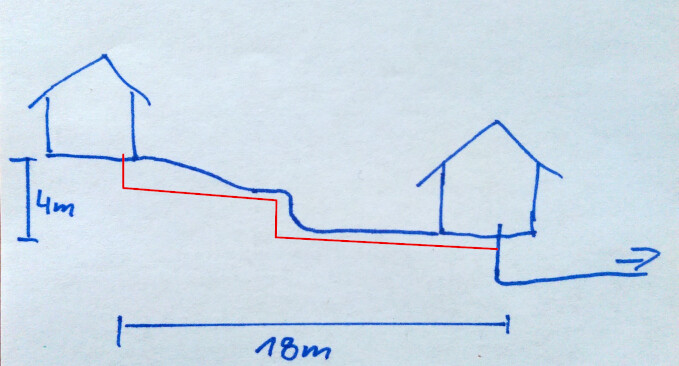
The slope has a step in the middle, see the following sketch.
How should the drain pipe (marked in red) best be routed?
Like this?
Or better like this?
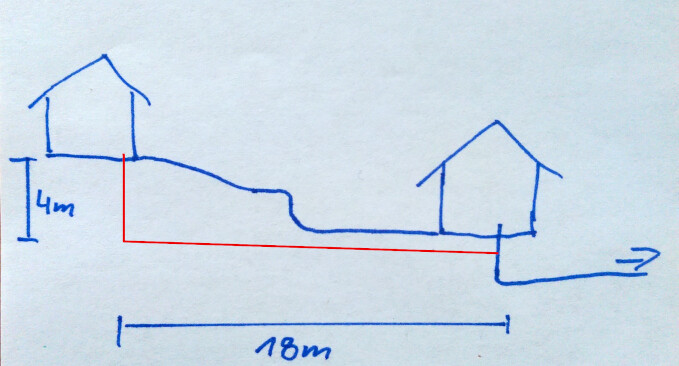
Version 1 would be easier to carry out since it requires less deep excavation and we have partly rocky ground.
Question:
Is it a problem to have an additional step in the pipe run?
A 110mm (4 inch) pipe will be installed. For bends, I would use 2x 45° or if necessary 3x 30° angles.
Is there anything special to consider regarding the long distance of 18m (59 feet) (steeper slope, etc.)?
Clogs due to incorrect installation would, of course, be very frustrating.
Thanks for your tips.
there are two buildings on our property.
One has a sewage connection, and the other is going to have a toilet installed and be connected to the existing sewage pipe.
It is a sloped site – the house with the existing connection is about 4m (13 feet) lower than the one without a connection. The future distance between the downpipes will be about 18m (59 feet).
The slope has a step in the middle, see the following sketch.
How should the drain pipe (marked in red) best be routed?
Like this?
Or better like this?
Version 1 would be easier to carry out since it requires less deep excavation and we have partly rocky ground.
Question:
Is it a problem to have an additional step in the pipe run?
A 110mm (4 inch) pipe will be installed. For bends, I would use 2x 45° or if necessary 3x 30° angles.
Is there anything special to consider regarding the long distance of 18m (59 feet) (steeper slope, etc.)?
Clogs due to incorrect installation would, of course, be very frustrating.
Thanks for your tips.

Version 1 uses a 100mm (4-inch) pipe,
the horizontal sections have a slope of 1cm per 1m (0.4 inches per 3.3 feet), the vertical sections are 90 degrees, fittings are 45 degrees,
from house 2 onward, pipes of 125mm/150mm (5 inches/6 inches) lead to the sewer.
At the first bend, I would replace the upper elbow with a 45-degree T-piece and lead a pipe vertically upwards with a sealed cap, serving as an inspection/cleanout/flushing access.
the horizontal sections have a slope of 1cm per 1m (0.4 inches per 3.3 feet), the vertical sections are 90 degrees, fittings are 45 degrees,
from house 2 onward, pipes of 125mm/150mm (5 inches/6 inches) lead to the sewer.
At the first bend, I would replace the upper elbow with a 45-degree T-piece and lead a pipe vertically upwards with a sealed cap, serving as an inspection/cleanout/flushing access.

Version 1 as already described by @Nida35a. Just as an explanation: The slope must be followed very precisely (construction laser). Possibly even slightly less. Otherwise, "thin liquids" will flow away faster than the solids can be transported with the water. It is even better to install a small inspection chamber vertically at each section, which can be cleaned if necessary. A "hidden" vertical drop section alone will not make you happy in the long run. As an extra tip: Do not set the flush tank to the minimum water volume.
Similar topics